Tag: EGLE

Flow Water Advocates opposes Gratiot County CAFO permit

Flow Water Advocates and commenters oppose Gratiot County CAFO expansion; request public hearing.

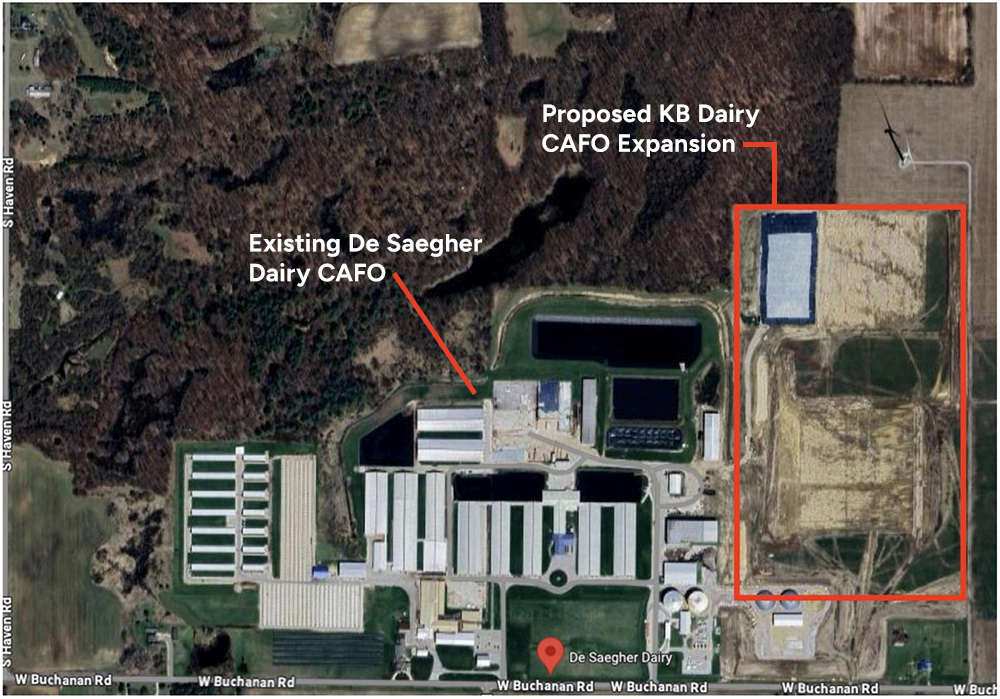
Traverse City, Mich. — Flow Water Advocates (“Flow”), on behalf of its thousands of members, is joined by concerned Michigan residents and organizations in filing public comments opposing a NPDES-CAFO Individual Permit for a 3,450-head dairy CAFO expansion proposed by KB Dairy LLC. The proposed expansion is contiguous with and uses the same address as the 8,400-animal De Saegher Dairy in Middleton, Michigan. If approved, the permit would create the largest dairy CAFO in Michigan. Flow and co-signers ask the Michigan Department of Environment, Great Lakes, and Energy (EGLE) to deny the permit, and hold a local public hearing to facilitate awareness and meaningful public participation.

Support Flow’s work to defend the Great Lakes.

Concentrated Animal Feeding Operations (CAFOs), commonly referred to as factory farms, are large livestock facilities that house several hundred to tens of thousands of animals. Gratiot County is home to some of the largest dairy CAFOs in Michigan, and over 400 million gallons of CAFO animal wastes are spread on saturated fields each year — equivalent to the daily sewage generated by Los Angeles County. Dennis Kellogg, a sixth-generation farmer in Gratiot County, describes the CAFO waste management practices:

“When the CAFOs spread their manure, there is required to be a reasonable setback distance from the edge of the field. I’ve noticed they apply right up to the lot lines of residences, businesses, schools, and other public use areas…These facilities are polluting our local communities with excessive amounts of manure, and are not being held accountable for it. Who pays the price for this?

The comments detail several concerns, including improper separate permitting of the fully contiguous proposed KB Dairy CAFO, which is owned by the same investment corporation as the De Saegher CAFO; failure of the existing De Saegher CAFO to obtain the required groundwater discharge permit; deficiencies in the Comprehensive Nutrient Management Plan (CNMP); and the public health threat posed by groundwater contamination in a rural area that relies on private wells for drinking water.

The comments also note EGLE’s obligations under the public trust doctrine and the Michigan Environmental Protection Act (MEPA) to protect Michigan’s water from impairment, for the benefit of all residents.

“These massive livestock operations have contributed to unchecked environmental destruction and soaring cancer rates in other parts of the upper Midwest,” says Carrie La Seur, Legal Director for Flow Water Advocates. “Michiganders take rightful pride in their role as defenders of the Great Lakes. It’s time to take a stand for healthy food, healthy animals, and healthy water.”

Flow is joined in its comments by the Great Lakes Environmental Law Center, farmer Dennis Kellogg, Michigan Farmers Union, Michigan Lakes and Streams Association, Michigan Organic Food & Farm Alliance, Michiganders for a Just Farming System, Progress Michigan, and Socially Responsible Agriculture Project.

###

Flow Water Advocates is an independent 501(c)(3) nonprofit organization based in Traverse City, Michigan. Our mission is to ensure the waters of the Great Lakes Basin are healthy, public, and protected for all. With a staff of legal and policy experts, strategic communicators, and community builders, Flow is a trusted resource for Great Lakes advocates. We help communities, businesses, agencies, and governments make informed policy decisions and protect public trust rights to water. Learn more at www.FlowWaterAdvocates.org.
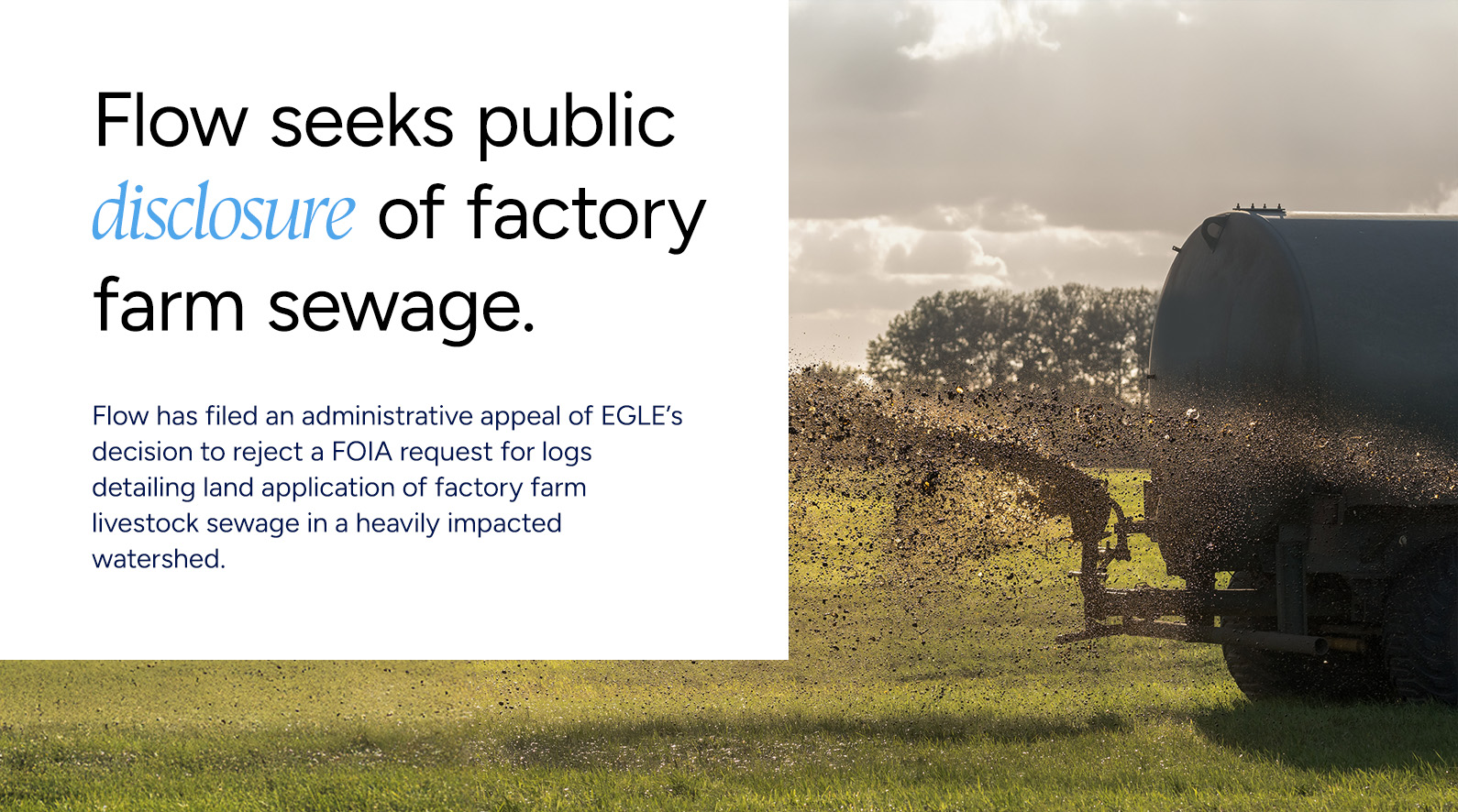
Flow appeals EGLE rejection of FOIA request; seeks public disclosure of factory farm sewage land application.

Traverse City, Mich. — Flow Water Advocates (“Flow”) has filed an administrative appeal of a Michigan Department of Environment, Great Lakes, and Energy (EGLE) decision to reject Flow’s FOIA requests for logs Concentrated Animal Feeding Operations (CAFOs) are required by permit to maintain and disclose to EGLE and the public. These logs from fourteen CAFOs provide details on land application of livestock sewage in a heavily impacted watershed. As Great Lakes water quality and access advocates, Flow has a long-standing interest in protecting Michigan’s surface and drinking water.

Support Flow’s work to defend the Great Lakes.

CAFOs, commonly referred to as factory farms, are large livestock facilities that house several hundred to tens of thousands of animals, producing sewage equivalent to large cities. The National Pollutant Discharge Elimination Systems (NPDES) permitting program under the Clean Water Act regulates their animal waste disposal. CAFO operators typically dispose of waste by applying it to fields — often in amounts far greater than can be taken up by the soil and crops. Rural watersheds across Michigan, and in turn the Great Lakes, are heavily impacted by CAFO waste runoff and leaching.

“For many rural residents, dealing with CAFO odors, runoff, heavy trucking, and water quality destruction — surface and ground — has become an exhausting, expensive, year-round ordeal,” says Flow Legal Director Carrie La Seur. “Michigan has something priceless in its natural heritage. This is not just a paperwork exercise, it’s essential information citizens need to protect their health and quality of life.”

The logs detail the time, date, quantity, method, location, and application rate for each location where CAFO wastes are applied to land; a description of the weather conditions at the time; and whether the land was frozen or snow-covered. Crucially, they also include the total amount of nitrogen and phosphorus applied to each field that receives CAFO wastes. Overloading these nutrients can cause toxic algal blooms, closed beaches, and fish kills. The disclosure Flow seeks is critical to understanding how CAFO waste impacts lakes, streams, and other waters.

By Michigan law, the public has the right to access any document “prepared, owned, used, in the possession of, or retained by a public body in the performance of an official function, from the time it is created” (MCL 15.232). If the documents do not exist, the failure to maintain records by all fourteen CAFOs would represent egregious NPDES permit violations, and require immediate enforcement action by EGLE to protect the health of Michiganders.

###

Flow Water Advocates is an independent 501(c)(3) nonprofit organization based in Traverse City, Michigan. Our mission is to ensure the waters of the Great Lakes Basin are healthy, public, and protected for all. With a staff of legal and policy experts, strategic communicators, and community builders, Flow is a trusted resource for Great Lakes advocates. We help communities, businesses, agencies, and governments make informed policy decisions and protect public trust rights to water. Learn more at www.FlowWaterAdvocates.org.

Michigan’s new FY 2025-26 budget, and what it means for water.

Flow’s mission is to ensure Michigan’s waters are healthy, public, and protected for everyone. Our priorities include water infrastructure funding, tackling nitrate contamination in drinking water, factory farm pollution, and the need for a statewide septic code. We track state budgets closely because they signal real-world priorities.

The newly approved FY 2025-26 budgets for Michigan’s environmental agencies offer both encouraging developments and areas of concern.

Signs of progress.

Several bright spots align with Flow’s goals.

The budget maintains investments in drinking water infrastructure. Lead service line replacement efforts received a net increase of $13.4 million, and another $34 million is set aside for local water projects through the State Revolving Fund. While much of this funding is one-time rather than permanent, it represents real dollars for pipes, treatment upgrades, and safer drinking water in the near future.

There is also forward progress on transparency. New reporting requirements will make the Michigan Department of Environment, Great Lakes, and Energy (EGLE) more accountable for how quickly it issues permits and how well it meets performance targets. These kinds of changes don’t grab headlines, but they matter, especially when communities struggle to understand or navigate the regulatory process.

One especially helpful provision is a new investment in permitting guidebooks for industries like large livestock operations. For groups like Flow working to halt pollution from Concentrated Animal Feeding Operations (CAFOs), clearer rules mean fewer loopholes and stronger protections for lakes, streams, groundwater, and rural communities.

Areas Michigan must not ignore.

Still, there are warning signs worth watching.

The State Revolving Fund—the backbone of Michigan’s water infrastructure financing system—lost $34 million in ongoing annual support, which was replaced with one-time funding. In other words, the funding exists for now, but it’s no longer guaranteed in future years. That kind of uncertainty makes it harder for small towns and rural communities to plan long-term water projects.

An even more glaring omission is the decision not to fund a statewide septic system database. Michigan remains the only state in the country without a uniform septic code, and failing septic systems are a major source of groundwater and drinking water contamination—especially in areas already facing nitrate pollution. Knowing where systems are, and whether they’re failing, is the first step toward fixing them. That step is now delayed.

Another area of grave concern is reduced staffing. Across EGLE, the DNR, and the Michigan Department of Agriculture & Rural Development (MDARD), the FY 2025-26 budget reflects a net loss of 49 full-time positions compared to the previous year. EGLE alone loses 15 positions, including staff responsible for water quality programs, contaminated site remediation, and municipal water assistance. The DNR loses 30 positions, and MDARD loses four, including staff involved in pesticide management and laboratory monitoring.

These reductions may look like mere numbers on paper, but they translate directly to fewer boots on the ground—fewer inspectors, engineers, hydrologists, and scientists who ensure that permits are enforced, wells are tested, pollution is contained, and communities receive timely support. Michigan’s environmental laws are only as strong as the departments tasked with administering them. When staffing is cut, delays grow longer, backlogs increase, and the state’s ability to respond to urgent, immediate, and emerging threats—whether from PFAS, nitrates, failing septic systems, or industrial spills— diminishes.

Michigan has made meaningful investments in water infrastructure and transparency. To fully realize those gains, the state must also preserve the workforce required to carry them out.

Moving forward.

The takeaway is not that Michigan is abandoning clean water efforts—but that much of the current progress depends on temporary funding. That leaves big questions for long-term water protection.

Flow will continue to advocate for permanent, reliable infrastructure funding, stronger well and septic oversight, and protections for rural communities facing pollution burdens.

Budgets reflect priorities. This one keeps Michigan moving, but not yet fast enough toward the stable, long-term protections that our water and people deserve.

Flow, Sierra Club, and Surfrider Foundation to EGLE: Reject the Line 5 tunnel permit.

PRESS RELEASE: SEPTEMBER 9, 2025

Download the written comments to EGLE (PDF)

Traverse City, Mich. – On August 29, 2025, Flow Water Advocates, a Great Lakes water protection organization, together with the Sierra Club and Surfrider Foundation, submitted written comments on Enbridge’s application for a Water Resources Permit for its proposed Line 5 tunnel project through the Straits of Mackinac. The Michigan Department of Environment, Great Lakes, and Energy (EGLE) is reviewing the application for compliance under the Michigan Natural Resources and Environmental Protection Act (NREPA), Parts 303 and 325.

Flow’s comments demand that EGLE’s review consider the entire project, and detail the many adverse environmental impacts that will or are likely to result from the project’s approval, including:

  • a projected six years of construction traffic and noise, light, and air pollution; 
  • the destruction of precious wetland ecosystems; 
  • climate impacts from the tunnel’s construction and the products it will transport for the duration of a 99-year lease, and 
  • the potential impacts resulting from a project failure, including a catastrophic oil spill.

Flow’s comments also highlight the expert reports and Enbridge’s own expert testimony that have confirmed available alternatives for transporting the products currently flowing through Line 5.

Because the proposed tunnel will have significant–and potentially catastrophic–impacts on Michigan’s public trust waters and natural resources, and because these impacts can be avoided through available alternatives, EGLE must deny the permit under Michigan’s controlling environmental laws and regulations.

Michiganders are counting on the State to uphold its responsibility to protect the public trust rights of current and future generations who depend on the Great Lakes for their drinking water, subsistence, and way of life.

An additional public comment period for Enbridge’s application to EGLE for a wastewater discharge permit under NREPA, Part 31, is anticipated in the coming months.

###

Flow Water Advocates is a nonpartisan 501(c)(3) nonprofit organization based in Traverse City, Michigan. Our mission is to ensure the waters of the Great Lakes Basin are healthy, public, and protected for all. With a staff of legal and policy experts, writers, and community builders, Flow is a trusted resource for Great Lakes advocates. We help communities, businesses, agencies, and governments make informed policy decisions and protect public trust rights to water. Learn more at www.FlowWaterAdvocates.org.
FAQs: Making public comments to EGLE on the Line 5 tunnel

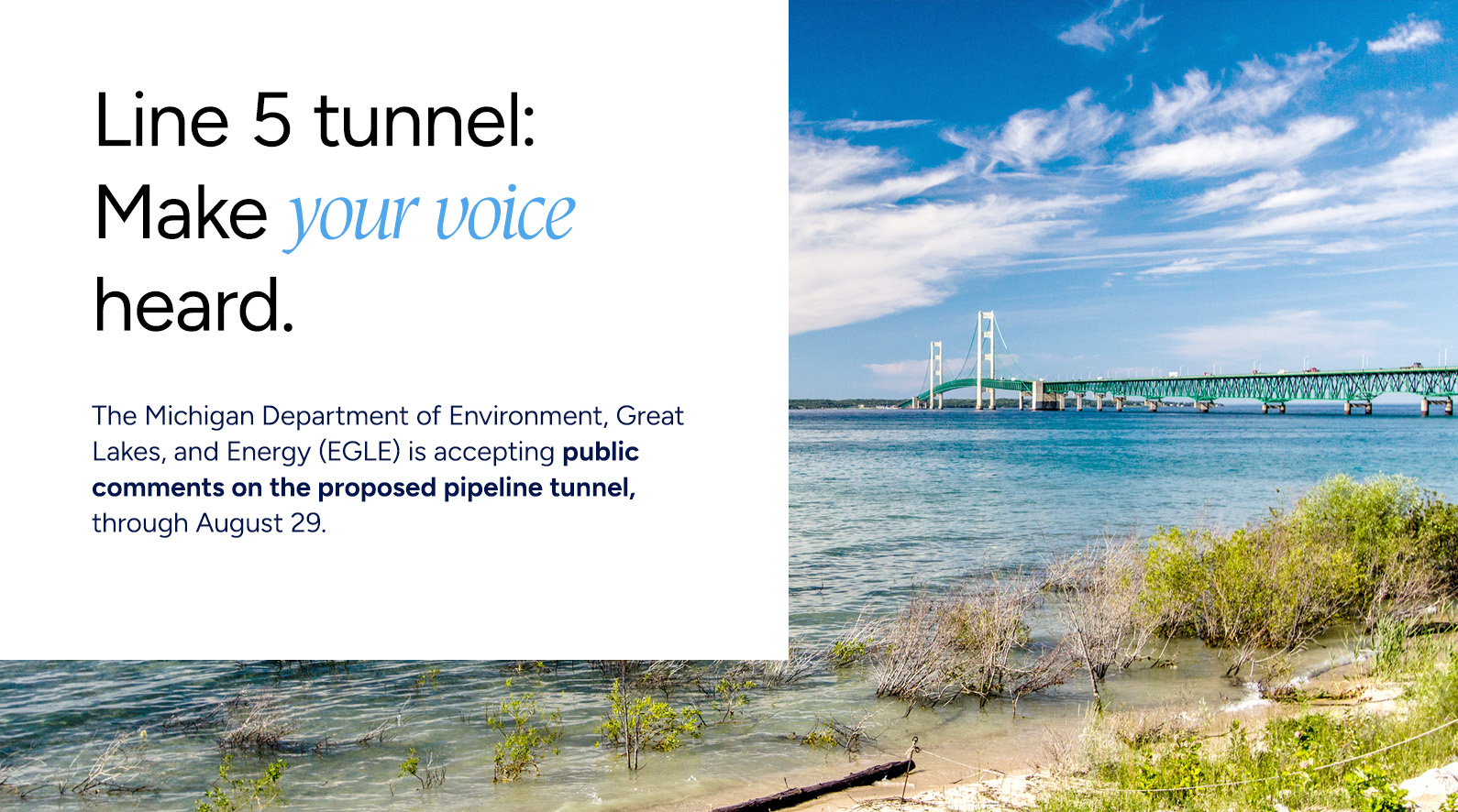
The Michigan Department of Environment, Great Lakes, and Energy (EGLE) is taking public comments on Enbridge’s proposed Line 5 pipeline tunnel through August 29, 2025. The State of Michigan now has the power to deny the tunnel permit, and protect the Great Lakes from years of construction upheaval, wetlands damage, and other risks

Michigan can assert its sovereignty, stop the exploitation of our publicly-held resources for private profit, and protect the waters today, and for future generations. Here’s how you can engage with EGLE on this important issue: 

(1) Attending a virtual public information session on August 12 (6:00pm EDT). This is an opportunity to ask EGLE representatives questions and learn more about the application and next steps.

(2) Attending the virtual public hearing on August 19 (6:00pm EDT) and providing oral comments that will be considered by EGLE in its review of the application .

(3) Submitting written comments that will be considered by EGLE in its review of the application by August 29.

Here are answers to some of the questions we’ve received about the EGLE permit process, and how to get involved:

If I have already submitted comments on the project, can I submit comments during this public comment period?

Yes. The current application for a Water Resources Permit under Michigan’s Wetland Protection Act (Part 303) and Michigan’s Great Lakes Submerged Lands Act (Part 325) is distinct from the review of earlier permit applications for the project, so it is important to submit comments on the current proposal to ensure your voice is heard.

Flow Water Advocates will be providing both oral comments at the August 19 hearing and written comments by the August 29 deadline, and we encourage interested members of the public to do the same.

Do I have to live in Michigan to contribute comments?

No, we all have an interest in protecting the Great Lakes and there are no restrictions on who can participate in the public comment period.

What makes a strong public comment?

The most effective comments are grounded in the facts of the proposed project and its likely impacts, and the requirements for permit approval under the law. Highlighting your personal connections to the waters, ecosystems, communities, cultural resources, and economies that stand to be impacted by the project is also powerful.

When preparing to provide oral comments at the public hearing, we recommend that you write down what you would like to say in advance and practice sharing it a couple times, as each person is usually allowed only 3 minutes to speak. Three minutes of speaking time is about 400 words, depending on how quickly you speak.

What are some of Flow Water Advocates’ major concerns with Enbridge’s permit application?

First, Enbridge has not provided sufficient information–on the full project, its potential environmental impacts, or the available alternatives–for EGLE to properly consider its application for a Water Resources Permit under Part 325 and Part 303 of Michigan’s Natural Resources and Environmental Protection Act .

Second, when all of the necessary information is considered, it is clear that the tunnel project cannot be lawfully permitted because the project will have more than minimal environmental effects, and because the shutdown of Line 5 is a viable, and much preferable, alternative to constructing an unprecedented tunnel project to house a new section of oil pipeline through the heart of the Great Lakes.

Finally, Enbridge does not have the necessary legal authorization to operate the proposed tunnel project in the Straits, as required under the Great Lakes Submerged Lands Act and Michigan’s public trust doctrine.

For more information on the potential environmental impacts of the project, deficiencies with the application materials, and the viable alternatives that must be considered, visit our website: https://flowwateradvocates.org/line5/.

If we don’t have time to comment on everything, are there any aspects of the permit that we should prioritize?

There is certainly a lot to cover–the gaps in the application, the many potential environmental impacts, and the available alternatives to the project that must be considered.

When you have limited time to prepare comments, a good strategy can be to focus your comments on an issue or two that you care about or in which you have particular insight or expertise, knowing that others will do the same.

Oil and Water Don’t Mix has compiled a list of several issues that can be raised and expanded on in public comments.

Earthjustice has also provided a helpful comment submission form with a message to get you started.

If you have additional questions about submitting comments, we encourage you to attend the public information session hosted by EGLE on August 12.

When you register for the session, there is the option to include questions that you would like to be addressed by the agency and there will also be time for additional questions at the end of the session.

Factory farm webinar: Weigh in on how Michigan regulates factory farm waste.

Factory farms, or Concentrated Animal Feeding Operations (CAFOs), threaten our waters with immense quantities of sewage, which too often are sprayed on fields where it can then runoff into streams and leach into groundwater — including into our drinking water. 

On August 8, the Michigan Department of Environment, Great Lakes, and Energy (EGLE ) will hold an hybrid remote public hearing in Lansing on the long-contested 2020 NPDES-CAFO General Permit, to regulate factory farm waste discharges to our waters. 

To prepare for this important hearing, join Flow Water Advocates on July 31 at Noon for a briefing on the issue, and learn how you can weigh in to support effective regulation and clean waters in rural Michigan and the Great Lakes. 

Flow has been an intervenor in an administrative contested case and litigation on this permit over the past 5 years. 

How to join the EGLE public hearing on August 8 at 9:00am:

Location: Microsoft Teams Meeting
Meeting ID: 293 614 609 636 1
Passcode: 6FV72vK3
Call in (audio only)
Telephone: 1-248-509-0316 (Toll)
Phone Conference ID: 581 485 136#

Science alone won’t save the lake: Agricultural runoff in the Western Lake Erie Basin.

Facing facts and moving forward: Notes from the 2025 State of the Western Lake Erie Basin Conference.

On June 26, the State of the Western Lake Erie Basin (WLEB) conference, hosted by Michigan’s Department of Environment, Great Lakes, and Energy (EGLE), brought together researchers, agency staff, and community advocates working in one of Michigan’s most heavily farmed—and heavily polluted—regions.

The focus was on advancements and priorities in the WLEB, especially efforts to tackle harmful algal blooms (HABs). Highlighted tracks included:

  • Implementation Science in Agricultural Systems: Potentials for and Assessments of Innovative Behavior Change Interventions
  • Healthy Soils, Healthy Waters: Understanding Links Between Soil Health and Water Quality on Farms in the Western Lake Erie Basin
  • and Understanding Legacy Phosphorus in the Western Lake Erie Basin.

A common theme ran through all sessions: the problem is well understood—now is the time to implement real solutions to reduce pollution.

Agricultural runoff is the main issue.

EGLE made it clear that the biggest threat to the WLEB is non-point source pollution, particularly runoff from agricultural sources. That aligns with what they’ve stated in their MI Environment article about harmful algal blooms (HABs). The article explains, “In May, the State of Michigan updated its Domestic Action Plan (DAP) for combating harmful algal blooms (HABs). The plan contains measures to reduce phosphorus runoff by a sustained 40% from a 2008 baseline measurement by targeting nutrient-rich releases from wastewater treatment plants and phosphorus runoff from farm fields and fertilized lawns.”

Presenters reiterated throughout the day that this problem isn’t new and it’s not only about current practices. Decades of fertilizer use have left legacy phosphorus in soils and sediments. Addressing these long-term consequences is critical to building effective, lasting solutions and achieving sustainable land management.

People are trying new things.

Despite the challenges, there were some encouraging updates. One session focused on using behavioral science—not just facts and figures—to help understand how farmers make decisions. Findings show that simply providing more information doesn’t always lead to action; real change requires meeting people where they are.

Another panel showed how improving soil health can also help reduce runoff. However, even with these promising tools, a major theme emerged again: none of it will scale up without stronger policies to support it.

Policy support is the missing piece.

A major challenge is the damage resulting from environmental rollbacks. During the Trump administration in 2020, agencies like the EPA and USDA weakened review processes, referring to it as “permitting reform.” In truth, these changes limited public input and undermined environmental protections. Fact sheets from that time detailed reduced deadlines and page counts—presented as cutting red tape—but in practice, these reforms made it easier for large-scale projects, including agricultural operations, to bypass environmental scrutiny. That’s a serious concern in regions like Western Lake Erie.

Science alone won’t save the lake.

The conference underscored a key takeaway: science alone isn’t enough to solve nutrient pollution. Policies rooted in strong science—and the enforcement to support them—are essential. Otherwise, even the best ideas remain stuck in pilot programs.
The case of the Western Lake Erie Basin shows what happens when known problems go unaddressed—but also what’s possible when land use and water protection are treated as urgent, interdependent priorities.

At Flow Water Advocates, the work continues to advocate for policies that protect Michigan’s water and communities. Clean water depends on effective protections—and real accountability—when it comes to farming, development, and pollution.

Michigan’s water withdrawal program lacks tools needed to protect our water—Here’s why it matters

Michigan sits at the heart of the Great Lakes—the largest freshwater system on Earth. Despite this abundance, our water resources are not immune to overuse and mismanagement. A 2024 audit released by the Office of the Auditor General highlighted several important areas where the state’s water withdrawal program can be improved to better protect our water resources.

Download the audit report (PDF)

Weak enforcement mechanisms in the law, flaws in the methodology for predicting impacts, and poor data security are all major concerns. Without stronger systems in place, it’s possible for some users to withdraw volumes of water that threaten stream health, aquifers, and the principles of the Great Lakes Compact. In this piece, we unpack the audit’s findings, why they matter, and the changes we need to ensure Michigan protects its most vital resource—our water.

About Michigan’s water withdrawal law.

The Michigan Legislature passed, and former Governor Granholm signed into law, a bill regulating large-scale water withdrawals in 2008. The legislation was needed to fulfill Michigan’s responsibilities to manage water quantity under the Great Lakes Compact. The law requires the Michigan Department of Environment, Great Lakes, and Energy (EGLE) to register large quantity water withdrawals between 100,000 and 2 million gallons per day, collect annual water use data, make determinations about potential impacts on water resources, and process permits for withdrawals greater than 2 million gallons per day.

What the audit found.

The Office of Auditor General’s 2024 performance review of the Michigan Department of Environment, Great Lakes, and Energy (EGLE) pointed to several challenges in implementing the state’s water withdrawal program, including:

  • Enforcement limitations: Hundreds of large water users failed to report their actual withdrawals, and in many cases, no follow-up action was taken.
  • Flawed oversight: EGLE’s review process for new large-scale withdrawals was plagued by delays and inaccuracies, leaving some withdrawals underestimated or unregulated.
  • Data security risks: Weak access controls in EGLE’s databases could lead to unauthorized changes to withdrawal records.

These findings suggest that Michigan’s ability to track and regulate large-scale water withdrawals needs reinforcement. Without timely and accurate data, the state may not be able to prevent overuse or ensure compliance with legal standards—posing risks to long-term water sustainability.

A particular concern is that the tools used by EGLE to evaluate the impact of proposed water withdrawals do not always result in the same calculations. The Auditor General found that in one case, the difference might have resulted in an adverse resource impact. The difference in the permits the Auditor General reviews was minus 2.4 to plus 4.7 million gallons per year. The Michigan Water Use Advisory Council has called for state funding investments in groundwater and surface water data collection to help address this need.

Why does it matter?

Although Michigan is rich in water resources, scarcity is already a worsening problem in some local areas of the state. In recent years, these areas have faced lower stream flows, stressed aquifers, and polluted water supplies – particularly in agricultural areas where heavy irrigation and fertilizer use put additional pressure on water resources.

The audit raises important questions about how well Michigan is upholding its commitments under the Great Lakes–St. Lawrence River Basin Water Resources Compact (commonly known as the Great Lakes Compact). This regional agreement, supported by Michigan and seven other states, is designed to prevent overuse and privatization and ensure the long-term sustainability of Great Lakes water. Under the Compact:

  • Any new or increased large-scale withdrawals in Michigan must be properly reviewed to ensure they do not harm water resources.
  • Withdrawals that could affect Great Lakes levels or cause environmental harm must be subject to strict review and regulation.
  • The state is responsible for monitoring and enforcing compliance.

Michigan has a responsibility to ensure that large-scale withdrawals are properly reviewed, monitored, and publicly reported. The audit underscores areas where more robust enforcement and improved oversight could help fulfill that commitment and close potential gaps in implementation.

What needs to change.

To protect Michigan’s water future, we believe the audit should be a catalyst for improvement. Key actions include:

  • Strengthening enforcement: Water users who fail to report their withdrawals must face real consequences. The legislature must give EGLE the tools to enforce the law, including stronger penalties and authority to move swiftly after violations.
  • Ensuring compliance with the Great Lakes Compact: Michigan must ensure that every large-scale withdrawal follows the Compact’s rules. That includes proper environmental reviews, accurate monitoring, and transparent public reporting. Improvements in water withdrawal assessment tools are critical, and so is the data collection needed to make the tools work.
  • Increasing transparency: The public has a right to know how much water is being taken from Michigan’s lakes, rivers, and aquifers—and whether that use is sustainable. EGLE should make water withdrawal data publicly accessible to increase accountability.

Why this matters to you.

Water is Michigan’s greatest natural resource. From the Great Lakes to groundwater aquifers, it sustains our communities, ecosystems, and economy. When large-scale withdrawals are not properly monitored or enforced, we will all pay the price—in the form of depleted rivers, contaminated wells, and strained public water supplies.

At Flow Water Advocates, we see this audit as an opportunity for constructive action. By addressing the issues raised and strengthening our water withdrawal program, Michigan can honor its Compact commitments and ensure long-term water security.

You can help by:

  • Staying informed about water policy issues in Michigan.
  • Supporting stronger water withdrawal protections.
  • Calling on EGLE and state lawmakers to enforce the Great Lakes Compact and strengthen oversight of water withdrawals.

Our water is a public trust. Let’s keep it that way.

Polluter accountability bills Introduced in Michigan Legislature

New bills would help clean up, prevent environmental contamination

June 11, 2025

Polluter accountability legislation, including Senate Bills 385, 368, 387, 391, 392, and 393, was introduced this week by State Senators. Several of the bills have already been introduced in the House as HB 4636-4640, and the remaining bills will be introduced this week. The package would save taxpayers millions of dollars and result in a cleaner, healthier environment. Flow submitted written testimony in favor of the legislation. Flow has worked on this issue for several years, and collaborated with lawmakers and coalition partners to draft the legislation.

Share on Instagram

Senate Bill 392 would dramatically reduce the creation of “dead zones,” or areas where groundwater contamination is pervasive, by requiring that it be cleaned up to residential standards (except where that is technically infeasible). Current law has facilitated the frequent use of institutional controls, like deed restrictions and local ordinances, to prohibit the use of contaminated areas rather than clean them up. SB 392 would promote active cleanup of contaminated sites to better protect public health and the environment. As of June 2025, there were 4760 institutional controls in Michigan.

Senate Bill 391 would provide more information to the Michigan Department of Environment, Great Lakes, and Energy (EGLE) and the public about sites and cleanups by requiring reports on past pollutant releases, reporting on self-managed cleanups of releases, post-cleanup monitoring to detect migration of contaminants in groundwater, and that owner/operators file due care plans detailing how they will fulfill their duty to protect the public. Other bills in the new package would streamline the process EGLE follows to revise and strengthen cleanup criteria; increase transparency in the cleanup program; and provide a cause of action in court for funding medical monitoring needed by people exposed to contamination.

The legislation introduced this week is similar to bills that passed the Senate last fall, but did not receive consideration in the House. The need for reform is especially urgent as Michigan grapples with over 300 confirmed PFAS contamination sites, and thousands more suspected locations – many without a responsible party identified. Polluter accountability laws would create a legal pathway to hold manufacturers and industrial polluters liable for cleanups and long-term health impacts.

Michigan had a “polluter pay” law in place between 1990 and 1995, which held owners and operators of contaminated sites strictly liable for their cleanup. The law generated approximately $100 million in polluter payments, but it was repealed in 1995 by the Legislature and then-Governor John Engler. The repeal has cost Michigan taxpayers over $1.5 billion in cleanup funding over the past 25 years.  There are more than 24,000 contaminated sites in Michigan, with groundwater and soil too polluted to use. Approximately 11,000 of those sites are considered to be “orphaned” without a legally responsible owner. They comprise an area that is cumulatively twice the size of the City of Grand Rapids. Many of the orphaned and unremediated sites are located in or near low-income communities and communities of color, exacerbating environmental injustice and putting already vulnerable populations at heightened health risks.

EGLE estimates that approximately $13 billion in public funds will be needed to clean up all orphan sites, where those responsible for the pollution are now bankrupt or defunct. Billions more will be needed from private parties that caused contamination of other sites. Polluter accountability laws can help ensure these funds are available for cleanup.

“The rollback has compromised the health and safety of Michigan residents, and put an unfair financial burden on taxpayers who are forced to bear the cost of cleaning up messes created by corporate polluters,” said Liz Kirkwood, executive director of FLOW. “Common sense reforms to bring back polluter accountability will enable Michigan to chart a cleaner, healthier future and help communities and businesses thrive.”

The so-called “institutional controls” – deed restrictions and local ordinances that substitute in many locations for cleanup – were studied by FLOW and the Institute for Water Research at Michigan State University. The study found that the true economic, ecological, and social costs of relying on land and water use restrictions to address contamination are likely significantly higher than estimated.

In several locations around the state where contamination has not been cleaned up, toxic chemicals have volatilized into homes, businesses, and even a day care center, necessitating evacuations to protect the occupants.

Michigan can no longer afford to let polluters off the hook. For too long, families, small businesses, and communities have borne the health and financial costs of toxic contamination they didn’t cause. Restoring polluter accountability is not only common sense–it’s a moral and fiscal imperative. These reforms will ensure that those who profit from pollution pay to clean it up. The Legislature has a clear opportunity to correct decades of environmental injustice and protect Michigan’s water, land, and public health for generations to come. FLOW and its partners urge the Michigan Legislature to act swiftly on this bill package to restore polluter accountability. With mounting cleanup costs, growing public health threats, and an increasingly contaminated groundwater system, delay is not an option. The time to act is now.

Community power: CEIC works to restore Sadony Bayou and Mirror Lake

By Carrie La Seur
FLOW Legal Director

In April 2023, FLOW’s Dave Dempsey blogged about contamination at a quiet place called Sadony Bayou, north of White Lake along the Lake Michigan coastline, where lime piles and decades of industrial waste have decimated once-thriving habitat. The bayou doesn’t look like much from the road running by, but inside, it’s a struggling universe – an ancestral home and migration territory to dragonflies, long-horned caddisflies, damselflies, purple martins, blue herons, belted kingfishers, caspian terns, wood frogs, green frogs, Fowler’s toads, and a former spawning ground for pike. Once, bullfrogs sang.

(click to enlarge)

Once known as “Stump” (because a stump served as a post office) and Ferrysburg or Ferrisville, the community that formed at the old channel connecting the bayou to Lake Michigan was the first settlement in the White Lake area – a bustling logging town.

In the 1860s, Government Channel was constructed, connecting White Lake to Lake Michigan. By 1877 the Old Channel had been blocked off. Although still receiving water from Pierson Creek, Sadony Bayou had no way to cleanse and revive itself by moving water and sediments in and out, as bayous must to survive. Then, in the 1950s, Dupont Chemical arrived next to the bayou, depositing lime and other industrial waste on its property, which then migrated into soil and water. A 1965 berm breach in Dupont’s Pierson Creek Landfill, uphill from Pierson Creek, which feeds the bayou, caused extensive contamination with toxic waste. In 1967, a valve opened over Pierson Creek, diverting wastewater into the creek, killing everything.

(click to enlarge)

On top of the chemical burden, blowing and drifting dunes deposited enough sediment that algae began to choke the strangled bayou. Sadony Bayou was once very deep and flowed directly into Lake Michigan. Now it’s shallow, without flow. The sun beats down, warming the water. Nutrients from upstream agriculture and a golf course consume available oxygen, degrading habitat. Kayaks and canoes have disappeared, and anglers no longer line up to cast lines off the bridge by the Old Channel Inn for pike, perch, and largemouth bass.

When the Chemours Environmental Impact Committee (CEIC, pronounced “seek”) formed in 2018 to represent the concerns of local residents and ensure a thorough cleanup, they were focused on the many landfills and spill areas on the Chemours property. Over the past 6 ½ years, CEIC has communicated regularly with the Michigan Department of Environment, Great Lakes, and Energy’s Hazardous Waste Section, as it works with Chemours on its Facility Investigation and Corrective Measures Study. Last summer Chemours and EGLE signed an enforceable document, known as the Corrective Action Consent Order, which allows EGLE to approve actions and impose deadlines. Currently CEIC is awaiting release of the report that will provide insight into cleanup plans in the Corrective Measures Implementation plan.

Back in 2018, CEIC did not imagine that they would sidetrack into a related, yet unrelated mission – the restoration of Sadony Bayou. In 2023, Marty Holtgren, an aquatic biologist with experience in restoring waterways, joined CEIC’s efforts as project manager. CEIC, with the Muskegon Conservation District as fiscal sponsor, received an EGLE grant for an “Evaluation of Sadony Bayou to Support Restoration.” That work continued into 2024 with the help of experts brought in by Marty.

Meanwhile, Marty, CEIC, and fiscal sponsor Muskegon County Environmental Coordinating Council, received a grant from the White Lake Community Fund, called “Establishing a Vision for Sadony Bayou.” Marty and his team listened to residents in three visioning sessions while looking at historical data, maps, and photos of the bayou since the early 1800s.

These smaller grants prepared the way to begin restoration in earnest. Marty Holtgren and Caroline Gottschalk of the University of Wisconsin, with FLOW as fiscal sponsor, have submitted a pre-proposal for a National Fish and Wildlife Foundation-National Coastal Resilience Fund grant, to arrive at a community- and township-supported restoration design that is ready to advance to final design and permitting.

—–

(click to enlarge)

CEIC has also been busy these past several weeks with another water body, this one located on the Chemours property, just south of the giant lime pile and in the center of the plume of contaminated groundwater. In the words of one resident who visited Mirror Lake as a teen in the 1960s, “It was a wildlife paradise. A lot of ducks: Green- and blue-winged teal, black, and mallards. (A lot of them.) Mink, muskrats, red-tailed hawks, goshawk (like a big falcon), ruffed grouse. You would see them down there everywhere.”

CEIC has known for years that Chemours intended to dredge the lime from Mirror Lake, and when they suddenly received a Public Notice of Chemours’ application for a permit to “excavate the escaped lime from wetland area and at edge of Mirror Lake,” CEIC jumped into action, submitting comments and encouraging community members and supporters to respond as well, which would earn a chance for a public hearing. Comments ranged from where they intended to deposit the dredged lime, to the apparent lack of a restoration and monitoring plan, to concerns of how the dredging might influence the water level and the migration of the plume of contaminated water.

On May 5th, CEIC was pleased to receive a formal announcement of a virtual Public Hearing on May 27th at 6:00 pm. This notice is accompanied by a Restoration and a 10-year Monitoring plan developed by the Muskegon Conservation District. At this writing, CEIC is still consulting with experts regarding some details of the evaluation and plan and will be submitting further comments, as well as encouraging community members to consider submitting comments by the June 6 deadline.

These are encouraging developments, but local residents – and local bullfrogs – should expect nothing less than full transparency and a commitment to robust cleanup from the agency charged with “safeguard(ing) the state’s natural resources, including air, water, and land, from pollution, impairment, and destruction.” Michigan Constitution of 1963, Art. IV, Sec. 52.