Tag: mackinac straits

Flow, Sierra Club, and Surfrider Foundation to EGLE: Reject the Line 5 tunnel permit.

PRESS RELEASE: SEPTEMBER 9, 2025

Download the written comments to EGLE (PDF)

Traverse City, Mich. – On August 29, 2025, Flow Water Advocates, a Great Lakes water protection organization, together with the Sierra Club and Surfrider Foundation, submitted written comments on Enbridge’s application for a Water Resources Permit for its proposed Line 5 tunnel project through the Straits of Mackinac. The Michigan Department of Environment, Great Lakes, and Energy (EGLE) is reviewing the application for compliance under the Michigan Natural Resources and Environmental Protection Act (NREPA), Parts 303 and 325.

Flow’s comments demand that EGLE’s review consider the entire project, and detail the many adverse environmental impacts that will or are likely to result from the project’s approval, including:

  • a projected six years of construction traffic and noise, light, and air pollution; 
  • the destruction of precious wetland ecosystems; 
  • climate impacts from the tunnel’s construction and the products it will transport for the duration of a 99-year lease, and 
  • the potential impacts resulting from a project failure, including a catastrophic oil spill.

Flow’s comments also highlight the expert reports and Enbridge’s own expert testimony that have confirmed available alternatives for transporting the products currently flowing through Line 5.

Because the proposed tunnel will have significant–and potentially catastrophic–impacts on Michigan’s public trust waters and natural resources, and because these impacts can be avoided through available alternatives, EGLE must deny the permit under Michigan’s controlling environmental laws and regulations.

Michiganders are counting on the State to uphold its responsibility to protect the public trust rights of current and future generations who depend on the Great Lakes for their drinking water, subsistence, and way of life.

An additional public comment period for Enbridge’s application to EGLE for a wastewater discharge permit under NREPA, Part 31, is anticipated in the coming months.

###

Flow Water Advocates is a nonpartisan 501(c)(3) nonprofit organization based in Traverse City, Michigan. Our mission is to ensure the waters of the Great Lakes Basin are healthy, public, and protected for all. With a staff of legal and policy experts, writers, and community builders, Flow is a trusted resource for Great Lakes advocates. We help communities, businesses, agencies, and governments make informed policy decisions and protect public trust rights to water. Learn more at www.FlowWaterAdvocates.org.

Enbridge Line 5 tunnel: What every Michigander needs to know

Canadian pipeline company Enbridge wants to bore a massive fossil fuels tunnel through Straits of Mackinac. The proposed four mile tunnel would remove 364,000 cubic yards (or

27,000 dump truck loads) of earth and rock from the bottomlands of the Great Lakes.

The U.S. Army Corps of Engineers finds that the tunnel project would result in both short- and long-term detrimental impacts1, including loss of wetlands and wildlife habitats; potential release of drilling fluids; up to six years of construction noise, lights, traffic, and vibrations; limits to recreational activities; destruction of archaeological resources; and impacts to property values and tourism.

The State of Michigan is the legal trustee of the Straits, and has the power and duty to protect them for the benefit of Michiganders and future generations. Let’s take a look at why the tunnel is a dead end:

We can not trust Enbridge with our Great Lakes.

1. The Line 6B disaster.
Enbridge was responsible for the devastating 2010 Line 6B oil spill in Marshall, Michigan — one of the worst inland oil spills in U.S. history. In its investigation of the 1.2 million gallon disaster, the NTSB cited “pervasive organizational failures” at Enbridge.2

2. Bad track record.
There have been 34 documented Line 5 oil spills in Michigan and Wisconsin, totaling over 1.3 million gallons. The pattern continued as recently as November 2024, when 70,000 gallons3 spilled in Jefferson, Wisconsin

3. Irresponsible.
In 2024, the federal government had to order Enbridge to repair cracks4 in Line 5, and assess cracks using more comprehensive methods that account for all pipeline stresses.5 Enbridge should have taken this measures without being told.

4. Unaccountable.
In 2020, an Enbridge internal investigation revealed that an Enbridge-contracted ship likely dragged a cable and damaged Line 5 in the Mackinac Straits. Enbridge later admitted it failed to notify the state as was required.6

The Line 5 tunnel would primarily serve Canada, not Michigan.

According to Enbridge, Line 5 supplies half of the oil used in Ontario and Quebec,7 or approximately 396 thousand barrels per day.8 Line 5 carries 400-450 thousand barrels of crude oil per day9 from northwestern Canada, eastward. Upwards of 88% of Line 5 crude oil flows from Canada, to Canada, using the Great Lakes and Michigan as a risky short-cut to Sarnia, Ontario.

Line 5 also carries 80 thousands barrels of Natural Gas Liquids per day.

“We’ve seen multiple occasions where as a country we [Canada] can’t get behind building pipelines, so it’s important to keep the existing ones up and running.”10

Vern Yu, Enbridge Executive Vice-President and President, Liquids Pipelines (fmr.)

Unstudied, unstable.

What we know about the rock quality under the Straits.

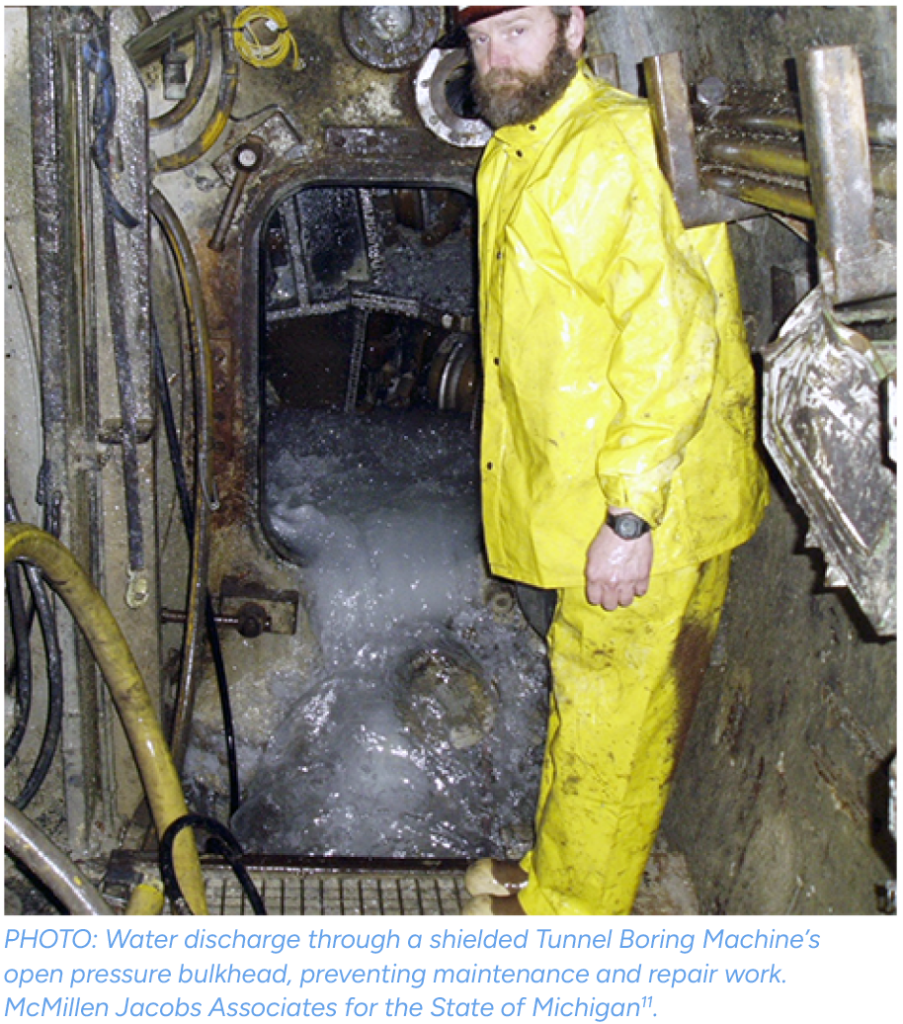
A technical review of the proposed tunnel by the Michigan Department of Transportation raised numerous red flags and factors that could result in tunnel collapse, environmental damage, or even an explosion.

The combination of poor geology, length, depth, potential for methane gas pockets, and extremely high hydrostatic pressure12 all add up to an unprecedented, untested design unlike any other tunnel in the world.

Enbridge hasn’t done its homework.

1. Lack of due diligence.
Understanding the bedrock and geology of the tunnel’s path is critical for its safe construction and operation. But Enbridge only sampled the rock an average of once every 950 feet, far below the industry standard of once every 50 to 250 feet.13

2. Insufficient sampling.
Enbridge only took one rock sample over a span of about 11,000 feet14 — the deepest, most critical section of the proposed tunnel route. There is a span of 1.5 miles that has not been sampled at all (thousands of feet longer than the un-sampled sections of similar tunnel project).15

3. Wrong depth.
Enbridge didn’t take enough rock samples, and some of the samples it did take were not deep enough.16 The percentage of samples laying within the zone of the tunnel path was less than the typical amount of samples studied during comparable projects.17

4. Unprecedented.
A hazardous liquids pipeline tunnel of this length, depth, and in geologic and hydrostatic pressure conditions like those found in the Mackinac Straits has never before been attempted.18 We cannot allow the Great Lakes to be Enbridge’s guinea pig.

The unacceptable risk of collapse and explosion.

Instead of solid, uniform bedrock, this tunnel would bore through fractured geologic formations that are “poor” and “very poor” quality, and contain voids.19 This type of rock with large, open seams, has high hydraulic conductivity, which means water can easily flow through it. Studies have also found high hydrostatic pressure at tunnel depth.20

This all adds up to a sponge-like environment that is vulnerable to uncontrollable inflows of water — water that is connected to Lake Michigan.

Tunneling through a slurry of rock and soil, or mixed-face tunneling, is “the most dangerous type of tunneling”21 and there is a risk of collapse around the tunnel boring machine (TBM).

Experts also warn that vapors within the tunnel and dissolved methane in the groundwater could ignite and cause an explosion.22, 23

A tunnel to the past.

Investing in a new fossil fuels tunnel doesn’t add up.

The world is changing, and so are energy markets. Increasing fuel efficiency, electric vehicle sales, and decarbonization across industries make this new fossil fuels tunnel a bad bet.

With global oil demand predicted to peak this decade,24 we should not invest in a massive piece of fossil fuel infrastructure that will start to become obsolete almost as soon as it opens.

A bad investment for Enbridge and Michigan.

1. Skyrocketing costs.
A 2025 report by the non-partisan Institute for Energy Economics and Financial Analysis (IEEFA) found that the tunnel may cost up to three times more than initial estimates.25 Meanwhile, Enbridge also faces an expensive 41-mile reroute in Wisconsin.

2. Depressed market.
During this critical time for climate action, projects like the Line 5 tunnel are a bad bet — and Wall Street knows it. The fossil fuels sector underperformed the S&P 500 for 7 of the last 10 years, delivering the lowest performance of all S&P 500 sectors.26

3. Declining demand.
According to Goldman Sachs, global oil demand will peak in 2035 and then begin to decline27 — just six years after the tunnel is scheduled to open.28 U.S. gasoline consumption peaked in 2018 and has fallen more than 4% despite population growth.29

4. You’re on the hook.
Ownership of the tunnel would transfer to the Mackinac Straits Corridor Authority — or in other words, Michigan taxpayers. Enbridge may lease the tunnel rent- free30 for up to 99 years. It’s unclear who will be liable for its upkeep if the lease is terminated early.31

The tunnel isn’t the answer.

There’s no question: Line 5 as it exists today, resting exposed on the lake bed floor, buffeted by strong currents and vulnerable to anchor strikes,32 is an unacceptable threat to our Great Lakes.

That’s why Michigan Gov. Gretchen Whitmer revoked the Line 5 easement in 2020 and ordered that it be shut down. (Enbridge continues to operate Line 5 in defiance of the State of Michigan.)

Due to the poor rock quality and volatile gasses, the tunnel would not eliminate the threat of an oil spill.

The multi-year construction phase would be especially risky, as Enbridge plans to operate the existing Line 5 during the boring underneath.

The good news is, there are other ways33 to supply fossil fuels to eastern Canada and replace the much smaller amounts supplied by Line 5 to Michigan and the U.S. — alternatives that don’t endanger the Great Lakes.

Here’s the big picture: building the tunnel would feed climate change, lock Michigan into fossil fuels, and deincentivize the development of healthier regional energy networks and solutions. We can do better.

Michigan after Line 5.

We can get oil out of the Great Lakes and make a better future.

Facing competition from other pipeline companies and declining demand, Enbridge is working overtime to protect its profits and convince Michiganders that we’re dependent on Line 5, but that’s not true.

We have a range of viable alternatives to Line 5, including excess capacity in existing pipelines34 that go around, and not through, the Great Lakes

What happens when we decommission Line 5.

1. Stable prices.
Enbridge’s own expert found that gas prices in Michigan would only increase half a cent per gallon,36 well within normal fluctuations. And a report from supply chain analyst PLG Consulting says that a planned and orderly shut down of Line 5 will not result in price spikes.37

2. Depressed market.
PLG Consulting has also calculated that 87% of Line 5’s crude oil supply could be replaced within three months by fully utilizing Enbridge Line 78 through southern Michigan. Any shortfalls could be supplemented by other transport methods and regions.38

3. Energy independence for Canada.
Since early 2025, Canadian leaders have expressed new interest in investing in their energy security.39 This could include reviving the proposed Energy East pipeline, which would run entirely north of the U.S. border and Great Lakes, supplying Canada’s eastern provinces.40

4. Protected waters.
Michigan has the power to deny the tunnel permit, and protect the Great Lakes from years of construction upheaval, wetlands damage, and other risks. Michigan can assert its sovereignty, stop the exploitation of our resources, and protect the waters today and for generations to come.

References

1. U.S. Army Corps of Energineers, Enbridge Line 5 Tunnel Project Final Environmental Impact Statement.
2. National Transportation Safety Board, https://www.ntsb.gov/investigations/AccidentReports/Reports/PAR1201.pdf
3. Wisconsin Public Radio, https://www.wpr.org/environment/enbridge-oil-spill-jefferson-county-wisconsin-pipeline
4. Detroit News, https://www.detroitnews.com/story/news/local/michigan/2024/07/08/enbridge-line-6 b-proposed-eighth-modification-circumferential-cracks/74327136007/
5. U.S. Dept. of Justice, https://www.justice.gov/enrd/media/1359506/dl
6. MI Attorney General, https://www.michigan.gov/ag/news/press-releases/2020/06/25/judge-orders-line-5-to -cease-operations
7., 10. Canada House of Commons, https://www.ourcommons.ca/DocumentViewer/en/43-2/CAAM/meeting-4/evidence
8. Government of Canada, https://www150.statcan.gc.ca/t1/tbl1/en/cv.action?pid=2510003001 9., 33., 34., 35., 37., 38. PLG Consulting, https://plgconsulting.com/white-paper-likely-market-responses-to-a-line-5-shutdown/
11., 12. McMillen Jacobs & Associates for MDOT, https://www.michigan.gov/-/media/Project/Websites/egle/Documents/Multi-Division/L ine-5/MDOT_Question_on_Collapses_in_Terms_of_Loss_of_Face_Control_Jan_2021.pd f
13. Michigan Advance, https://michiganadvance.com/2020/09/28/geologists-condemn-line-5-tunnel-plan-pe rmitting-the-project-at-this-time-would-be-a-mistake/
14., 15. McMillen Jacobs & Associates for MDOT, https://www.michigan.gov/-/media/Project/Websites/egle/Documents/Multi-Division/L ine-5/MDOT_Question_on_Risk_mitigation_Jan_2021.pdf
16., 17., 19., 20. McMillen Jacobs & Associates for MDOT, https://www.michigan.gov/-/media/Project/Websites/egle/Documents/Multi-Division/L ine-5/MDOT_Question_on_Geotechnical_Investigation_Jan_2021.pdf
18. EarthJustice, https://earthjustice.org/press/2025/tribes-greens-take-line-5-tunnel-to-michigans-supremecourt
21. Michigan Advance, https://michiganadvance.com/2020/09/28/geologists-condemn-line-5-tunnel-plan-permittin g-the-project-at-this-time-would-be-a-mistake/
22. Richard Kuprewicz, comments to the Michigan Public Service Commission, https://narf.org/nill/documents/20211214-line5-mpsc-kuprewicz-testimony.pdf
23. Brian O’Mara, testimony to the Michigan Public Service Commission, https://turtletalk.blog/wp-content/uploads/2023/02/bay-mills-experts.pdf
24., 27. Goldman Sachs, https://www.goldmansachs.com/insights/articles/peak-oil-demand-is-still-a-decade-away 25. Institute for Energy Economics and Financial Analysis, https://ieefa.org/resources/enbridge-should-consider-closing-its-old-troubled-line-5-pipeline
26. Institute for Energy Economics and Financial Analysis, https://ieefa.org/sites/default/files/2025-01/REVIEWED-15818-Briefing%20Note_2024%20Re cap%20oil%20stocks%20%281%29.pdf
28. Bridge Michigan, https://www.bridgemi.com/michigan-environment-watch/trump-administration-fast-track-lin e-5-tunnel-calling-project-emergency 29. U.S. Energy Information Administration, https://www.eia.gov/tools/faqs/faq.php?id=23&t=10
30., 31. State of Michigan, https://www.michigan.gov/psab/-/media/Project/Websites/psab/archive/media/ProposedTun nelLease_12-13-18.pdf
32. Flow Water Advocates, https://flowwateradvocates.org/line5
36. Neil K. Earnest, Muse, Stancil & Co, federal court filing, https://environmentaldefence.ca/wp-content/uploads/2022/06/Report-expert-Enbridge-exp ert-Neil-Earnest-Muse-Stancil.pdf
39. Canadian Broadcasting Corporation, https://www.cbc.ca/news/politics/west-east-pipeline-jonathan-wilkinson-1.7452406
40. Financial Post, https://financialpost.com/commodities/energy/sentiment-pipelines-trump-canada

Two Virtual Hearings, Two Real Steps Closer to Shutting Down Line 5 in the Great Lakes

enbridges-line-5-under-the-straits-of-mackinac

Take Action: Click Here to Urge Michigan’s Leaders to Shut Down the “Significantly Damaged” Line 5 Right Now

Jim Olson is FLOW’s Founder and Legal Advisor


By Jim Olson 

For the past 6 years, Canada’s Enbridge has maneuvered the State of Michigan into rounds of back-and-forth letters, meetings, and agreements that have done nothing but delay any enforcement action to shut down Line 5 in the Straits of Mackinac, where Lake Michigan meets Lake Huron. After two pivotal hearings on Tuesday, June 30, however, Enbridge has begun to lose its grip on the fate of its dangerous twin Line 5 crude oil pipelines in the public waters of the Straits. Two hearings, and the State and its citizens are two steps closer to shutting down the unstable twin crude oil pipelines once and for all without replacement.

1st Hearing: The Michigan Public Service Commission on Enbridge’s Proposed Oil Pipeline Tunnel

On the morning of June 30, in a virtual public hearing with hundreds of participants, the Michigan Public Service Commission (MPSC) approved 3-to-0 an Order that rejected Enbridge’s bid to avoid its obligation to prove it is entitled to locate and construct its proposed tunnel pipeline “in the public interest” and that it is necessary at this time in history. (See FLOW E.D. Liz Kirkwood’s reaction here).

The company argued that it didn’t need the MPSC’s approval of the pipeline tunnel because the State’s utility commission approved the necessity of the existing line in 1953. In an Order more than 70 pages long, the MPSC described the complexity and importance of the public interest and necessity for a crude oil pipeline in the Great Lakes in 2020, not 67 years ago. The Order included an outline of the depth of the issues posed by the tunnel proposal before the public panel, relying on extensive comments submitted by the Michigan Environmental Council and National Wildlife Federation, Michigan tribal governments, For Love of water (FLOW), Michigan’s Attorney General Dana Nessel, and many other organizations and citizens.

The submitted comments pointed to the overarching public interest and public trust in the Great Lakes, demand for crude oil, alternative routes, threats to the environment, and risks to the Great Lakes from climate change, such as high-water levels and damaged infrastructure. The Order requires Enbridge to prove under the scrutiny of the MPSC in a formal, trial-like proceeding that the pipeline tunnel proposal is in the public interest, necessary, and that there are no reasonable alternatives to shipping oil through its and North America’s massive pipeline system.

2nd Hearing: Ingham County Circuit Court on a Preliminary Injunction to Shut Down Existing Line 5 in Attorney General Dana Nessel for the People of Michigan versus Enbridge Energy

On the afternoon of June 30, after a 5-hour virtual hearing in Ingham County Circuit Court in Lansing, Circuit Court Judge James Jamo continued the temporary restraining order (“TRO”) he issued on June 22, shutting down the flow of oil through Line 5 in the Straits of Mackinac. Enbridge argued that historical in-line inspections and video footage of scrapes to the exterior of the pipes and a twisted support structure designed to minimize damage from strong currents demonstrated the steel pipelines themselves were safe. Enbridge introduced a letter from the federal Pipeline and Hazardous Materials Safety Administration (PHMSA) that stated the agency did “not object” to restarting the pipelines “based on the assurances of Enbridge.” Lawyers for Enbridge told the Court that if PHMSA says it’s safe, then the State and Court have no jurisdiction or power to interfere with restarting the lines, and that Enbridge should be able to reopen the lines. 

The Attorney General’s lead attorney told the Court that Enbridge hadn’t turned over all of the information related to Enbridge’s “assurances” to PHMSA and that the cause of the damage to the structure and lines remained unknown. He argued that without more information and independent review of what happened, there was no way Enbridge or the State could comply with the stringent due care and prudence obligations under public trust law to insure that the pipelines are not a danger to the waters, bottomlands, and people of Michigan. The public trust in the waters and bottomlands of the Great Lakes is derived from the State’s title granted to it when it joined the United States in 1837, and it can’t be impaired, endangered, or controlled by primarily private interests.

Judge Jamo probed Enbridge’s lawyers on whether PHMSA’s “non-objection” could deprive the State of its public trust jurisdiction by a letter based on only the assurances of Enbridge. The lawyers couldn’t give a clear answer, and by the end of the hearing it was clear that what PHMSA said was evidence of safety, was not conclusive of the broader duty of the State and the Court to determine whether there was a violation of the due care requirement to protect the public trust in the Straits.

At the end of the hearing, the Court continued the TRO issued June 22. On Wednesday morning, July 1, the Court issued an amended TRO, keeping the suspension of use of the lines in force, but allowing Enbridge to inspect the west leg of the dual lines in the Straits to see if it could be used in the near future “subject to any future order of the Court.”

Clearly, Judge Jamo has taken control of the risks associated with the location of crude oil pipelines in the Straits. The condition of the two lines has totally changed from 1953. Approximately 150 saddle supports (with 50 some more on the way) have been added since 2001 to stabilize the failure of the original lines because of powerful currents in the Straits. Two recent events damaged the coating on the west line and broke an anchor support on the east line. Enbridge inspectors were not sure what caused the damage, but they thought it appeared to be anchor strikes or other objects dragged by passing ships. This is alarming because this brings the total number of known strikes to dual lines to three in the last 18 months. It appears Judge Jamo is exercising due care in continuing the shutdown of the lines. He took the request for preliminary injunction under advisement. In the near future, he is expected to decide on a previous motion to rule that the 1953 easement allowing Enbridge to place the two lines in the Straits in the first place is no longer valid under the public trust laws that protect the Straits and all of the Great Lakes.

Ultimately, this case and the fate of Line 5 will turn on the reality that in 2020 the conditions and circumstances are not the same as 1953. The Line 5 twin pipelines in the water and across the lakebed are in the wrong place because of certain serious conditions that will continue to exist and cannot be controlled. Under public trust law, these lines and the easement that allowed them are no longer lawful. Attorney General Nessel did the right thing in filing this lawsuit—the lines in this location violate the public trust and constitute a public nuisance in the form of an “environmental ticking time bomb,” as the State has argued, that could go off at any time. How strong a current, how many near-disaster anchor-strikes or other errors will it take before the inevitable catastrophe happens? Now is the time to prosecute these claims to the right conclusion, a permanent and orderly shutdown.

In the meantime, Circuit Court Judge Jamo was correct in keeping this matter under his control and advisement, and to continue the temporary order suspending the use of these pipelines pending further proceedings. For the moment, the pumps and twin lines remain silent.

U.S. Army Corps to Limit Line 5 Tunnel Review

“The US Army Corps of Engineers decision to exclude the cumulative impacts of the fossil fuels Line 5 will transport, climate concerns, and, remarkably, engineering concerns raised by experts as to the integrity of the tunnel, flies in the face of the Corps’ purpose and mission, the Biden Administration’s goals and policy, and public concern for the protection of Great Lakes waters.” – Liz Kirkwood, FLOW Executive Director

Why Do Canadians Seem to Care So Little about Protecting the Great Lakes from Line 5?

Dr. Daniel Macfarlane, Institute of the Environment and Sustainability

By Daniel Macfarlane

As a Canadian living in Michigan, I’ve never seen a state or province that identifies with the Great Lakes the way Michigan does: their silhouette adorns t-shirts, water bottles, and bumper stickers everywhere. At the same time, I would say that the Great Lakes-St. Lawrence system is woven into the nationalisms and founding mythologies of the Canadian nation-state, especially in central Canada, in a way that isn’t true of the United States. You might even say that the Great Lakes are in the DNA of the territory now called Canada.

The Great Lakes and St. Lawrence River are the historic Canadian heartland—the equivalent of the East Coast of the United States. All three founding nations of Canada (Indigenous, British, and French) crowded the shores of these sweetwater seas and the St. Lawrence River. Nowadays, the Great Lakes-St. Lawrence basin hosts the political, financial, and industrial hubs of Canada, and about half the country’s population.

But if the Great Lakes are so important to Canadians, why do they seem to care so little about protecting them? Specifically, I’m talking about Enbridge’s Line 5 pipeline.

Line 5, a hydrocarbon pipeline, runs through Michigan’s Upper Peninsula, across the state’s venerated Straits of Mackinac, and then through lower Michigan to Sarnia, Ontario. Built nearly 70 years ago, and in a deteriorating condition, Line 5 daily transports about 23 million gallons of oil and natural gas liquids from the Canadian West.

Line 5 is a ticking time bomb, especially at the Straits, where Enbridge is proposing a tunnel for this decaying and dangerous dual pipeline—but if you read the fine print, it will take a decade to build and taxpayers will be on the hook for the risky endeavor.

If the Great Lakes are so important to Canadians, why do they seem to care so little about protecting them? Specifically, I’m talking about Enbridge’s Line 5 pipeline.

In November 2020, Michigan Governor Gretchen Whitmer revoked the 1953 easement granted to the Lakehead Pipe Line, now Enbridge, for the Straits crossing. Enbridge ignored the Governor’s May 12 deadline to shut down Line 5, with backing from the Canadian government, and the matter was sent for mediation. But in early September, the State of Michigan moved to break off this “unproductive” dialogue.

On October 4, 2021, the Canadian government officially invoked a bilateral 1977 Pipeline Transit Treaty that applies to pipelines that cross from one country into the other and back. Governor Whitmer said she was “profoundly disappointed” with the Trudeau government. And she should be, since Ottawa is essentially shilling for a private oil company. 

The status quo is going to end in disaster. Canada is a climate villain, marching itself and the rest of the world to “global weirding.” Backing the likes of Enbridge is not only bad for the planet, it is bad economics. 

In any case, the 1977 treaty is a diplomatic agreement not to interfere with or levy any fees or duties on hydrocarbons that are already flowing—“in transit” to use the treaty language—and should have no applicability on the bigger question of whether a state or province wants a foreign pipeline in their territory. In other words, the intention of this treaty was not to stop a state (or province) from exercising its sovereignty over its own public waters or deciding whether or not to revoke permission for a foreign pipeline crossing its territory; the point was to stop an arbitrary or gouging bait-and-switch where a political jurisdiction acting as the middle man gives consent to a pipeline and then jacks up the price.

Many Canadians have been boisterously loud about stopping new and existing pipelines within Canada. But why are Canadians so seemingly ignorant, or ambivalent, about Line 5? A major reason is certainly that most of the fossil fuels sent through Line 5 ends up in Ontario and Quebec. Of course, Canada is also a type of petro-state, addicted to the profits and efficiencies of fossil fuels; many have a vested interest in maintaining the status quo.

Just imagine how Canadians would react if the situation were reversed, and the U.S. refused to stop a pipeline that a province didn’t want. Moreover, if Canada is serious about reconciliation, it needs to stop pipelines. Many pipelines in Canada threaten the territories of numerous bands and First Nations, often without their consent and in conflict with the spirit of treaties and agreements.

But the status quo is going to end in disaster. Canada is a climate villain, marching itself and the rest of the world to “global weirding.” Backing the likes of Enbridge is not only bad for the planet, it is bad economics. 

A recent report stated that close to 85% of Canada’s fossil fuels need to stay in the ground if the country wants to have a decent chance of meeting the 1.5 degree Celsius goal in the Paris Agreement.  According to another analysis, building the Line 5 tunnel and continuing the pipeline could contribute an additional 27 million metric tons of greenhouse gases to the atmosphere annually, generating $41 billion in climate damages between 2027 and 2070.

Those climate damages are going to haunt Canada as well as the U.S. Moreover, the models show that a Line 5 spill at the Straits of Mackinac would likely flow into the Canadian part of Lake Huron. Enbridge’s track record doesn’t exactly inspire confidence. I live and teach in Kalamazoo, where in 2010 Enbridge’s Line 6B had a catastrophic failure into the eponymous river. A pipeline rupture would be all but impossible to rectify quickly in the Straits when there is ice cover in winter. 

Just imagine how Canadians would react if the situation were reversed, and the U.S. refused to stop a pipeline that a province didn’t want. Moreover, if Canada is serious about reconciliation, it needs to stop pipelines. Many pipelines in Canada threaten the territories of numerous bands and First Nations, often without their consent and in conflict with the spirit of treaties and agreements.

There are alternatives for getting energy to the areas of Canada served by Line 5. These can be used in the short-term. But, make no mistake, the goal here is not to just shift fossil fuels to a different pipeline. The end game is an energy transition, and a just one at that.  In the long run, stopping Line 5, and other pipelines, could actually be doing Canadians a favor: weaning them off of fossil fuels and their infrastructure, and protecting the Great Lakes and the climate.  What could be more neighborly? 

Daniel Macfarlane is an Associate Professor in the Institute of the Environment and Sustainability at Western Michigan University. He is also a senior fellow at the Bill Graham Center for Contemporary International History, University of Toronto, and President of the International Water History Association. His research and teaching focus on the Great Lakes-St. Lawrence basin, and he is the author or co-editor of four books, including Border Flows: A Century of the American-Canadian Water Relationship, and he is completing a book on Canada-U.S. environmental and energy relations.
Digging a Hole for Future Generations

By 4-3 Vote, Grand Traverse County Commissioners Support ‘Line 5’ Oil Tunnel in the Great Lakes

By Kelly Thayer

After a brief rally outside with many participants wearing black t-shirts saying, “No Line 5 Oil Tunnel,” dozens of people this morning (August 21) overflowed the meeting room and lobby of the Grand Traverse County Board of Commissioners in Traverse City. In all, 54 residents spoke out for the next 2 ½ hours against a resolution supporting a proposed tunnel under the Straits of Mackinac. Only two people — one an owner of a local gas and oil company — spoke for the oil tunnel.

And then the county commissioners had the final say, with the majority ultimately disagreeing with their own constituents and voting 4-3 for the resolution. (Click here to view a video of the meeting.)

The outcome was disheartening to many in attendance who spoke of Enbridge’s spill-laden track record and the risk to the Great Lakes, drinking water, the economy, tribal rights, the climate, and a way of life that could be denied to future generations.

“It’s not a good pipeline. And for all the reasons already said, it needs to be shut down. And so promoting the life of it isn’t exactly helpful for my generation, or generations that come after me – or your generation! It’s not good for our water, it’s not good for our state, it’s not good for the world! So just consider that, please,” said Kellyn Walker Hundley, a teenager who attended and also is the daughter of Commissioner Bryce Hundley, an opponent of the resolution.

The pro-tunnel result delivered a boost for Enbridge, which didn’t comment at the meeting, but instead is letting its money do the talking by spending heavily on public relations and lobbying to gain support among counties statewide for their proposed oil tunnel. Only three other counties — all in the Upper Peninsula — to date have approved the model resolution that bears close resemblance to talking points that Line 5-owner Enbridge has circulated for months.

The Canadian energy transport giant’s goal is to build political backing for a tunnel as a replacement for its decaying oil pipelines crossing the open waters and bottomlands of the Straits of Mackinac, where Lake Michigan meets Lake Huron. Enbridge thought it had secured the oil tunnel in late 2018, when Michigan lawmakers rushed through a bill in lame-duck session. In March, however, newly elected Attorney General Dana Nessel found that the oil tunnel legislation to be unconstitutional.

Enbridge sued the State of Michigan in early June to resuscitate the law, and the multibillion-dollar company also is working with the Republican majority, as well as some Democrats, in the state House and Senate to introduce a new oil tunnel bill as early as this month to overcome the flaws flagged by Nessel. Nessel in late June also sued Enbridge to revoke the 1953 easement that conditionally authorizes Enbridge to pump oil through the twin pipelines in the Straits.

FLOW and its team of lawyers, scientists, engineers, and an international risk expert since 2013 have studied the increasing threat from Line 5 in the Straits of Mackinac and, more recently, the proposed Line 5 oil tunnel.

FLOW Deputy Director Kelly Thayer read a statement calling on the county board to reject the oil tunnel resolution, which claims an admirable safety record that is at odds with the reality that Line 5 has leaked at least 33 times, spilling a total of 1.1 million gallons of oil in Michigan and Wisconsin.

“It is vital to understand that with a ‘yes’ vote today for the oil tunnel resolution, you would effectively be interfering in ongoing litigation between Enbridge and the State of Michigan,” Thayer said. “Why entangle Grand Traverse County in these legal fights on Enbridge’s behalf?”

Enbridge wants the right to bore a tunnel in the next 5-10 years for Line 5 through State of Michigan public trust bottomlands under the Straits. Enbridge also wants to keep pumping up to 23 million gallons of oil and natural gas liquids a day through the decaying, 66-year-old Line 5 pipelines in the Straits during tunnel feasibility studies and construction.

An oil tunnel also would fail to address the risk posed by Line 5’s more than 400 stream and river crossings in the Upper and Lower Peninsulas and would conflict with Michigan Gov. Gretchen Whitmer’s plans to combat ongoing climate change.

FLOW and other Great Lakes advocates have long called for shutting down Line 5, which primarily serves Canada’s, not Michigan’s, needs and threatens the Great Lakes. FLOW research shows that viable alternatives exist to deliver propane to Michigan and oil to regional refineries, and Gov. Whitmer has formed an Upper Peninsula Energy Task Force to identify energy supply options. The system can adjust with smart planning.

You can learn more by visiting FLOW’s Line 5 program page and by downloading a copy of FLOW’s latest:

Kelly Thayer is FLOW’s Deputy Director

The Future of Line 5 in the Straits of Mackinac


Now that Michigan’s governor and attorney general have sunk the oil tunnel scheme hatched by the last administration, I’m asked nearly every day: What can citizens and state leaders do to shut down the propped-up, banged-up Line 5 oil pipelines in the Straits of Mackinac for good?

Here’s my answer, as succinctly as I can distill it, accompanied by a summary of the law and political history in play.

So what should Governor Whitmer and Attorney General Nessel do?

Governor Gretchen Whitmer and Attorney General Dana Nessel must take swift and comprehensive actions to review and reverse the improper failure of the former Snyder administration to bring Line 5-owner Enbridge under the rule of law. Enbridge has had its way with Michigan’s prior elected officials, and it is time to call a halt to this nonsense. Here are the steps to getting Enbridge out of the Great Lakes for good:

Proposed Oil Tunnel:

  1. Send a Letter: Tunnel Deal Is Dead– Governor Whitmer and Attorney General Nessel should send a formal letter to Enbridge advising the company that its agreements calling for a transfer or occupancy of the Straits of Mackinac public trust bottomlands, the new state-granted easement, and 99-year lease for the proposed oil tunnel that would house a new Line 5 are unenforceable unless Enbridge has obtained authorization under state law – the Great Lakes Submerged Lands Act (GLSLA).

Line 5 in the Straits:

  1. Send another Letter: No Life Support for Line 5 – Governor Whitmer and the Michigan Department of Environmental Quality (DEQ), along with Attorney General Nessel, should send a letter to Enbridge advising it that the agreements purporting to grant Enbridge occupancy and use of waters and bottomlands the existing Line 5 for 10 years or more are unenforceable, because the former administration and Enbridge failed to obtain the required authorization under the GLSLA.
  1. Apply the Law to the Redesign of the Ailing Pipelines – Governor Whitmer and the DEQ, along with Attorney General Nessel, should investigate and correct the lack of review and showings required by the GLSLA and public trust law for the substantial change in design implemented for the 3 miles of pipeline elevated above the lakebed under the guise of “repair.” Enbridge should be instructed that it must show the risks and magnitude of harm are minimal and that there exist no other alternative than the existing line in the Straits or Great Lakes.

How Did We Get Here on Line 5? Tracing the Law and the Politics

The plotting of former Governor Snyder’s administration and Enbridge to hand over the public trust soils and bedrock under the Straits of Mackinac for the company to build and operate a new crude oil pipeline in a tunnel for 99 years has been put on hold.

On her first full day in office, Governor Gretchen Whitmer asked Attorney General Dana Nessel for a formal opinion on whether the Snyder-Enbridge agreement and legislature’s stamp of approval through a lame-duck law known as “Act 359” to hand over the Straits for Enbridge’s tunnel  to Enbridge was constitutional.  In late March, Attorney General Nessel found it was not constitutional because the legislature tried to graft a private tunnel-pipeline project onto a public infrastructure law that governs a public icon—the Mackinac Bridge.

Read more about the history and law surrounding Line 5 here!

  1. Revoke the Easement – Attorney General Nessel along with the Department of Natural Resources (DNR), along with the above actions, revoke the 1953 easement because under the current circumstances the existing Line 5 is no longer in compliance with the common law standards of the paramount interests of the Great Lakes protected by public trust law; if Enbridge desires to continue using the existing line in the Straits, the company must submit an application for authorization of such use and occupancy along with the authorizations identified in this list.
  1. Increase Insurance Requirement and Verify It – Governor Whitmer, the DEQ, and the DNR, with the Attorney General, should require Enbridge to submit financial assurances that cover the worst case economic and natural resources damages of at least $6 billion (significantly more than the current cap of $1.8 billion), retain qualified experts to determine the adequacy of those assurances, and require Enbridge to name the State of Michigan as an “additional insured” and/or “named insured” on its insurance coverage for Line 5. Inadequate insurance is another cause for revoking the easement.

Once the Governor and Attorney General do these things, they will have taken action consistent with their pledge in being elected to lead the State and protect the Great Lakes, by nullifying the improper actions and agreements of their predecessors and bringing Enbridge, finally, under the rule of law. Regardless of the outcome, the interested parties, communities, and persons in this controversy and the government will be required to make determinations concerning the fate of Line 5 in an open forum based on facts, science, and law.  We are ruled by law, not by self-serving agreements that were plotted to avoid it.

Given President Trump’s executive orders this week to water-down or smooth over federal laws and regulations affecting water, the Great Lakes, and pipelines, it is more critical than ever that Governor Whitmer and Attorney General Nessel exercise the full jurisdiction and authority they and the State of Michigan under its exclusive power over use of the waters and bottomlands of the Great Lakes, its lakes and streams, public lands, and the public trust in the Great Lakes and navigable waters and public common property of Michigan. This trust imposes a duty on our leaders to protect the interests of citizens, the legal beneficiaries of this trust. Not the President, not Congress, not federal agencies, or state government can repeal, limit, or narrow the state’s duties and citizens’ individual and common rights under this public trust.

What Should Citizens Do?

It is quite simple: Citizens should do what they always do best. Continue to stay involved, increase communications to Governor Whitmer, Attorney General Nessel, and the Director of the DEQ, and the DNR.  These communications should do the following:

  • Thank our state leaders for taking action on the unconstitutional Act 359 and the misguided oil tunnel agreement;
  • Urge our state leaders to take immediate steps to implement the actions outlined above to formally scrap the oil tunnel and shut down Line 5.

FLOW Praises Governor for Action on Line 5


FOR IMMEDIATE RELEASE:                                                                      March 28, 2019

Liz Kirkwood, FLOW Executive Director                                                   Email: Liz@FLOWforWater.org
Office: (231) 944-1568, Cell: (570) 872-4956                                           Web: www.FLOWforWater.org

Jim Olson, FLOW Founder and President                                                Email: olson@envlaw.com
(231) 499-8831 

Dave Dempsey, FLOW Senior Advisor                                                     Email: dave@FLOWforWater.org
(612) 703-2720


In the wake of an opinion by Attorney General Dana Nessel invalidating a law that sought to give away Great Lakes public trust bottomlands to Enbridge for 99 years for a private oil tunnel, Governor Gretchen Whitmer has now ordered state agencies to pause permitting on Line 5, an action hailed by FLOW (For Love of Water), a Great Lakes law and policy center based in Traverse City.

“We welcome the Governor’s swift, prudent action to halt the legal effect of the law and tunnel and side agreements,” said Jim Olson, founder and president of FLOW. “Now, it’s time to bring the existing perilous Line 5 in the Straits under rule of law and decommission it as quickly as possible.”

“The backroom deals creating Enbridge’s proposed oil tunnel couldn’t survive public scrutiny, and now we know they can’t survive the rule of law,” said Liz Kirkwood, Executive Director of FLOW. “It’s time to focus on Michigan’s true energy future and protect Michigan’s Great Lakes and our economy from a Line 5 pipeline rupture. The path forward for Michigan is for Gov. Whitmer to immediately begin the process of decommissioning Line 5 in the Straits of Mackinac.”


FLOW Praises Attorney General for Restoring Rule of Law on Line 5


FOR IMMEDIATE RELEASE:                                                                      March 28, 2019

Liz Kirkwood, FLOW Executive Director                                                   Email:Liz@FLOWforWater.org
Office: (231) 944-1568, Cell: (570) 872-4956                                           Web: www.FLOWforWater.org

Jim Olson, FLOW Founder and President                                                Email:olson@envlaw.com
Cell: (231) 499-8831

Dave Dempsey, FLOW Senior Advisor                                                     Email:Dave@FLOWforWater.org
(612) 703-2720


FLOW supports attorney general’s process and opinion, which is binding on state agencies and rejects the fatally flawed law and undermines side agreements on Enbridge oil pipelines, proposed tunnel in Mackinac Straits


In a major step toward restoring the rule of law, Michigan Attorney General Dana Nessel issued an opinion today declaring unconstitutional a hastily crafted law that sought to give away Great Lakes public trust bottomlands to Enbridge for 99 years for a private oil tunnel, while allowing the aged, dangerous existing “Line 5” oil pipelines in the Straits to continue operating for another decade as the tunnel is considered and possibly built.

The move comes in response to a formal request by Gov. Gretchen Whitmer and is critical to unpacking the layers of problems with the law creating the Mackinac Straits Corridor Authority that the lame-duck legislature rushed through in late 2018.

“We applaud Attorney General Nessel for clearly recognizing the legislative overreach, restoring the rule of law, and stopping the attack on the Great Lakes and the state constitution, which demands that the state’s air, water, and natural resources are treated and protected as ‘paramount,’” said Liz Kirkwood, an environmental attorney and Executive Director of FLOW (For Love of Water), a Great Lakes law and policy center based in Traverse City.

The attorney general’s opinion on Public Act 359 is binding on state agencies and voids the tunnel agreement called for by the law, and also nullifies the legal effect of the side agreements reached between the state of Michigan under then-Gov. Rick Snyder and Line 5-owner Enbridge. Those agreements allowed continued oil pumping through the Straits, where Lake Michigan meets Lake Huron, and an easement and 99-year lease of Great Lakes public bottomlands to Canadian-based Enbridge for private control of the tunnel for its own gain.

Public Act 359 and the related agreements for a tunnel and continued use of the existing, flawed Line 5 were not authorized under the standards of public trust law; the state and Enbridge flouted the Great Lakes Submerged Lands Act (GLSLA) that requires transfers and agreements for occupancy of the soils of under the Great Lakes by trying to avoid and ignore this most basic law and public trust principles.

Public Act 359 and the side agreements are peppered with other serious problems, most of which are covered by the questions the Governor asked the Attorney General to answer, which include:

  • Adding the tunnel and corridor authority to the 1952 law that created the Mackinac Bridge Authority goes far beyond the original public purpose to build a public bridge;
  • Establishing a term for members of the board of the corridor authority that exceeds the 4-year limit under Article III of the Michigan Constitution;
  • Violating provisions of the state constitution that prohibit fostering private or special purposes, the commingling of the government to aid primarily private projects, the appropriation of public property for private purposes, and the entanglement of the credit and taxpayers of the State for primarily private purposes.

“We hope this critical first step by the Attorney General will be followed by an immediate and full review of the Snyder administration’s and agencies’ deliberate evasion of the rule of law and mishandling of the grave and continuing risks of the existing Line 5, and the real and imminent threat to the Straits of Mackinac, towns and cities like Mackinac Island, tribal fishing interests, private property interests, businesses, and the rights of the public in the soils and waters of the Great Lakes,” said Olson.

FLOW recommends that Gov. Whitmer take immediate action to end the massive threat posed by the existing Line 5 in the Straits of Mackinac in a swift and orderly fashion based on the rule of law under our state constitution, statutes, and the public trust doctrine in the Great Lakes, including by:

  • Acknowledging that State of Michigan agencies are bound by the attorney general’s opinion.
  • Sending a letter to Enbridge indicating that the company should decide for itself, if it wants to build a new oil tunnel, and apply, if it chooses under the Great Lakes to construct a tunnel under the rule of law. The rule of law requires a full consideration of the risk to the paramount public rights in the soils and waters of the Great Lakes, and a showing that the company has no prudent and feasible alternatives to using the Great Lakes as a shortcut for western Canadian oil on its way to refineries in eastern Canada as well as overseas markets. If the company does not chose to do this, or cannot satisfy these mandatory requirements that protect the Great Lakes, then it should choose to use other parts of its several-thousand mile system.
  • Starting the process to decommission the 66-year-old Line 5 pipelines in the Straits of Mackinac, which are operating without lawful authority, in violation of the public trust and GLSLA, and in violation of their 1953 easement granted by the state. If Enbridge chooses to continue operating the existing Line 5 in the future, it can apply under the GLSLA for new authority to continue using Line 5 if it can demonstrate little risk and no feasible and prudent alternative to the unacceptable existing Line 5, but the state is not obligated to agree.

“Public Act 359, coupled with the State’s public entanglement with Enbridge, has put private gain and economic interests above the State’s and public’s paramount trust interest in the waters and soils of the Great Lakes,” said Olson. “The unconstitutional law and entangled state and Enbridge agreements represent one of the largest, if not largest, threats in the state’s history to the state’s ownership and public trust duty to protect the public’s rights and uses from private takeover or harm to the Great Lakes.”


Take Action Today to Oppose Michigan’s Senate Bill 1197 and Save the Mackinac Bridge from Enbridge Line 5

FLOW President Jim Olson addresses the board of the Mackinac Bridge Authority at its Nov. 8, 2018, meeting in St. Ignace.


FLOW is urging supporters to contact your Michigan lawmakers today using our guidance below and to plan to join FLOW and other leaders of the Oil & Water Don’t Mix campaign who are hosting a Line 5 lawmaker lobby day for Tuesday, November 27, in Lansing, to fight for the Great Lakes and the Mackinac Bridge by opposing Governor Snyder’s Enbridge oil tunnel scheme and shutting down Line 5 in the Mackinac Straits.

In coordination with the Snyder administration, departing State Sen. Tom Casperson, a Republican from Escanaba, on November 8 introduced Senate Bill 1197 to amend the Mackinac Bridge Authority Act to allow it to own and operate a “utility tunnel,” with the Enbridge Line 5 oil pipeline as the intended occupant. There’s also the uncertain prospect of adding gas or electric lines, which could rent space in the tunnel by paying Enbridge, not the bridge authority that is proposed to own it. In fact, if the fiber optic lines that currently cross the Mackinac Bridge were moved to the proposed tunnel, Enbridge could gain more than $500,000 a year in lease revenue currently going to operate and maintain the bridge.

Please use our updated Line 5 oil tunnel fact sheet to get informed and share it with your lawmakers and others who can help stand up for the Great Lakes and the Mighty Mac. Here are the three key points to make when contacting your lawmaker (You can look up your state representative here and state senator here).

Senate Bill 1197:

  1. Fails to address the imminent risk of the decaying Line 5 pipelines lying on the bottom of the Great Lakes for 10 years or more. The deal struck by Gov. Snyder and Enbridge would lock in, by right, the operation of the 65-year old, gouged, damaged, and deteriorating Line 5 dual pipelines across the Straits of Mackinac for at least the 10-year period it is expected that tunnel construction would take.  At any future time, if the Enbridge decides not to build the tunnel, the agreement would obligate future governors to keep Line 5 in the waters of the Mackinac Straits indefinitely!
  2. Compromises the mission of the Mackinac Bridge Authority (MBA) and the Mighty Mac itself. For more than 60 years, the Mackinac Bridge Authority has overseen and managed Michigan’s most iconic asset with no hint of controversy and with impeccable performance. This proposed legislation would draw the MBA into the middle of a major controversy with no other purpose than to allow a private, Canadian oil company to continue using a short cut across Michigan and through the Great Lakes to transport oil from western Canadian oil fields to eastern Canadian refineries, with some of that oil being shipped overseas.
  3. Exposes the Mackinac Bridge Authority, toll payers, and taxpayers to financial peril. Since its beginning, the Mackinac Bridge was designed to be funded through the tolls collected by those crossing the bridge. The proposed legislation, which is designed to authorize the backroom deal struck by Gov. Snyder and Enbridge, opens up numerous areas of financial risk for the MBA and the public, including the potential liability in the event of an explosion or other catastrophe associated with the proposed tunnel or if Enbridge fails to keep its commitments to build and maintain the tunnel during the 99-year lease.

The Michigan Senate could quickly approve the bill in the lame duck session after Thanksgiving, and send it to the House. Gov. Snyder is seeking to sign and tie the hands of the incoming administration of Governor-elect Gretchen Whitmer and Attorney General-elect Dana Nessel, who both campaigned for shutting down Line 5, not replacing it with a tunnel. Gov. Snyder also released a draft of a third oil tunnel agreement with Enbridge, which Senate Bill 1197 seeks to enact.

Click here for FLOW’s summary of recent action at the November 8 meeting of the Mackinac Bridge Authority. Stay tuned to the FLOW’s website for additional updates, legal analyses, and more steps that citizens, communities, and businesses can take to protect the Great Lakes and the Mighty Mac.