Traverse City, Mich. — On January 23, Flow Water Advocates (“Flow”) filed its reply to the arguments raised by Enbridge Limited Energy LLC, the Michigan Public Service Commission (MPSC), and other Appellees in Flow’s Michigan Supreme Court case challenging the MPSC’s issuance of a permit to the company for its proposed Line 5 pipeline tunnel through the Straits of Mackinac.
In its brief, Flow argues that under the Michigan Environmental Protect Act (MEPA) and the common-law public trust doctrine, the MPSC has an obligation to withhold authorization for the tunnel project unless and until EGLE determines that the tunnel will not impair the public’s rights to the Great Lakes “waters and [the] lands beneath them” (Glass v Goeckel (2005); see also Collins v Gerhardt (1926)). Neither EGLE nor any state entity has made such a determination.
Support Flow’s work to defend the Great Lakes.
Notably, EGLE is currently reviewing a new, modified permit application from Enbridge. It is seeking additional information about the environmental impacts and alternatives to the tunnel because, according to EGLE, Enbridge has thus far failed to demonstrate that the project will not create untenable risks or violate Great Lakes Submerged Lands Act (GLSLA) standards.
In September, the Court granted Flow and other parties a landmark application for leave to appeal, paving the way for a review of the MPSC tunnel permit. The court specifically directed the parties to address whether the MPSC is required to comply with the common law public trust doctrine in its permitting decisions. Flow’s reply brief can be downloaded in full from its website, FlowWaterAdvocates.org/Line5.
Flow is represented in this case by its legal team and co-counsel, Kanji & Katzen, P.L.L.C. and Olson & Howard, P.C. The case will be heard alongside a related appeal from a coalition of the Little Traverse Bay Band of Odawa Indians, Bay Mills Indian Community, Grand Traverse Band of Ottawa and Chippewa Indians, and Nottawaseppi Huron Band of the Potawatomi, with the Environmental Law and Policy Center and the Michigan Climate Action Network.
###
Flow Water Advocates is an independent 501(c)(3) nonprofit organization based in Traverse City, Michigan. Our mission is to ensure the waters of the Great Lakes Basin are healthy, public, and protected for all. With a staff of legal and policy experts, strategic communicators, and community builders, Flow is a trusted resource for Great Lakes advocates. We help communities, businesses, agencies, and governments make informed policy decisions and protect public trust rights to water. Learn more at www.FlowWaterAdvocates.org.
Traverse City, Mich. — On December 5, Flow Water Advocates (Flow), a Great Lakes water protection organization, in partnership with the Sierra Club and Surfrider Foundation (known collectively as the Water Coalition), submitted written comments on the U.S. Army Corps of Engineers’ Supplemental Draft Environmental Impact Statement (Supplemental DEIS) for Enbridge’s proposed Line 5 tunnel project, which is now considering an alternative to the tunnel proposal using Horizontal Directional Drilling (HDD) to create a borehole and install a replacement pipeline under the Straits of Mackinac (the HDD Installation Alternative).
Support Flow’s work to defend the Great Lakes.
Enbridge’s application for the proposed project’s federal Clean Water Act and Rivers and Harbors Act permits is currently under review by the U.S. Army Corps of Engineers (the Corps). The National Environmental Protection Act (NEPA) requires agency and public review, including the preparation of both a Draft and Final Environmental Impact Statement (and supplements, when warranted), which must assess the purpose and need for the proposed project, alternatives to the proposal, and an assessment of the environmental consequences of the project.
While the Corps originally discounted the HDD Installation Alternative as infeasible years ago, the Supplemental DEIS states that Enbridge submitted information that pursuing the alternative is now technically feasible due to advances in technology, and that the Corps subsequently determined that the HDD Installation Alternative should be subject to “detailed analysis” in the EIS.
The Water Coalition’s comments emphasize that the Corps’ unjustified fast-tracking of the review process for both the DEIS and the Supplemental DEIS unlawfully undermines public participation in the process, as well as the “hard look” required by the agency under NEPA. The comments also highlight the Supplemental DEIS’ striking failure to include the information necessary for the agency to properly review the HDD Installation Alternative and its potential impacts on the surrounding lands and waters. Among the deficits are a failure to detail impacted wetlands, confirm the stability of the bedrock, and survey for protected species and archeological resources.
In order to comprehensively compare the potential environmental impacts of the HDD Installation Alternative against Enbridge’s preferred tunnel project, the Corps and the public must have sufficient location-specific data and information about the risks posed by each technology, as well as the site-specific impacts of each method. The Corps attempts to justify these deficiencies in the Supplemental DEIS by deferring the required assessment to a potential future in which Enbridge chooses to pursue the HDD alternative. However, this reasoning hampers the evaluation of alternatives, and is unacceptable under federal law.
The comments conclude that the supplemental review does not remedy the fatal flaws of the May 2025 DEIS, outlined in the Water Coalition’s June 2025 comments, but rather compounds them.
The people of the Great Lakes Basin depend on the Corps, with its technical expertise and mandate to serve the public interest, to take great care in its consideration of the potential significant environmental impacts of the proposed tunnel and alternatives. The Corps violates that mandate in both the May 2025 DEIS and the new Supplemental DEIS, by failing to collect the information necessary to properly assess the risks, and by unlawfully failing to consider feasible alternatives to building a new pipeline through the Straits. Flow and its partners remain steadfast in their commitment to hold the Corps accountable to its legal obligations.
The Corps anticipates that it will publish a Final EIS in early 2026, followed by a Record of Decision in the Spring.
###
Flow Water Advocates is an independent 501(c)(3) nonprofit organization based in Traverse City, Michigan. Our mission is to ensure the waters of the Great Lakes Basin are healthy, public, and protected for all. With a staff of legal and policy experts, strategic communicators, and community builders, Flow is a trusted resource for Great Lakes advocates. We help communities, businesses, agencies, and governments make informed policy decisions and protect public trust rights to water. Learn more at www.FlowWaterAdvocates.org.
Do you enjoy celebrating the holidays with your friends and family? How about checking items off your bucket list, or watching the Super Bowl? Are cookies, chips, and pizza some of your guilty pleasures?
We don’t know if this is absolutely bonkers PR, or just some good old-fashioned Search Engine Optimization tactics. But either way, you almost have to admire the chutzpah!
An ongoing list of things Enbridge takes credit for:
Line 5 – the 72-year-old dual pipelines suspended across the bottomlands of the Straits of Mackinac – has been battered by anchor strikes and entangled by cables from passing ships.
It is universally accepted that the exposed pipelines represent a clear and present danger to the Great Lakes and the regional economy should Line 5 fail.
In the final two months of Governor Rick Snyder’s second term in 2018, the State of Michigan hurriedly signed four agreements with Enbridge, the Canadian pipeline company that owns and operates Line 5, authorizing the construction of a tunnel beneath the Straits of Mackinac intended to contain and protect Line 5.
The agreements, hastily prepared without public hearings or public review of any kind, require the State of Michigan to take ownership of the tunnel once construction is complete, and to oversee the operation and maintenance of the tunnel for the next 99 years.
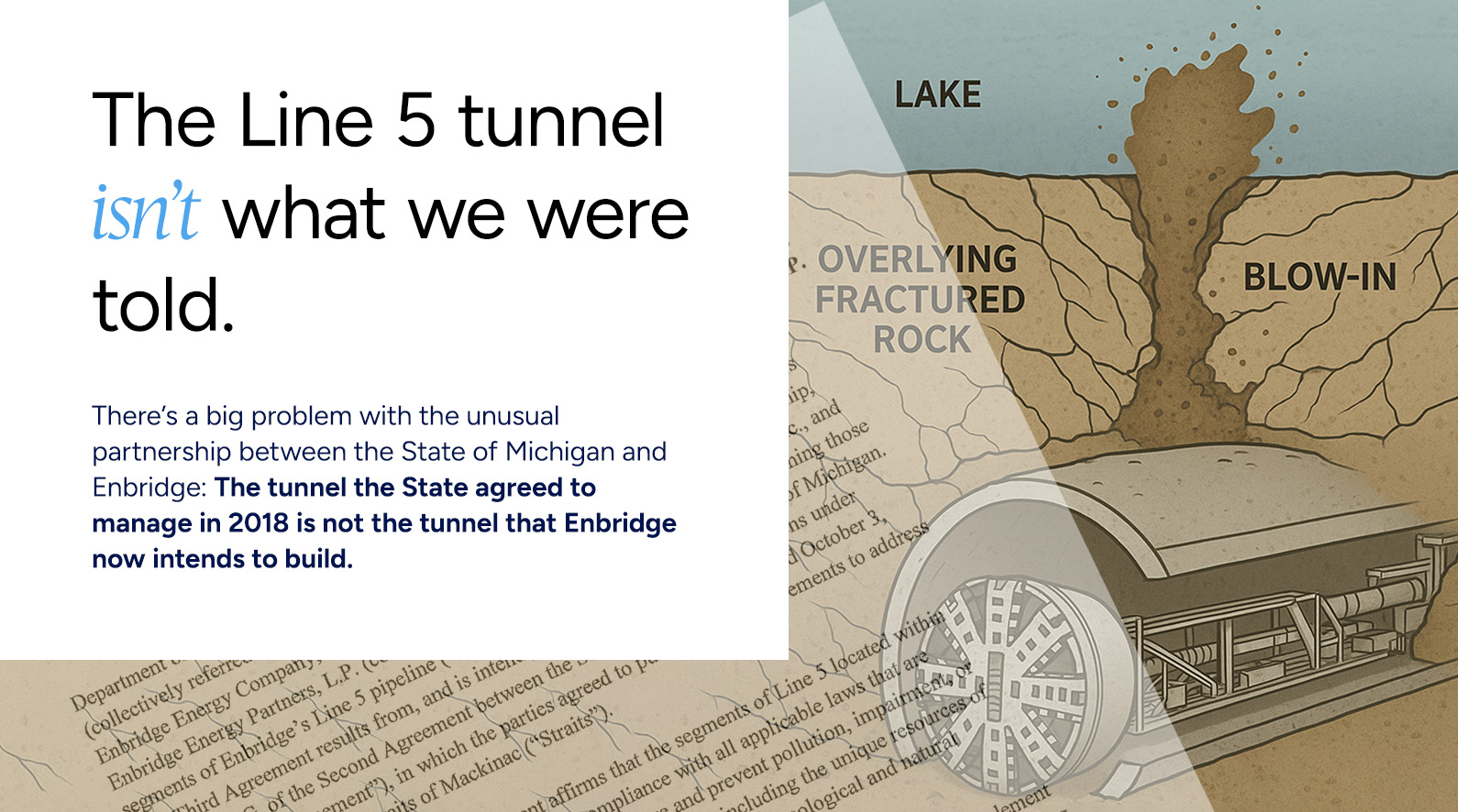
There is one notable problem with this unusual partnership between the State and Enbridge: The tunnel the State agreed to manage is not the tunnel that Enbridge intends to build.
"Almost every aspect of the tunnel’s design, construction, and operation is radically different that what was originally intended," says Brian O’Mara, an expert with over 30 years of tunnel construction experience. "The tunnel project is so off track in so many ways, it is questionable that it can ever be successfully constructed, let alone operated safely."
Basic design assumptions for the proposed tunnel.
The State’s participation in the tunnel project was based on a detailed report, Alternatives Analysis for the Straits Pipeline, authored in 2017 by Dynamic Risk Assessment Systems, Inc., a company providing engineering consulting services to the pipeline industry. Dynamic Risk’s assessment was based upon a tunnel design that was distinctly different from the tunnel design that Enbridge proposes today.
Dynamic Risk recommended a tunnel alternative for Line 5 pipeline based upon the following assumptions:
A thorough and comprehensive investigation of the lakebed would be conducted to understand the geological conditions that the proposed tunnel project would encounter.
The pipeline within the proposed tunnel would be permanently embedded in concrete that would completely fill the 10-foot diameter of the tunnel.
The tunnel would be bored through entirely sound and solid bedrock.
There would be minimal groundwater inflow and pressure.
There would be no methane or toxic gas (H2S) encountered.
None of these assumptions proved to be true or accurate.
How the tunnel has changed.
First, the Dynamic Risk evaluation assumed that “a comprehensive site-specific subsurface investigation and lab testing program would be required” by the State of Michigan, before construction to identify the characteristics of the rocks the tunnel excavation would encounter.
But the expert consultants, McMillen Jacobs Associates (MJA), retained by the Michigan Department of Transportation, identified numerous problems and red flags that were not adequately addressed in Enbridge’s investigation of the proposed tunnel path. For example, MJA found that Enbridge “did not adequately characterize the anticipated ground conditions on site” and that many of the rock sample borings intended to characterize the underlying geology did not reach the proposed depth of the tunnel, with only one boring sample taken from the most critical two-mile length of the tunnel’s proposed pathway.
Second, the tunnel design recommended and approved by the State’s consultant, Dynamic Risk, was a tunnel, 10 feet in diameter, with a “closed annulus,” meaning that the interior of the tunnel would be filled with an impermeable, inflammable cement surrounding the pipelines. The concrete would permanently seal the pipelines, preventing damage or leaks and affording an additional critical measure of safety. The present design is for an open, unsealed, 21-foot tunnel lacking the security and protection that a sealed tunnel would provide.
Third, the Dynamic Risk report on which the State relied assumed that the tunnel would be bored through solid bedrock. But Enbridge’s limited investigation found conditions that would be extremely challenging. It found that the tunnel route would encounter rock formations that are highly fractured and highly permeable, with most rock formations classified as “poor” or “very poor.” Moreover, the boring samples repeatedly encountered “voids”- open underground spaces that would need to be filled with concrete and grout before the tunnel boring machine could progress through the proposed route.
Fourth, the MJA consultants found that the extreme depth of the tunnel route will result in the boring effort encountering high “hydraulic conductivity and hydrostatic pressure” constituting “areas of significant risk impacting tunnel operations due to high groundwater inflows.” The MJA reports state that pressures may “overwhelm” the systems designed to treat water infiltration, estimated at 25,000 gallons per day. The US Army Corps of Engineers’ draft Environmental Impact Statement indicates that the pressures the tunneling machine would encounter may be the highest ever in a tunnel construction project.
Fifth, Enbridge reported that no methane of consequence was encountered in its limited geological investigation, but internal reports indicated that methane was detected in some of the samples and Enbridge failed to note that the proposed tunnel would be situated directly above the Collingwood-Utica Shale Oil and Gas play capable of yielding gas and oil in recoverable quantities. In 1971, a similar tunnel building effort in Lake Huron resulted in a methane explosion that killed 22 construction workers inside the tunnel.
A continued threat to the Great Lakes.
The tunnel project on the table today is substantially different from the tunnel project that was proposed when the agreements were signed by Governor Snyder. And the tunnel design recommended by Dynamic Riskand relied upon by the Michigan Public Service Commission (MPSC) and the Mackinac Straits Corridor Authority (MSCA) is not the design being advanced by Enbridge now.
The proposed tunnel construction has the potential to impair both the Great Lakes bottomlands and the waters of Lakes Michigan and Huron. A recent survey found that there have been 321 documented tunnel failures through 2020. The proposed project is replete with “red flags” indicating the project will encounter extraordinary environmental challenges. It is clear that the proposed tunnel project is not as safe as Enbridge wants Michiganders to believe. The risks that the proposed project presents to the Great Lakes cannot be ignored. With the permitting process for the tunnel underway, we must all call on our federal and state agencies to protect the public interest in our shared freshwater resources.
Editor’s note: Learn more about FLOW’s efforts to shut down Line 5 and stop the proposed oil pipeline tunnel on FLOW’s Line 5 program page and new Line 5 fact sheet.
The public will have a last chance on October 6 to comment orally to the leadership and staff of the U.S. Army Corps of Engineers, Detroit District, on the agency’s plans for a study of an oil tunnel proposed under the Great Lakes.
The Army Corps will hold an online meeting from 1-4 p.m. on Thursday to help set the scope of the agency’senvironmental impact statement study of a proposal by Enbridge, Inc., of Canada, to build an oil tunnel under the Straits of Mackinac. The tunnel would house Enbridge’sLine 5 oil pipeline, which has leaked dozens of times across Michigan and Wisconsin while carrying oil since 1953 from western Canada primarily to refineries in Sarnia, Ontario. The Army Corps study is expected to continue through at least 2023.
In addition to the Oct. 6 meeting, the public can comment on the study of the tunnel proposal by October 14 by mail or the Army Corpsproject website. The Oil & Water Don’t Mix campaign, of which FLOW is a founding steering committee member, also iscollecting and forwarding comments to the Army Corps using an email template that suggests key points to make. FLOW’s preliminary tunnel comment also provides critical elements to convey.
Many Troubling Aspects of the Tunnel Proposal
Enbridge wants to bore and blast a 20-foot-in-diameter tunnel under the Straits of Mackinac, just west of the Mackinac Bridge, to house a new Line 5 pipeline. The Canadian company’s stated goal is to continue for another 99 years carrying up to 23 million gallons of oil and natural gas liquids a day through Line 5 and State of Michigan public trust bottomlands where Lake Michigan meets Lake Huron, just west of the Mackinac Bridge.
FLOW and our partners have identifiedcritical deficiencies in the project’s construction permit application, its legal authorization, and the review by State of Michigan environmental agencies of expected impacts to wetlands, bottomlands, and surface water, including from the daily discharge of millions of gallons of wastewater during construction. FLOW and our allies have expressed continuing concerns about the impact to the Great Lakes and lack of public necessity for the project, which wouldworsen climate change by adding greenhouse gas emissions each year equivalent to almost seven new coal-fired power plants or nearly 6 million new cars to the road, according to experts.
Enbridge alsolacks adequate liability insurance, according to areport released by the Attorney General Dana Nessel’s office revealing that Enbridge’s subsidiaries, not its parent company, hold Line 5’s1953 easement and signed the proposed tunnel agreement; the assets of the subsidiaries’ parent Enbridge are inadequate to cover the costs and economic damages in the event of a moderate spill.
At Prior Army Corps Hearing, a Strong Majority Rejected the Proposed Oil Tunnel
The Army Corps already has held a Sept. 1 online comment session to help scope its tunnel study and a Sept. 8 in-person hearing in St. Ignace, where more than 4 out of 5 people who spoke, from among a crowd of hundreds, said that an oil pipeline tunnel proposed under the Great Lakes was a dangerous idea that would rob future generations by threatening the most precious thing on earth—fresh water—and worsening the climate crisis.
Hundreds of people attend a public comment session held by the U.S. Army Corps of Engineers on the oil pipeline tunnel proposed by Enbridge under the Straits of Mackinac, on Sept. 8, 2022, at Little Bear East Arena in St. Ignace, Michigan. Photo by Kelly Thayer.
Most commenters at the seven-hour, St. Ignace hearing expressed deep concern for the harm that construction or a potentialexplosion or spill from the operation of an oil pipeline tunnel could have on their children and grandchildren’s future, local residents, the Great Lakes, drinking water, tourist economy, and jobs—as well as tribal rights, tribal member survival, cultural heritage, the fishery, ecology of the Straits of Mackinac, and the climate. (Read FLOW’s coverage here).
FLOW’s Position on the Scope of the Army Corps Tunnel Study
FLOW’sposition, as expressed at the hearing in St. Ignace, is that the Army Corps’ environmental study of the tunnel proposal and alternatives must under the law include, at a minimum:
A “no action” alternative that would use existing capacity in other pipelines and, if necessary, other transportations solutions—such asrail and truck transport of natural gas liquids—in lieu of building new pipeline infrastructure.
An alternative to connect Enbridge’s Superior, Wisc., and Sarnia, Ontario, terminals without crossing the Great Lakes. (See FLOW’sfact sheet on alternatives).
A tunnel alternative that fully eliminates the risk of oil intrusion into the Straits in the event of an explosion or similar event.
Army Corps Process to Continue through at Least 2023
Enbridge has applied for a Army Corps permit under the Rivers and Harbors Act of 1899 and the Clean Water Act, seeking federal approval to discharge dredged or fill materials into waters of the United States, as well as the construction of structures or work that may affect navigable waters. The Army Corps also will conduct an ethnographic/traditional cultural landscape study as part of the environmental impact statement under the National Historic Preservation Act. After considering public comment and issuing the draft EIS likely by fall 2023, the Army Corps will seek additional public feedback, release a final study, and then issue a “record of decision” regarding whether to issue, issue with modification, or deny the Department of the Army permit altogether—consistent with the National Environmental Policy Act.
Potential direct effects to waters of the United States including wetlands; water and sediment quality; aquatic species and fisheries; threatened and endangered species;
Archaeological and cultural resources, including the Straits as a Traditional Cultural Landscape; Tribal treaty rights and interests;
Recreation and recreational resources; waste management; aesthetics; noise; air quality; climate change, including greenhouse gas emissions and the social cost of greenhouse gasses;
Public health and safety during construction and operations; navigation; erosion; invasive species; energy needs; environmental justice; needs and welfare of the people; and cumulative effects.
FLOW’s Legal Team and Allies Helped Spur the Army Corps’ Full Environmental Study
FLOW continues to be deeply engaged in every step of the Army Corps study and committed to shutting down Line 5 and stopping the oil tunnel. FLOW’s legal team and allies helped spur the Army Corps’ full Environmental Study through our legal research, analysis, and comment, including FLOW’s formal legal comments submitted to the agency in July 2020. The legal team challenged the proposed tunnel in December 2020 by submitting comprehensive comments to the U.S. Army Corps of Engineers calling for an environmental impact statement on behalf of a dozen organizations: Chippewa Ottawa Resource Authority, Clean Water Action—Michigan, FLOW, Groundwork Center, League of Women Voters of Michigan, Michigan Environmental Council, Michigan League of Conservation Voters, NMEAC, Sierra Club Michigan Chapter, Straits Area Concerned Citizens for Peace, Justice and Environment, Straits of Mackinac Alliance, and TC 350. The comments demonstrated a serious gap in Enbridge’s evaluation of the presence of loose, unconsolidated rock and sediment in the bottom of the Straits of Mackinac that Enbridge has characterized as solid bedrock.
Editor’s note: Learn more about FLOW’s efforts to shut down Line 5 and stop the proposed oil pipeline tunnel on FLOW’s Line 5 program page and new Line 5 fact sheet.
By Zach Welcker, FLOW Legal Director
For Love of Water (“FLOW”) submitted legal and technical comments before today’s deadline in response to the U.S. Army Corps of Engineers’ Notice of Intent to Prepare a Draft Environmental Impact Statement for Enbridge’s proposal to bore and blast a 20-foot-in-diameter tunnel under the Straits of Mackinac, just west of the Mackinac Bridge, to house a new Line 5 oil pipeline for another 99 years.
Zack Welcker, FLOW Legal Director
The public can still comment on the proposed oil tunnel in the Great Lakes by 11:59 p.m. EDT today (Oct. 14, 2022) on the Army Corps’ project website.
The public can still comment on the proposed oil tunnel in the Great Lakes by 11:59 p.m. EDT today (Oct. 14, 2022) on the Army Corps’ project website. The Oil & Water Don’t Mix campaign, of which FLOW is a founding steering committee member, also is collecting and forwarding comments to the Army Corps using an email template that suggests key points to make. FLOW’s tunnel comment also provides critical elements to convey.
FLOW urged the Army Corps to broaden the scope of its analysis to ensure that all regional alternatives are fully considered in an effort to meet regional fossil-fuel energy demands, which are forecasted to dwindle in the ongoing transition to clean energy, while maximizing protection of the Great Lakes and combating climate change.
Enbridge’s proposed Line 5 oil tunnel is not a viable alternative given the forecasted dwindling demand for fossil fuels and the need to maximize protection of the Great Lakes and combat climate change.
In FLOW’s view, Enbridge’s proposed Line 5 oil tunnel is not a viable alternative to meet these regional objectives when viewed in light of all relevant facts. FLOW anticipates that the manifold risks of the tunnel proposal will continue to grow as Enbridge begins to fill data gaps related to geologic conditions, construction challenges, and worker safety.
FLOW Raises Concerns about Risk to Great Lakes, Lack of Public Need, and Information Gaps
FLOW’s comments to the Army Corps include an emphasis on the:
Line 5 Pipeline Risk—FLOW opposes tethering the shutdown of the existing dual Line 5 pipelines to a tunnel project that will not resolve underlying the environmental and cultural concerns about siting a major oil pipeline in the middle of America’s greatest surface freshwater resource.
A diver points to broken straps along an encrusted segment of Line 5 on the bottom of the Straits of Mackinac.
Lack of Information—The public is deeply concerned about the risk of a catastrophic tunnel explosion, the economic feasibility and environmental impacts of constructing the tunnel, and the long-term climate impacts of the tunnel proposal. The public needs more information than Enbridge has provided to understand the risks and benefits.
The public is deeply concerned about the risk of a catastrophic tunnel explosion, the economic feasibility and environmental impacts of constructing the tunnel, and the long-term climate impacts of the tunnel proposal.
Lack of Public Need—As Enbridge implicitly concedes, there is no long-term public need for the proposed tunnel from an energy standpoint, and it would undermine federal greenhouse-gas reduction policies. Enbridge’s own expert has determined that a Line 5 shutdown would have a de minimis impact on fuel prices.
Overly Narrow Focus—Regionalizing the Purpose and Need Statement in the Army Corps study is warranted because Enbridge’s 645-mile Line 5 pipeline is almost 70 years old and past the end of its projected operational life. As Line 5 would need a systemic makeover to keep operating for another 99 years, Enbridge’s proposed tunnel should not be segmented and evaluated in isolation from the entire operation.
Line 5 shown in red runs from Superior, Wisc., to Sarnia, Ont., as part of Enbridge’s larger pipeline network in yellow running from the Alberta, Canada, tar sands to Montreal.
Line 5 pipeline is almost 70 years old and past the end of its projected operational life.
Strong Public Interest in Great Lakes Protection—The Army Corps’ Purpose and Need Statement in the Notice of Intent is also deficient for lack of recognition of the public interest in protecting the Great Lakes in the face of global water shortages, chronic drought in the United States, and other costly impacts from climate change. Protection of the largest and most valuable surface freshwater system in the world is an economic and environmental imperative. The Great Lakes contain 84% of North America’s fresh surface water and are the cultural backbone for eight states, two provinces, and multiple tribes and First Nations.
FLOW cited lack of recognition of the public interest in protecting the Great Lakes in the face of global water shortages, chronic drought in the United States, and other costly impacts from climate change.
Army Corps Should Consider a Range of Reasonable Alternatives
In order to meet the objectives of a Purpose and Need Statement that focuses on the connection between Enbridge’s Superior, Wisconsin, and Sarnia, Ontario, terminals and gives primacy to the public’s interest in maximizing protection of the Great Lakes, the Army Corps should, at a minimum, consider the following alternatives:
Tar sand oil production, Fort McMurray, Alberta, Canada. Photo by Environmental Defence Canada.
An alternative to connect Enbridge’s Superior and Sarnia terminals without crossing the Great Lakes.
An alternative to use existing capacity in other pipelines and, if necessary, other transportations solutions–such as rail and truck transport of natural gas liquids–in lieu of building new pipeline infrastructure.
A tunnel alternative that fully eliminates the risk of oil intrusion into the Straits of Mackinac in the event of an explosion or similar event.
A “no action” alternative.
Protection of the largest and most valuable surface freshwater system in the world is an economic and environmental imperative. The Great Lakes contain 84% of North America’s fresh surface water and are the cultural backbone for eight states, two provinces, and multiple tribes and First Nations.
The Army Corps’ analysis of “energy need” should result in a determination that Enbridge’s proposed tunnel is contrary to the public interest. The confluence of future demand-side constraints, including the electrification of transportation, disinvestment in Albertan oil production, North American and global prohibitions on the sale and use of internal combustion engine vehicles, and governmental efforts aimed at reducing greenhouse gas emissions are accelerating the transition to a global clean energy economy. These forces driving change are being embraced by public and private interests and represent future trends that will bring measurable economic, environmental, and social benefits. The confluence of these market forces militates against future large-scale investment in fossil fuel infrastructure.
Editor’s note: Learn more about FLOW’s efforts to shut down Line 5 and stop the proposed oil pipeline tunnel on FLOW’s Line 5 program page and new Line 5 fact sheet.
Photo above: MPSC Chairman Sally A. Talberg, presiding over the Commission hearing today on Enbridge’s proposed oil pipeline tunnel in the Straits of Mackinac.
FLOW E.D. Liz Kirkwood
The following statement can be attributed to Liz Kirkwood, environmental attorney and executive director of FLOW (For Love of Water), a Great Lakes law and policy center based in Traverse City:
“The Michigan Public Service Commission’s decision today is a big win for all Michigan residents that upholds their public trust rights in the Great Lakes. The MPSC flatly rejected the untenable claim by Enbridge that it had somehow already received approval in 1953, when Line 5 was built in the Straits of Mackinac, for an oil tunnel it is proposing 67 years later in 2020. The 3-0 vote by the MPSC means Enbridge will not be allowed to dodge a full review of their proposed oil pipeline tunnel, including an August 24 public hearing, which is desperately needed in light of the potential impact on the Great Lakes and its regional economy.
“We applaud the MPSC for rejecting Enbridge’s declaratory ruling request, and instead, requiring that Enbridge’s application be reviewed as a contested case with a public hearing under Michigan’s Act 16. Enbridge now has the burden to show a public need for this proposed oil pipeline under the Great Lakes, ensure no harm or pollution to our public trust waters and lands, and fully consider feasible and prudent alternatives to this project. With society’s urgent need to tackle climate change head on and ensure freshwater security, Enbridge cannot show that its proposed fossil fuel infrastructure is a credible solution for Michigan’s 21st century just and equitable future.”
See FLOW’s additional coverage of the MPSC review of the Enbridge oil pipeline tunnel here:
For the past 6 years, Canada’s Enbridge has maneuvered the State of Michigan into rounds of back-and-forth letters, meetings, and agreements that have done nothing but delay any enforcement action to shut down Line 5 in the Straits of Mackinac, where Lake Michigan meets Lake Huron. After two pivotal hearings on Tuesday, June 30, however, Enbridge has begun to lose its grip on the fate of its dangerous twin Line 5 crude oil pipelines in the public waters of the Straits. Two hearings, and the State and its citizens are two steps closer to shutting down the unstable twin crude oil pipelines once and for all without replacement.
1st Hearing: The Michigan Public Service Commission on Enbridge’s Proposed Oil Pipeline Tunnel
On the morning of June 30, in a virtual public hearing with hundreds of participants, the Michigan Public Service Commission (MPSC) approved 3-to-0 an Order that rejected Enbridge’s bid to avoid its obligation to prove it is entitled to locate and construct its proposed tunnel pipeline “in the public interest” and that it is necessary at this time in history. (See FLOW E.D. Liz Kirkwood’s reaction here).
The company argued that it didn’t need the MPSC’s approval of the pipeline tunnel because the State’s utility commission approved the necessity of the existing line in 1953. In an Order more than 70 pages long, the MPSC described the complexity and importance of the public interest and necessity for a crude oil pipeline in the Great Lakes in 2020, not 67 years ago. The Order included an outline of the depth of the issues posed by the tunnel proposal before the public panel, relying on extensive comments submitted by the Michigan Environmental Council and National Wildlife Federation, Michigan tribal governments, For Love of water (FLOW), Michigan’s Attorney General Dana Nessel, and many other organizations and citizens.
The submitted comments pointed to the overarching public interest and public trust in the Great Lakes, demand for crude oil, alternative routes, threats to the environment, and risks to the Great Lakes from climate change, such as high-water levels and damaged infrastructure. The Order requires Enbridge to prove under the scrutiny of the MPSC in a formal, trial-like proceeding that the pipeline tunnel proposal is in the public interest, necessary, and that there are no reasonable alternatives to shipping oil through its and North America’s massive pipeline system.
2nd Hearing: Ingham County Circuit Court on a Preliminary Injunction to Shut Down Existing Line 5 in Attorney General Dana Nessel for the People of Michigan versus Enbridge Energy
On the afternoon of June 30, after a 5-hour virtual hearing in Ingham County Circuit Court in Lansing, Circuit Court Judge James Jamo continued the temporary restraining order (“TRO”) he issued on June 22, shutting down the flow of oil through Line 5 in the Straits of Mackinac. Enbridge argued that historical in-line inspections and video footage of scrapes to the exterior of the pipes and a twisted support structure designed to minimize damage from strong currents demonstrated the steel pipelines themselves were safe. Enbridge introduced a letter from the federal Pipeline and Hazardous Materials Safety Administration (PHMSA) that stated the agency did “not object” to restarting the pipelines “based on the assurances of Enbridge.” Lawyers for Enbridge told the Court that if PHMSA says it’s safe, then the State and Court have no jurisdiction or power to interfere with restarting the lines, and that Enbridge should be able to reopen the lines.
The Attorney General’s lead attorney told the Court that Enbridge hadn’t turned over all of the information related to Enbridge’s “assurances” to PHMSA and that the cause of the damage to the structure and lines remained unknown. He argued that without more information and independent review of what happened, there was no way Enbridge or the State could comply with the stringent due care and prudence obligations under public trust law to insure that the pipelines are not a danger to the waters, bottomlands, and people of Michigan. The public trust in the waters and bottomlands of the Great Lakes is derived from the State’s title granted to it when it joined the United States in 1837, and it can’t be impaired, endangered, or controlled by primarily private interests.
Judge Jamo probed Enbridge’s lawyers on whether PHMSA’s “non-objection” could deprive the State of its public trust jurisdiction by a letter based on only the assurances of Enbridge. The lawyers couldn’t give a clear answer, and by the end of the hearing it was clear that what PHMSA said was evidence of safety, was not conclusive of the broader duty of the State and the Court to determine whether there was a violation of the due care requirement to protect the public trust in the Straits.
At the end of the hearing, the Court continued the TRO issued June 22. On Wednesday morning, July 1, the Court issued an amended TRO, keeping the suspension of use of the lines in force, but allowing Enbridge to inspect the west leg of the dual lines in the Straits to see if it could be used in the near future “subject to any future order of the Court.”
Clearly, Judge Jamo has taken control of the risks associated with the location of crude oil pipelines in the Straits. The condition of the two lines has totally changed from 1953. Approximately 150 saddle supports (with 50 some more on the way) have been added since 2001 to stabilize the failure of the original lines because of powerful currents in the Straits. Two recent events damaged the coating on the west line and broke an anchor support on the east line. Enbridge inspectors were not sure what caused the damage, but they thought it appeared to be anchor strikes or other objects dragged by passing ships. This is alarming because this brings the total number of known strikes to dual lines to three in the last 18 months. It appears Judge Jamo is exercising due care in continuing the shutdown of the lines. He took the request for preliminary injunction under advisement. In the near future, he is expected to decide on a previous motion to rule that the 1953 easement allowing Enbridge to place the two lines in the Straits in the first place is no longer valid under the public trust laws that protect the Straits and all of the Great Lakes.
Ultimately, this case and the fate of Line 5 will turn on the reality that in 2020 the conditions and circumstances are not the same as 1953. The Line 5 twin pipelines in the water and across the lakebed are in the wrong place because of certain serious conditions that will continue to exist and cannot be controlled. Under public trust law, these lines and the easement that allowed them are no longer lawful. Attorney General Nessel did the right thing in filing this lawsuit—the lines in this location violate the public trust and constitute a public nuisance in the form of an “environmental ticking time bomb,” as the State has argued, that could go off at any time. How strong a current, how many near-disaster anchor-strikes or other errors will it take before the inevitable catastrophe happens? Now is the time to prosecute these claims to the right conclusion, a permanent and orderly shutdown.
In the meantime, Circuit Court Judge Jamo was correct in keeping this matter under his control and advisement, and to continue the temporary order suspending the use of these pipelines pending further proceedings. For the moment, the pumps and twin lines remain silent.
Michigan A.G. Dana Nessel’s team to make arguments in historic public trust case to end threat of Great Lakes oil spill
Jim Olson is FLOW’s Founder, President, and Legal Advisor
By Jim Olson
Streaming live online this Friday morning, Michigan Attorney General Dana Nessel or members of her staff—attorneys Peter Manning, Bob Reichel, and Dan Bock, steeped in water and natural resources law—will make historic arguments to bring Line 5 in the Straits of Mackinac under the rule of law and lead to its orderly closure. Nessel’s action was taken to protect the public trust of all of Michigan’s citizens, now and in the future, in Attorney General Dana Nessel On Behalf of the People of Michigan v. Enbridge Energy, Limited Partnership, et al., before Ingham County Circuit Court Judge James S. Jamo.
Line 5 in Court: Watch Live on Friday, May 22, at 9 a.m. EST
The public can watch this legal effort by the State of Michigan to shut down Line 5, which is supported FLOW and other organizations standing up for the public trust in our Great Lakes. This case is set for oral argument at 9 a.m. on Friday, May 22. According to the Court, you may watch the hearing by tuning in to the livestream on Judge Jamo’s YouTube Channel.
After 6 years of stalling and unfulfilled promises by former Governor Rick Snyder’s administration and former Attorney General Bill Schuette, Michigan voters in 2018 ushered in new leaders—Governor Gretchen Whitmer and Attorney General Dana Nessel, who pledged to end Line 5’s threat to the Straits, where Lake Michigan converges and collides with Lake Huron.
Last June, Attorney General Nessel fulfilled her promise to take swift, strong action to bring an end to the unacceptable, massive, catastrophic risk of damage to the Great Lakes posed by Enbridge’s 67-year-old Line 5 the Straits of Mackinac.
Growing Pile of Evidence against Line 5
The State of Michigan’s legal action comes in response to growing evidence of Line 5’s failed design, anchor strikes, strong currents, sloughing and shored-up pipelines operating beyond their life expectancy, admitted inability to clean up a spill, and a conservative, worst-case scenario rupture from an anchor strike (which actually happened on April 1, 2018, narrowly avoiding a spill) forecast to trigger more than $6 billion of measurable damages. Scientific studies show that a spill would smother several hundred miles of shoreline, affect up to 60 percent of Lake Huron’s surface area and a substantial portion of Lake Michigan, close drinking water and sanitation systems of cities like Mackinac Island, shut down fishing, kill fish and fish habitat, halt shipping, and cause irreparable damage and impairment of public uses, private property, businesses, and the ecological diversity of the upper reaches of two Great Lakes.
As the chief legal officer of the people of Michigan, A.G. Nessel filed a lawsuit, not just as an attorney, but as the named Plaintiff for the People of Michigan—she is bringing this action as Attorney General and on behalf of the citizens of Michigan to decommission and shut down Line 5 because of its unlawful breach of the public trust in the Great Lakes, failing design and imminent risks in the Straits of Mackinac.
Historic Public Trust Case the First brought by a Michigan Attorney General for the People in 60 Years
The attorney general’s action is truly historic. Why?
It has been 60 years since an Attorney General of Michigan filed a lawsuit to protect the paramount public trust in the Great Lakes and legal rights of citizens as beneficiaries to enjoy and use our waters for navigation, fishing, boating, drinking water, swimming, historic and biological research, and recreation. That’s right. It’s been 60 years since then Michigan Attorney General, later state Supreme Court Justice, Paul Adams won a landmark victory in 1960 in Obrecht v National Gypsum Co. (361 Mich 399 (1960)), a landmark Michigan Supreme Court case putting a stop to unauthorized industrial encroachment and risk to the public trust and paramount protected uses of our Great Lakes.
Cottage owners and citizens along the shore of Lake Huron filed a lawsuit to stop the encroachment of a large industrial loading dock to reach ships a quarter-mile into Lake Huron. Justice Adams intervened as a party in the case and aligned himself and the People of Michigan with the cottagers and citizens whose use and enjoyment of the trust waters of Lake Huron would be subordinated to the private use of the industrial dock and mining company. After an extensive battle in the lower courts and arguments in the Supreme Court, the Court sided with Justice Adams and the people of Michigan.
Writing for the Court, Justice Black, a lawyer from the shoreline City of Port Huron, foreshadowed the future battles over the Great Lakes:
The last great frontiers of Michigan’s public domain lie submerged between her thousands of miles of shoreline… [T]he courts of these inland coastal states may well brace themselves for a series of new questions having to do with the nature and alienability of sovereign title to such domain and the inevitable collision of riparian rights… with the sovereign responsibility [of the state] as permanent trustee thereof. These cases become a notable forerunner. (Id. 361 Mich at 403)
The defendant National Gypsum Corporation claimed the private riparian right as owner of lake frontage to build a dock into the lake as far as needed to reach deep-draft ships. Justice Adams and his allies argued that the private right was subordinate to the public trust rights of citizens. Reaching back to 100 years of court fights over the St. Clair Flats and Lake Michigan, and relying on the 1892 U.S. Supreme Court Illinois Central case that ruled the Great Lakes were subject to the public trust doctrine, our Michigan Court ruled that a private corporation could not subordinate or alienate the public trust in the Great Lakes:
No part of the beds of the Great Lakes, belonging to Michigan can be alienated or otherwise devoted to private use in the absence of due finding of one of two exceptional reasons for such alienation or devotion to non-public use.
* * *
No one… has the right to construct for private use a permanent deep-water dock or pier on the bottom lands of the Great Lakes… unless and until he has sought and received, from the legislature or its authorized agency, such assent based on the finding as will legally warrant the intended use of such lands. Indeed, and aside from the common law as expounded in Illinois Central, the legislature bids us construe its design and purpose ‘so as to preserve and protect the interests of the general public’ in such submerged lands and as authorizing the sale, lease, exchange or other disposition of such submerged lands when and only when it is ‘determined by the department of conservation that such lands have no substantial public value for hunting, fishing, swimming, pleasure boating or navigation and that the general public interest will not be impaired by such sales, lease or other disposition.’ (Id., at 412-413, citing and adopting Illinois Central R. Co. v. Illinois, 146 U.S. 387, 455-60 (1892)).
The Public Trust Imposes a High, Solemn Duty on the Government
Unlike other natural resource laws, the public trust imposes a high, solemn duty on the government to protect these waters, bottomlands, habitat, shorelines, and paramount public uses from private takeover or impairment (Collins v Gerhardt, 237 Mich 38, 49 (1926). The public trust doctrine imposes on the State as trustee “a high solemn and perpetual trust which it is the duty of the State to forever maintain.”). Justice Black and the Court agreed “with the attorney general that the public title and right is supreme as against National Gypsum’s asserted right of wharfage, and hold that the latter may be exercised by the Company only in accordance with the regulatory assent of the State. No such assent has been given and, for that reason alone, the chancellor erred in decreeing that National Gypsum might proceed with what in law has become, since entry of such decrees, an entry upon and unlawful detention of State property.” (Id., at 413-414)
So, in 2020 once again a collision looms over the right of a corporation to occupy for itself the state-titled trust bottomlands and waters of the Straits of Mackinac, the very heart of the Great Lakes, for its aged dual pipelines to transport crude oil to its private markets. It cannot do so without the assent of the State “in the absence of due findings” that the one or two of the narrow exceptions apply. In short, public trust law as one would expect does not authorize any deed, occupancy, or alienation of public trust bottomlands and waters except where there are findings that the private use protects and promotes the public trust interests and protected uses—navigation, fishing, boating, drinking water, swimming, and other recreational or ecological purposes—or that these treasured public trust resources have no such public value.
Courtroom Context on May 22
Let’s return to the present, May 2020. Like Paul Adams in 1960, our State Attorney General Dana Nessel and her lawyers Manning, Reichel, and Bock have filed briefs and will argue Friday that the 67-year-old Enbridge Line 5, like National Gypsum’s private industrial dock in 1960, is unlawful under the high, solemn public trust law and duties of government that apply to our Great Lakes.
The facts are undisputed. In 1953, after the legislature delegated authority to grant public utility easements over or under state lands, including our public trust Great Lakes, the Department of Conservation never made any findings that the easement to Enbridge for its dual crude oil pipelines (1) would preserve and protect the public’s public interests and uses, or (2) do not have substantial public value for navigation, fishing, boating, swimming, other accepted public trust uses. Without these findings, Line 5 must be terminated. The only way the Enbridge’s private use can be validated is for the company to apply to the State for findings in 2020 that the known risks of devastating unacceptable harm to the Great Lakes, communities, property owners, businesses and citizens is consistent with and will protect these paramount public trust uses, or that the Straits of Mackinac has no public value for these uses.
A Powerful Mix of Duty, Integrity, Courage on Display
We applaud Attorney General Nessel and her legal staff for their courage to take a stand in fulfillment of their solemn duty to protect and preserve the integrity of the public trust in our bottomlands and waters of or Great Lakes. Yes, this case is about integrity, and it has all the hallmarks to become the next historical milestone in the history and jurisprudence over the great frontier of those lands and waters between our shores.
Citing new research and documentation revealing cracks, dents, corrosion, and structural defects in the twin oil pipelines in the Mackinac Straits, 22 environmental and tribal groups today formally requested that Gov. Snyder and Attorney General Schuette shut down “Line 5” oil in the Straits based on Enbridge’s multiple easement violations. The violations mean Enbridge is operating illegally and has broken its legal agreement with the state and people of Michigan.
Enbridge’s ongoing violations related to pipeline design threaten the very safety and health of the Great Lakes, and thus trigger the state’s duty to enforce its agreement with Enbridge. Under the 1953 easement, the state must provide Canadian-based energy transporter Enbridge 90 days to resolve any known easement violations. The state now has substantial legal and factual cause to terminate the agreement with Enbridge to stop the oil flow and protect the Great Lakes, public water supplies, and the Pure Michigan economy, according to an April 13 letter to Snyder and Schuette, signed by partner groups in the Oil & Water Don’t Mix campaign.
“The law and this easement agreement are clear: state leaders cannot wait another year or more while Enbridge continues to violate safety conditions it agreed to and withholds safety inspection and other data from the public and the state,” said environmental attorney Liz Kirkwood, Executive Director of FLOW (For Love of Water) in Traverse City. “Gov. Snyder and Attorney General Schuette must start the clock to terminate the state’s easement agreement that allows Enbridge to operate the Line 5 pipelines on state-owned bottomlands and waters.”
In their letter, the groups identified eight specific violations of the easement and state law, including:
Concealing information about cracks, dents, and corrosion with continued, sweeping assertions and misrepresentations that the Straits pipelines are in “excellent condition, almost as new as when they were built and installed” and have “no observed corrosion.” Of the nine rust spots on the eastern Straits pipeline, corrosion has eaten away 26 percent of the pipeline’s wall thickness in a 7-inch-long area, according to newly released company data.
Failing to meet the pipeline wall thickness requirement due to corrosion and manufacturing defects. Newly released Enbridge data reveals that manufacturing defects in the 1950s resulted in pipeline wall thickness of less than half an inch in perhaps hundreds of sections and up to 41 percent less thick than mandated on the west Straits pipeline. Enbridge continues to boast about its “nearly one-inch-thick walls of Line 5’s steel pipe travelling under the Straits.”
Failing to meet the “reasonably prudent person” provision by claiming that its steel pipelines lying underwater just west of the Mackinac Bridge since 1953 can last forever and do not require a plan for eventual decommissioning. The 63-year-old pipelines were built to last 50 years.
Failing to demonstrate adequate liability insurance, maintain required coating and wood-slat covering to prevent rust and abrasion and adequately support the pipeline, resulting in stressed and deformed segments.
Failing to adhere to federal emergency spill response and state environmental protection laws, including Act 10 of P.A. 1953, the Great Lakes Submerged Lands Act (“GLSLA”), the Michigan Environmental Protection Act (“MEPA”), and public trust law.
The twin Enbridge Line 5 oil pipelines lying exposed in the Mackinac Straits, where Lake Michigan and Lake Huron meet, are a high-risk shortcut moving up to 23 million gallons of oil and propane a day primarily from western Canadian oil fields to eastern Canadian refineries, as well as on to Montreal and export markets. FLOW’s research shows there are alternatives to Line 5 that do not threaten the Great Lakes, which hold 20 percent of the world’s fresh surface water, and do not disrupt Michigan’s oil and gas supply.
“Enbridge has consistently failed to provide appropriate documentation to the state and the public that supports its position that Line 5 is fit for service”, said Ed Timm, PhD, PE, a retired chemical engineer and former senior scientist and consultant to Dow Chemical’s Environmental Operations Business, who advises the Oil & Water Don’t Mix campaign. “The historical record and the documentation that Enbridge has provided raise many questions that suggest this unique pipeline no longer conforms to its original design specifications and easement requirements.”
Dozens of local communities and organizations, hundreds of businesses, and thousands of individuals and families support efforts by the Oil & Water Don’t Mix campaign to prevent a catastrophic oil spill by stopping the oil flowing through Line 5 in the Mackinac Straits, which University of Michigan experts have called the “worst possible place for an oil spill in the Great Lakes.” Enbridge has a long history of oil spills from Line 5, which runs from Superior, Wisc., to Sarnia, Ont., and is responsible for 2010’s million-gallon oil spill disaster into the Kalamazoo River that cost $1.2 billion to clean up to the extent possible.
“I think pipelines are the safest way to transport oil, but because of the conditions of the Straits and the age of the pipelines, it is past time for an independent analysis to ensure the safety of this line for the citizens of Michigan,” said James Tamlyn, Chair of the Emmet County Board of Commissioners, which passed a resolution in December calling on the Snyder administration to shut down Line 5 in the Straits of Mackinac. “There’s one thing we all agree on and that’s the importance of protecting our clean water. It defines us and without it, our communities and businesses would be wiped out.”
To date, more than 30 cities, villages, townships, and counties across Michigan have voted to call on the governor and attorney general to stop the oil flowing through the Straits, including Mackinac Island, Mackinaw City, and the cities of Cheboygan, Petoskey, Charlevoix, and Traverse City. Dramatic new research from the University of Michigan released in late March shows an Enbridge oil pipeline rupture in the Mackinac Straits could impact more than 700 miles of Lake Michigan and Lake Huron coastlines, as well as more than 15% of Lake Michigan’s open water and nearly 60% of Lake Huron’s open water.
“The effects of an oil spill in the Mackinac Straits would have catastrophic consequences for our area and for all Michiganders for years to come,” said Bobie Crongeyer, a community leader with Straits Area Concerned Citizens for Peace, Justice & the Environment, which has advanced resolutions to shut down Line 5 in many communities. “Tourists will find other places to vacation, while we will be left with the devastation that Enbridge leaves behind, including a poisoned fishery and drinking water supplies and a shattered economy.”



 Enbridge, Inc., of Canada, to build an oil tunnel under the Straits of Mackinac. The tunnel would house Enbridge’s
 In addition to the Oct. 6 meeting, the public can comment on the study of the tunnel proposal by October 14 by mail or the Army Corps
 Canadian company’s stated goal is to continue for another 99 years carrying up to 23 million gallons of oil and natural gas liquids a day through Line 5 and State of Michigan public trust bottomlands where Lake Michigan meets Lake Huron, just west of the Mackinac Bridge.


