Tag: Sierra Club

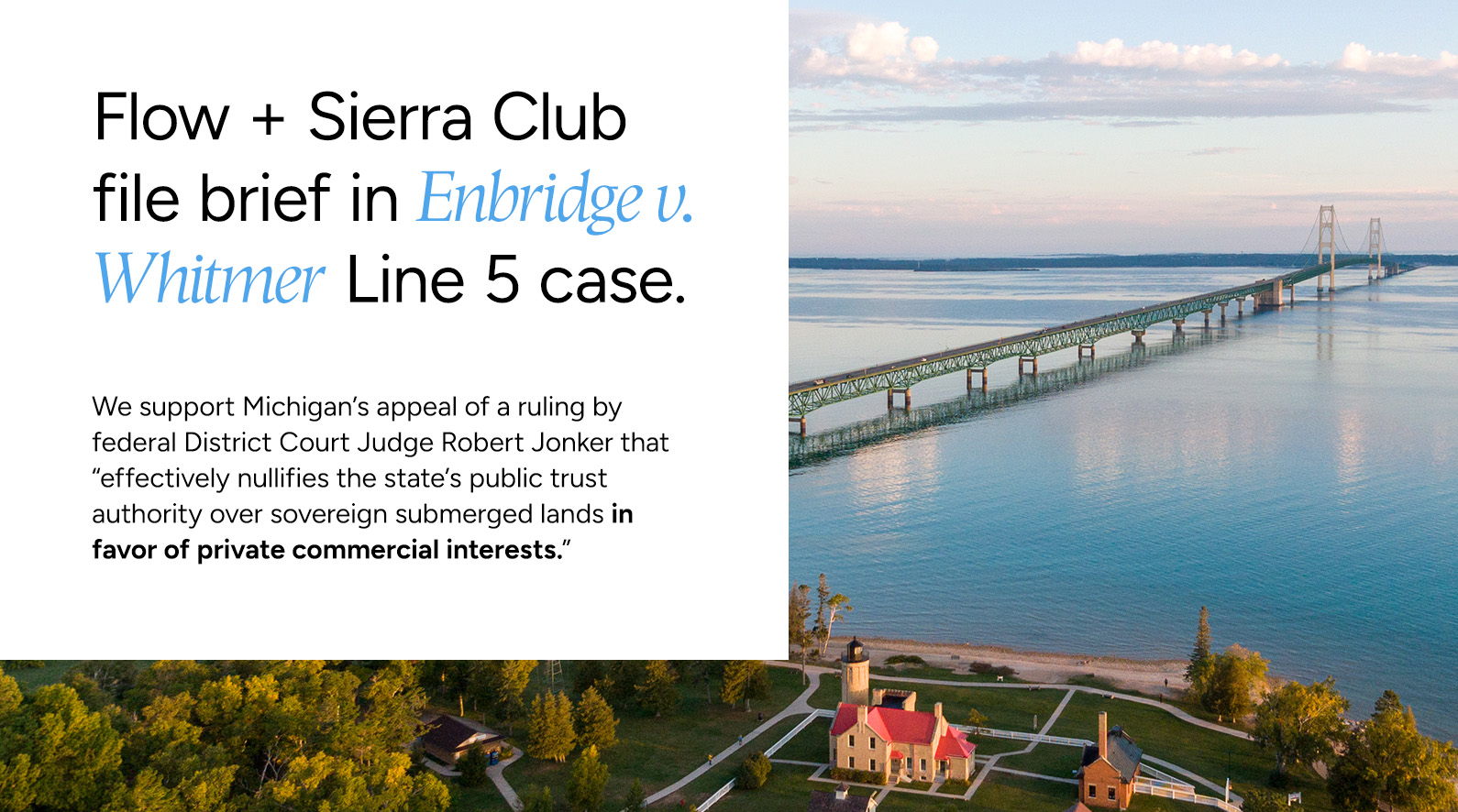
Flow and Sierra Club file joint amici brief in Enbridge v. Whitmer Line 5 case

Traverse City, Mich. — On May 11th, 2026, Flow Water Advocates (“Flow”) and Sierra Club filed an amici curiae, or friend of the court, brief in support of the State of Michigan’s appeal of a federal court’s failure to recognize and uphold an essential attribute of state sovereignty — the public trust doctrine. Flow and Sierra Club together represent thousands of Michiganders who stand up for the State’s right and duty to protect our publicly held lands in the Straits of Mackinac from the urgent threat to the waters and shorelines of the Great Lakes posed by Enbridge’s aging and vulnerable Line 5 pipeline.

Last December, federal District Court Judge Robert Jonker issued a ruling that, as Flow and Sierra Club explain in their brief, “effectively nullifies that state’s exercise of public trust authority over sovereign submerged lands in favor of private commercial interests — an extraordinary action never before sanctioned by the United States Supreme Court or any federal appellate court.” Flow and the Sierra Club argue further that the District Court committed legal error in holding that the State’s attempt to shut down Line 5 is preempted by the safety regulations in the federal Pipeline Safety Act of 1992 and interferes with the federal government’s conduct of relations with Canada and the administration of a 50-year-old treaty between the two countries.

Flow’s Senior Legal Advisor and Founder, Jim Olson said, “Public trust rights and interests foreclose any preemption because the State’s public trust responsibility is an essential element of statehood and can never be abrogated.”

“State sovereignty has to be protected here. The State of Michigan stood by its people and took action to protect Michiganders from the Line 5 pipeline. The safety of Michigan’s communities, lands, and waters is at risk every day this pipeline continues to operate,” said Anne Woiwode, leader, Sierra Club Michigan Chapter.

Flow and Sierra Club’s argument is grounded in the well-established, Supreme Court affirmation of the public trust doctrine (Ill. Cent. R. Co. v. Illinois, 146 U.S. 387, 453-55 (1892)) that supports revocation of a conveyance that was wrongfully granted in violation of the public trust. The State’s power to revoke isn’t just a power possessed by the state; it is an obligation when a conveyance (in this case, the easement) violates the public trust. As stated in Flow and Sierra Club’s brief: “Equating Michigan’s exercise of its public trust authority with enforcement of a “safety standard,” and thus preempted by 49 U.S.C. Section 60104(c), requires a semantical backflip that is contrary to the clear statement rule.”

Flow and Sierra Club also argue that the State’s easement revocation is not preempted by the foreign affairs doctrine; in fact, the 1977 Treaty governing transnational pipelines expressly provides the State with the authority to do what Michigan did in this case. The District Court’s interpretation of the treaty would “read a significant reservation of rights out of the treaty altogether.”

Five additional amici were filed in support of the state, including: The Great Lakes Business Network; a coalition of states led by Minnesota; a group of preemption, energy law, and environmental law scholars; a coalition of tribal nations led by Bay Mills Indian Community; and a group of foreign relations law professors.

###

Flow Water Advocates is an independent 501(c)(3) nonprofit organization based in Traverse City, Michigan. Our mission is to ensure the waters of the Great Lakes Basin are healthy, public, and protected for all. With a staff of legal and policy experts, strategic communicators, and community builders, Flow is a trusted resource for Great Lakes advocates. We help communities, businesses, agencies, and governments make informed policy decisions and protect public trust rights to water. Learn more at FlowWaterAdvocates.org.

Sierra Club is America’s largest and most influential grassroots environmental organization, with more than 3.5 million members and supporters. In addition to protecting every person’s right to get outdoors and access the healing power of nature, the Sierra Club works to promote clean energy, safeguard the health of our communities, protect wildlife, and preserve our remaining wild places through grassroots activism, public education, lobbying, and legal action. For more information, visit www.sierraclub.org.

Comments on Army Corps’ Line 5 Supplemental DEIS considering Horizontal Directional Drilling


DOWNLOAD: Flow Water Advocates, Sierra Club, and Surfrider Foundation comments on Line 5 Tunnel Project Supplemental Draft EIS on the HDD Installation Alternative


Traverse City, Mich. — On December 5, Flow Water Advocates (Flow), a Great Lakes water protection organization, in partnership with the Sierra Club and Surfrider Foundation (known collectively as the Water Coalition), submitted written comments on the U.S. Army Corps of Engineers’ Supplemental Draft Environmental Impact Statement (Supplemental DEIS) for Enbridge’s proposed Line 5 tunnel project, which is now considering an alternative to the tunnel proposal using Horizontal Directional Drilling (HDD) to create a borehole and install a replacement pipeline under the Straits of Mackinac (the HDD Installation Alternative).

Support Flow’s work to defend the Great Lakes.

Enbridge’s application for the proposed project’s federal Clean Water Act and Rivers and Harbors Act permits is currently under review by the U.S. Army Corps of Engineers (the Corps). The National Environmental Protection Act (NEPA) requires agency and public review, including the preparation of both a Draft and Final Environmental Impact Statement (and supplements, when warranted), which must assess the purpose and need for the proposed project, alternatives to the proposal, and an assessment of the environmental consequences of the project.

While the Corps originally discounted the HDD Installation Alternative as infeasible years ago, the Supplemental DEIS states that Enbridge submitted information that pursuing the alternative is now technically feasible due to advances in technology, and that the Corps subsequently determined that the HDD Installation Alternative should be subject to “detailed analysis” in the EIS.

The Water Coalition’s comments emphasize that the Corps’ unjustified fast-tracking of the review process for both the DEIS and the Supplemental DEIS unlawfully undermines public participation in the process, as well as the “hard look” required by the agency under NEPA. The comments also highlight the Supplemental DEIS’ striking failure to include the information necessary for the agency to properly review the HDD Installation Alternative and its potential impacts on the surrounding lands and waters. Among the deficits are a failure to detail impacted wetlands, confirm the stability of the bedrock, and survey for protected species and archeological resources.

In order to comprehensively compare the potential environmental impacts of the HDD Installation Alternative against Enbridge’s preferred tunnel project, the Corps and the public must have sufficient location-specific data and information about the risks posed by each technology, as well as the site-specific impacts of each method. The Corps attempts to justify these deficiencies in the Supplemental DEIS by deferring the required assessment to a potential future in which Enbridge chooses to pursue the HDD alternative. However, this reasoning hampers the evaluation of alternatives, and is unacceptable under federal law.

The comments conclude that the supplemental review does not remedy the fatal flaws of the May 2025 DEIS, outlined in the Water Coalition’s June 2025 comments, but rather compounds them.

The people of the Great Lakes Basin depend on the Corps, with its technical expertise and mandate to serve the public interest, to take great care in its consideration of the potential significant environmental impacts of the proposed tunnel and alternatives. The Corps violates that mandate in both the May 2025 DEIS and the new Supplemental DEIS, by failing to collect the information necessary to properly assess the risks, and by unlawfully failing to consider feasible alternatives to building a new pipeline through the Straits. Flow and its partners remain steadfast in their commitment to hold the Corps accountable to its legal obligations.

The Corps anticipates that it will publish a Final EIS in early 2026, followed by a Record of Decision in the Spring.

###

Flow Water Advocates is an independent 501(c)(3) nonprofit organization based in Traverse City, Michigan. Our mission is to ensure the waters of the Great Lakes Basin are healthy, public, and protected for all. With a staff of legal and policy experts, strategic communicators, and community builders, Flow is a trusted resource for Great Lakes advocates. We help communities, businesses, agencies, and governments make informed policy decisions and protect public trust rights to water. Learn more at www.FlowWaterAdvocates.org.