Tag: amicus brief

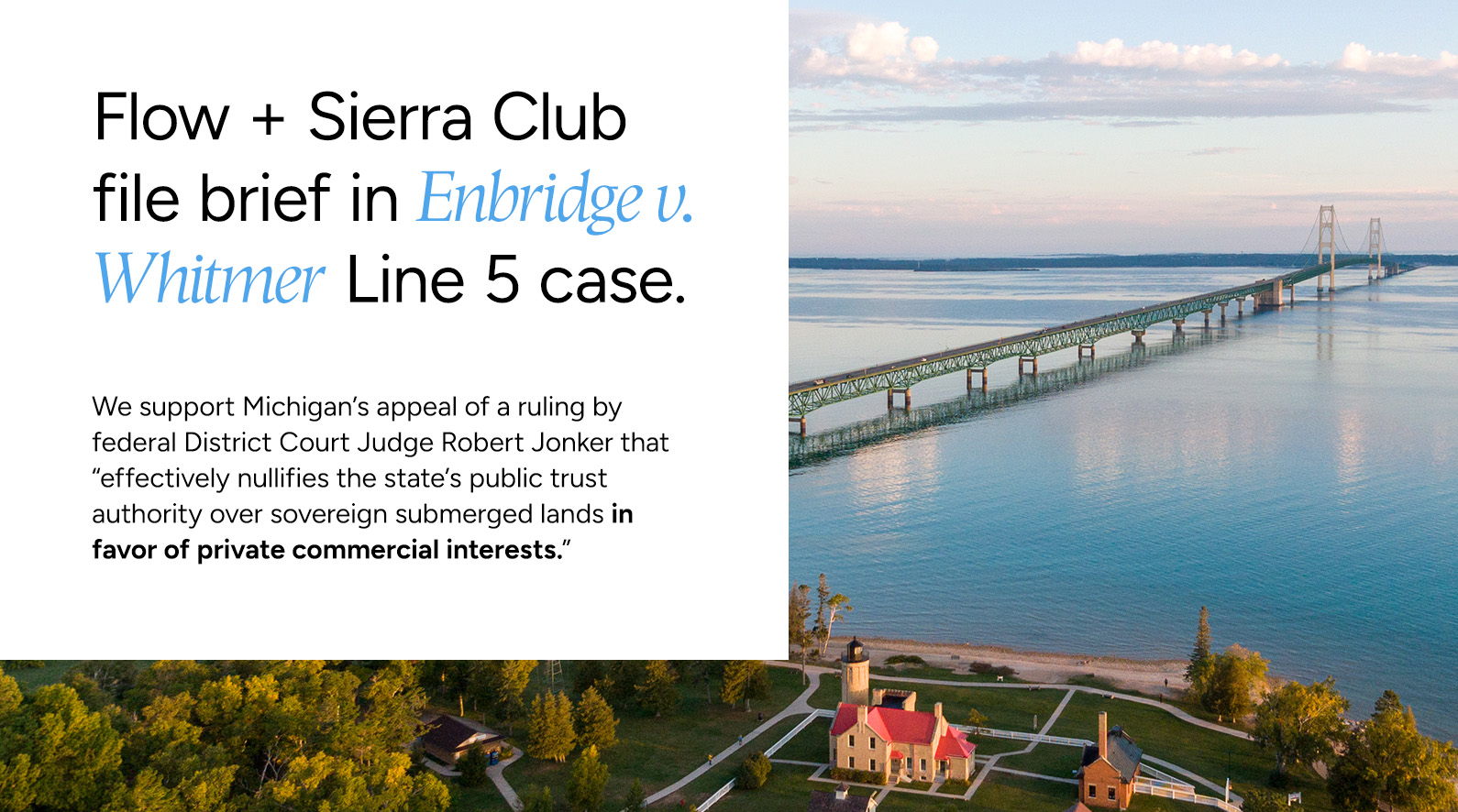
Flow and Sierra Club file joint amici brief in Enbridge v. Whitmer Line 5 case

Traverse City, Mich. — On May 11th, 2026, Flow Water Advocates (“Flow”) and Sierra Club filed an amici curiae, or friend of the court, brief in support of the State of Michigan’s appeal of a federal court’s failure to recognize and uphold an essential attribute of state sovereignty — the public trust doctrine. Flow and Sierra Club together represent thousands of Michiganders who stand up for the State’s right and duty to protect our publicly held lands in the Straits of Mackinac from the urgent threat to the waters and shorelines of the Great Lakes posed by Enbridge’s aging and vulnerable Line 5 pipeline.

Last December, federal District Court Judge Robert Jonker issued a ruling that, as Flow and Sierra Club explain in their brief, “effectively nullifies that state’s exercise of public trust authority over sovereign submerged lands in favor of private commercial interests — an extraordinary action never before sanctioned by the United States Supreme Court or any federal appellate court.” Flow and the Sierra Club argue further that the District Court committed legal error in holding that the State’s attempt to shut down Line 5 is preempted by the safety regulations in the federal Pipeline Safety Act of 1992 and interferes with the federal government’s conduct of relations with Canada and the administration of a 50-year-old treaty between the two countries.

Flow’s Senior Legal Advisor and Founder, Jim Olson said, “Public trust rights and interests foreclose any preemption because the State’s public trust responsibility is an essential element of statehood and can never be abrogated.”

“State sovereignty has to be protected here. The State of Michigan stood by its people and took action to protect Michiganders from the Line 5 pipeline. The safety of Michigan’s communities, lands, and waters is at risk every day this pipeline continues to operate,” said Anne Woiwode, leader, Sierra Club Michigan Chapter.

Flow and Sierra Club’s argument is grounded in the well-established, Supreme Court affirmation of the public trust doctrine (Ill. Cent. R. Co. v. Illinois, 146 U.S. 387, 453-55 (1892)) that supports revocation of a conveyance that was wrongfully granted in violation of the public trust. The State’s power to revoke isn’t just a power possessed by the state; it is an obligation when a conveyance (in this case, the easement) violates the public trust. As stated in Flow and Sierra Club’s brief: “Equating Michigan’s exercise of its public trust authority with enforcement of a “safety standard,” and thus preempted by 49 U.S.C. Section 60104(c), requires a semantical backflip that is contrary to the clear statement rule.”

Flow and Sierra Club also argue that the State’s easement revocation is not preempted by the foreign affairs doctrine; in fact, the 1977 Treaty governing transnational pipelines expressly provides the State with the authority to do what Michigan did in this case. The District Court’s interpretation of the treaty would “read a significant reservation of rights out of the treaty altogether.”

Five additional amici were filed in support of the state, including: The Great Lakes Business Network; a coalition of states led by Minnesota; a group of preemption, energy law, and environmental law scholars; a coalition of tribal nations led by Bay Mills Indian Community; and a group of foreign relations law professors.

###

Flow Water Advocates is an independent 501(c)(3) nonprofit organization based in Traverse City, Michigan. Our mission is to ensure the waters of the Great Lakes Basin are healthy, public, and protected for all. With a staff of legal and policy experts, strategic communicators, and community builders, Flow is a trusted resource for Great Lakes advocates. We help communities, businesses, agencies, and governments make informed policy decisions and protect public trust rights to water. Learn more at FlowWaterAdvocates.org.

Sierra Club is America’s largest and most influential grassroots environmental organization, with more than 3.5 million members and supporters. In addition to protecting every person’s right to get outdoors and access the healing power of nature, the Sierra Club works to promote clean energy, safeguard the health of our communities, protect wildlife, and preserve our remaining wild places through grassroots activism, public education, lobbying, and legal action. For more information, visit www.sierraclub.org.

FLOW & GLBN Brief: Michigan has Sovereign Right and Duty to Protect Great Lakes Waters and Bottomlands

Download the amici brief [filed October 22, 2024]

Traverse City, Mich.—On October 22, FLOW (For Love of Water) and Great Lakes Business Network (GLBN) filed a brief calling on the U.S. Court of Appeals to stop a pipeline company from stripping away Michigan’s power to protect the Great Lakes.

Enbridge Energy, which owns the dual Line 5 pipelines, launched the 2020 federal lawsuit Enbridge v. Gov. Gretchen Whitmer in defiance of Governor Whitmer’s 2020 order revoking an easement for the Line 5 across the Straits of Mackinac bottomlands. FLOW and GLBN’s brief supports the appeal by the State of Michigan to reverse the July 5, 2024 order by Judge Robert J. Jonker of the U.S. District Court for the Western District of Michigan denying Gov. Whitmer’s motion to dismiss on sovereign immunity grounds. The denial, if upheld on appeal, would allow Enbridge to continue its litigation that absurdly asserts that federal law precludes the State of Michigan from enforcing its public trust rights and responsibilities regarding Enbridge’s dangerous operation of Line 5 on State-owned submerged lands at the Straits of Mackinac.

Built in 1953, Line 5 is a 71-year-old dual oil and gas pipeline exposed to fierce currents where Lake Michigan and Lake Huron meet. Ships’ anchors have repeatedly struck the pipelines and cables dragged by passing vessels have damaged the pipelines and their supports. A rupture could irreversibly harm the priceless national treasure of the Great Lakes, and cause billions of dollars of damage to the regional economy.

Not long after Enbridge filed its federal court lawsuit opposing the state’s authority to protect public trust waters, Governor Whitmer moved to dismiss the action, on the grounds that Michigan officials have immunity under the U.S. Constitution’s Eleventh Amendment from federal lawsuits that would encumber the State of Michigan’s ownership of, and jurisdiction over, submerged Great Lakes bottomlands, and interfere with Michigan’s ability to manage those lands in accordance with its public trust responsibilities. Judge Jonker held, we think wrongfully, that an exception applies allowing private parties to sue individual state officials in federal court if they are allegedly violating federal law.

In its amicus brief, FLOW and GLBN argue that Enbridge’s lawsuit against the state impairs state sovereign and public trust powers that are critical to the protection of the Great Lakes. The public trust doctrine, which was encoded in Michigan law over 100 years ago, holds that the waters and bottomlands of the Great Lakes within Michigan’s borders are held in trust by the State for the benefit of the people of Michigan, not for private interests. Long-standing legal principles that balance federal and state sovereign interests weigh in favor of states’ rights and jurisdiction over the public navigable waters and bottomlands of the Great Lakes to protect these precious resources.

As an advocacy organization committed to protecting precious state sovereign water resources, FLOW was granted permission to file a “friend of the court” or “amicus” brief, to provide the Sixth Circuit Court of Appeals with our unique perspective, knowledge, and experience regarding Michigan and Great Lakes states’ sovereign ownership of public lands and water resources under the public trust doctrine.

The Great Lakes Business Network joins FLOW in this amici brief in support of the State of Michigan, asking the Sixth Circuit Court of Appeals to reverse the District Court and order dismissal of Enbridge’s unsupportable lawsuit.

FLOW joins amicus brief in Michigan Supreme Court CAFO case

By Carrie La Seur, FLOW Legal Director

My lungs remember. While I was an Iowa Environmental Protection Commissioner, I said yes to a chance to visit a relatively small hog confinement run, by the dad of one of my son’s best friends. It was just a few miles from our home in Mount Vernon, population 4,460, so I drove my old Celica out to the barns one frozen morning. I hadn’t been on another farm recently, and it was a small operation, so I didn’t have to “shower in” or put on different clothes, as many larger operations — also known as CAFOs, or Confined Animal Feeding Operations — require for biosecurity. We just walked through two sets of doors and stepped onto the steel grated floor of the hog barn.

If you’ve ever heard a pig squeal, you can imagine the effect of hundreds of pigs squealing, not in unison but total cacophony at the appearance of humans in their white-walled, tightly packed world. The smell hits just as hard, not so much the stink of manure as the nostril assault of pure ammonia from the urine pooled in vaults beneath your feet. My first instinct was not to breathe, then to take shallow, singed breaths, trying not to let the gas deep into my lungs.

We walked the full length of the barn, as the hogs rushed back and forth in their pens, Alan briefing me in steady, Iowa farmer tones on the life cycle of a confinement animal, the feed and medicine, waste handling, and the value of each pig to his bottom line, how carefully he watches them. This kind of small operation is unusual in the world of industrial livestock, where the number of farms has been dropping for decades, while the average size of an operation grows – and the size of its waste stream.

As a result, America’s farm country is adrift on a sea of manure. In Michigan alone, livestock confinements produce sewage equivalent to the state’s entire human population of 10 million, plus nearly another 4 million people. It’s like having Pennsylvania’s untreated sewage shipped to Michigan and spread on the ground and into our lakes, rivers, and streams. 

All this goes to explain why eleven organizations recently filed an amicus brief in litigation pending before the Michigan Supreme Court. Michigan Farm Bureau, a rich and powerful insurance company and lobbying agency masquerading as a grassroots ag group, is blocking the state’s efforts to control widespread water and soil pollution from livestock confinements. Our brief argues that no one is above the law, or the duty to protect Michigan’s waters for all of us.

Download and read the amicus brief (PDF)

FLOW and its many allies, from CAFO neighbors to trout fishers to city dwellers paying to clean up an uncontrolled wastestream delivered to them by rivers, have had enough. For too long, agricultural polluters have had a free pass and no accountability as we dump vast amounts taxpayer money into voluntary water quality measures that work only for a short time, or not at all. We’re looking for creative ways to fight back. Join us.

FLOW files amicus brief; urges Sixth Circuit Court of Appeals to remand Line 5 lawsuit back to state court

Read FLOW’s summary of the PLG Consulting report, Likely Market Responses to a Line 5 Shutdown

[PRESS RELEASE: DOWNLOAD PDF]

[AMICUS BRIEF: DOWNLOAD PDF]

Traverse City, Mich.—Today, September 25, 2023, FLOW (For Love of Water) filed a motion with the Sixth Circuit Court of Appeals in the 2019 state lawsuit Attorney General Dana Nessel v. Enbridge, requesting the federal appeals court to accept an amicus brief that articulates why this case should be remanded back to state court where it belongs.

Built in 1953, Line 5 is a 70-year-old oil pipeline operating in fierce currents on the bottomlands of the Straits of Mackinac, where Lake Michigan and Lake Huron meet. The underwater pipeline has been repeatedly struck by ship’s anchors, and cables dragged by passing vessels have damaged the pipeline and its supports. Line 5 is uniquely vulnerable to multiple impacts that could result in irreversible environmental harm and billions of dollars of damage to the Great Lakes regional economy.

Three years after the Attorney General filed the 2019 state lawsuit, Enbridge in a procedural tactic removed the case to the federal district court in Grand Rapids, Michigan. The federal district court refused to remand the case back to state court. The Sixth Circuit Court of Appeals accepted Attorney General Nessel’s request to appeal the district court’s ruling in July, and has directed the Attorney General and Enbridge to submit legal arguments on whether to remand the case back to state court in Michigan.

The waters and bottomlands are sovereign public trust resources held by the State of Michigan in trust for the benefit of the citizens of Michigan and the Great Lakes region. Long-standing legal principles that balance federal and state interests weigh in favor states’ rights and jurisdiction over public navigable waters and bottomlands.

As an advocacy organization committed to protection of the precious state sovereign water resources, FLOW has requested permission to file a “friend of the court” brief, technically called an amicus brief, to provide the Sixth Circuit Court of Appeals our unique perspective regarding its knowledge and experience of Michigan and Great Lakes states’ sovereign ownership of public lands and water resources under the public trust doctrine. State courts are the sworn guardians with a responsibility to protect the public’s rights in and uses of navigable waters and submerged lands throughout the Great Lakes region. Our shared waters are a public trust, and it is the duty of our state governments to act as stewards of this trust, ensuring that the interests of current and future generations are safeguarded.

But for the State of Michigan’s conditional authorization under public trust law, Line 5 could not have been built on the bottomlands of Lake Michigan in the Straits of Mackinac. When the state granted an easement to Enbridge’s predecessor 70 years ago, it was subject to the perpetual duty and right of the state to assure the public trust in the Great Lakes is never impaired. The easement was never properly authorized, and in any event, is subject to revocation and termination when the public trust waters and natural resources are threatened with risks of devastating harm. In the absence of that authorization and in the face of this extraordinary risk, Line 5 can not continue to operate.

The Great Lakes Business Network (GLBN) alongside 60 Tribes and First Nations have filed two additional amici briefs supporting the Attorney General’s request to remand the Line 5 public trust case back to state court.

###