Tag: CAFO

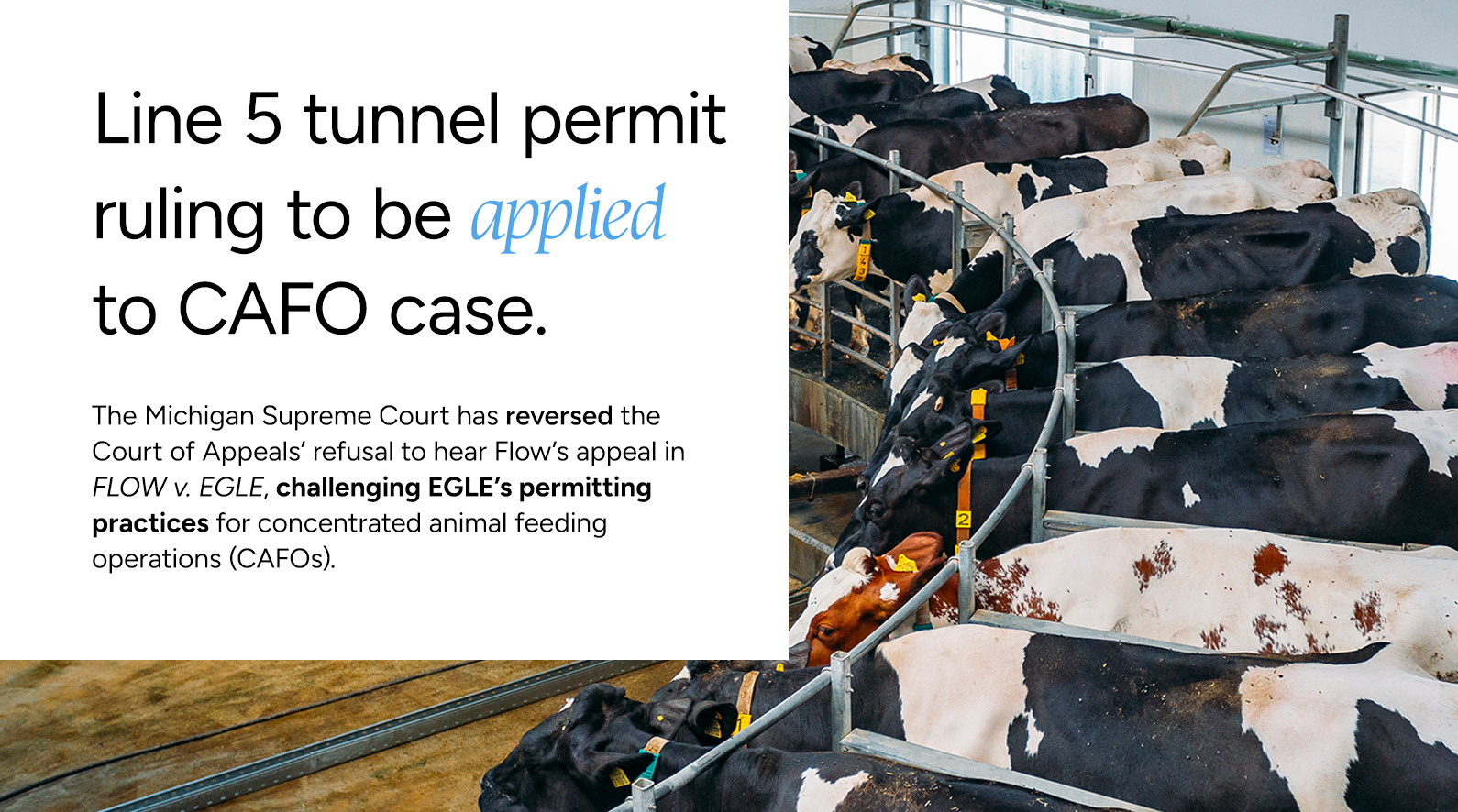
MI Supreme Court directs Court of Appeals to apply Line 5 ruling to CAFO nutrient pollution

FOR IMMEDIATE RELEASE: September 29, 2026

TRAVERSE CITY, Mich. — On September 25, 2026, the Michigan Supreme Court reversed the Court of Appeals’ refusal to hear Flow Water Advocates’ appeal challenging the Michigan Department of Environment, Great Lakes, and Energy (EGLE) and its permitting practices for industrial agriculture pollution. Flow appealed to the High Court following a lower court decision in FLOW v. EGLE that failed to properly apply the Michigan Environmental Protection Act (MEPA) in permitting proceedings for wastewater discharges from concentrated animal feeding operations (CAFOs). CAFOs generate an immense volume of animal waste, which is primarily spread on fields as fertilizer. Excess manure on these fields can then leach into groundwater and run off into waterways, fueling algal blooms and creating toxic “dead zones.”

The High Court directed the Court of Appeals to apply its July 31, 2026 Line 5 tunnel permit ruling in FLOW v. MPSC and the related Tribal coalition case. In that ruling, the High Court found that MEPA requires the Michigan Public Service Commission (MPSC) to determine the proper scope and likely impacts and alternatives to the proposed Enbridge Line 5 tunnel under Lake Michigan in the Straits of Mackinac. With its new order in FLOW v. EGLE, the High Court is signaling to the lower courts that in their de novo review of permit decisions, Michigan agencies must separately apply the state’s flagship environmental law, MEPA, and public trust common law to all permitting decisions that implicate Great Lakes waters and bottomlands.

“Flow and our partners were deeply gratified by the High Court’s decision in the Line 5 tunnel permit case,” said Liz Kirkwood, executive director of Flow. “And while that decision certainly marked an important milestone in the fight to get oil out of the Great Lakes, just as important are the ripple effects we are now seeing — this powerful precedent can now be applied to other critical threats to our waters, like CAFO pollution.”

Passed in 1970, MEPA paired with public trust common law to prevent and minimize environmental harm to Michigan’s natural resources. In permitting decisions, MEPA requires state agencies to determine whether proposed conduct is harmful, and if so, prohibits the conduct in favor of feasible and prudent alternatives.

In FLOW v. EGLE, both parties agreed to the undisputed facts that EGLE’s CAFO permitting and certificate of coverage (COC) approval program allows ongoing pollution of Michigan’s waters and natural resources. But Flow and EGLE disagreed on whether EGLE is required to conduct a separate and independent MEPA analysis for CAFO permitting decisions. Flow’s position is that EGLE must apply a separate MEPA analysis when issuing a Part 31 wastewater discharge permit or CAFO certification. Furthermore, if no feasible and prudent alternatives exist, the EGLE permit process must determine alternative locations, methods, or measures for animal waste disposal to mitigate the likely harm. In its September 25th order, the Michigan Supreme Court reversed and remanded these significant public interest questions for a decision in the first instance by the Court of Appeals.

“Public rights to our public waters are empty promises without permitting systems that prevent pollution and harm to our water ecosystems,” said Kirkwood. “You can’t fish, swim, or drink contaminated waters and that’s why we have environmental laws like MEPA and the public trust to keep our public rights protected from one generation to the next.”

Flow is represented in the lawsuit by environmental attorneys Jim Olson and Rebecca Millican of the Olson & Howard P.C. law firm in Traverse City, and the late Jeffrey Haynes of Birmingham, Michigan.

###

Flow Water Advocates is an independent 501(c)(3) nonprofit organization based in Traverse City, Michigan. Our mission is to ensure the waters of the Great Lakes Basin are healthy, public, and protected for all. With a staff of legal and policy experts, strategic communicators, and community builders, Flow is a trusted resource for Great Lakes advocates. We help communities, businesses, agencies, and governments make informed policy decisions and protect public trust rights to water. Learn more at www.FlowWaterAdvocates.org.

Flow Water Advocates opposes Gratiot County CAFO permit

Register for the hearing on February 3, 6pm:

Learn more about the proposed permit:

Flow Water Advocates and commenters oppose Gratiot County CAFO expansion; request public hearing.

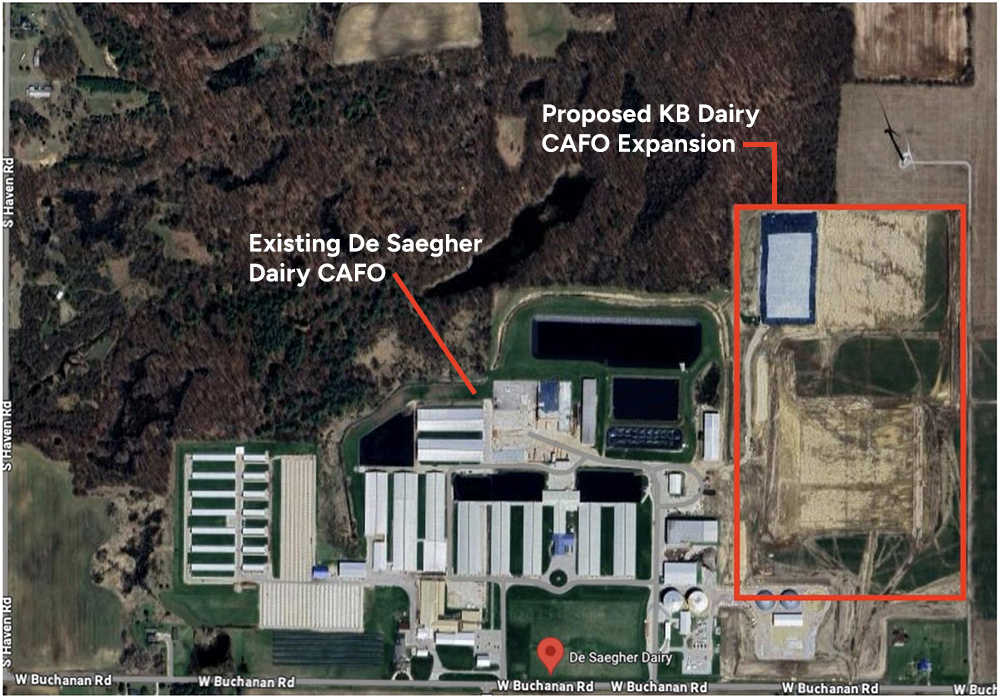
Traverse City, Mich. — Flow Water Advocates (“Flow”), on behalf of its thousands of members, is joined by concerned Michigan residents and organizations in filing public comments opposing a NPDES-CAFO Individual Permit for a 3,450-head dairy CAFO expansion proposed by KB Dairy LLC. The proposed expansion is contiguous with and uses the same address as the 8,400-animal De Saegher Dairy in Middleton, Michigan. If approved, the permit would create the largest dairy CAFO in Michigan. Flow and co-signers ask the Michigan Department of Environment, Great Lakes, and Energy (EGLE) to deny the permit, and hold a local public hearing to facilitate awareness and meaningful public participation.

Support Flow’s work to defend the Great Lakes.

Concentrated Animal Feeding Operations (CAFOs), commonly referred to as factory farms, are large livestock facilities that house several hundred to tens of thousands of animals. Gratiot County is home to some of the largest dairy CAFOs in Michigan, and over 400 million gallons of CAFO animal wastes are spread on saturated fields each year — equivalent to the daily sewage generated by Los Angeles County. Dennis Kellogg, a sixth-generation farmer in Gratiot County, describes the CAFO waste management practices:

“When the CAFOs spread their manure, there is required to be a reasonable setback distance from the edge of the field. I’ve noticed they apply right up to the lot lines of residences, businesses, schools, and other public use areas…These facilities are polluting our local communities with excessive amounts of manure, and are not being held accountable for it. Who pays the price for this?“

The comments detail several concerns, including improper separate permitting of the fully contiguous proposed KB Dairy CAFO, which is owned by the same investment corporation as the De Saegher CAFO; failure of the existing De Saegher CAFO to obtain the required groundwater discharge permit; deficiencies in the Comprehensive Nutrient Management Plan (CNMP); and the public health threat posed by groundwater contamination in a rural area that relies on private wells for drinking water.

The comments also note EGLE’s obligations under the public trust doctrine and the Michigan Environmental Protection Act (MEPA) to protect Michigan’s water from impairment, for the benefit of all residents.

“These massive livestock operations have contributed to unchecked environmental destruction and soaring cancer rates in other parts of the upper Midwest,” says Carrie La Seur, Legal Director for Flow Water Advocates. “Michiganders take rightful pride in their role as defenders of the Great Lakes. It’s time to take a stand for healthy food, healthy animals, and healthy water.”

Flow is joined in its comments by the Great Lakes Environmental Law Center, farmer Dennis Kellogg, Michigan Farmers Union, Michigan Lakes and Streams Association, Michigan Organic Food & Farm Alliance, Michiganders for a Just Farming System, Progress Michigan, and Socially Responsible Agriculture Project.

###

Flow Water Advocates is an independent 501(c)(3) nonprofit organization based in Traverse City, Michigan. Our mission is to ensure the waters of the Great Lakes Basin are healthy, public, and protected for all. With a staff of legal and policy experts, strategic communicators, and community builders, Flow is a trusted resource for Great Lakes advocates. We help communities, businesses, agencies, and governments make informed policy decisions and protect public trust rights to water. Learn more at www.FlowWaterAdvocates.org.
Flow appeals EGLE rejection of FOIA request; seeks public disclosure of factory farm sewage land application.

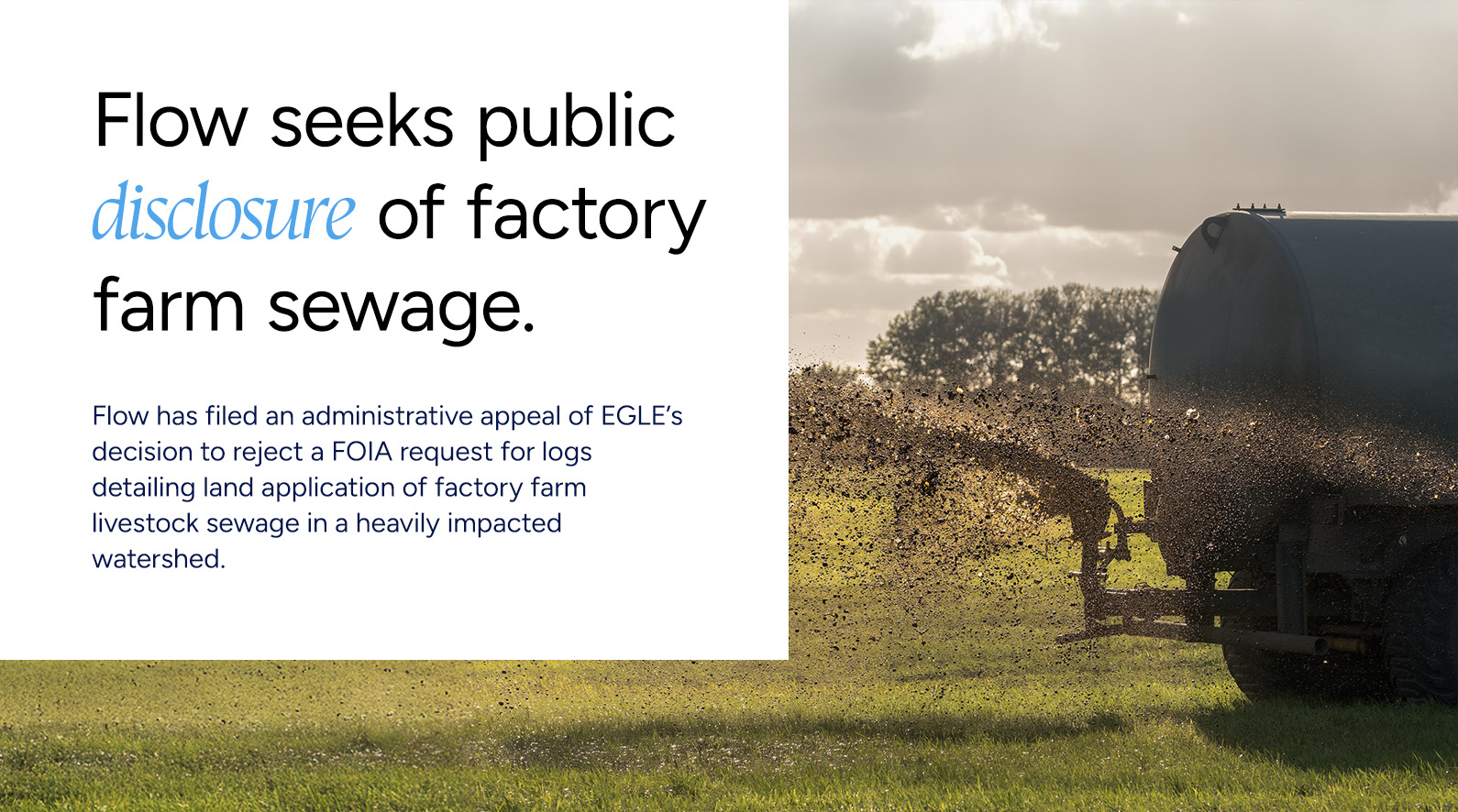
Traverse City, Mich. — Flow Water Advocates (“Flow”) has filed an administrative appeal of a Michigan Department of Environment, Great Lakes, and Energy (EGLE) decision to reject Flow’s FOIA requests for logs Concentrated Animal Feeding Operations (CAFOs) are required by permit to maintain and disclose to EGLE and the public. These logs from fourteen CAFOs provide details on land application of livestock sewage in a heavily impacted watershed. As Great Lakes water quality and access advocates, Flow has a long-standing interest in protecting Michigan’s surface and drinking water.

Support Flow’s work to defend the Great Lakes.

CAFOs, commonly referred to as factory farms, are large livestock facilities that house several hundred to tens of thousands of animals, producing sewage equivalent to large cities. The National Pollutant Discharge Elimination Systems (NPDES) permitting program under the Clean Water Act regulates their animal waste disposal. CAFO operators typically dispose of waste by applying it to fields — often in amounts far greater than can be taken up by the soil and crops. Rural watersheds across Michigan, and in turn the Great Lakes, are heavily impacted by CAFO waste runoff and leaching.

“For many rural residents, dealing with CAFO odors, runoff, heavy trucking, and water quality destruction — surface and ground — has become an exhausting, expensive, year-round ordeal,” says Flow Legal Director Carrie La Seur. “Michigan has something priceless in its natural heritage. This is not just a paperwork exercise, it’s essential information citizens need to protect their health and quality of life.”

The logs detail the time, date, quantity, method, location, and application rate for each location where CAFO wastes are applied to land; a description of the weather conditions at the time; and whether the land was frozen or snow-covered. Crucially, they also include the total amount of nitrogen and phosphorus applied to each field that receives CAFO wastes. Overloading these nutrients can cause toxic algal blooms, closed beaches, and fish kills. The disclosure Flow seeks is critical to understanding how CAFO waste impacts lakes, streams, and other waters.

By Michigan law, the public has the right to access any document “prepared, owned, used, in the possession of, or retained by a public body in the performance of an official function, from the time it is created” (MCL 15.232). If the documents do not exist, the failure to maintain records by all fourteen CAFOs would represent egregious NPDES permit violations, and require immediate enforcement action by EGLE to protect the health of Michiganders.

###

Flow Water Advocates is an independent 501(c)(3) nonprofit organization based in Traverse City, Michigan. Our mission is to ensure the waters of the Great Lakes Basin are healthy, public, and protected for all. With a staff of legal and policy experts, strategic communicators, and community builders, Flow is a trusted resource for Great Lakes advocates. We help communities, businesses, agencies, and governments make informed policy decisions and protect public trust rights to water. Learn more at www.FlowWaterAdvocates.org.
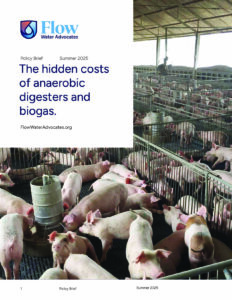
Policy Brief: The hidden costs of anaerobic digesters and biogas

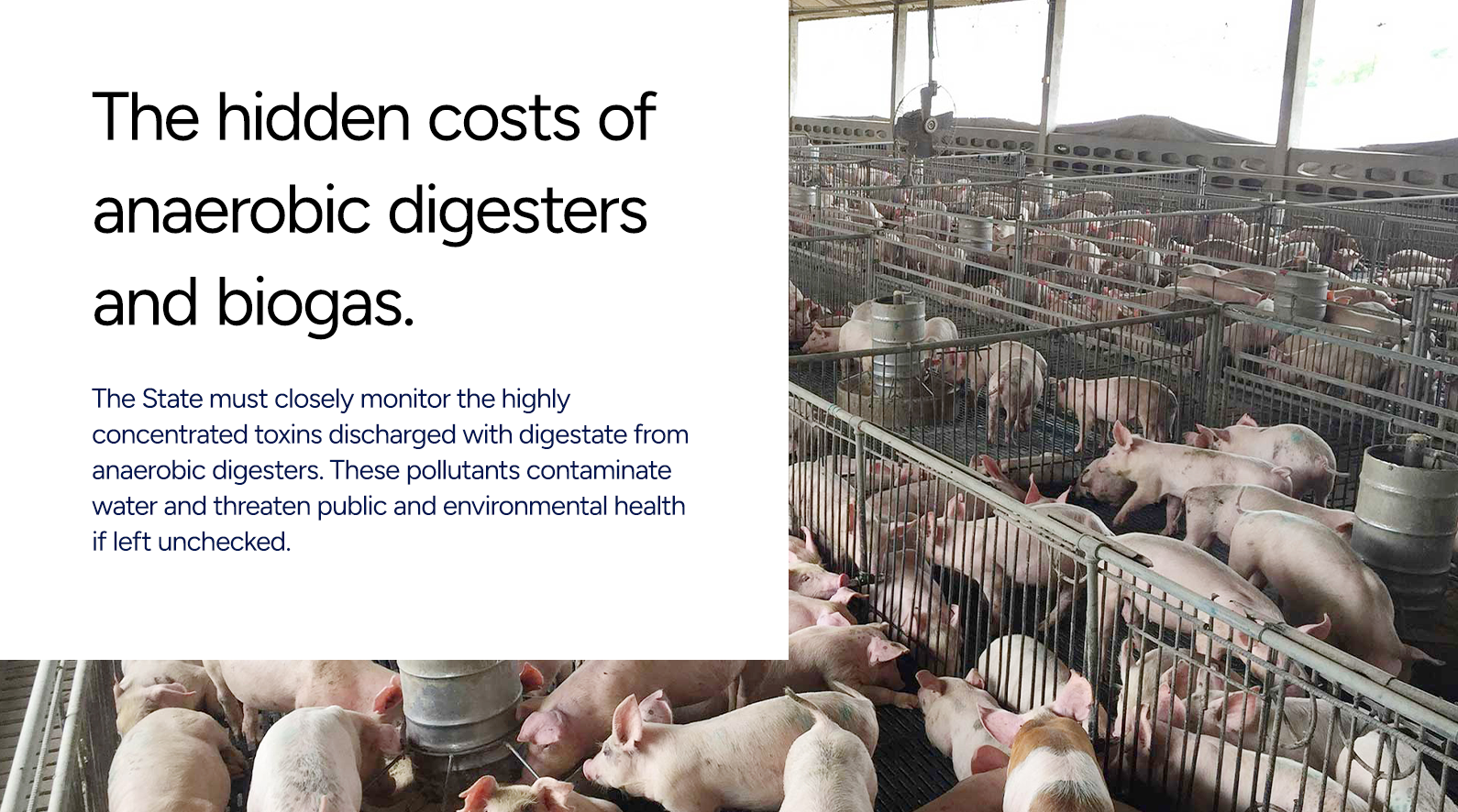
Anaerobic digesters are facilities that decompose organic waste, separating biogas from a sludge called “digestate.” Biogas can be used on-site, paired with a facility like a livestock confinement, or processed into purified pipeline-grade biomethane for electricity or transportation. While biogas can be part of a sustainable farm operation, it has many potential shortfalls that must be evaluated carefully to protect the public interest.

On concentrated animal feeding operations (CAFOs), a digester may be a cover on a cesspit. After the methane is captured, CAFO operators spread untreated digestate — which may contain biological hazards like thermotolerant, antibiotic-resistant E. coli bacteria — onto farm fields as “fertilizer.” Digesters fed by sources like municipal food waste may produce digestate that is contaminated by high levels of heavy metals and toxic compounds like PFAS and PFOS, which may then be sold or given away to spread on fields.

Download the PDF below to learn more! 

Download our policy brief: The hidden costs of anaerobic digesters and biogas

This worksheet breaks down anaerobic digestion to better understand the impacts that CAFOs inflict on the environment, the animals, and the threat to public health in communities across Michigan.

Explore more about CAFOs

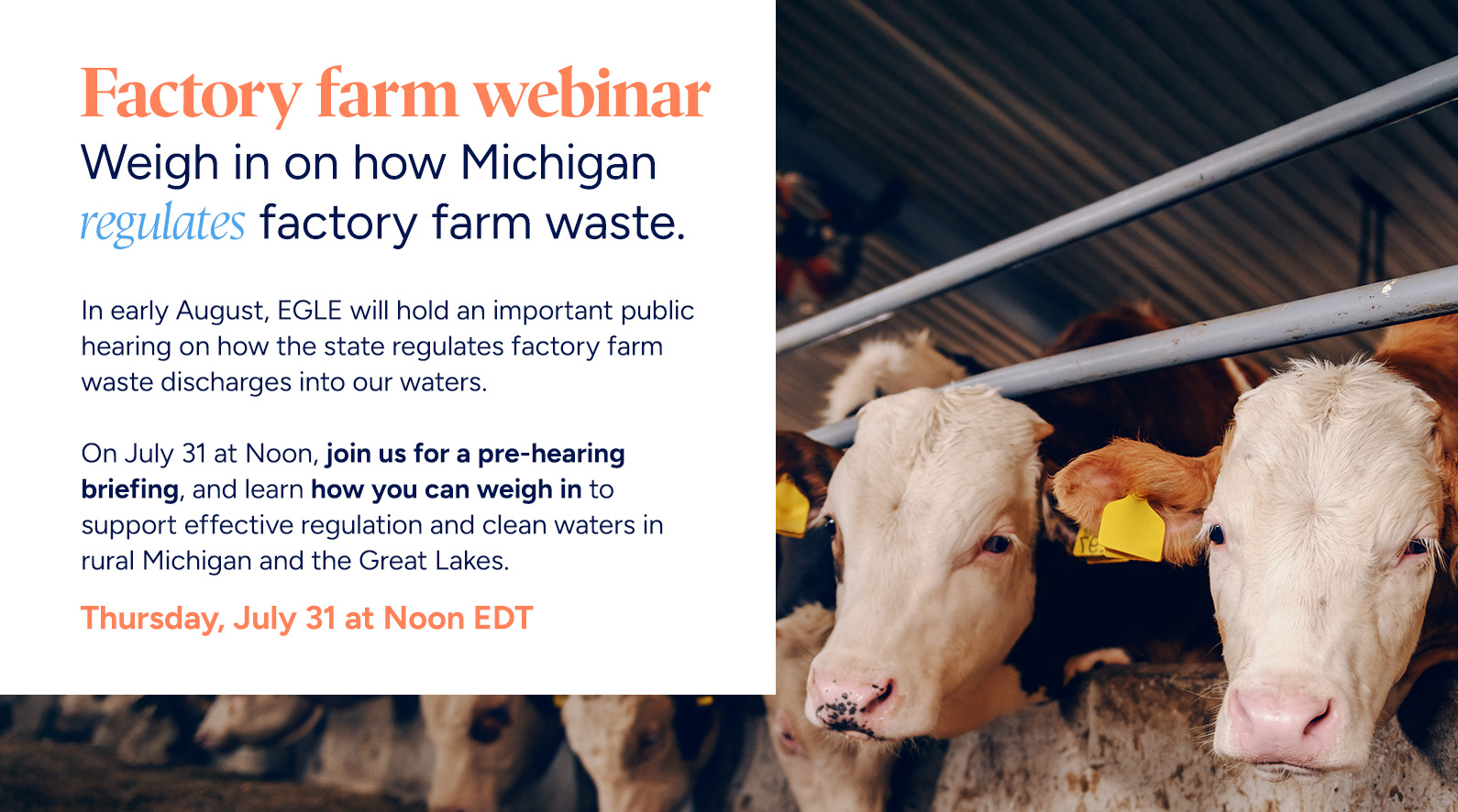
Factory farm webinar: Weigh in on how Michigan regulates factory farm waste.

Factory farms, or Concentrated Animal Feeding Operations (CAFOs), threaten our waters with immense quantities of sewage, which too often are sprayed on fields where it can then runoff into streams and leach into groundwater — including into our drinking water. 

On August 8, the Michigan Department of Environment, Great Lakes, and Energy (EGLE ) will hold an hybrid remote public hearing in Lansing on the long-contested 2020 NPDES-CAFO General Permit, to regulate factory farm waste discharges to our waters. 

To prepare for this important hearing, join Flow Water Advocates on July 31 at Noon for a briefing on the issue, and learn how you can weigh in to support effective regulation and clean waters in rural Michigan and the Great Lakes. 

Flow has been an intervenor in an administrative contested case and litigation on this permit over the past 5 years. 

How to join the EGLE public hearing on August 8 at 9:00am:

Location: Microsoft Teams Meeting
Meeting ID: 293 614 609 636 1
Passcode: 6FV72vK3
Call in (audio only)
Telephone: 1-248-509-0316 (Toll)
Phone Conference ID: 581 485 136#

Manure maelstrom: the Great Lakes are drowning in livestock waste

Stand aside Silicon Valley, the next big tech disruptor might be a giant manure scooper. Why? Because the Great Lakes, the largest freshwater system on Earth, are becoming a sea of livestock excrement, thanks the number of large-scale Concentrated Animal Feeding Operations (CAFOs) found in Michigan.

We’re talking about 81 million people’s worth of fecal waste flowing through rivers, lakes, and streams, into the Great Lakes Basin every year. And that’s only on the U.S. side.

FLOW wanted a visual representation of this sewage avalanche, so we asked Iowa water quality scientist and blogger Chris Jones to produce a map of Great Lakes livestock waste in terms of human cities, like he did for Iowa a few years back. Iowa’s “real population”, he calls it. We learned that:

  • Manistee, Wexford, and Kalkaska counties receive an almost Minneapolis-sized load of livestock waste.
  • Allegan County (pop. 122,000) has livestock waste equivalent to 3.35 million humans.
  • Huron County (pop. 31,000) has livestock waste equivalent to 2.25 million humans.
  • The total amount of livestock waste flowing into the Great Lakes basin is equivalent to 81 million humans — the approximate population of the entire country of Germany.

Hover to enlarge. Map developed by Chris Jones, a research engineer (IIHR-Hydroscience and Engineering) at the University of Iowa. Also available on the author’s blog. 

In a contest no one wants to win, Michigan takes the crown for the most livestock waste in the Great Lakes watershed. The fallout from this fecal flood includes toxic algae blooms, dead rivers, and beach closures. This isn’t just an environmental issue — it’s an economic and public health problem. There are whole states worth of untreated sewage draining to the Great Lakes.

Think about it: tourism takes a hit, property values plummet, and clean-up costs skyrocket — and taxpayers are ultimately left holding the bag. Meanwhile, industrial-scale CAFOs laugh all the way to the bank, suing the state any time it tries to enforce the Clean Water Act.

So what’s the solution? To start, we need to strict regulations on Concentrated Animal Feeding Operations (CAFOs) and how they dispose of animal wastes. The industry should pay for the environmental damage it’s causing. And we should invest in some serious clean-up technology. As consumers, we should ask where our animal products come from, and support small scale, local farmers.

Nutrient Pollution: The Second Battle of Lake Erie

One of the military clashes between England and the United States was the battle of Lake Erie. On September 10, 1813, nine ships under U.S. Master Commandant Oliver Hazard Perry bested a nine-ship English fleet in a decisive battle for control of western Lake Erie and surrounding lands. Today, a 352-foot International Peace Memorial on South Bass Island commemorates the longest undefended border in the world, uniting Canada and the U.S. 

For more than three decades now, our nations have engaged in a different kind of struggle – to rescue western Lake Erie from a tsunami of toxic algae. No one is winning except the industrial agriculture interests that profit from lax environmental regulation, as untreated factory farm sewage is allowed to pour into Michigan’s formerly pure waters. We need a fundamentally different approach to nutrient pollution.

When detergents in wastewater caused algae blooms in the 1960s, the U.S. and Canada moved quickly to control the culprit – phosphorus – with dramatic improvements in just a few years. The battle was won, but the war wasn’t over. Beginning in the 1990s, annual algae blooms returned to western Lake Erie, growing in severity until, in 2014, Toledo, Ohio had to shut down its drinking water intake and put the entire city on bottled water for days. Tens of millions of taxpayer dollars spent on cleanup strategies in the past decade have done little to diminish the threat to Lake Erie and its many tributaries, which used to be swimmable and fishable. Today, they run brown and weedy, choked with ag-sourced sewage.

Nutrient pollution includes nitrogen and phosphorus, both products of agriculture and other human activities. It’s tricky to regulate because nutrients are essential to the food cycle, but too much quickly turns toxic for humans and animals alike. Nutrient pollution causes fish kills and dead zones. It contaminates private wells by leaching through soil. Exposure can cause diarrhea, nausea, vomiting, irritation of the skin, eyes, and throat, allergic reactions, or breathing difficulties. Prolonged exposure can cause cancer.

Wastewater plants were responsible for some of the nutrient pollution, but research quickly identified factory farms as the leading source of the algae resurgence.

The International Joint Commission, which deals with issues affecting waterways along the U.S.-Canada border, called for a 40% reduction in phosphorus in western Lake Erie, but every year we miss that goal by miles, despite an agreement by Ohio, Michigan, and Ontario to reach the 40% goal by 2025. They won’t come close. Western Lake Erie’s target phosphorus load was met only once from 2013 through 2024. Some say there has been virtually no reduction. This year’s bloom was detected on June 24, the earliest date ever, reaching 620 square miles, and was still visible as October began.

Clearly, we need more tools in our toolbox. In other parts of the world, holistic approaches to nutrient pollution show promise. The Netherlands, for example, has implemented “nitrogen accounting,” which makes individual sources of nutrient pollution responsible for tracking their outputs. It’s a flexible approach that allows for creativity and customized practices at the local level, as long as nutrient outputs stay below the required levels.

Nutrient pollution has become a global problem that requires innovative, game-changing thinking and cross-border collaborations. We have no time to lose.


Policy Brief: The hidden environmental and economic costs of anaerobic digesters and biogas


Policy Brief: Impacts of Anaerobic Digesters (PDF)


Anaerobic digesters are facilities that decompose organic waste, separating biogas from solids and liquids, called “digestate.” Biogas can be used on-site or processed into purified pipeline-grade biomethane for electricity or transportation. On confined animal feeding operations (CAFOs), a biodigester may be a cover on a cesspit. After the methane is captured, CAFO operators dump untreated digestate full of heavy metals and biological hazards like thermotolerant E.coli onto farm fields as “fertilizer.”

In this policy brief from FLOW, we break down the unintended environmental and economic impacts of anaerobic digesters, and the hidden costs of biogas production. We also make recommendations for how the state of Michigan should regulate digesters to protect our groundwater, and ultimately, the Great Lakes.

The Water We Drink, The Land We Live on: A Call to Action Against Confined Animal Feeding Operations

Friends of FLOW,

As a descendant of early Montana homesteaders, I’ve been blessed to spend much of my life close to pristine trout streams and millions of acres of wilderness. I’ve pulled lambs, witnessed calves being born on open range, and found myself way too close to grizzlies and bison. Both the responsibility of an animal whose life is in our hands and the awe of a brush with a truly wild creature offer insight into our humble human place in the universe.

As an environmental lawyer, I’ve also witnessed the insidious creep of industrial agriculture, which disrupts these natural rhythms and threatens the very foundation of our rural communities by replacing careful husbandry with the profitability of volume. Nowhere is this threat more evident than in the rise of the confined animal feeding operation (CAFO), an industrial model of livestock production that undermines the quality of the food we eat every day, while dumping cities’ worth of untreated sewage onto our land and into our water.

“[CAFO] waste contains a noxious cocktail of pathogens, antibiotics, hormones, and excess nutrients, all of which can and do seep into our groundwater, contaminate our rivers and lakes, and pollute the air we breathe.”

— Carrie La Seur, FLOW Legal Director

CAFOs, as you likely know, are large-scale facilities where thousands of animals live foreshortened lives fueled by diets nature never intended. Their cramped, unsanitary conditions contribute to the current avian flu outbreak. CAFOs generate massive amounts of sewage, often stored in open cesspits or spread onto fields as fertilizer in quantities even the poorest soil could never absorb. This waste contains a noxious cocktail of pathogens, antibiotics, hormones, and excess nutrients, all of which can and do seep into our groundwater, contaminate our rivers and lakes, and pollute the air we breathe.

When I started working with For Love of Water in Michigan late in 2023, one request rose above all the other urgent water quality issues on this water-obsessed peninsula: please, people said, help us do something about CAFOs. Michigan has nearly 300 permitted CAFOs, a number that’s doubled in the last 20 years, as the total number of farms plummeted. They’re concentrated in rural areas where residents rely on private wells for drinking water. These communities, full of generational residents who value open spaces and the gifts of nature, are now at increased risk of water contamination, with potentially devastating consequences for public health. We’ve all witnessed outbreaks of waterborne illnesses, elevated levels of nitrates in drinking water (especially dangerous for infants), and even the emergence of antibiotic-resistant bacteria.

See EGLE, Regulated Concentrated Animal Feeding Operations (CAFOs) map and MSU Extension, Small Farm Manure Management Planning. <​​https://egle.maps.arcgis.com/apps/webappviewer/index.html?id=0fae269e1c45485f876c99391403bd3e>, <https://www.canr.msu.edu/animal-agriculture/uploads/files/Small%20Farm%20Manure%20Management%20Planning.pdf> (visited April 18, 2024).

But the damage doesn’t stop with threats to human health. CAFO waste can also degrade soil quality, contribute to harmful algal blooms, and drive the decline of fish and wildlife populations. The sheer scale of these operations places an immense strain on local infrastructure, from roads and bridges to downstream wastewater treatment plants. Residents on municipal water pay more to cover expensive filtration of CAFO pollution.

And let’s not forget the toll CAFOs take on rural communities – displacing small family farms and concentrating economic power in the hands of a few corporations. Industrial agriculture churns workers through low-paying, dangerous jobs often held by migrants who don’t dare report health and safety violations. Unlike the traditional family farm, these animal factories change the feel of a community. They breed a sinister atmosphere, where complaints are met with threats of violence and penalties for complaining written into state law: Michigan’s Right to Farm Act allows the ag department to bill its investigation costs to anyone who complains more than three times about a CAFO, if the department finds that the CAFO is complying with a set of loosely defined, industry-friendly standards called “Generally Accepted Agricultural Management Practices”, or GAAMPs. The point is clear: don’t complain.

So, what can we do? We won’t stand by and watch as our water is poisoned, our land is degraded, and our communities are hollowed out. We must raise our voices in defense of clean water, healthy food, and vibrant rural communities.

“CAFO waste can also degrade soil quality, contribute to harmful algal blooms, and drive the decline of fish and wildlife populations. The sheer scale of these operations places an immense strain on local infrastructure, from roads and bridges to downstream wastewater treatment plants.”

FLOW, with its deep commitment to protecting Michigan’s waters, is uniquely positioned to lead this charge. I urge all our members and allies to expand your advocacy efforts to include the fight against CAFOs in favor of an agriculture that honors people, land, water, and animals. This means working with legislators to strengthen regulations, supporting community-led initiatives to monitor water quality, and expanding public understanding about the dangers of an unethical, corporatized agriculture.

But we must go further. We must challenge the notion that CAFOs are the only way to produce food. We must support farmers — they’re all around us, please go meet them! — who are raising livestock in a way that respects the land, the animals, and the people who depend on them. We must build a food system that is not only sustainable but also just and equitable.

This is not just an environmental issue. It’s a moral issue. It’s a question of how we want to live, how we want to eat, and what kind of future we want to create for ourselves and our children. It’s a question of whether we will continue down a path of pollution and exploitation, or whether we will chart a new course toward a more sustainable and humane way of life.

I believe that we have the power to choose a different path. I believe that we can build a food system that nourishes both body and soul, a system that honors the land and the people who work it. I believe that we can create a future where clean water flows freely, where rural and urban communities thrive, and where all beings are treated with dignity and respect.

Let us work together to make this vision a reality.

In solidarity,

Carrie La Seur

Find a local farm market near you!

Farm markets can reduce environmental impacts on communities when food systems stay local. Finding a farm market near you can be a great place to start and can make a difference!

Find a market!

Great Lakes Manure Conference: Agriculture Runoff and Lake Erie

On May 1-2, 2024, FLOW policy director Carolan Sonderegger and legal director Carrie La Seur attended the Great Lakes Manure Conference in Toledo, Ohio. The conference was an opportunity to tour the Maumee River, and learn from experts about legal, environmental, and public health issues posed by Concentrated Animal Feeding Operations (CAFOs). Below, Carolan shares her learnings and reflections from the conference:


On the first day of the Great Lakes Manure Conference in Toledo, attendees joined a bus tour of local CAFOs (Concentrated Animal Feeding Operations) and a boat tour of the Maumee River, which provided ample room for networking and knowledge exchange. During the boat tour, we were able to see several grain silo facilities alongside the river.

One of the major highlights of the tour was the Glass City River Wall, which happens to be the largest mural in the United States (pictured above). The mural is not just a beautiful sight to behold; it is also an inspiration and a tribute to the local community’s resilience and determination to seek clean water and better nutrition for people worldwide. The mural depicts the historical significance of the indigenous peoples who lived and farmed along Ohio rivers for thousands of years, a testament to their enduring spirit in the face of environmental challenges.

The Maumee River is one of the United States’ largest Areas of Concern (AOC) – areas that have experienced environmental degradation. The river has been a hotspot of industrial and municipal development for almost 200 years. Due to agriculture runoff, unregulated waste disposal, industrial contamination, combined sewer overflows, and disposal of dredged materials, the Maumee River is the largest system emptying contaminants into Lake Erie.

In the Ottawa River, one of several embedded watersheds, high levels of PCBs and other contaminants led to a no-contact advisory for over 25 years, which was finally lifted in 2018. Human activities have resulted in the loss of more than 90% of Northwest Ohio’s wetlands, including the Toussaint Wildlife Area, a historic wetland. The contamination led to a restriction on fish and wildlife consumption until only recently, which was lifted in August of 2022. Many community members were observed fishing for sustenance along the banks, despite the fish consumption advisory recommending no more than one meal per week.

As seen in the picture above, the Maumee River appears to be vastly different from the waters and rivers of Northern Michigan. In contrast to our clear blue Niibii (water), the Maumee River resembled a dark and murky likeness to chocolate milk due to an abundance of suspended sediment. The Environmental Protection Agency (EPA) has been collaborating with federal, state, and local partners to carry out remediation and restoration work in the region to tackle the existing beneficial use impairments (BUIs) – which identify significant environmental degradation. Although much work remains to be done, significant progress has been made on contaminated sediment remediation and habitat restoration efforts. Although turbidity is a water quality indicator, it is not an overarching testament to the river’s rehabilitation.

On the second day of the conference, we convened at the University of Toledo’s Lake Erie Center. We were privileged to hear from a diverse group of experts, including Kathy Martin, a civil engineer with over 25 years of experience in CAFOs; Fritz Byer, a Harvard Law graduate with over 35 years of practice; and others from Food and Water Watch, Waterkeeper Alliance, USDA/NRCS, and CAFO neighbors. The conference covered crucial topics, such as CAFO permitting (or lack thereof), manure digesters, CAFO history and economics, and the Nutrients Farm Bill. These discussions provided valuable insights into the current state of environmental conservation and the actions needed to address the issues.

Some speakers described the inconsistency in CAFO regulation from state to state in the Great Lakes basin, which aggravates cross-border cleanup challenges. Others addressed public health threats caused by CAFO waste, including multi-drug-resistant bacteria and avian flu, which can both spread to humans. University of Missouri Professor Emeritus of Agricultural Economics John Ikerd described the economics of CAFOs. It actually costs less to raise an animal on a traditional, diversified farm than in a CAFO, but CAFOs raise such large numbers of animals that smaller operations can’t compete on price.

Attorneys brought a legal perspective on current challenges to CAFOs, and how quickly the industry pivots to dodge regulation and enforcement. It is clear that we need a broad, national approach to reforming food systems, to restore healthy relationships among humans, animals, land, and water. This is FLOW’s vision.