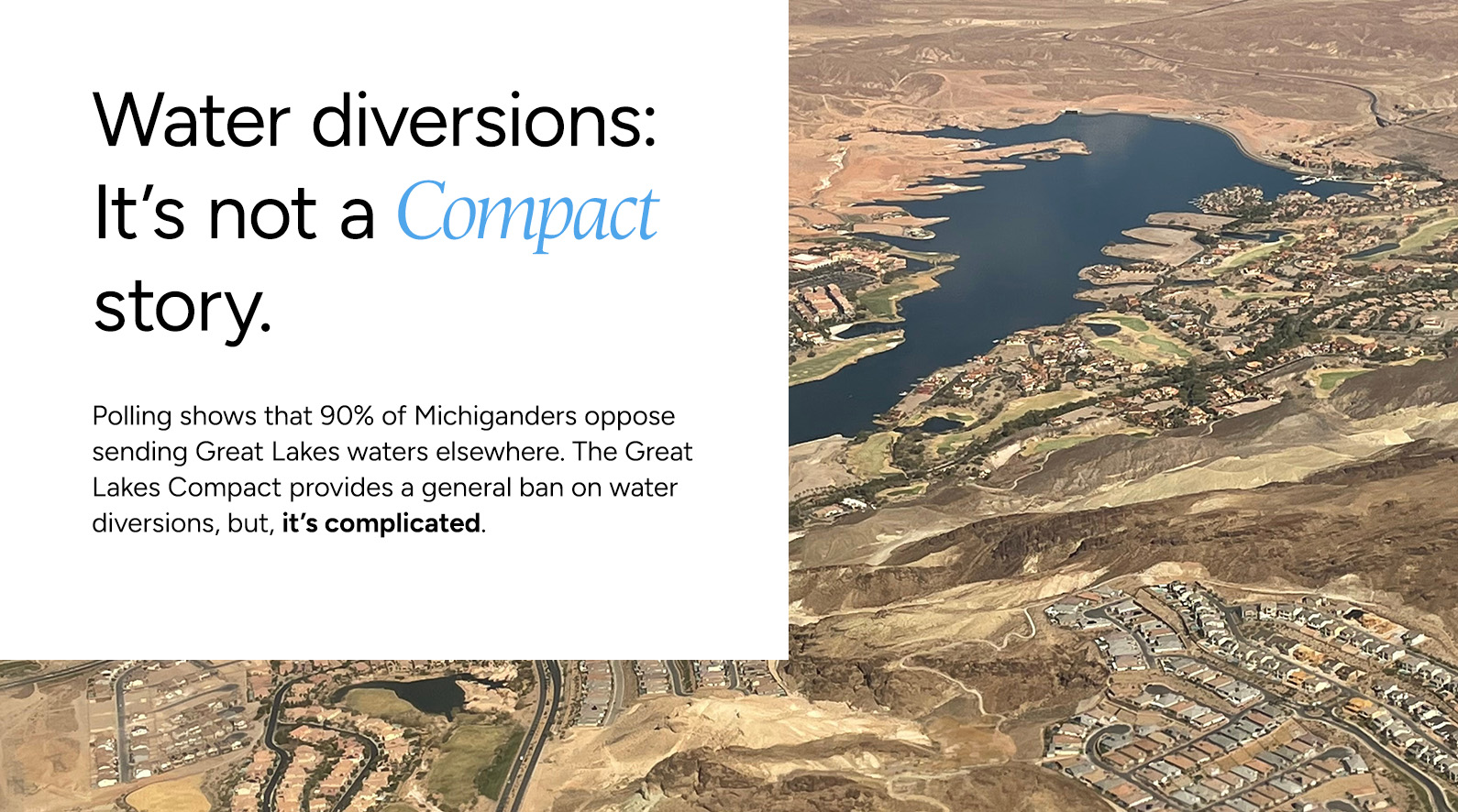

Adapted from a piece that originally appeared on his Substack, Flow senior policy advisor Dave Dempsey breaks down the threat of Great Lakes water diversions, and what the Great Lakes Compact does — and does not — protect.
One of the few issues that unites more than 90% of the Michigan voting public is strong opposition to sending Great Lakes water elsewhere.
That’s more significant than it sounds: there are seven other Great Lakes states, and at least five do divert some (mostly small volumes) out of the watershed. That’s a function of geography. All Great Lakes states except Michigan contain large areas of land that are not part of the Great Lakes basin. As some of those areas grow or need to replace contaminated drinking water supplies, they turn to Great Lakes water.
The Great Lakes Compact (PDF), signed into law by President George Bush in 2008, regulates these short-distance diversions while banning long-distance shipments of Great Lakes water by a pipeline, canal, tunnel, aqueduct, channel, modification of the direction of a water course, a tanker ship, tanker truck or rail tanker. Many, including environmental advocates, say the Compact provides ironclad defenses against a Texas or Nebraska water diversion.
It’s true that the Compact was a major step forward for protectors of the Great Lakes, and commendations are due to those who patiently negotiated it. The Great Lakes St. Lawrence Governors and Premiers organization is managing its implementation well.
But the Compact is not perfect or comprehensive, and the possibility of losing control of Great Lakes water remains.
There is a general ban on diversions, but the Compact exempts a “non-commercial project on a short-term basis for firefighting, humanitarian, or emergency response purposes.” “Short-term” and “humanitarian” are undefined terms. Is it humanitarian to send trainloads of Great Lakes water to Western states for six months during an historic drought?
Then there’s the vexing problem of commercialized water, often called the “bottled water exception.” It’s more than that. The Compact presumes that private parties can take Great Lakes water and sell it as a product anywhere — including outside the watershed. This loophole comes from the definition of “product” in the Compact.
Also, the Compact leaves it up to each state to decide whether water shipped out of the basin in any container of 5.7 gallons or less is a diversion. No state has decided that it is. Which means you can’t ship a tanker of raw water from the Great Lakes, but you can send a tanker with the same volume of water out of the basin if it’s in small bottles.

Some might shrug and say “so what?” The volumes withdrawn for bottling are relatively small in the context of the six quadrillion gallons of the Great Lakes.
That’s missing the point. Claiming water as private property and selling it for profit is not the same as using water to grow crops. The farmer does not assert ownership, only a right to use.
By sanctioning claims of private ownership, the Compact opens, rather than closes the door to commercial claims on the Great Lakes.
Finally, there’s a wild card that no Compact can defend against: He lives in the White House and has a habit of declaring emergencies to achieve policy ends.
He also is not on the best terms with the Canadian government. The New York Times and others reported in 2025 that President Trump wanted to “tear up” Great Lakes agreements. Perhaps that’s why the Canadian National Post headlined an article last year, “Forget Tariffs, Trump May Try to Tap Canada’s Freshwater Next.”
If Trump tried to do such a thing, it’s doubtful he’d be thinking of sending the water to the Parchbelt of the U.S. It’s more likely that he would use the Columbia River for that. Instead, he might take Great Lakes water to develop a market in water as a commodity. Liquid bitcoin. Except we can live without bitcoin — not so with water.
It may sound outlandish and farfetched, but we’ve been living through outlandish and farfetched events for some time now.
Be vigilant.
