
Tag: bottled water loophole

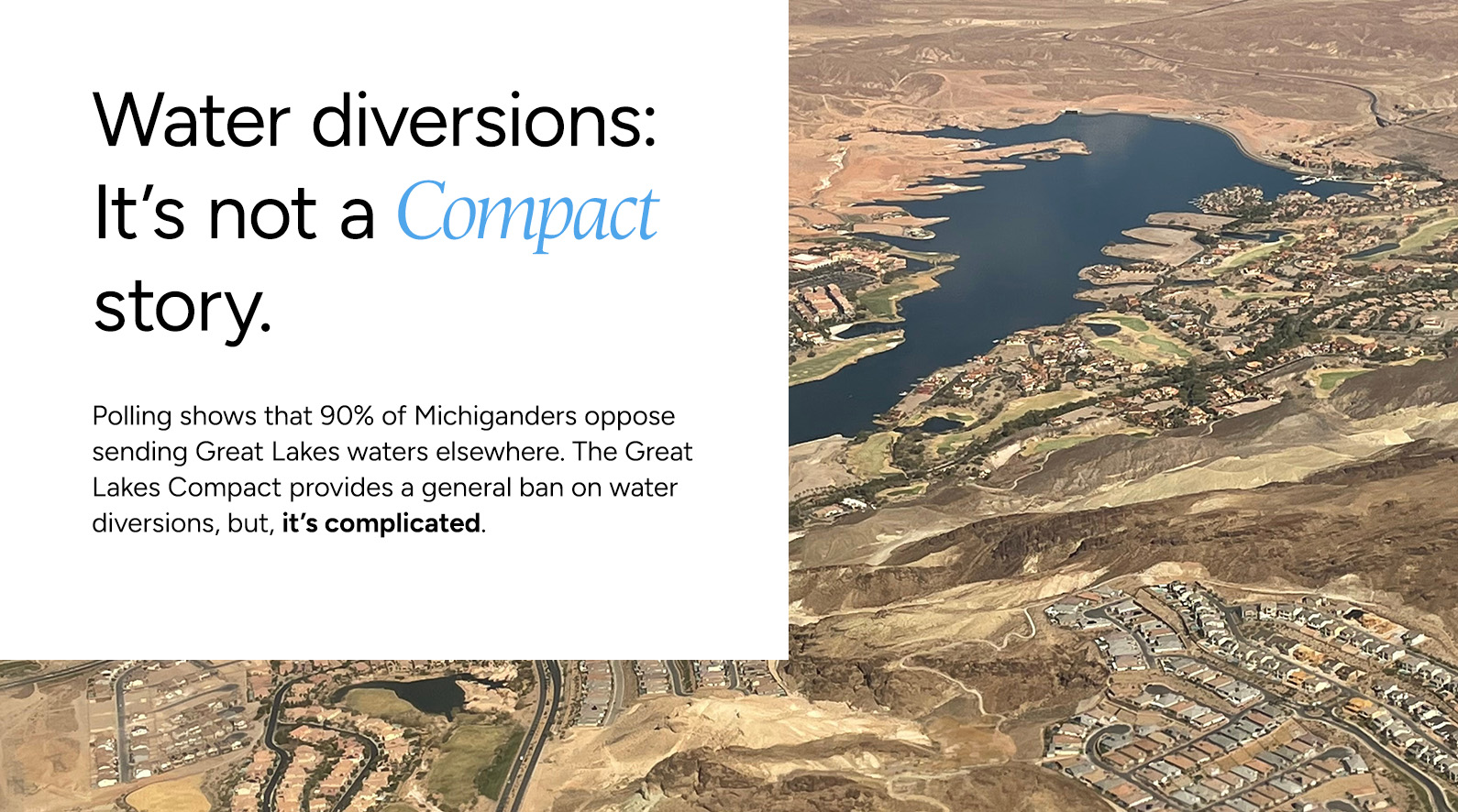
It’s not a Compact story: The complicated issue of Great Lakes water diversions

Adapted from a piece that originally appeared on his Substack, Flow senior policy advisor Dave Dempsey breaks down the threat of Great Lakes water diversions, and what the Great Lakes Compact does — and does not — protect. 

One of the few issues that unites more than 90% of the Michigan voting public is strong opposition to sending Great Lakes water elsewhere.

That’s more significant than it sounds: there are seven other Great Lakes states, and at least five do divert some (mostly small volumes) out of the watershed. That’s a function of geography. All Great Lakes states except Michigan contain large areas of land that are not part of the Great Lakes basin. As some of those areas grow or need to replace contaminated drinking water supplies, they turn to Great Lakes water.

The Great Lakes Compact (PDF), signed into law by President George Bush in 2008, regulates these short-distance diversions while banning long-distance shipments of Great Lakes water by a pipeline, canal, tunnel, aqueduct, channel, modification of the direction of a water course, a tanker ship, tanker truck or rail tanker. Many, including environmental advocates, say the Compact provides ironclad defenses against a Texas or Nebraska water diversion.

It’s true that the Compact was a major step forward for protectors of the Great Lakes, and commendations are due to those who patiently negotiated it. The Great Lakes St. Lawrence Governors and Premiers organization is managing its implementation well.

But the Compact is not perfect or comprehensive, and the possibility of losing control of Great Lakes water remains.

There is a general ban on diversions, but the Compact exempts a “non-commercial project on a short-term basis for firefighting, humanitarian, or emergency response purposes.” “Short-term” and “humanitarian” are undefined terms. Is it humanitarian to send trainloads of Great Lakes water to Western states for six months during an historic drought?

Then there’s the vexing problem of commercialized water, often called the “bottled water exception.” It’s more than that. The Compact presumes that private parties can take Great Lakes water and sell it as a product anywhere — including outside the watershed. This loophole comes from the definition of “product” in the Compact.

Also, the Compact leaves it up to each state to decide whether water shipped out of the basin in any container of 5.7 gallons or less is a diversion. No state has decided that it is. Which means you can’t ship a tanker of raw water from the Great Lakes, but you can send a tanker with the same volume of water out of the basin if it’s in small bottles.

Some might shrug and say “so what?” The volumes withdrawn for bottling are relatively small in the context of the six quadrillion gallons of the Great Lakes.

That’s missing the point. Claiming water as private property and selling it for profit is not the same as using water to grow crops. The farmer does not assert ownership, only a right to use.

By sanctioning claims of private ownership, the Compact opens, rather than closes the door to commercial claims on the Great Lakes.

Finally, there’s a wild card that no Compact can defend against: He lives in the White House and has a habit of declaring emergencies to achieve policy ends.

He also is not on the best terms with the Canadian government. The New York Times and others reported in 2025 that President Trump wanted to “tear up” Great Lakes agreements. Perhaps that’s why the Canadian National Post headlined an article last year, “Forget Tariffs, Trump May Try to Tap Canada’s Freshwater Next.”

If Trump tried to do such a thing, it’s doubtful he’d be thinking of sending the water to the Parchbelt of the U.S. It’s more likely that he would use the Columbia River for that. Instead, he might take Great Lakes water to develop a market in water as a commodity. Liquid bitcoin. Except we can live without bitcoin — not so with water.

It may sound outlandish and farfetched, but we’ve been living through outlandish and farfetched events for some time now.

Be vigilant.

Citizens fight proposal to bottle and sell Lake Superior water

A proposal to turn artesian groundwater that feeds Lake Superior in northern Wisconsin into a product for sale continues to run head-on into the law, the community, a tribe, and a citizens group, Lake Superior Not for Sale (LSNFS).

The most recent defeat for Kristle KLR came in June, when the Wisconsin Court of Appeals upheld a Bayfield County Board of Adjustment decision to deny the company a Conditional Use Permit (CUP) to harvest, store, and transport artesian water. The company has lost every round since it took the issue to the courts in 2022. Now the last stop in the judicial system is the Wisconsin Supreme Court, which rarely accepts appeals in such circumstances.

When Kristle KLR announced its proposal to bottle and sell the water, it said it would store the water in underground tanks on site, and transport it via tanker trucks to an off-site bottling facility in Superior, Wisconsin. Proposed markets included the Twin Cities of Minnesota, which lie outside the Great Lakes watershed.

But the proposal ran into a buzzsaw of opposition from surrounding communities, the Red Cliff Band of Lake Superior Chippewa, LSNFS, and others.
The proposal was designed to evade the Great Lakes Compact’s ban on diversions outside of the Great Lakes watershed by exploiting a loophole in the Compact that exempts diversions of water in containers under 5.7 gallons in volume.

The Red Cliff Band of Lake Superior Chippewa officially condemned the proposal with a resolution calling water “a finite resource” and adding that “societal demands to monetize fresh water supplies represent an existential threat to our culture and lifestyle,” including fisheries and wild rice. Linda Nguyen, Red Cliff Environmental Director said, “To allow for the commodification of water is to allow the theft of our sacred relative.”

LSNFS signs reading “Not For Sale,” with the image of Lake Superior in the background, sprouted up in Bayfield, Ashland, and Douglas Counties. By the end of 2022, over 3,000 yard signs had been distributed throughout the upper Midwest, throughout all 11 tribes in the State of Wisconsin and into Canada.

“This area has been fighting resource extraction threats since the land was ceded in the 1842 Treaty, so the communities are strong and relationships are deep,” said Dana Churness, one of the principals in the Lake Superior Not for Sale group. “This is what allows us to feel exhilarated and ready for what comes next. We absolutely have to be. Are some days exhausting? You bet. However, the corporate threats won’t rest, and neither will we.“

Rob Lee, an attorney for Midwest Environmental Advocates in Madison, which has represented citizens opposed to the withdrawal, says the success of the opposition to date “demonstrates what happens when regular people band together to oppose extractive industries like this, and that the people living on the shores of Lake Superior are adamant that Wisconsin’s precious water resources will not be privatized for purely monetary gain. It shows that those people can work through their local elected officials to get things done, and that local governments in Wisconsin have the authority to be responsive to their citizens’ concerns.”

The legal work takes funding, which LSNFS has raised by tabling at events and selling the signs and gear.

The threats to the water continue. Churness says citizens are wary of a bill introduced by Congressman Tom Tiffany of Wisconsin, which would redesignate Wenabozho Ominisan – currently known as the Apostle Islands Lakeshore – as a national park. Introduced without meaningful consultations with affected communities and the Red Cliff tribe, the bill has awakened concerns that it is a step toward federal takeover of water extraction.

“We can only expect that Tiffany’s legislation is preparing for future water extraction, if Trump is elected in November,” Churness says. She urges businesses or organizations interested in signing a petition or resolution against this legislation to contact lakesuperiornotforsale@gmail.com. LSNFS continues to accept donations for its defense of the Lake Superior watershed.