
Tag: Great Lakes Compact

O, Canada: Will a trade war lead to water conflicts?

Adapted from a piece that originally appeared on his Substack, Flow senior policy advisor Dave Dempsey on the recent breakdown in trade talks between the U.S. and Canada, and what impact it could have on water policy cooperation.

The recent breakdown in trade talks between the U.S. and Canada has the potential to alter the nations’ relationship permanently — and set off water conflicts.

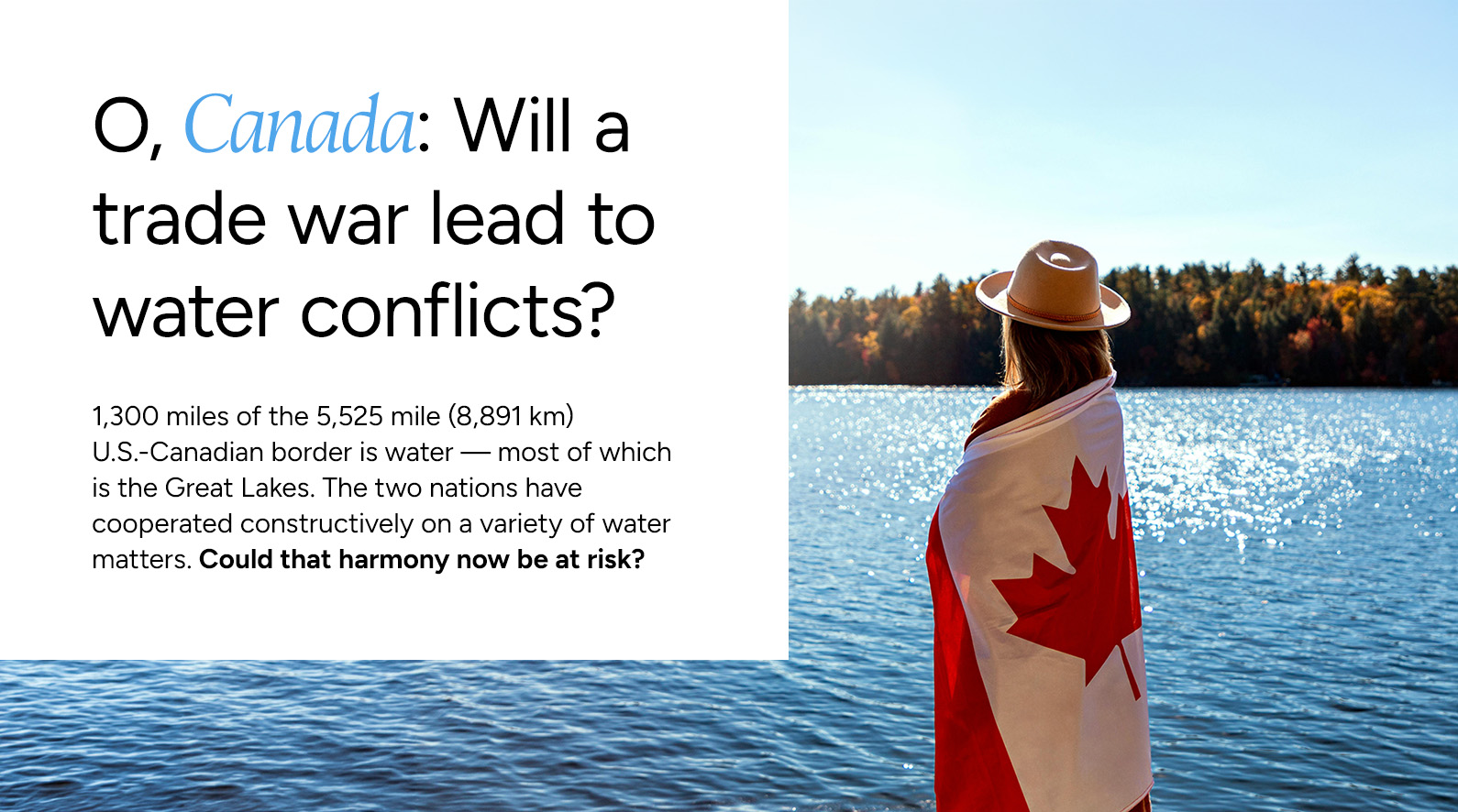
The U.S. and Canada share the longest non-militarized border in the world, 5,525 miles (8,891 km). Some 1,300 miles of that is a water boundary, with the overwhelming share in the Great Lakes. The two nations have cooperated constructively on a variety of water matters. It’s been a world-class model of binational harmony.

That is at risk now.

It goes deeper than one of the two nations trying to name a shared lake after itself.

The U.S. -Canada water relationship has been governed by the Boundary Waters Treaty of 1909. That treaty pledges the U.S. and Canada to recognize and respect each other’s rights and its own responsibilities along the aquatic border. It also pledges them to consult each other to prevent and resolve disputes over boundary waters projects that affect interests on the other side, including dams and diversions.

The treaty allows either party to withdraw from the agreement with one year’s notice, but an impatient U.S. Administration might not wait that long. Withdrawing from or ignoring the treaty means the U.S. could construct water projects along the border that jeopardize Canadian interests without bothering to consult that nation. It could even divert boundary waters on the U.S. side.

Another risk is that the Trump Administration might view the U.S. waters of the Great Lakes as its property, regardless of the fact that water washes back and forth across the border. There is danger in monetizing water and treating it as an asset, leased or sold just like minerals on public land.

A potentially greater threat would put the 2008 Great Lakes Compact on the line. The Compact, ratified by all eight Great Lakes states, was designed to keep water within those states, instead of shipping it elsewhere. But the Compact also contains a loophole allowing diversion of Great Lakes water “in a non-commercial project on a short-term basis for firefighting, humanitarian, or emergency response purposes.”

As Flow Water Advocates has pointed out, this exemption language is vague. Most importantly, “short-term, “humanitarian” and “emergency response” are undefined. Is it humanitarian to quench the thirst of the western states? Could water scarcity or drought outside the Great Lakes watershed be declared an emergency? If there is an apparent national emergency, would Washington exercise federal pre-emption as it did on the so-called energy emergency on Inauguration Day 2025?

A president who is angry at Canada for standing up to him on trade, and thinks a “giant faucet” exists in Canada that can be used to help solve California’s water problems may have even wilder ideas about what the Great Lakes can do.

The water quality of the Great Lakes is not at immediate risk because of the trade war. So far, the U.S. Great Lakes Restoration Initiative has continued at close to previous levels with bipartisan support in Congress. That could change, but there’s no reason to think it will in the near term. In fact, the executive order attempting to rename Lake Ontario boasts that the U.S. “is the greatest protector of the Great Lakes, including the body of water currently known as Lake Ontario. Without the security and investment provided by the United States, this freshwater system would not be open for shipping, recreation, and responsible use to the same extent as it is today.”

Still, the Great Lakes states should be prepared to shoulder more of the fiscal burden to protect the lakes.

A final comment: Canadians are not the pushovers that some think. The U.S. mistakes Canadian civility for weakness. Having worked with Canadians on environmental issues for 40 years, I can assure anyone with doubts that our northern neighbors are as steely as any people.

As Bret Stephens said in the New York Times in August 2026, referring to American invasions of Canada in 1775 and 1812, “My guess is that this third attempt of ours to conquer our hearty Northern friends will end in much the same way.”

But in the meantime, water could be a casualty.
It’s not a Compact story: The complicated issue of Great Lakes water diversions

Adapted from a piece that originally appeared on his Substack, Flow senior policy advisor Dave Dempsey breaks down the threat of Great Lakes water diversions, and what the Great Lakes Compact does — and does not — protect. 

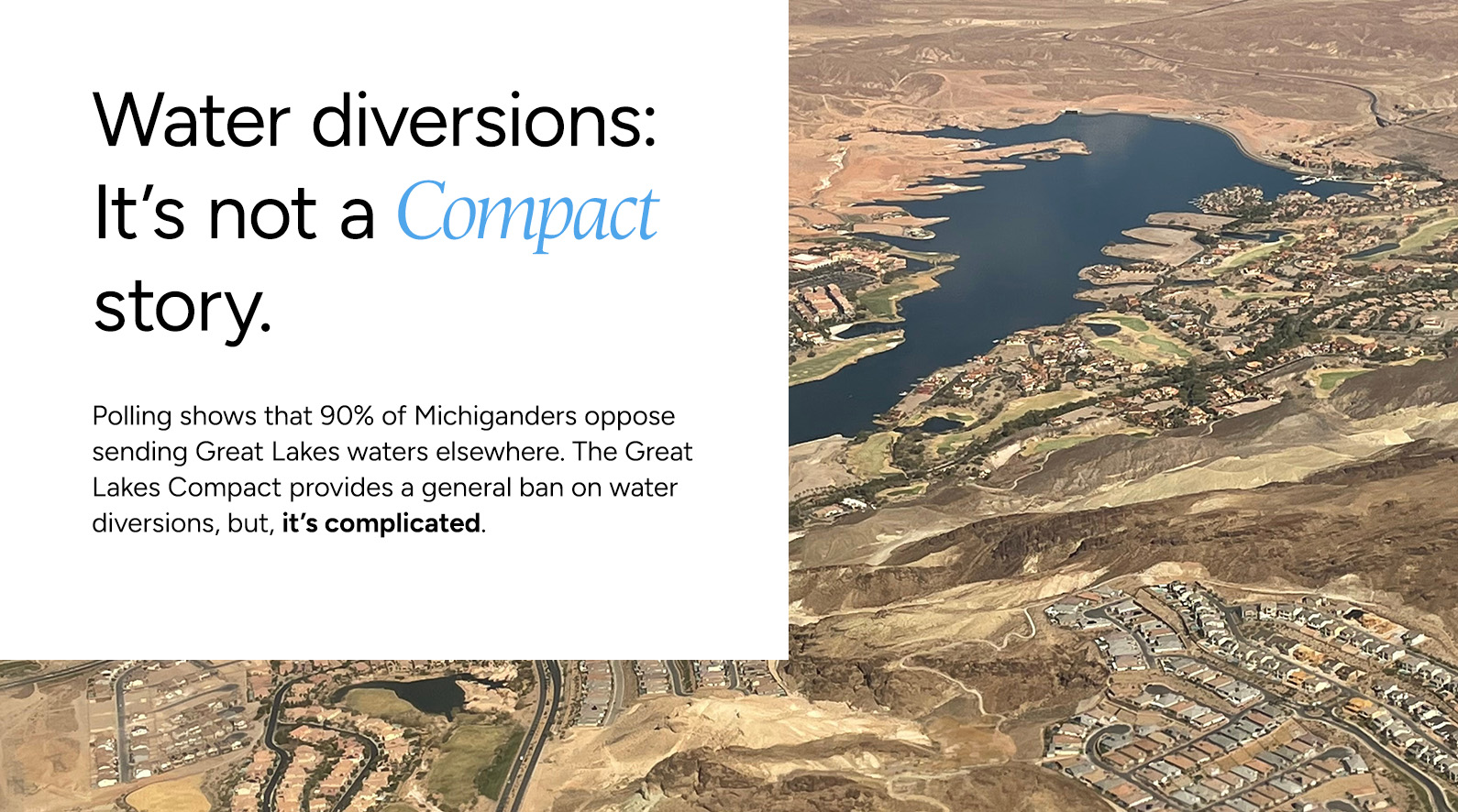
One of the few issues that unites more than 90% of the Michigan voting public is strong opposition to sending Great Lakes water elsewhere.

That’s more significant than it sounds: there are seven other Great Lakes states, and at least five do divert some (mostly small volumes) out of the watershed. That’s a function of geography. All Great Lakes states except Michigan contain large areas of land that are not part of the Great Lakes basin. As some of those areas grow or need to replace contaminated drinking water supplies, they turn to Great Lakes water.

The Great Lakes Compact (PDF), signed into law by President George Bush in 2008, regulates these short-distance diversions while banning long-distance shipments of Great Lakes water by a pipeline, canal, tunnel, aqueduct, channel, modification of the direction of a water course, a tanker ship, tanker truck or rail tanker. Many, including environmental advocates, say the Compact provides ironclad defenses against a Texas or Nebraska water diversion.

It’s true that the Compact was a major step forward for protectors of the Great Lakes, and commendations are due to those who patiently negotiated it. The Great Lakes St. Lawrence Governors and Premiers organization is managing its implementation well.

But the Compact is not perfect or comprehensive, and the possibility of losing control of Great Lakes water remains.

There is a general ban on diversions, but the Compact exempts a “non-commercial project on a short-term basis for firefighting, humanitarian, or emergency response purposes.” “Short-term” and “humanitarian” are undefined terms. Is it humanitarian to send trainloads of Great Lakes water to Western states for six months during an historic drought?

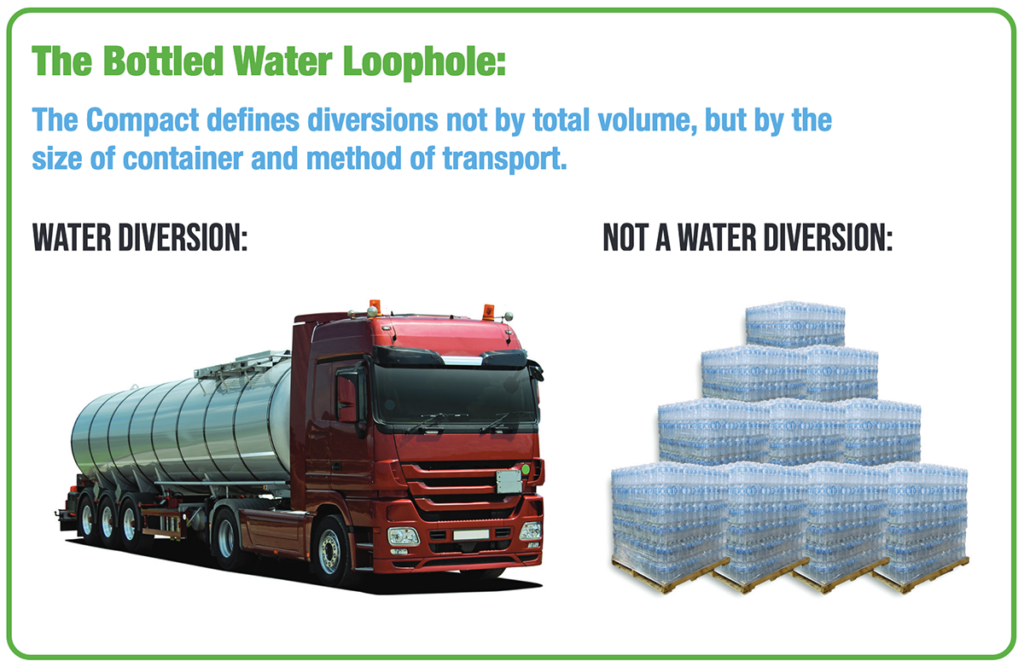
Then there’s the vexing problem of commercialized water, often called the “bottled water exception.” It’s more than that. The Compact presumes that private parties can take Great Lakes water and sell it as a product anywhere — including outside the watershed. This loophole comes from the definition of “product” in the Compact.

Also, the Compact leaves it up to each state to decide whether water shipped out of the basin in any container of 5.7 gallons or less is a diversion. No state has decided that it is. Which means you can’t ship a tanker of raw water from the Great Lakes, but you can send a tanker with the same volume of water out of the basin if it’s in small bottles.

Some might shrug and say “so what?” The volumes withdrawn for bottling are relatively small in the context of the six quadrillion gallons of the Great Lakes.

That’s missing the point. Claiming water as private property and selling it for profit is not the same as using water to grow crops. The farmer does not assert ownership, only a right to use.

By sanctioning claims of private ownership, the Compact opens, rather than closes the door to commercial claims on the Great Lakes.

Finally, there’s a wild card that no Compact can defend against: He lives in the White House and has a habit of declaring emergencies to achieve policy ends.

He also is not on the best terms with the Canadian government. The New York Times and others reported in 2025 that President Trump wanted to “tear up” Great Lakes agreements. Perhaps that’s why the Canadian National Post headlined an article last year, “Forget Tariffs, Trump May Try to Tap Canada’s Freshwater Next.”

If Trump tried to do such a thing, it’s doubtful he’d be thinking of sending the water to the Parchbelt of the U.S. It’s more likely that he would use the Columbia River for that. Instead, he might take Great Lakes water to develop a market in water as a commodity. Liquid bitcoin. Except we can live without bitcoin — not so with water.

It may sound outlandish and farfetched, but we’ve been living through outlandish and farfetched events for some time now.

Be vigilant.

Michigan’s water withdrawal program lacks tools needed to protect our water—Here’s why it matters

Michigan sits at the heart of the Great Lakes—the largest freshwater system on Earth. Despite this abundance, our water resources are not immune to overuse and mismanagement. A 2024 audit released by the Office of the Auditor General highlighted several important areas where the state’s water withdrawal program can be improved to better protect our water resources.

Download the audit report (PDF)

Weak enforcement mechanisms in the law, flaws in the methodology for predicting impacts, and poor data security are all major concerns. Without stronger systems in place, it’s possible for some users to withdraw volumes of water that threaten stream health, aquifers, and the principles of the Great Lakes Compact. In this piece, we unpack the audit’s findings, why they matter, and the changes we need to ensure Michigan protects its most vital resource—our water.

About Michigan’s water withdrawal law.

The Michigan Legislature passed, and former Governor Granholm signed into law, a bill regulating large-scale water withdrawals in 2008. The legislation was needed to fulfill Michigan’s responsibilities to manage water quantity under the Great Lakes Compact. The law requires the Michigan Department of Environment, Great Lakes, and Energy (EGLE) to register large quantity water withdrawals between 100,000 and 2 million gallons per day, collect annual water use data, make determinations about potential impacts on water resources, and process permits for withdrawals greater than 2 million gallons per day.

What the audit found.

The Office of Auditor General’s 2024 performance review of the Michigan Department of Environment, Great Lakes, and Energy (EGLE) pointed to several challenges in implementing the state’s water withdrawal program, including:

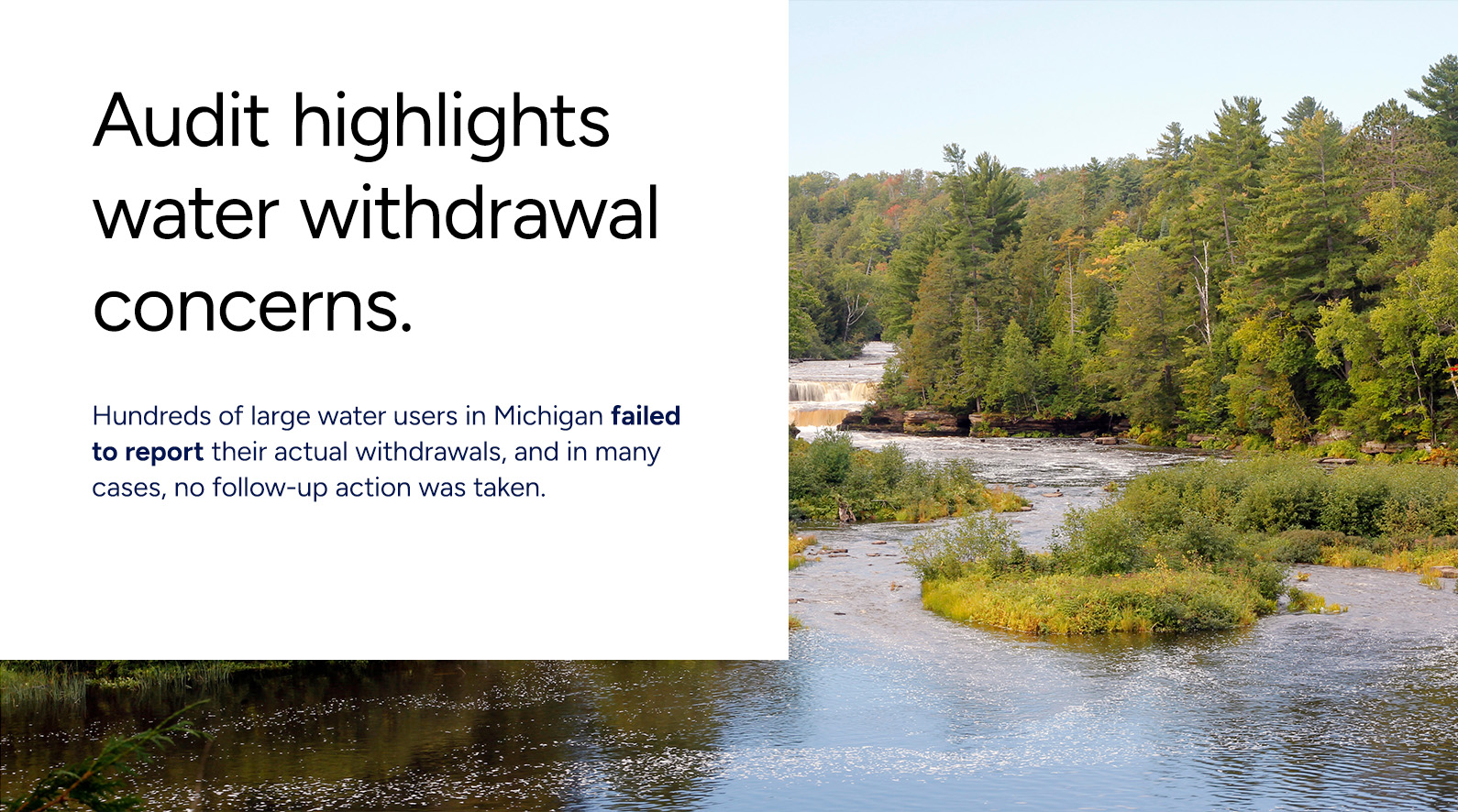
  • Enforcement limitations: Hundreds of large water users failed to report their actual withdrawals, and in many cases, no follow-up action was taken.
  • Flawed oversight: EGLE’s review process for new large-scale withdrawals was plagued by delays and inaccuracies, leaving some withdrawals underestimated or unregulated.
  • Data security risks: Weak access controls in EGLE’s databases could lead to unauthorized changes to withdrawal records.

These findings suggest that Michigan’s ability to track and regulate large-scale water withdrawals needs reinforcement. Without timely and accurate data, the state may not be able to prevent overuse or ensure compliance with legal standards—posing risks to long-term water sustainability.

A particular concern is that the tools used by EGLE to evaluate the impact of proposed water withdrawals do not always result in the same calculations. The Auditor General found that in one case, the difference might have resulted in an adverse resource impact. The difference in the permits the Auditor General reviews was minus 2.4 to plus 4.7 million gallons per year. The Michigan Water Use Advisory Council has called for state funding investments in groundwater and surface water data collection to help address this need.

Why does it matter?

Although Michigan is rich in water resources, scarcity is already a worsening problem in some local areas of the state. In recent years, these areas have faced lower stream flows, stressed aquifers, and polluted water supplies – particularly in agricultural areas where heavy irrigation and fertilizer use put additional pressure on water resources.

The audit raises important questions about how well Michigan is upholding its commitments under the Great Lakes–St. Lawrence River Basin Water Resources Compact (commonly known as the Great Lakes Compact). This regional agreement, supported by Michigan and seven other states, is designed to prevent overuse and privatization and ensure the long-term sustainability of Great Lakes water. Under the Compact:

  • Any new or increased large-scale withdrawals in Michigan must be properly reviewed to ensure they do not harm water resources.
  • Withdrawals that could affect Great Lakes levels or cause environmental harm must be subject to strict review and regulation.
  • The state is responsible for monitoring and enforcing compliance.

Michigan has a responsibility to ensure that large-scale withdrawals are properly reviewed, monitored, and publicly reported. The audit underscores areas where more robust enforcement and improved oversight could help fulfill that commitment and close potential gaps in implementation.

What needs to change.

To protect Michigan’s water future, we believe the audit should be a catalyst for improvement. Key actions include:

  • Strengthening enforcement: Water users who fail to report their withdrawals must face real consequences. The legislature must give EGLE the tools to enforce the law, including stronger penalties and authority to move swiftly after violations.
  • Ensuring compliance with the Great Lakes Compact: Michigan must ensure that every large-scale withdrawal follows the Compact’s rules. That includes proper environmental reviews, accurate monitoring, and transparent public reporting. Improvements in water withdrawal assessment tools are critical, and so is the data collection needed to make the tools work.
  • Increasing transparency: The public has a right to know how much water is being taken from Michigan’s lakes, rivers, and aquifers—and whether that use is sustainable. EGLE should make water withdrawal data publicly accessible to increase accountability.

Why this matters to you.

Water is Michigan’s greatest natural resource. From the Great Lakes to groundwater aquifers, it sustains our communities, ecosystems, and economy. When large-scale withdrawals are not properly monitored or enforced, we will all pay the price—in the form of depleted rivers, contaminated wells, and strained public water supplies.

At Flow Water Advocates, we see this audit as an opportunity for constructive action. By addressing the issues raised and strengthening our water withdrawal program, Michigan can honor its Compact commitments and ensure long-term water security.

You can help by:

  • Staying informed about water policy issues in Michigan.
  • Supporting stronger water withdrawal protections.
  • Calling on EGLE and state lawmakers to enforce the Great Lakes Compact and strengthen oversight of water withdrawals.

Our water is a public trust. Let’s keep it that way.

Citizens fight proposal to bottle and sell Lake Superior water

A proposal to turn artesian groundwater that feeds Lake Superior in northern Wisconsin into a product for sale continues to run head-on into the law, the community, a tribe, and a citizens group, Lake Superior Not for Sale (LSNFS).

The most recent defeat for Kristle KLR came in June, when the Wisconsin Court of Appeals upheld a Bayfield County Board of Adjustment decision to deny the company a Conditional Use Permit (CUP) to harvest, store, and transport artesian water. The company has lost every round since it took the issue to the courts in 2022. Now the last stop in the judicial system is the Wisconsin Supreme Court, which rarely accepts appeals in such circumstances.

When Kristle KLR announced its proposal to bottle and sell the water, it said it would store the water in underground tanks on site, and transport it via tanker trucks to an off-site bottling facility in Superior, Wisconsin. Proposed markets included the Twin Cities of Minnesota, which lie outside the Great Lakes watershed.

But the proposal ran into a buzzsaw of opposition from surrounding communities, the Red Cliff Band of Lake Superior Chippewa, LSNFS, and others.
The proposal was designed to evade the Great Lakes Compact’s ban on diversions outside of the Great Lakes watershed by exploiting a loophole in the Compact that exempts diversions of water in containers under 5.7 gallons in volume.

The Red Cliff Band of Lake Superior Chippewa officially condemned the proposal with a resolution calling water “a finite resource” and adding that “societal demands to monetize fresh water supplies represent an existential threat to our culture and lifestyle,” including fisheries and wild rice. Linda Nguyen, Red Cliff Environmental Director said, “To allow for the commodification of water is to allow the theft of our sacred relative.”

LSNFS signs reading “Not For Sale,” with the image of Lake Superior in the background, sprouted up in Bayfield, Ashland, and Douglas Counties. By the end of 2022, over 3,000 yard signs had been distributed throughout the upper Midwest, throughout all 11 tribes in the State of Wisconsin and into Canada.

“This area has been fighting resource extraction threats since the land was ceded in the 1842 Treaty, so the communities are strong and relationships are deep,” said Dana Churness, one of the principals in the Lake Superior Not for Sale group. “This is what allows us to feel exhilarated and ready for what comes next. We absolutely have to be. Are some days exhausting? You bet. However, the corporate threats won’t rest, and neither will we.“

Rob Lee, an attorney for Midwest Environmental Advocates in Madison, which has represented citizens opposed to the withdrawal, says the success of the opposition to date “demonstrates what happens when regular people band together to oppose extractive industries like this, and that the people living on the shores of Lake Superior are adamant that Wisconsin’s precious water resources will not be privatized for purely monetary gain. It shows that those people can work through their local elected officials to get things done, and that local governments in Wisconsin have the authority to be responsive to their citizens’ concerns.”

The legal work takes funding, which LSNFS has raised by tabling at events and selling the signs and gear.

The threats to the water continue. Churness says citizens are wary of a bill introduced by Congressman Tom Tiffany of Wisconsin, which would redesignate Wenabozho Ominisan – currently known as the Apostle Islands Lakeshore – as a national park. Introduced without meaningful consultations with affected communities and the Red Cliff tribe, the bill has awakened concerns that it is a step toward federal takeover of water extraction.

“We can only expect that Tiffany’s legislation is preparing for future water extraction, if Trump is elected in November,” Churness says. She urges businesses or organizations interested in signing a petition or resolution against this legislation to contact lakesuperiornotforsale@gmail.com. LSNFS continues to accept donations for its defense of the Lake Superior watershed.

Another Illinois City Seeks Lakes Michigan Water

More and more, communities outside of the Great Lakes watershed basin are looking for ways to tap into Great Lakes water, despite the Great Lakes Compact agreement ban on most out-of-basin water diversions.

The latest example is the City of South Barrington, Illinois, which announced recently it is paying $154,000 to a consultant to prepare a plan to buy water from the City of Chicago. That city diverts Lake Michigan water into the Illinois River watershed to prevent city sewage from fouling its drinking water, and to support barge traffic on the Chicago Sanitary and Ship Canal.  The diverted water is also treated and used by the City for drinking water.

Despite its geographic proximity to Lake Michigan, South Barrington lies outside the Lake Michigan watershed.

Although large, new consumptive uses of Great Lakes water require approvals under the Great Lakes Compact, water allocations from Chicago to other Illinois cities are exempt from the Compact as long as they stay within Chicago’s 3,200 cubic feet per second diversion, which is allowed by a U.S. Supreme Court ruling. Due to increased water use efficiency, Chicago has reduced its consumption, opening a margin that it is selling.

In other words, rather than returning the water it doesn’t use to Lake Michigan, Chicago can use it as an asset to be leased to communities beyond its borders and outside of the watershed. Last year, Chicago and the City of Joliet, Illinois – 35 miles from Chicago’s downtown – announced a 100-year agreement for Joliet to purchase treated drinking water from Chicago. The estimated price for the lease is $1 billion.

“It is time to reset the decades-old Supreme Court’s order,” says Jim Olson, founder of For Love of Water.

FREE REPORT: A Watershed Moment: The Great Lakes Compact After 15 Years

“The decree continues to bind the states and Great Lakes to the loss of 2 billion gallons a day, a drop of more than two inches a year, which during record low level years can result in devastating harm to the public trust for navigation, boating, fishing, shoreline wetlands and habitat along our coastlines. Yet it was entered into two decades before the nation’s and states’ first environmental and water laws and it was entered into before the legal recognition of the rights of the public and the lakes themselves that are protected by the universally accepted public trust law principle. And while the Chicago Diversion was exempted from the 2008 Great Lakes Compact’s diversion ban, that doesn’t prevent review of Chicago’s abuse of the Supreme Court’s consent order.”

Wisconsin is also using Lake Michigan water to support economic development outside the Great Lakes watershed, exploiting authority conferred by the Compact. In a report released earlier this year, FLOW found that state officials had okayed five new or increased water diversions outside the Great Lakes for development and population growth.

“Wisconsin’s reinterpretation of lawful exceptions to the Great Lakes Compact’s diversion ban has deviated from the common understanding upon its 2008 ratification. The Compact now enables rather than prevents diversion proposals in [watershed] straddling communities, and fosters population growth and water consumption outside the Great Lakes watershed,” FLOW said in the report.

WEBINAR: The Ethics of Sharing Great Lakes Water – April 17, 2024


With worsening water scarcity in the US and around the world, pressures to share Great Lakes water will grow.

The Great Lakes Compact allows water to be diverted outside of the watershed basin for “short-term humanitarian emergencies.” 

But what does this mean, and who defines it? What are the ethics of sharing water? Is it right, and under what conditions?

These questions are explored in a webinar hosted by FLOW featuring experts in environmental ethics and policy.

This webinar was recorded on April 17, 2024. Watch the recording:


Guest Speakers

Dr. Susan Chiblow
Dr. Susan (Sue) Bell Chiblow is Anishinaabe, born and raised in Garden River First Nation, Ontario. She has worked extensively with First Nation communities for the last 30 years in environmental related fields. She is an assistant professor at the University of Guelph in their new Bachelor of Indigenous Environmental Science and Practice program. Sue has been appointed as a Commissioner to the International Joint Commission.

Dr. Cameron Fioret
Cameron is on the Board of Directors of the Windsor, Ontario-based nonprofit Windsor of Change; and a Policy Analyst in the Government of Canada. Previously, he was a Policy Analyst in the Canada Water Agency, a Virtual Visiting Research Fellow at the United Nations University (UNU-CRIS), and a Visiting Scholar in the University of Michigan’s Water Center in the Graham Sustainability Institute. He completed his PhD at the University of Guelph under the supervision of Dr. Monique Deveaux, Canada Research Chair in Ethics and Global Social Change.

Dr. Caitlin Schroering
Dr. Schroering is an Assistant Professor in the Department of Global Studies at UNC Charlotte. She holds a Ph.D. in Sociology from the University of Pittsburgh, a Master of Arts in Latin American Studies from the University of Florida, and a Bachelor of Arts in Environmental Studies from Denison University. Her primary line of research is based on extensive fieldwork with two movements fighting against water privatization, one in Brazil and one in the United States. She is the author of Global Solidarities Against Water Grabbing: Without Water, We Have Nothing, forthcoming with Manchester University Press this September.

The discussion is moderated by FLOW senior policy advisor, Dave Dempsey. Dave is the author of Great Lakes For Sale, which provides historical context for the issue of Great Lakes diversions and chronicles the region’s internal wars over bottled water.

With thanks to:

This webinar is presented with sponsorship by the Barton J. Ingraham & Gail G. Ingraham Foundation.

Public Trust Bill Package Boosts Groundwater Protection in Michigan

Editor’s note: This is a FLOW media release issued March 17, 2022. Members of the media can reach FLOW Executive Director Liz Kirkwood at Liz@FLOWforWater.org or cell (570) 872-4956 or office (231) 944-1568.


FLOW Executive Director Liz Kirkwood expressed strong support for legislation introduced in Lansing today that would shore up public trust protections for the Great Lakes and groundwater against water-bottling companies thirsting for profits and strengthen safeguards for waterways on state land.

“The Great Lakes must never be for sale,” Kirkwood said in a video-recording message for the press conference announcing the legislation. “And Michigan’s groundwater must never become privatized and siphoned away.”

Watch Liz Kirkwood’s video message below:

The three-bill package (House Bills 5953, 5954, and 5955) introduced by Michigan Reps. Yousef Rabhi, Laurie Pohutsky, Rachel Hood, and Padma Kuppa would close the legal loophole in the Great Lakes Compact that allows private interests and international regimes to take massive amounts of Great Lakes water as long as it is extracted in containers of 5.7 gallons or less. The legislation also would explicitly apply public trust protections to groundwater, which provides drinking water to 45% of Michiganders and helps recharge the Great Lakes, and would direct the Department of Natural Resources to be strong public trustees of the lands and waters it manages. Rep. Kuppa also plans to introduce a groundwater resolution on March 22, World Water Day.

“These prudent changes will ensure that Michigan has the ability to stop privatization of the Great Lakes and groundwater, and reject future water withdrawals that are not in the public’s interest,” said Kirkwood, an environmental attorney who directs FLOW (For Love of Water), the Great Lakes law and policy center based in Traverse City. “We must protect every arc of the water cycle.”

Michigan’s groundwater supplies drinking water to 45% of Michiganders. Groundwater that discharges to lakes and streams also is crucial to sustain coldwater fisheries, stream ecology, and wetlands, and also accounts for approximately 20-40% of the volume of the Great Lakes.

“Without these protections explicitly in place we face the very real possibility that our most valuable natural resource, the water which defines our state, could be treated as a commodity for sale like oil,” Kirkwood said, “and virtually eliminate the state’s ability to protect this vital resource.”

Michigan Lawmakers Must Step Up on Behalf of Our Water

It is vital to assert the human right to water and prohibit private control and sale of water as a product

Jim Olson, FLOW Founder & Senior Legal Advisor

Editor’s Note: Great Lakes Echo published an article in December 2021 titled, “Can a bottled water royalty help preserve the Great Lakes?” which highlighted the idea of applying a royalty on sales of water captured by private entities and sold on the market. FLOW founder Jim Olson offers his thoughts on the nature of water as part of the public trust and the necessity of retaining state sovereignty over all water.

By Jim Olson

In Michigan, water in its natural state, including groundwater, is held by the state as sovereign for the benefit of the people. Michigan’s 2008 groundwater withdrawal law declares that lakes, streams, and groundwater–indeed springs, seeps, and wetlands–are a singularly connected part of the water cycle. The removal of water from one arc of the water cycle affects the other, often substantially.

It’s time for all legislators regardless of political party to step up on behalf of all of us and protect our public water, assert the human right to water, and prohibit private control and sale of water as a product.

The 2008 law also declares waters of the state, including groundwater, are held in trust for the benefit of citizens, and so does the eight-state Great Lakes Compact, which also dates back to 2008. When the singular and connected nature of groundwater and surface water is scientifically understood, that the removal of groundwater is a removal of surface water that is otherwise replenished by the groundwater, courts regularly subject the withdrawal to public trust protections. The U.S. Supreme Court, in its 2021 Mississippi v. Tennessee ruling, reaffirmed its basic rule that groundwater, like all waters within the boundaries of a state, are subject to exclusive control and ownership of the state, except for navigational servitude and interests. 

The Michigan Supreme Court has recognized that groundwater is not owned by anyone, and to the extent that it is, it is the common property of the state as sovereign. So, too has our legislature declared that our lakes, streams, and groundwater are a single hydrological system and that these common waters are held in trust by the State as sovereign. Sovereign means people–that’s all of us here in Michigan.

The International Bottled Water Association is wrong. Water is not a product until a state authorizes the sale of water as a product. That hasn’t happened in Michigan. BlueTriton Brands, formerly Nestlé Waters North America, Inc., like other bottled water operators, gets permits to withdraw and use water, but the notion that use includes sale has never been addressed. Once it is, water, if allowed to be sold in bottles or other containers less than 5.7 gallons must be licensed. Any other sale of water must be prohibited and explicitly not authorized or subject to license. Otherwise, Wall Street hedge funds and commodities exchanges will move in, prices will skyrocket, and water necessary to our own people, farmers, farms, industries, recreational pursuits, and communities will be subject to private control. 

We sure don’t want water traded or marketed out of the Great Lakes or Michigan. If there’s a humanitarian need or crisis, a one-time transfer can be done by the state for a public, humanitarian purpose on behalf of its citizens. But it won’t be sold, and it won’t be a product.

It’s unconscionable that those in cities and villages in rural areas facing water shutoffs because of inability to pay for the unaffordable rising costs of infrastructure or the presence of lead or another health threat should be forced to buy and use bottled water, which is degrading.

Municipal drinking water services are public goods established for public use, not private sale. That’s why bottled water companies that tap public water supplies in Michigan must obtain a license. Otherwise they would take the water, jack up the price once in a bottle, and not share the gain from selling a public good with the rest of the community’s residents–that’s called a subsidy, and under Michigan law and constitution, it’s unlawful. 

It’s time for all legislators regardless of political party to step up on behalf of all of us and protect our public water, assert the human right to water, and prohibit private control and sale of water as a product. It’s unconscionable that those in cities and villages in rural areas facing water shutoffs because of inability to pay for the unaffordable rising costs of infrastructure or the presence of lead or another health threat should be forced to buy and use bottled water, which is degrading, and 100 to 1000 times more expensive than what people should be able to pay to a city or village for their public water service.

Billions of Taxpayer Dollars and 2 Billion Gallons a Year of Great Lakes Water Don’t Mix with Private Corporate Profits and Promises

Revisiting the Foxconn Great Lakes Water Diversion in Wisconsin

By Jim Olson

Last summer I wrote about a Wisconsin administrative judge’s ruling that the diversion of 7 million gallons a minute — or 2 billion gallons of Great Lakes water per year — to the private corporation Foxconn to build a 22 million square-foot plant for 13,000 jobs should not qualify as a “public water supply”.

FLOW filed an amicus brief in the case, arguing in support of Wisconsin citizens and organizations that the Foxconn diversion was not exempt from the Great Lakes Compact, because it did not constitute a public water supply. Under the Compact and Wisconsin law, public water supply means “primarily residential” customers. To ensure a public service and purpose, the law and anti-diversion Compact are quite clear: If it’s not for many people who live in a straddling community but outside the basin, the water of the Great Lakes cannot be diverted. The law is also clear that it cannot be diverted for private purposes.

What happened in the Foxconn case was politics, plain and simple. Former Wisconsin Governor Scott Walker teamed up with the Taiwanese multinational electronics manufacturing company to commit $3 billion and 2 billion gallons of Great Lakes water for Foxconn’s promise of a 22 million square-foot facility and 13,000 jobs. Every business has to plan and decide for itself whether to build, finance, and operate an expansion. But 2018 was an election year, and Walker dangled everything he could to stir excitement for Wisconsin’s citizens. He rode the promises of Foxconn for tax base and jobs. Walker, a Republican, lost to now Governor Tony Evers, a Democrat. Foxconn didn’t uphold its part of the bargain with Walker. The company has downsized its facility to 1 million square feet, will offer a small fraction of the jobs, and will need much less water.

But no one has asked the real question: What do taxes, jobs, and transferring billions of gallons of Great Lakes water outside the Basin have to do with public water supply? What does this have to do with public services or public purpose? The answer is nothing.

The question now is: What is Governor Evers and Wisconsin citizens, and those of us in the Great Lakes Basin going to do about it? Under Scott Walker, Wisconsin bent the law and the Compact, but the new administration hasn’t done anything to remedy that. It’s time to take off the rose-colored glasses and protect the waters of the Great Lakes from becoming a subsidy and reservoir for private corporations outside the Basin.