
Tag: withdrawals

It’s not a Compact story: The complicated issue of Great Lakes water diversions

Adapted from a piece that originally appeared on his Substack, Flow senior policy advisor Dave Dempsey breaks down the threat of Great Lakes water diversions, and what the Great Lakes Compact does — and does not — protect. 

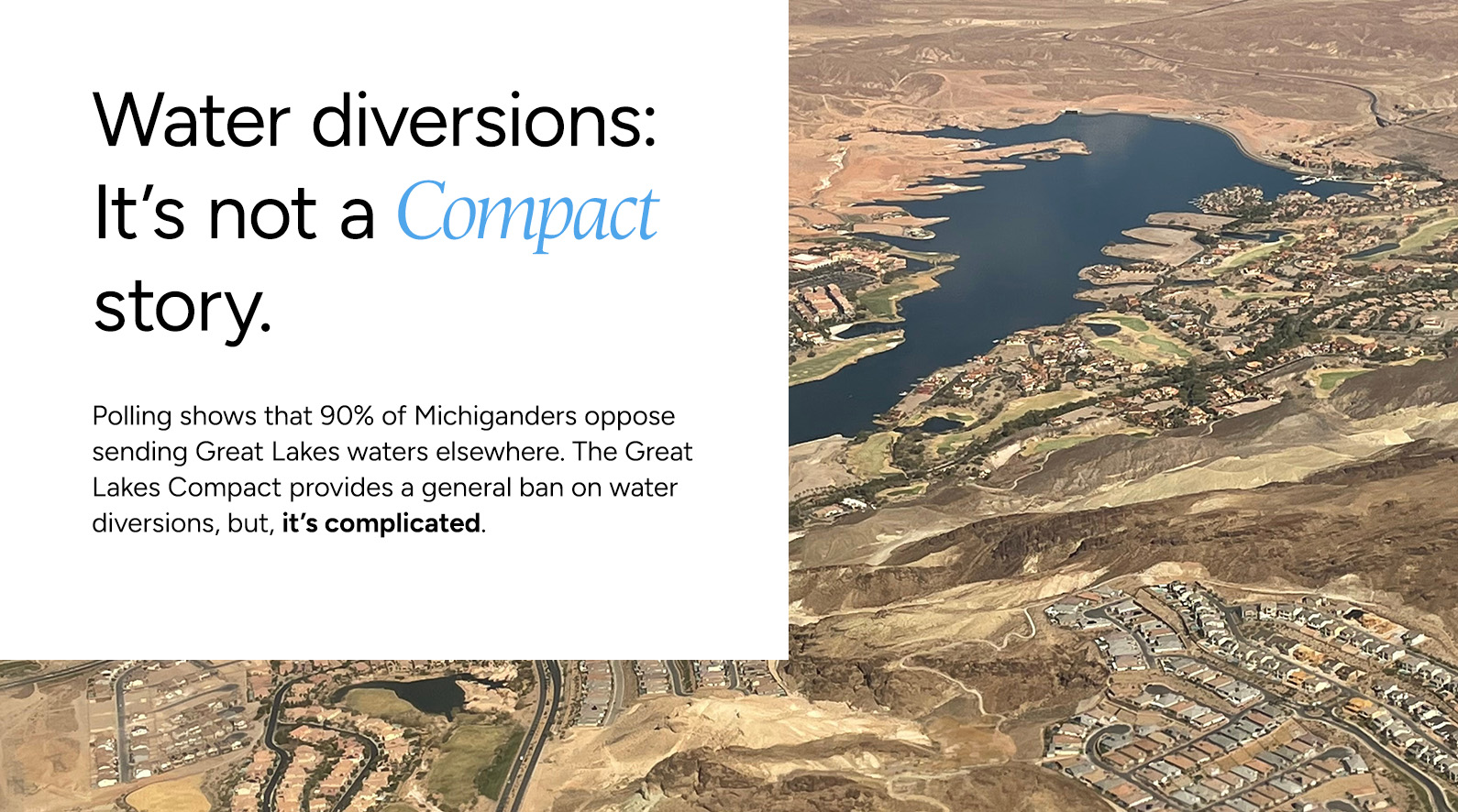
One of the few issues that unites more than 90% of the Michigan voting public is strong opposition to sending Great Lakes water elsewhere.

That’s more significant than it sounds: there are seven other Great Lakes states, and at least five do divert some (mostly small volumes) out of the watershed. That’s a function of geography. All Great Lakes states except Michigan contain large areas of land that are not part of the Great Lakes basin. As some of those areas grow or need to replace contaminated drinking water supplies, they turn to Great Lakes water.

The Great Lakes Compact (PDF), signed into law by President George Bush in 2008, regulates these short-distance diversions while banning long-distance shipments of Great Lakes water by a pipeline, canal, tunnel, aqueduct, channel, modification of the direction of a water course, a tanker ship, tanker truck or rail tanker. Many, including environmental advocates, say the Compact provides ironclad defenses against a Texas or Nebraska water diversion.

It’s true that the Compact was a major step forward for protectors of the Great Lakes, and commendations are due to those who patiently negotiated it. The Great Lakes St. Lawrence Governors and Premiers organization is managing its implementation well.

But the Compact is not perfect or comprehensive, and the possibility of losing control of Great Lakes water remains.

There is a general ban on diversions, but the Compact exempts a “non-commercial project on a short-term basis for firefighting, humanitarian, or emergency response purposes.” “Short-term” and “humanitarian” are undefined terms. Is it humanitarian to send trainloads of Great Lakes water to Western states for six months during an historic drought?

Then there’s the vexing problem of commercialized water, often called the “bottled water exception.” It’s more than that. The Compact presumes that private parties can take Great Lakes water and sell it as a product anywhere — including outside the watershed. This loophole comes from the definition of “product” in the Compact.

Also, the Compact leaves it up to each state to decide whether water shipped out of the basin in any container of 5.7 gallons or less is a diversion. No state has decided that it is. Which means you can’t ship a tanker of raw water from the Great Lakes, but you can send a tanker with the same volume of water out of the basin if it’s in small bottles.

Some might shrug and say “so what?” The volumes withdrawn for bottling are relatively small in the context of the six quadrillion gallons of the Great Lakes.

That’s missing the point. Claiming water as private property and selling it for profit is not the same as using water to grow crops. The farmer does not assert ownership, only a right to use.

By sanctioning claims of private ownership, the Compact opens, rather than closes the door to commercial claims on the Great Lakes.

Finally, there’s a wild card that no Compact can defend against: He lives in the White House and has a habit of declaring emergencies to achieve policy ends.

He also is not on the best terms with the Canadian government. The New York Times and others reported in 2025 that President Trump wanted to “tear up” Great Lakes agreements. Perhaps that’s why the Canadian National Post headlined an article last year, “Forget Tariffs, Trump May Try to Tap Canada’s Freshwater Next.”

If Trump tried to do such a thing, it’s doubtful he’d be thinking of sending the water to the Parchbelt of the U.S. It’s more likely that he would use the Columbia River for that. Instead, he might take Great Lakes water to develop a market in water as a commodity. Liquid bitcoin. Except we can live without bitcoin — not so with water.

It may sound outlandish and farfetched, but we’ve been living through outlandish and farfetched events for some time now.

Be vigilant.
Michigan’s water withdrawal program lacks tools needed to protect our water—Here’s why it matters

Michigan sits at the heart of the Great Lakes—the largest freshwater system on Earth. Despite this abundance, our water resources are not immune to overuse and mismanagement. A 2024 audit released by the Office of the Auditor General highlighted several important areas where the state’s water withdrawal program can be improved to better protect our water resources.

Download the audit report (PDF)

Weak enforcement mechanisms in the law, flaws in the methodology for predicting impacts, and poor data security are all major concerns. Without stronger systems in place, it’s possible for some users to withdraw volumes of water that threaten stream health, aquifers, and the principles of the Great Lakes Compact. In this piece, we unpack the audit’s findings, why they matter, and the changes we need to ensure Michigan protects its most vital resource—our water.

About Michigan’s water withdrawal law.

The Michigan Legislature passed, and former Governor Granholm signed into law, a bill regulating large-scale water withdrawals in 2008. The legislation was needed to fulfill Michigan’s responsibilities to manage water quantity under the Great Lakes Compact. The law requires the Michigan Department of Environment, Great Lakes, and Energy (EGLE) to register large quantity water withdrawals between 100,000 and 2 million gallons per day, collect annual water use data, make determinations about potential impacts on water resources, and process permits for withdrawals greater than 2 million gallons per day.

What the audit found.

The Office of Auditor General’s 2024 performance review of the Michigan Department of Environment, Great Lakes, and Energy (EGLE) pointed to several challenges in implementing the state’s water withdrawal program, including:

  • Enforcement limitations: Hundreds of large water users failed to report their actual withdrawals, and in many cases, no follow-up action was taken.
  • Flawed oversight: EGLE’s review process for new large-scale withdrawals was plagued by delays and inaccuracies, leaving some withdrawals underestimated or unregulated.
  • Data security risks: Weak access controls in EGLE’s databases could lead to unauthorized changes to withdrawal records.

These findings suggest that Michigan’s ability to track and regulate large-scale water withdrawals needs reinforcement. Without timely and accurate data, the state may not be able to prevent overuse or ensure compliance with legal standards—posing risks to long-term water sustainability.

A particular concern is that the tools used by EGLE to evaluate the impact of proposed water withdrawals do not always result in the same calculations. The Auditor General found that in one case, the difference might have resulted in an adverse resource impact. The difference in the permits the Auditor General reviews was minus 2.4 to plus 4.7 million gallons per year. The Michigan Water Use Advisory Council has called for state funding investments in groundwater and surface water data collection to help address this need.

Why does it matter?

Although Michigan is rich in water resources, scarcity is already a worsening problem in some local areas of the state. In recent years, these areas have faced lower stream flows, stressed aquifers, and polluted water supplies – particularly in agricultural areas where heavy irrigation and fertilizer use put additional pressure on water resources.

The audit raises important questions about how well Michigan is upholding its commitments under the Great Lakes–St. Lawrence River Basin Water Resources Compact (commonly known as the Great Lakes Compact). This regional agreement, supported by Michigan and seven other states, is designed to prevent overuse and privatization and ensure the long-term sustainability of Great Lakes water. Under the Compact:

  • Any new or increased large-scale withdrawals in Michigan must be properly reviewed to ensure they do not harm water resources.
  • Withdrawals that could affect Great Lakes levels or cause environmental harm must be subject to strict review and regulation.
  • The state is responsible for monitoring and enforcing compliance.

Michigan has a responsibility to ensure that large-scale withdrawals are properly reviewed, monitored, and publicly reported. The audit underscores areas where more robust enforcement and improved oversight could help fulfill that commitment and close potential gaps in implementation.

What needs to change.

To protect Michigan’s water future, we believe the audit should be a catalyst for improvement. Key actions include:

  • Strengthening enforcement: Water users who fail to report their withdrawals must face real consequences. The legislature must give EGLE the tools to enforce the law, including stronger penalties and authority to move swiftly after violations.
  • Ensuring compliance with the Great Lakes Compact: Michigan must ensure that every large-scale withdrawal follows the Compact’s rules. That includes proper environmental reviews, accurate monitoring, and transparent public reporting. Improvements in water withdrawal assessment tools are critical, and so is the data collection needed to make the tools work.
  • Increasing transparency: The public has a right to know how much water is being taken from Michigan’s lakes, rivers, and aquifers—and whether that use is sustainable. EGLE should make water withdrawal data publicly accessible to increase accountability.

Why this matters to you.

Water is Michigan’s greatest natural resource. From the Great Lakes to groundwater aquifers, it sustains our communities, ecosystems, and economy. When large-scale withdrawals are not properly monitored or enforced, we will all pay the price—in the form of depleted rivers, contaminated wells, and strained public water supplies.

At Flow Water Advocates, we see this audit as an opportunity for constructive action. By addressing the issues raised and strengthening our water withdrawal program, Michigan can honor its Compact commitments and ensure long-term water security.

You can help by:

  • Staying informed about water policy issues in Michigan.
  • Supporting stronger water withdrawal protections.
  • Calling on EGLE and state lawmakers to enforce the Great Lakes Compact and strengthen oversight of water withdrawals.

Our water is a public trust. Let’s keep it that way.