Tag: NPDES

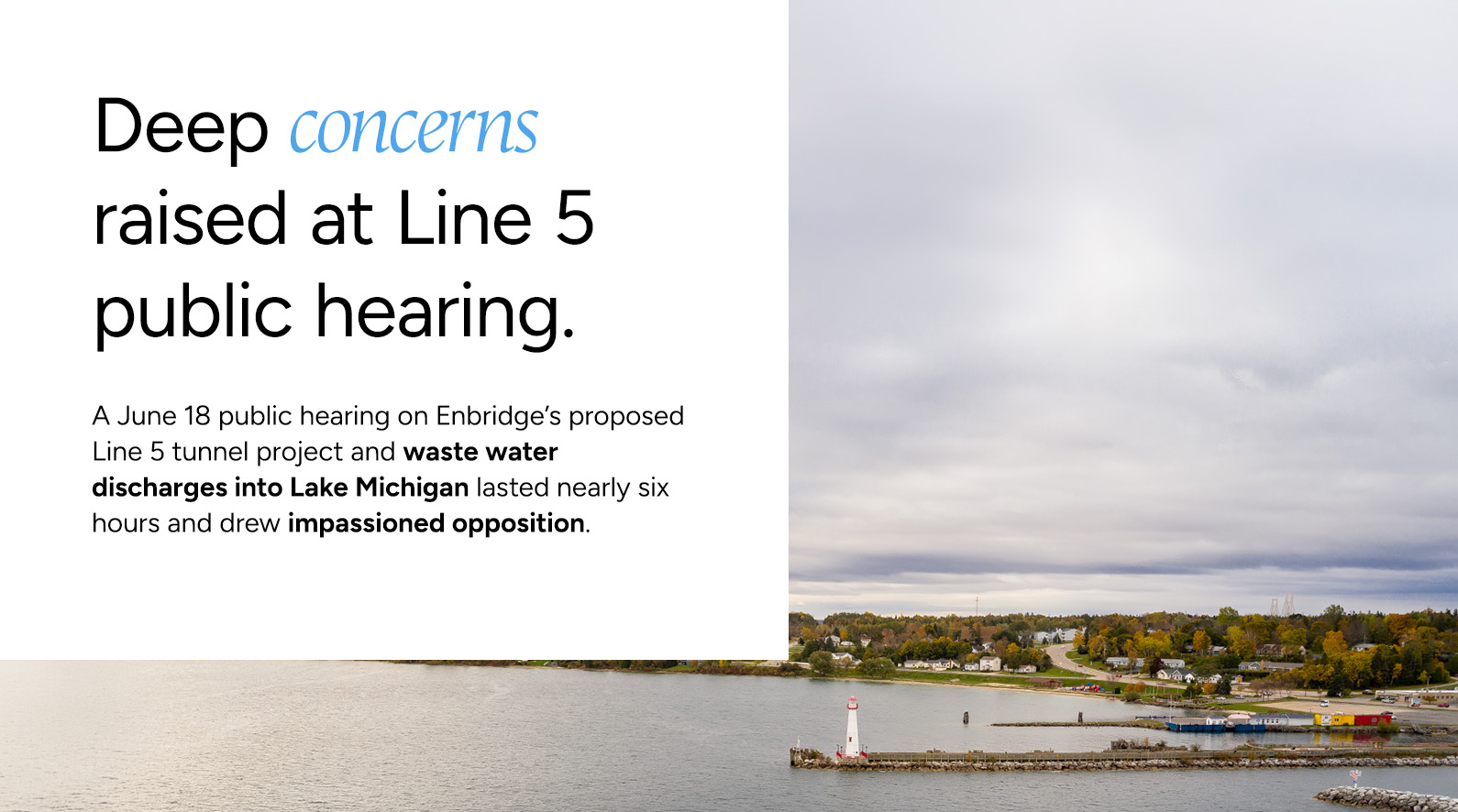
Deep concerns raised at Line 5 tunnel public hearing

Last week, over 200 participants gathered over Zoom for the public hearing on the proposed reissuance of the National Pollutant Discharge Elimination System Individual Permit (NPDES) for Enbridge’s proposed Line 5 tunnel through the Straits of Mackinac. 

Line 5 is a pair of aging oil pipelines that travels across the bottom of the Straits of Mackinac, where Lake Michigan meets Lake Huron. Enbridge, the Canadian company that owns Line 5, is proposing to replace the Line 5 pipelines with a tunnel that will be bored underneath the lakebed. The U.S. Army Corp. of Engineers (USACE) found that the tunnel will result in detrimental impacts, including loss of wetlands and wildlife habitats; potential release of drilling fluids; construction noise, lights, traffic, and vibrations; limits to recreational resources; and impacts to property values and tourism.

Enbridge is requesting a reissuance of the now-expired NPDES permit that the Michigan Department of Environment, Great Lakes, and Energy (EGLE) granted in 2021. If re-approved, the permit would allow Enbridge to dump massive amounts of warm waste water into Lake Michigan, take up to 2 million gallons of water per day from Lake Michigan, and discharge unknown toxic chemicals into the water as a result of the tunnel boring. The proposed draft permit and other related documents can be found here

Out of the 200+ participants at last week’s hearing, around 90 people spoke up and gave public comments in support or opposition to the NPDES permit. EGLE took comments for nearly 6 hours, as the hearing stretched on until almost midnight.

A majority of commenters opposed the permit, noting an array of concerns, including the lack of information on what chemicals Enbridge will be using for water treatment; Enbridge’s lack of trust and various failures at Line 3 in Minnesota and Line 6B in Kalamazoo; the company’s lack of good will in Wisconsin over the Bad River Band territory; concerns on the cultural impact to Indigenous Peoples and safety concerns about the construction camps near Indigenous lands, among others. Folks in attendance also highlighted concerns regarding the safety of dumping potentially contaminated wastewater into Lake Michigan, with several commenters noting that the temperature limit for wastewater as established in the permit was too high for the Great Lake’s cold water ecosystem.

Comments in support of the permit had an eerie familiarity as a number of commenters followed the same formula – establishing that they are a life-long Michiganders who love the outdoors, and highlighting the same language that we see from Enbridge itself about how the tunnel is the “most environmentally sound option” despite heavy evidence to the contrary. Supporters also argued that the tunnel will provide energy security to the Upper Peninsula, despite the fact that most of the fuel transported by Line 5 goes to Canada. There was also support for the permit from industry groups and unions because of alleged job creation.

However, over 60% of commenters opposed the tunnel. And, perhaps the most inspiring part of the evening: a majority of those commenters in opposition appeared to come from young people. The youth are showing up to protect the future from the devastation that the Line 5 tunnel could bring. The youngest commenter of the evening, a 3 (and a half) year old named Lola, spoke with more wisdom than some adults, saying “we can’t drink oil.” A seemingly simple, but essential thought that cannot be lost when it comes to the Great Lakes.

Sacrificing our freshwater, our drinking water, and our survival comes at an incredibly high cost, with little benefit for Michiganders. The great activist, scholar, philosopher, and author Dr. Angela Davis once said: “Youth always leads struggles for change. No revolution has ever happened without young people being in the forefront.” Building on the energy of these young people, Flow encourages readers to submit a comment to EGLE if you haven’t already. This may be the last chance for folks to submit comments urging EGLE to reject Enbridge’s dangerous and unnecessary tunnel project and protect Michigan and the Great Lakes for generations (like little Lola) to come. 
Flow appeals EGLE rejection of FOIA request; seeks public disclosure of factory farm sewage land application.

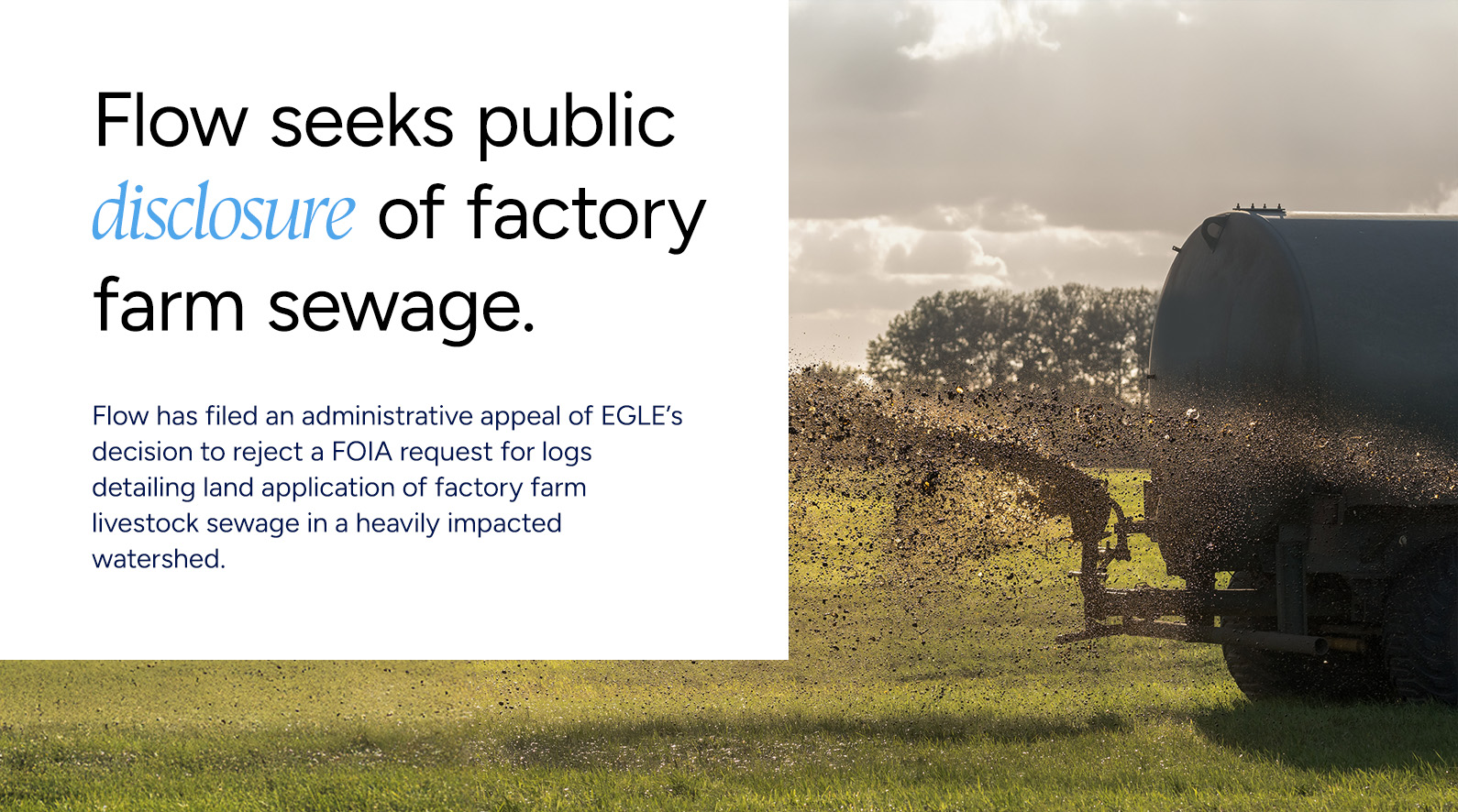
Traverse City, Mich. — Flow Water Advocates (“Flow”) has filed an administrative appeal of a Michigan Department of Environment, Great Lakes, and Energy (EGLE) decision to reject Flow’s FOIA requests for logs Concentrated Animal Feeding Operations (CAFOs) are required by permit to maintain and disclose to EGLE and the public. These logs from fourteen CAFOs provide details on land application of livestock sewage in a heavily impacted watershed. As Great Lakes water quality and access advocates, Flow has a long-standing interest in protecting Michigan’s surface and drinking water.

Support Flow’s work to defend the Great Lakes.

CAFOs, commonly referred to as factory farms, are large livestock facilities that house several hundred to tens of thousands of animals, producing sewage equivalent to large cities. The National Pollutant Discharge Elimination Systems (NPDES) permitting program under the Clean Water Act regulates their animal waste disposal. CAFO operators typically dispose of waste by applying it to fields — often in amounts far greater than can be taken up by the soil and crops. Rural watersheds across Michigan, and in turn the Great Lakes, are heavily impacted by CAFO waste runoff and leaching.

“For many rural residents, dealing with CAFO odors, runoff, heavy trucking, and water quality destruction — surface and ground — has become an exhausting, expensive, year-round ordeal,” says Flow Legal Director Carrie La Seur. “Michigan has something priceless in its natural heritage. This is not just a paperwork exercise, it’s essential information citizens need to protect their health and quality of life.”

The logs detail the time, date, quantity, method, location, and application rate for each location where CAFO wastes are applied to land; a description of the weather conditions at the time; and whether the land was frozen or snow-covered. Crucially, they also include the total amount of nitrogen and phosphorus applied to each field that receives CAFO wastes. Overloading these nutrients can cause toxic algal blooms, closed beaches, and fish kills. The disclosure Flow seeks is critical to understanding how CAFO waste impacts lakes, streams, and other waters.

By Michigan law, the public has the right to access any document “prepared, owned, used, in the possession of, or retained by a public body in the performance of an official function, from the time it is created” (MCL 15.232). If the documents do not exist, the failure to maintain records by all fourteen CAFOs would represent egregious NPDES permit violations, and require immediate enforcement action by EGLE to protect the health of Michiganders.

###

Flow Water Advocates is an independent 501(c)(3) nonprofit organization based in Traverse City, Michigan. Our mission is to ensure the waters of the Great Lakes Basin are healthy, public, and protected for all. With a staff of legal and policy experts, strategic communicators, and community builders, Flow is a trusted resource for Great Lakes advocates. We help communities, businesses, agencies, and governments make informed policy decisions and protect public trust rights to water. Learn more at www.FlowWaterAdvocates.org.

Factory farm webinar: Weigh in on how Michigan regulates factory farm waste.

Factory farms, or Concentrated Animal Feeding Operations (CAFOs), threaten our waters with immense quantities of sewage, which too often are sprayed on fields where it can then runoff into streams and leach into groundwater — including into our drinking water. 

On August 8, the Michigan Department of Environment, Great Lakes, and Energy (EGLE ) will hold an hybrid remote public hearing in Lansing on the long-contested 2020 NPDES-CAFO General Permit, to regulate factory farm waste discharges to our waters. 

To prepare for this important hearing, join Flow Water Advocates on July 31 at Noon for a briefing on the issue, and learn how you can weigh in to support effective regulation and clean waters in rural Michigan and the Great Lakes. 

Flow has been an intervenor in an administrative contested case and litigation on this permit over the past 5 years. 

How to join the EGLE public hearing on August 8 at 9:00am:

Location: Microsoft Teams Meeting
Meeting ID: 293 614 609 636 1
Passcode: 6FV72vK3
Call in (audio only)
Telephone: 1-248-509-0316 (Toll)
Phone Conference ID: 581 485 136#