Tag: Line 5 tunnel

Live webinar: A Deep Dive on Line 5

WEBINAR: Thursday, August 20 at 12:00pm EDT

Enbridge’s Line 5 pipeline and proposed tunnel in the Straits of Mackinac threaten the Great Lakes, while primarily serving Canada. In July, the Tribal and environmental coalition earned a significant victory when the Michigan Supreme Court vacated a required state permit for the tunnel project. Meanwhile, additional state and federal permit processes continue to play out, as the Line 5 issue shapes the important November election.

Join Flow Water Advocates and Oil & Water Don’t Mix on August 20 at Noon for a live webinar, A Deep Dive on Line 5, as we unpack what it all means, what happens next, and how you can help get oil out of the Great Lakes.

Our expert panel includes:

  • Riyaz Kanji, founding member and Directing Attorney of Kanji & Katzen – representing the Bad River Band of Lake Superior Chippewa and Flow Water Advocates
  • Debbie Chizewer, Managing Attorney, EarthJustice 
  • David Holtz, Oil & Water Don’t Mix Campaign Coordinator and member of the Sierra Club Board of Directors

Hosted and moderated by Flow executive director Liz Kirkwood.

About the panelists

Riyaz Kanji, Founding Member and Directing Attorney, Kanji & Katzen

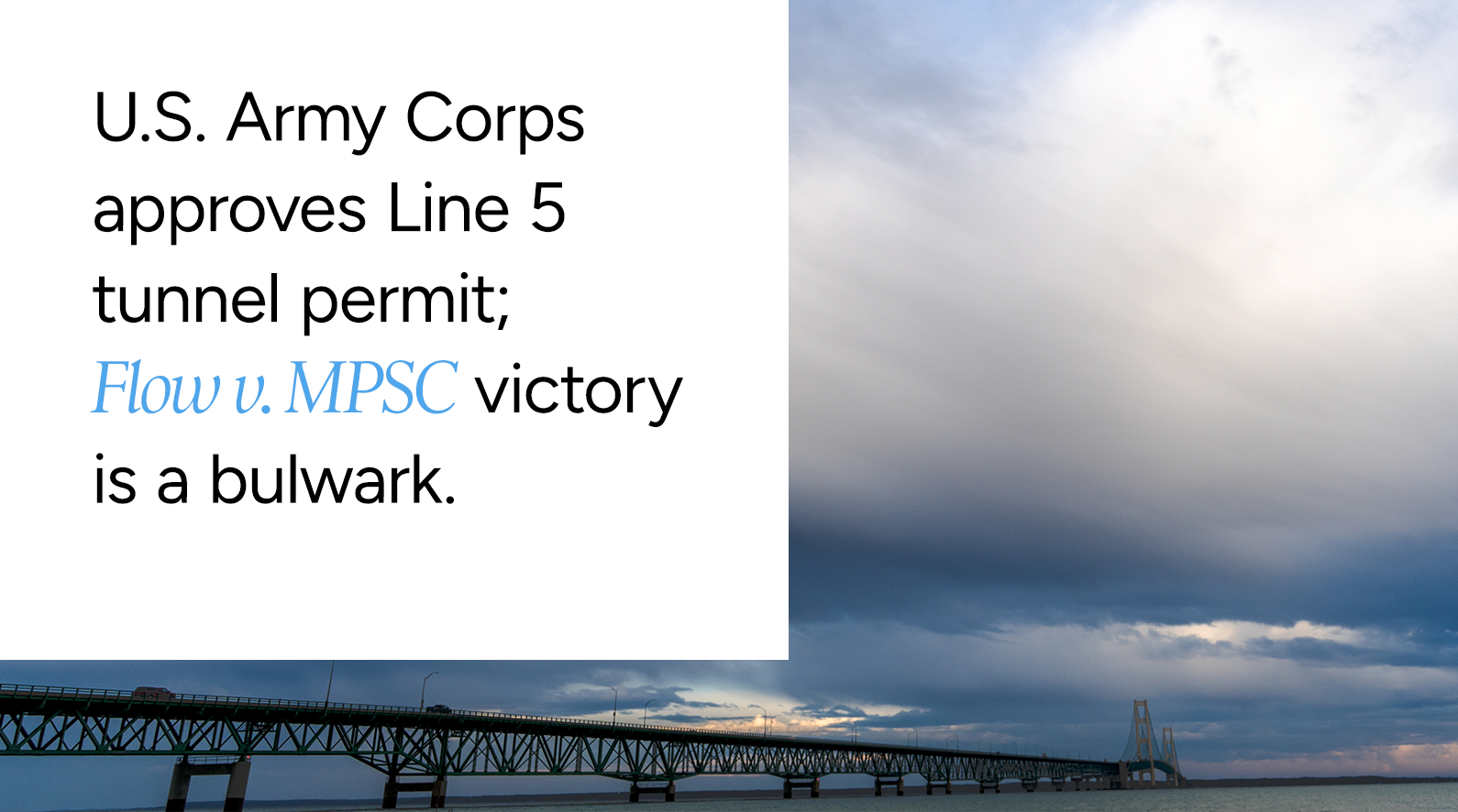
Riyaz Kanji is a founding member of Kanji & Katzen, PLLC, a firm whose mission is to advance Tribal sovereignty. A graduate of Harvard College and the Yale Law School, Riyaz served as a law clerk to the late Honorable Betty Fletcher of the United States Court of Appeals for the Ninth Circuit and Justice David Souter of the United States Supreme Court. He is an advisor to and vocal cheerleader for the Tribal Supreme Court Project. Riyaz represents Tribes at all levels of the federal court system, and was part of the team that argued and won the decision in McGirt v. Oklahoma vindicating the continued existence of the Muscogee Creek Reservation. Riyaz served as lead attorney for Flow Water Advocates in its recent successful appeal to the Michigan Supreme Court, FLOW v. MPSC, which vacated the Line 5 tunnel permit issued by the Michigan Public Service Commission.

Debbie Chizewer, Managing Attorney, EarthJustice

As the managing attorney for Earthjustice’s Chicago office, Debbie Chizewer has built a Midwest team and a docket of cases across three program areas — climate and energy, healthy communities, and wild lands and wildlife. This team’s work includes representation of Tribal Nations in the fight against the risky Line 5 oil pipeline and advocacy on behalf of Black, low-income communities facing disproportionate environmental harms from air and water pollution. Throughout her career, Debbie has advocated for environmental protection across many issues — fighting for environmental justice in the Midwest at Northwestern Law’s environmental law clinic, promoting Great Lakes health at the Alliance for the Great Lakes, and protecting wildlife and public lands in the Rockies for the National Wildlife Federation. Debbie graduated from Princeton University and Boston University School of Law. After graduation from law school, she clerked in the U.S. District Court in the District of Delaware.

David Holtz, Coalition Coordinator for Oil & Water Don't Mix and Member of the Sierra Club Board of Directors

David’s passion for environmental protection, social justice and belief in people-powered political change led him to become a Sierra Club volunteer and in 2013 join the campaign to shut down Enbridge’s dangerous Line 5 oil pipeline in the Straits of Mackinac. He currently serves as coalition coordinator for Oil & Water Don’t Mix. David is a member of the national Sierra Club Board of Directors where he serves on the board’s Executive Committee. For more than a decade David worked as a newspaper reporter and is a former senior aide to a Member of Congress from Michigan. David was a founding board member of the nonprofit communications hub, Progress Michigan, and served as its executive director from 2010 to 2013 and is the former Michigan Director for Clean Water Action. He is a U.S. Marine Corps Vietnam veteran.

Flow v. MPSC: MI Supreme Court issues Line 5 tunnel permit decision

FOR IMMEDIATE RELEASE: July 31, 2026

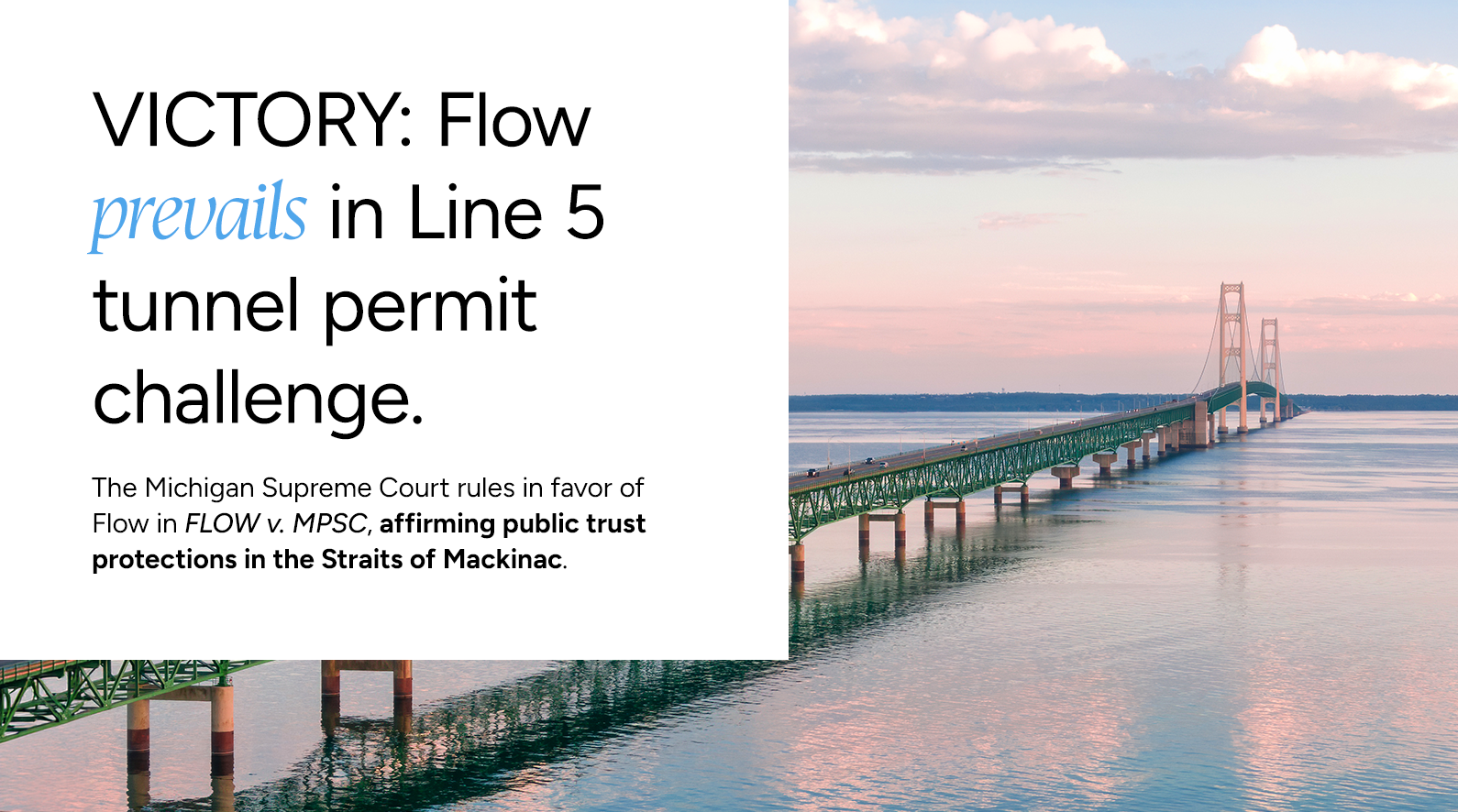
Michigan Supreme Court upholds the public’s rights to the Great Lakes, orders new review of Line 5 tunnel. 

Traverse City, Mich., July 31, 2026 — The Michigan Supreme Court ruled that Michigan regulators failed to properly weigh the Great Lakes’ public trust protections and environmental impacts before approving Enbridge Energy’s proposed Line 5 tunnel beneath the Straits of Mackinac. The Court overturned the Michigan Public Service Commission’s (“MPSC”) approval of the project and sent the case back to the agency for further review of public trust and environmental impacts — a major victory for Flow Water Advocates (“Flow”) and its Tribal and environmental co-appellants.

The ruling resolved the consolidated appeals brought by Flow, four federally recognized Tribes – the Little Traverse Bay Band of Odawa Indians, Bay Mills Indian Community, Grand Traverse Band of Ottawa and Chippewa Indians, and Nottawaseppi Huron Band of the Potawatomi – and the Environmental Law and Policy Center and the Michigan Climate Action Network, all of whom challenged the MPSC’s approval of the tunnel.

The High Court found that the Court of Appeals erred in this case “by applying a deferential standard of review to the MPSC’s decision, and the MPSC erred by (1) failing to consider whether the tunnel project will factually and proximately cause the extension of Line 5’s operational life, potentially resulting in additional environmental harm; (2) comparing alternatives in an inconsistent manner; and (3) failing to consider the project’s impact on public trust resources.” The Court rejected the Court of Appeals’ ruling that the MPSC lacked the authority to apply a common-law public trust analysis, stating, “We agree with FLOW and hold that MEPA requires separate consideration of harms to public trust resources.”

Lead attorney, Riyaz Kanji, remarked, “Today the Michigan Supreme Court vindicated the rights of every Michigander to the protection of the Great Lakes. It reaffirmed that the invaluable waters of the Great Lakes and submerged lands beneath them are held by the state for the benefit of the people, and that the public’s rights in those vital waters and lands cannot be given away to private interests like Enbridge without careful consideration of the environmental impacts and alternatives. The High Court made clear that regulators and state agencies, like the MPSC, which has authority over the location and operation of pipelines and other utilities, cannot avoid this fundamental duty to the public in their permit decisions.” 

Flow’s Executive Director, Liz Kirkwood, said, “This decision of the Michigan Supreme Court builds on a long lineage of public trust case law and affirms that the public trust doctrine and the Michigan Environmental Protection Act (“MEPA”) are alive and well in Michigan. Today’s historic ruling cements the importance of the MEPA and the common-law public trust doctrine in agency permitting decisions affecting the waters and natural resources of the people of Michigan. The MPSC cannot greenlight the tunnel project until the agency actually determines its impact on the public’s rights to the Great Lakes waters and the lands beneath them — and weighs that harm against the alternatives, as the law requires.”

Flow is represented in this case by its legal team and co-counsel, Kanji & Katzen, P.L.L.C. and Olson & Howard, P.C.

Flow Water Advocates statement on Whitmer administration’s Line 5 tunnel permit decisions.

FOR IMMEDIATE RELEASE: July 15, 2026

TRAVERSE CITY, Mich. — In a pair of key permit decisions announced today by the Michigan Department of Environment, Great Lakes, and Energy (EGLE) regarding Enbridge’s proposed pipeline tunnel through the Straits of Mackinac, the state has failed to carry out its duties under the Michigan Wetlands Protection Act (Part 303), the Great Lakes Submerged Lands Act (Part 325), and the Public Trust Doctrine to protect Michigan wetlands and submerged lands. It has also disregarded over 70,000 public comments EGLE received during the public comment period last summer and instead sided with Enbridge and its pipeline that ends in Sarnia, Ontario and primarily delivers crude oil to Canada.

“That these heartbreaking permit decisions were announced during a period of dangerously bad air quality due to climate change-related wildfires is sadly poetic,” said Liz Kirkwood, Flow Water Advocates executive director. “It’s a stark illustration that building this tunnel and further entrenching the burning of fossil fuels isn’t just wrong for the Straits and Michiganders, it’s wrong for the planet.”

Flow Water Advocates holds that under the Great Lakes Submerged Lands Act, the tunnel project cannot be lawfully permitted unless the state has found that adverse effects to the environment and public trust are minimal, and that there are no feasible and prudent alternatives to the applicant’s proposed activity (in this case, Enbridge’s proposal to bore a 4.5-mile tunnel through the Straits).

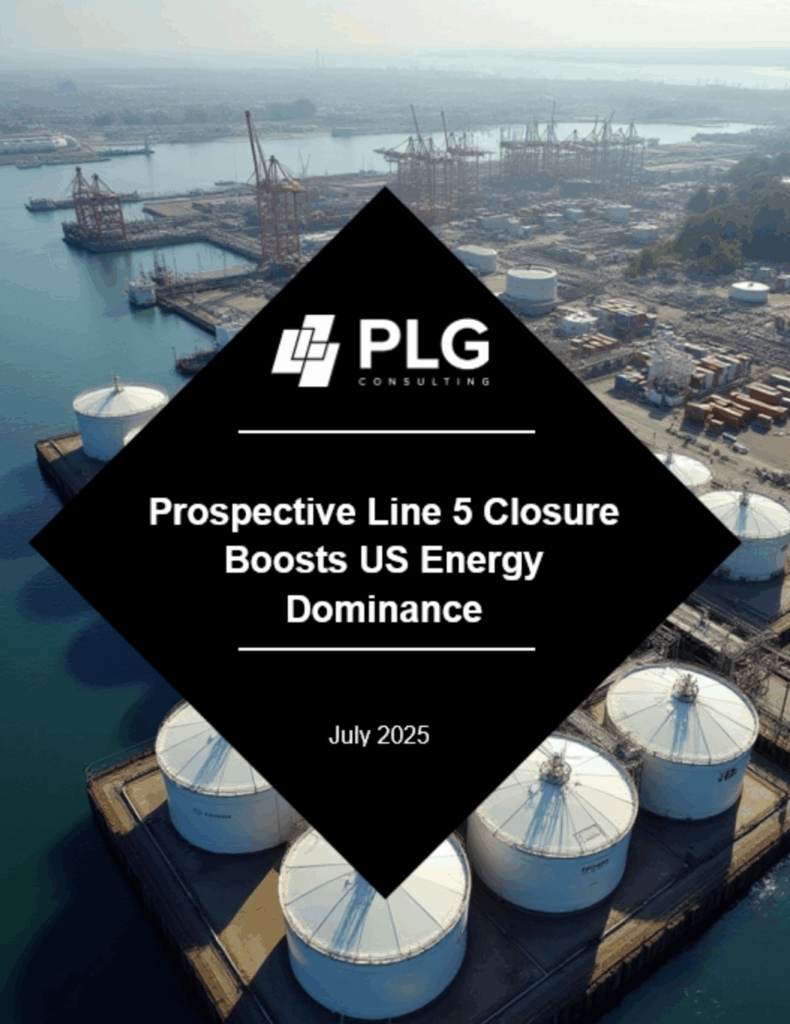
No such finding has been made, and feasible alternatives — including utilizing excess capacity elsewhere in pipeline and rail networks, as detailed in a pair of reports by energy supply chain analysts PLG Consulting (Likely Market Responses to a Potential Shutdown of Line 5 (2023), Prospective Line 5 Closure Boosts US Energy Dominance (2025)) — are available. The decisions are particularly egregious given the fact that feasible and prudent alternatives are also identified in the state’s own record.

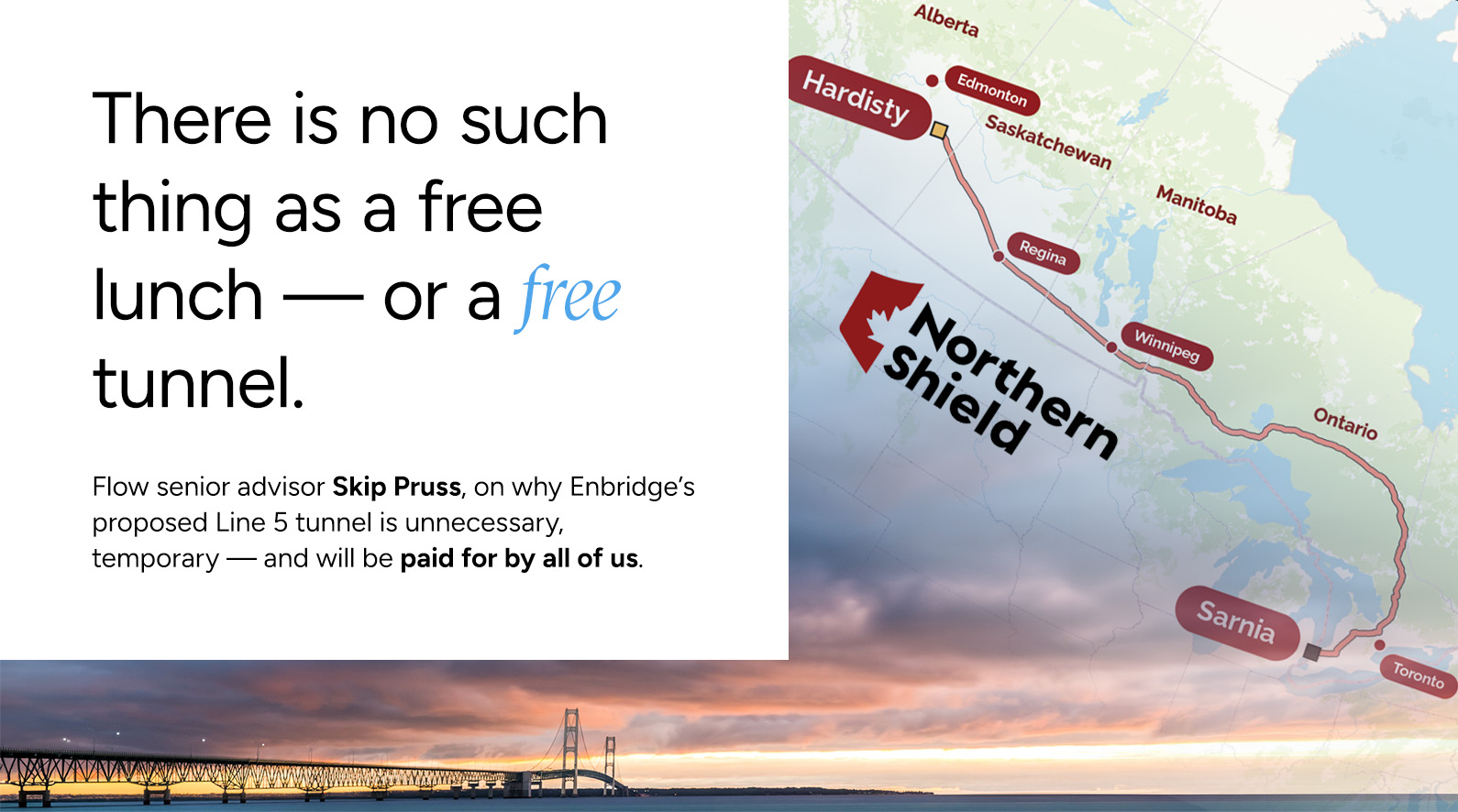
And just last week, the CBC reported that Ontario Premier Doug Ford and Alberta Premier Danielle Smith are backing a new “Northern Shield” oil pipeline that would stretch from Western Canada to Sarnia, bypassing the U.S. and the Great Lakes. Last fall, the Ontario government began a feasibility study for the project, which would bolster Canadian energy independence — and potentially render Enbridge’s Line 5 and proposed tunnel redundant.

In joint comments submitted to EGLE, Flow Water Advocates, the Sierra Club, and Surfrider Foundation wrote “Enbridge’s pursuit of the Line 5 tunnel runs in direct contradiction to the public interest in Michigan’s invaluable freshwater resources and the ecosystems they support; in the sacred cultural sites within and surrounding the Straits and the Tribal rights that are inextricably tied to them; in a healthy climate future and a resilient Michigan economy; and in the vested rights of all Michiganders to use and enjoy the State’s public trust resources free from the threat of substantial impairment.”

The permit approvals announced today are a blow to Michigan’s public trust resources, Tribal rights and interests, and Governor Whitmer’s own Healthy Climate Plan and commitment to carbon neutrality.

Enbridge cannot begin construction of this proposed tunnel under the Great Lakes until it has secured final approval for two other major permits, including the National Pollutant Discharge Elimination System (NPDES) permit from EGLE, and the federal permit from the U.S. Army Corps of Engineers. A permit issued by the Michigan Public Service Commission (MPSC) has been appealed to the Michigan Supreme Court by Flow Water Advocates (For Love of Water v. MPSC) and a coalition of tribal nations joined by the Environmental Law & Policy Center and Michigan Climate Action Network (Little Traverse Bay Bands v. MPSC). A decision is expected in late July.

###

Flow Water Advocates is an independent 501(c)(3) nonprofit organization based in Traverse City, Michigan. Our mission is to ensure the waters of the Great Lakes Basin are healthy, public, and protected for all. With a staff of legal and policy experts, strategic communicators, and community builders, Flow is a trusted resource for Great Lakes advocates. We help communities, businesses, agencies, and governments make informed policy decisions and protect public trust rights to water. Learn more at www.FlowWaterAdvocates.org.

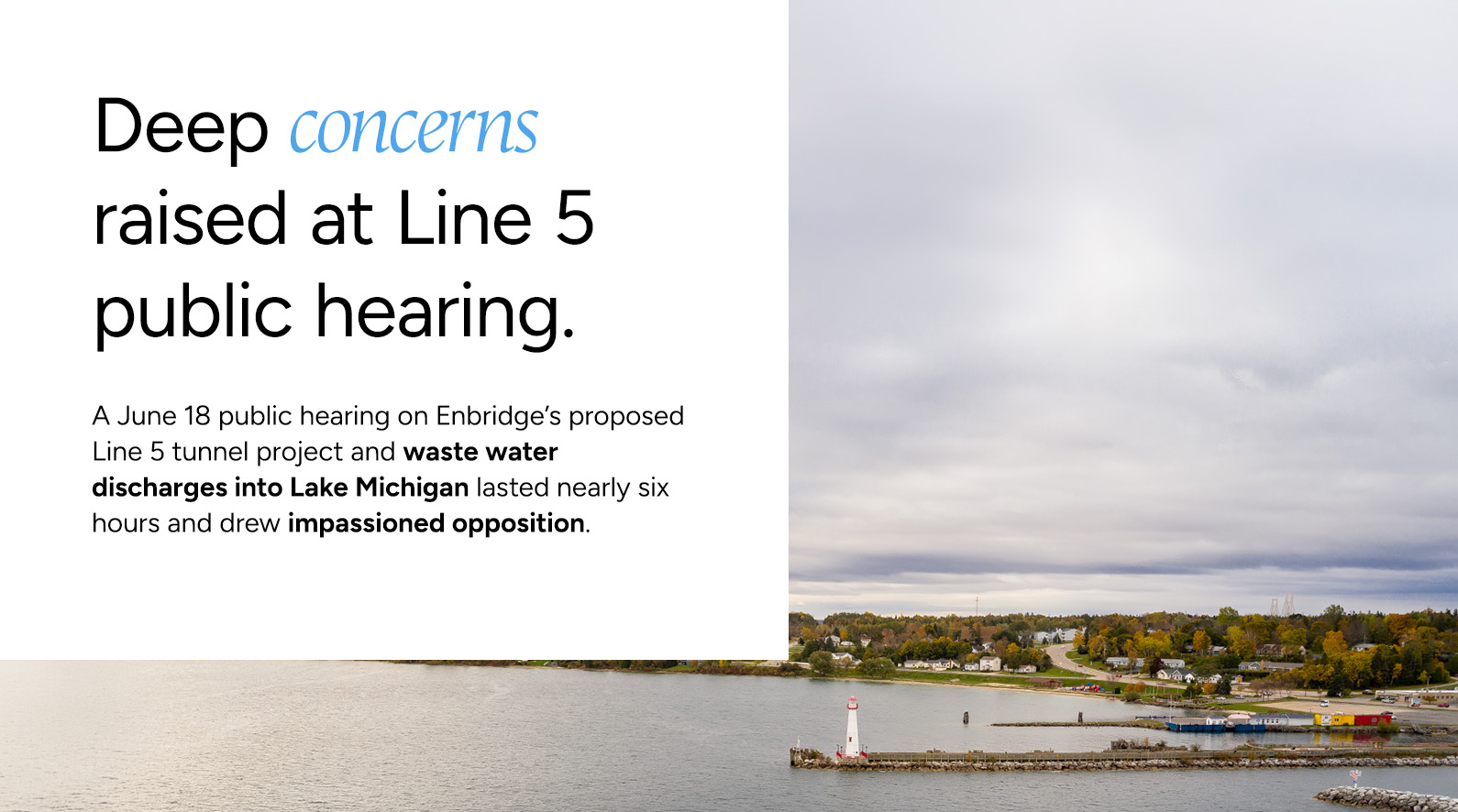
Deep concerns raised at Line 5 tunnel public hearing

Last week, over 200 participants gathered over Zoom for the public hearing on the proposed reissuance of the National Pollutant Discharge Elimination System Individual Permit (NPDES) for Enbridge’s proposed Line 5 tunnel through the Straits of Mackinac. 

Line 5 is a pair of aging oil pipelines that travels across the bottom of the Straits of Mackinac, where Lake Michigan meets Lake Huron. Enbridge, the Canadian company that owns Line 5, is proposing to replace the Line 5 pipelines with a tunnel that will be bored underneath the lakebed. The U.S. Army Corp. of Engineers (USACE) found that the tunnel will result in detrimental impacts, including loss of wetlands and wildlife habitats; potential release of drilling fluids; construction noise, lights, traffic, and vibrations; limits to recreational resources; and impacts to property values and tourism.

Enbridge is requesting a reissuance of the now-expired NPDES permit that the Michigan Department of Environment, Great Lakes, and Energy (EGLE) granted in 2021. If re-approved, the permit would allow Enbridge to dump massive amounts of warm waste water into Lake Michigan, take up to 2 million gallons of water per day from Lake Michigan, and discharge unknown toxic chemicals into the water as a result of the tunnel boring. The proposed draft permit and other related documents can be found here

Out of the 200+ participants at last week’s hearing, around 90 people spoke up and gave public comments in support or opposition to the NPDES permit. EGLE took comments for nearly 6 hours, as the hearing stretched on until almost midnight.

A majority of commenters opposed the permit, noting an array of concerns, including the lack of information on what chemicals Enbridge will be using for water treatment; Enbridge’s lack of trust and various failures at Line 3 in Minnesota and Line 6B in Kalamazoo; the company’s lack of good will in Wisconsin over the Bad River Band territory; concerns on the cultural impact to Indigenous Peoples and safety concerns about the construction camps near Indigenous lands, among others. Folks in attendance also highlighted concerns regarding the safety of dumping potentially contaminated wastewater into Lake Michigan, with several commenters noting that the temperature limit for wastewater as established in the permit was too high for the Great Lake’s cold water ecosystem.

Comments in support of the permit had an eerie familiarity as a number of commenters followed the same formula – establishing that they are a life-long Michiganders who love the outdoors, and highlighting the same language that we see from Enbridge itself about how the tunnel is the “most environmentally sound option” despite heavy evidence to the contrary. Supporters also argued that the tunnel will provide energy security to the Upper Peninsula, despite the fact that most of the fuel transported by Line 5 goes to Canada. There was also support for the permit from industry groups and unions because of alleged job creation.

However, over 60% of commenters opposed the tunnel. And, perhaps the most inspiring part of the evening: a majority of those commenters in opposition appeared to come from young people. The youth are showing up to protect the future from the devastation that the Line 5 tunnel could bring. The youngest commenter of the evening, a 3 (and a half) year old named Lola, spoke with more wisdom than some adults, saying “we can’t drink oil.” A seemingly simple, but essential thought that cannot be lost when it comes to the Great Lakes.

Sacrificing our freshwater, our drinking water, and our survival comes at an incredibly high cost, with little benefit for Michiganders. The great activist, scholar, philosopher, and author Dr. Angela Davis once said: “Youth always leads struggles for change. No revolution has ever happened without young people being in the forefront.” Building on the energy of these young people, Flow encourages readers to submit a comment to EGLE if you haven’t already. This may be the last chance for folks to submit comments urging EGLE to reject Enbridge’s dangerous and unnecessary tunnel project and protect Michigan and the Great Lakes for generations (like little Lola) to come. 

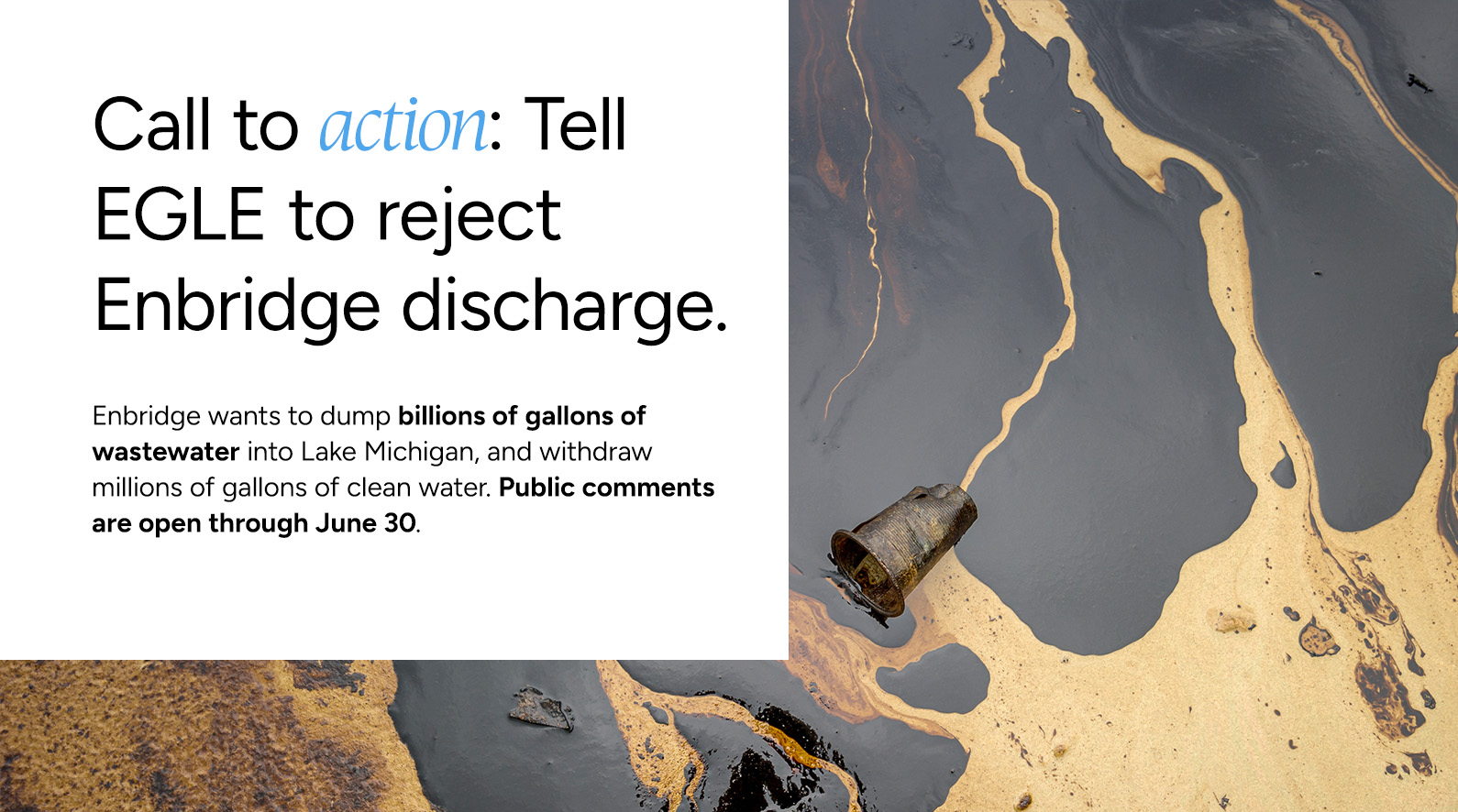
Last chance to speak up: Reject Enbridge’s discharge into Lake Michigan

What is happening:

Enbridge is requesting a permit from the Michigan Department of Environment, Great Lakes, and Energy (EGLE) for its proposed Line 5 pipeline tunnel under the Straits of Mackinac. If approved, the permit would allow Enbridge to:

  • Dump billions of gallons of wastewater into Lake Michigan — enough to fill 9 Olympic-sized swimming pools every day
  • Take up to 2 million gallons of water per day directly from Lake Michigan
  • Discharge chemical additives, chlorides, solids, as well as pollutants from the heavy machinery used to bore the tunnel (like metals, oil, and grease)

The discharges may also affect the temperature and pH of the water, altering its chemistry and stressing fish and other aquatic life.

What you can do:

EGLE is now taking public comments on Enbridge’s requested National Pollutant Discharge Elimination System (NPDES) permit, now and through June 30.

1) Tell EGLE and the State of Michigan to say NO to Enbridge’s plan to take millions of gallons of clean water from Lake Michigan, and discharge billions of gallons of dirty wastewater back into Lake Michigan. DEADLINE: June 30.

2) Attend the virtual public hearing on June 18 at 6:00pm. The public meeting will include a presentation and Q&A session, after which the public will have an opportunity to provide comments for the record. 

Enbridge must receive multiple state and federal permits for its troubled tunnel proposal. You may have already commented on a previous federal or state permit application for the tunnel (thank you!), but it’s important to comment on this new permit too.

This is likely our last chance to tell EGLE and Governor Whitmer to reject Enbridge’s dangerous and unnecessary tunnel project and deny Enbridge permission to pollute the Great Lakes.

Additional resources:

Michigan gets the risk, Canada gets the oil

What every Michigander needs to know about the Line 5 tunnel

REPORT: Enbridge's tunnel plan costly and ill-advised

Line 5 tunnel appeal: Join us in Lansing on March 11!

Flow Water Advocates and our allies are challenging the MPSC’s Line 5 tunnel permit in the Michigan Supreme Court, and you’re invited to a gathering and press conference in Lansing on March 11. 

Join in community at Lansing’s Central United Methodist Church at 9:00am to listen to oral arguments via livestream, make posters, and mingle with other Line 5 advocates. Space in the courtroom is very limited, so we’ve arranged this separate venue where everyone can listen and participate.

Following oral arguments, we’ll head to the Michigan Supreme Court steps for a press conference and show of solidarity. 

Coming from Traverse City? Oil & Water Don’t Mix has arranged for a bus to take folks down to Lansing at 5:45am; returning at 3:30pm.

Whether you plan to ride the bus or not, please register here for this event:

Flow files reply brief in Line 5 tunnel permit case before the Michigan Supreme Court

Download Flow’s reply brief (PDF)

Traverse City, Mich. — On January 23, Flow Water Advocates (“Flow”) filed its reply to the arguments raised by Enbridge Limited Energy LLC, the Michigan Public Service Commission (MPSC), and other Appellees in Flow’s Michigan Supreme Court case challenging the MPSC’s issuance of a permit to the company for its proposed Line 5 pipeline tunnel through the Straits of Mackinac.

The Office of the Michigan Attorney General and the Great Lakes Business Network filed amicus briefs in support of Flow. The parties now have the opportunity to respond to adverse amicus briefs, due on February 13. The court will hear oral arguments in March.

In its brief, Flow argues that under the Michigan Environmental Protect Act (MEPA) and the common-law public trust doctrine, the MPSC has an obligation to withhold authorization for the tunnel project unless and until EGLE determines that the tunnel will not impair the public’s rights to the Great Lakes “waters and [the] lands beneath them” (Glass v Goeckel (2005); see also Collins v Gerhardt (1926)). Neither EGLE nor any state entity has made such a determination.

Support Flow’s work to defend the Great Lakes.

Notably, EGLE is currently reviewing a new, modified permit application from Enbridge. It is seeking additional information about the environmental impacts and alternatives to the tunnel because, according to EGLE, Enbridge has thus far failed to demonstrate that the project will not create untenable risks or violate Great Lakes Submerged Lands Act (GLSLA) standards.

In September, the Court granted Flow and other parties a landmark application for leave to appeal, paving the way for a review of the MPSC tunnel permit. The court specifically directed the parties to address whether the MPSC is required to comply with the common law public trust doctrine in its permitting decisions. Flow’s reply brief can be downloaded in full from its website, FlowWaterAdvocates.org/Line5.

Flow is represented in this case by its legal team and co-counsel, Kanji & Katzen, P.L.L.C. and Olson & Howard, P.C. The case will be heard alongside a related appeal from a coalition of the Little Traverse Bay Band of Odawa Indians, Bay Mills Indian Community, Grand Traverse Band of Ottawa and Chippewa Indians, and Nottawaseppi Huron Band of the Potawatomi, with the Environmental Law and Policy Center and the Michigan Climate Action Network.

###

Flow Water Advocates is an independent 501(c)(3) nonprofit organization based in Traverse City, Michigan. Our mission is to ensure the waters of the Great Lakes Basin are healthy, public, and protected for all. With a staff of legal and policy experts, strategic communicators, and community builders, Flow is a trusted resource for Great Lakes advocates. We help communities, businesses, agencies, and governments make informed policy decisions and protect public trust rights to water. Learn more at www.FlowWaterAdvocates.org.

Michigan revoked the Line 5 easement 5 years ago. What happens next?

Updated December 19, 2025

Five years ago, on November 13, 2020, Michigan Governor Gretchen Whitmer and the Department of Natural Resources revoked and terminated the 1953 easement that had allowed Enbridge to locate and operate its dual Line 5 pipelines on the lakebed and in the waters of the Straits of Mackinac. As public trustee and fiducidary, the state revoked the easement for two key reasons:

  • The state has a duty under the public trust doctrine to protect the waters of the Great Lakes for the people of Michigan. This duty required the state to revoke the easement due to the “extraordinary and unacceptable risk” posed by the aging, vulnerable pipelines, which have been struck multiple times by anchors and cabling.
  • Enbridge “repeatedly and incurably” violated the express terms of this public trust easement, and had done so for decades. Enbridge persistently failed to satisfy numerous conditions related to the support, protective coatings, and curvature of the pipelines.

An analogy to landlord-tenant law is warranted since the state of Michigan is the sovereign owner and protector of the public trust waters and bottomlands in the Great Lakes. In the case of landlord-tenant relations, any landlord would be within their rights to evict a tenant who violated their lease, repeatedly left the stove on and the bathtub overflowing, and refused to leave when the lease was up. And a landlord would be correctly concerned about a tenant who had previously burned down another apartment due to negligence.

Half a decade later.

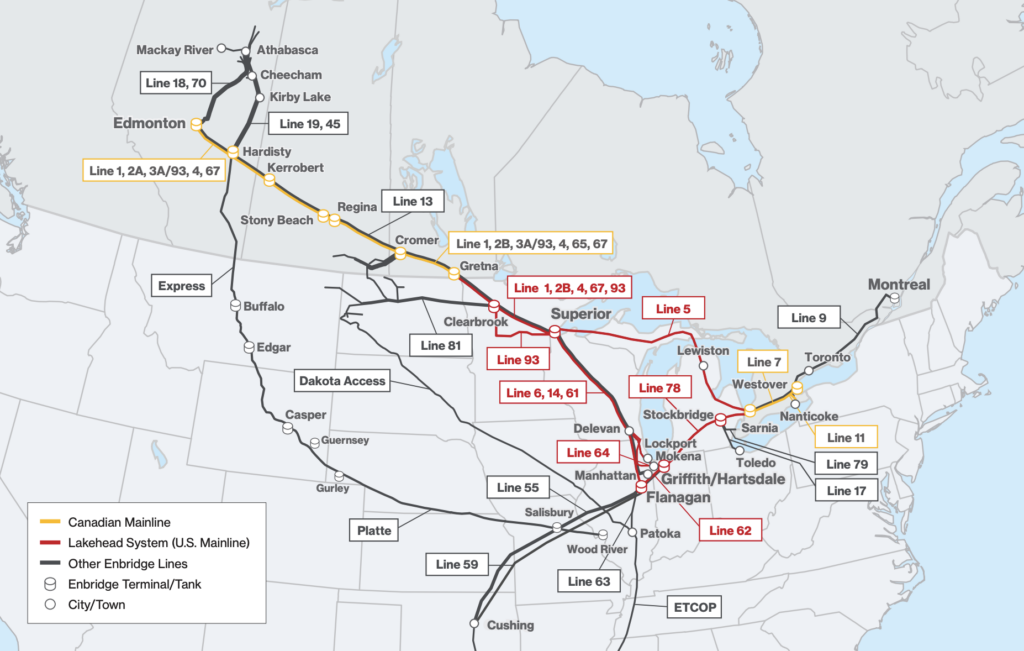
And yet, half a decade later, the Line 5 pipelines remain, haphazardly suspended across the lakebed floor, buffeted by strong currents and vulnerable to anchor strikes and other hazards in one of the busiest shipping lanes in the Great Lakes. Each day, Line 5 carries nearly 23 million gallons of fossil fuels from western Canada, through the Great Lakes — the majority of which supply Canadian refineries in Ontario and Quebec. The water security of the Great Lakes is at high risk every day.

On each of the 1,825 days and counting since the easement was revoked, Michigan has borne unacceptable risks so that a Canadian pipeline company can continue to profit, protect its market share, and deliver crude oil primarily from Canada to Canada. The Line 5 pipeline in the Straits of Mackinac could only be built in 1953 with a public trust easement from the state of Michigan; therefore, an easement authorizing Enbridge permission to occupy our public waters is necessary for its continued operation. That easement no longer exists.

The Line 5 pipeline and the proposed replacement tunnel are now being fought in multiple courts by multiple parties, including Flow Water Advocates.

Here’s where Line 5 currently stands in Michigan:

Nessel v. Enbridge

At issue:
In 2019, Michigan Attorney General Dana Nessel filed suit in Michigan’s 30th Circuit Court (Ingham County), seeking an order to decommission Line 5. She argues that its continued operation violates the public trust doctrine, is a public nuisance under common law, and violates the Michigan Environmental Protection Act.

Flow, along with the Great Lakes Business Network and the Sierra Club, briefed the court in 2019, 2021, and 2024 in support of Michigan’s sovereignty and public trust rights.

What has happened so far:
Enbridge has successfully delayed the case (and kept the oil and profits flowing) over matters of jurisdiction, and it initially succeeded in moving the case from state to federal court — long after the 30-day time limit to do so had passed.

  • In June 2024, the U.S. Sixth Circuit Court of Appeals ruled that the move to federal court was indeed untimely, and sent the case back to state court.

  • Enbridge then appealed to the U.S. Supreme Court, which in June 2025 agreed to hear the case on the procedural question of whether district courts have the authority to excuse the 30-day time limit — again prolonging the risks of Line 5’s continued operation. The SCOTUS will hear oral arguments in spring 2026.
What happens next:
In August 2025, Ingham County circuit court Judge James Jamo denied Enbridge’s request to stay (pause) the state case while awaiting a SCOTUS ruling. We are now awaiting a decision by Judge Jamo on whether Line 5 will be shut down.

Enbridge v. Whitmer

At issue:
On November 24, 2020, Enbridge filed its federal court lawsuit asserting that Governor Whitmer does not have the authority to protect its sovereign interests of public trust waters and submerged lands, and that state action against Line 5 may violate Enbridge’s alleged treaty right to pump oil through the Great Lakes uninterrupted.

What has happened so far:
Governor Whitmer moved to dismiss the action on the grounds that state officials have immunity from federal lawsuits under the U.S. Constitution’s Eleventh Amendment. Enbridge’s separate federal case against the state still remains before Judge Jonker in the U.S. District Court for the Western District of Michigan who held (we think wrongfully) that an exception applies.

  • In an October 2024 amicus brief, Flow and the Great Lakes Business Network argue that Enbridge’s lawsuit impairs state sovereign and public trust duties; and that long-standing legal principles that balance federal and state sovereign interests weigh in favor of states’ rights and jurisdiction over the public navigable waters and bottomlands of the Great Lakes.

On November 12, 2025, Judge Jonker heard oral arguments in the case. Michigan Assistant AG Keith Underkoffler argued that the state’s preexisting authority could not be undermined by the federal Pipeline Safety Act, which wasn’t enacted until 1968. Further, he argued that the state would not have granted the easement in 1953 if it had known that 15 years later, the state’s rights in relation to the easement would be preempted by the federal government.

On December 17, 2025, Judge Jonker issued a decision improperly preventing the State of Michigan from enforcing Gov. Whitmer’s revocation and termination of the easement.

What happens next:
The State of Michigan now has the option to appeal Judge Jonker’s decision to the U.S. Court of Appeals for the Sixth Circuit.

Michigan Supreme Court: Line 5 tunnel permit

At issue:
In late 2023, the Michigan Public Service Commission approved a permit for Enbridge’s proposed Line 5 pipeline tunnel under the Straits of Mackinac. In doing so, Flow argues that the MPSC failed in its duties under the public trust doctrine, Michigan Environmental Protection Act (MEPA), and Great Lakes Submerged Lands Act to protect the waters of the Great Lakes and their bottomlands for the people of Michigan; and that the MPSC failed to consider feasible and prudent alternatives to the tunnel.

What has happened so far:
Flow, along with other environmental groups, tribes, and an individual, appealed the MPSC’s permit decision in the Michigan Court of Appeals. In February 2025, the Court of Appeals affirmed the MPSC’s tunnel permit.

Flow and others then appealed that decision to the Michigan Supreme Court, which in September 2025 announced it would hear the appeals, paving the way for a review of the permit. The Supreme Court specifically directed the parties to address whether the MPSC is required to comply with the common law public trust doctrine and MEPA in its permitting decisions.

What happens next:
Flow and the other appellants submitted opening briefs to the court on November 14, 2025. Additional briefing will take place in December and January, with oral arguments expected to be scheduled in 2026.

Meanwhile, the proposed tunnel has yet to receive the required permits from the Michigan Department of Environment, Great Lakes, and Energy (EGLE) and the U.S. Army Corps of Engineers (USACE).

Read: Flow’s comments to EGLE; Flow’s comments to USACE.

The USACE is now also conducting a supplemental Environmental Impact Statement (EIS) that will evaluate horizontal directional drilling. Flow, in partnership with the Sierra Club and Surfrider Foundation, submitted public comments on December 5, 2025.

The next five years.

It is unlikely — though not impossible — that we will go another half-decade before the Line 5 threat is resolved. Flow is fighting every day for a resolution that respects Michigan’s sovereignty, the public trust doctrine, and the rights of all Michiganders present and future to enjoy, navigate, use, and be sustained by the irreplaceable waters of our Great Lakes. As part of our work, we also are committed to ensuring water security and energy security solutions for the Great Lakes region. It is our fervent hope that Line 5 is shut down lawfully by our civil courts, and not because of an oil spill disaster.

Flow Water Advocates files Line 5 brief with the Michigan Supreme Court.

November 17, 2025

[ DOWNLOAD: Flow Water Advocates Brief on Appeal (PDF) ]


Traverse City, Mich. — Flow Water Advocates (“Flow”) has filed a brief in its appeal of the Michigan Public Service Commission’s decision to approve a permit for Enbridge’s proposed Line 5 pipeline tunnel under the Straits of Mackinac. Flow’s appeal will be heard in the Michigan Supreme Court.

In September, the Court granted a landmark application for leave to appeal, paving the way for a review of the permit. Flow initiated the legal challenge, arguing that the MPSC failed to uphold its public trust obligations to protect Michigan’s waters and submerged lands. The Supreme Court’s order specifically directs the parties to address whether the MPSC is required to comply with the common law public trust doctrine in its permitting decisions.

Support Flow’s work to defend the Great Lakes.

In its brief filed on November 14, Flow addresses three central questions regarding the common-law public trust doctrine and the Michigan Environmental Protection Act (“MEPA”) and their application by the MPSC.

First, Flow argues that the plain meaning of the statutory text and the legislative history of MEPA binds all agencies to protect the air, water, and other natural resources and the public trust in these resources.

Second, Flow maintains that all agencies, including the MPSC, as arms of the state have an independent duty to comply with the State’s public trust obligations. As the sovereign title holder, the State may not violate the public trust by granting rights to use the Great Lakes bottomlands without regard to the trust’s restrictions. Thus, the effect of the common-law public trust doctrine is to safeguard the public’s interests in the waters and submerged lands of the Great Lakes. When the MPSC granted the tunnel permit without conducting a public trust analysis, it failed to fulfill its duty to assess potential impacts to the public’s paramount rights in the resources at stake.

Third, Flow argues that the MPSC cannot permit Enbridge’s tunnel project unless and until the Department of Environment, Great Lakes and Energy (“EGLE”) makes the requisite public-trust determinations under the common-law public trust doctrine and the Great Lakes Submerged Lands Act. In its brief, Flow articulates what a proper public trust analysis must look like to ensure that the proposed action — in this case, the siting and construction of an underground tunnel and pipeline through the bottomlands of the Straits — does not violate the State’s obligation to protect these public trust resources. EGLE cannot approve any proposed use of Great Lakes bottomlands, unless it has determined both that the adverse effects to the environment and the public trust will be minimal, and that there is no feasible and prudent alternative to the applicant’s proposed activity — such as the shutdown of Line 5. These mandatory determinations have not been made; therefore, the MPSC is required to deny Enbridge’s permit application under Michigan law.

Flow is represented in this case by its legal team and co-counsel, Kanji & Katzen, P.L.L.C. and Olson & Howard, P.C. The case will be heard alongside a related appeal from a coalition of the Little Traverse Bay Band of Odawa Indians, Bay Mills Indian Community, Grand Traverse Band of Ottawa and Chippewa Indians, and Nottawaseppi Huron Band of the Potawatomi, with the Environmental Law and Policy Center and the Michigan Climate Action Network.

###

Flow Water Advocates is an independent 501(c)(3) nonprofit organization based in Traverse City, Michigan. Our mission is to ensure the waters of the Great Lakes Basin are healthy, public, and protected for all. With a staff of legal and policy experts, strategic communicators, and community builders, Flow is a trusted resource for Great Lakes advocates. We help communities, businesses, agencies, and governments make informed policy decisions and protect public trust rights to water. Learn more at www.FlowWaterAdvocates.org.

Michigan Supreme Court grants review of Line 5 tunnel permit

FOR IMMEDIATE RELEASE: September 19, 2025

Lansing, Mich. – The Michigan Supreme Court has granted a landmark application for leave to appeal, paving the way for a review of the Michigan Public Service Commission’s (MPSC) decision to approve a permit for Enbridge’s proposed oil pipeline tunnel in the Straits of Mackinac. This order, issued on September 19, 2025, also invites the State Bar of Michigan Environmental Law Section and Real Property Law Section to file amicus briefs.

Support Flow’s work to defend the Great Lakes.

For Love of Water (FLOW), a Traverse City-based environmental nonprofit recently rebranded as Flow Water Advocates, initiated the legal challenge, arguing that the MPSC failed to uphold its public trust obligations to protect Michigan’s waters. The Supreme Court’s order specifically directs the parties to address whether the MPSC is required to comply with the common law public trust doctrine in its permitting decisions.

“This is an incredibly important step forward for the protection of the Great Lakes,” said Flow Water Advocates Legal Director Carrie La Seur. “The public trust doctrine is a fundamental principle of Michigan law that must be considered in decisions that affect our natural resources. We are eager to argue this case and ensure that our state’s waters are protected for generations to come.”

The case will be heard alongside a related appeal from the Little Traverse Bay Bands of Odawa Indians, a testament to the broad legal and public interest in this issue. The Supreme Court’s decision to grant review signifies the high stakes and critical legal questions surrounding the Enbridge Line 5 tunnel.

Flow is represented in this case by its legal team and co-counsel.

###

Flow Water Advocates is an independent 501(c)(3) nonprofit organization based in Traverse City, Michigan. Our mission is to ensure the waters of the Great Lakes Basin are healthy, public, and protected for all. With a staff of legal and policy experts, writers, and community builders, Flow is a trusted resource for Great Lakes advocates. We help communities, businesses, agencies, and governments make informed policy decisions and protect public trust rights to water. Learn more at www.FlowWaterAdvocates.org.