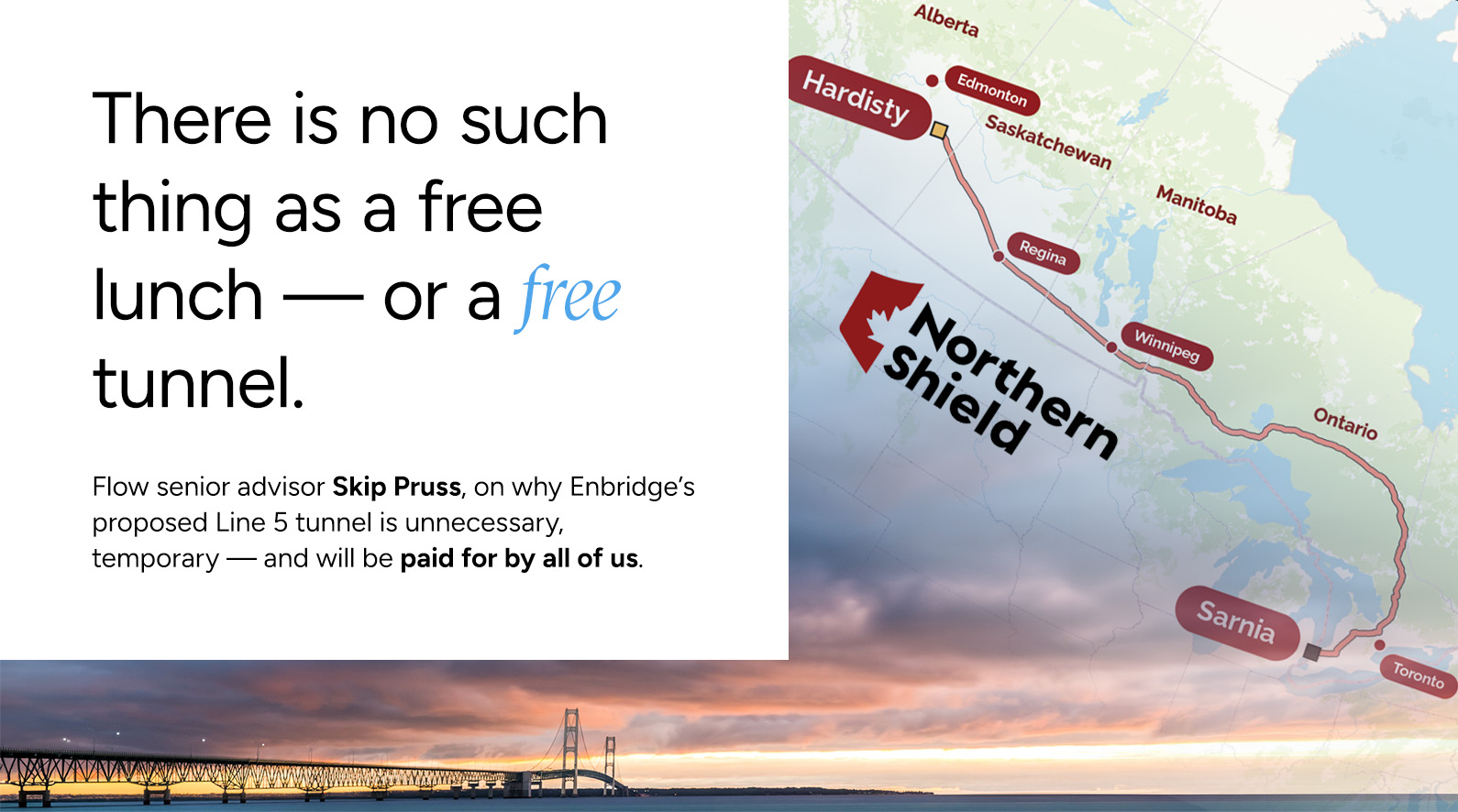
Every day, hundreds of thousands of barrels of crude oil and natural gas liquids (NGLs) flow across the Straits of Mackinac through two 20-inch pipelines that have proven vulnerable to anchors dropped by passing freighters and barges. There’s a broad consensus for the need to remove the aging pipelines and reduce the risk of a catastrophic oil spill in one of the world’s most environmentally sensitive areas.
The solution proposed by Enbridge, the Canadian owner of the pipelines, is to build a tunnel, 21-feet in diameter and four miles long, deep below the Straits of Mackinac. The tunnel would enclose a new pipeline, making it less vulnerable than it is today.
The cost? Likely $2 billion – to be paid by consumers.
In an era of rising costs with consumer pain over the high cost of gas in particular, it would be reasonable and prudent to look for another, less costly delivery solution.
Energy security after Line 5.
Two exhaustive studies by PLG, one of the world’s leading pipeline and logistical consultancies with deep analytical expertise, have identified solutions that would reduce costs for both Enbridge and consumers while completely obviating any future environmental risks.
PLG identified a range of replacement options that are both “commercially viable and operationally feasible.”
Enbridge’s Lakehead System is a complex web of energy infrastructure transporting 36 million barrels of through more than 1900 miles of pipelines, with 20 major terminals, 200 tanks, and over 600 pumping systems.
First constructed more than 70 years ago, Line 5 is part of Enbridge’s Lakehead System, a network of pipelines in the Great Lakes region. It is fed by Enbridge pipelines originating in Western Canada.
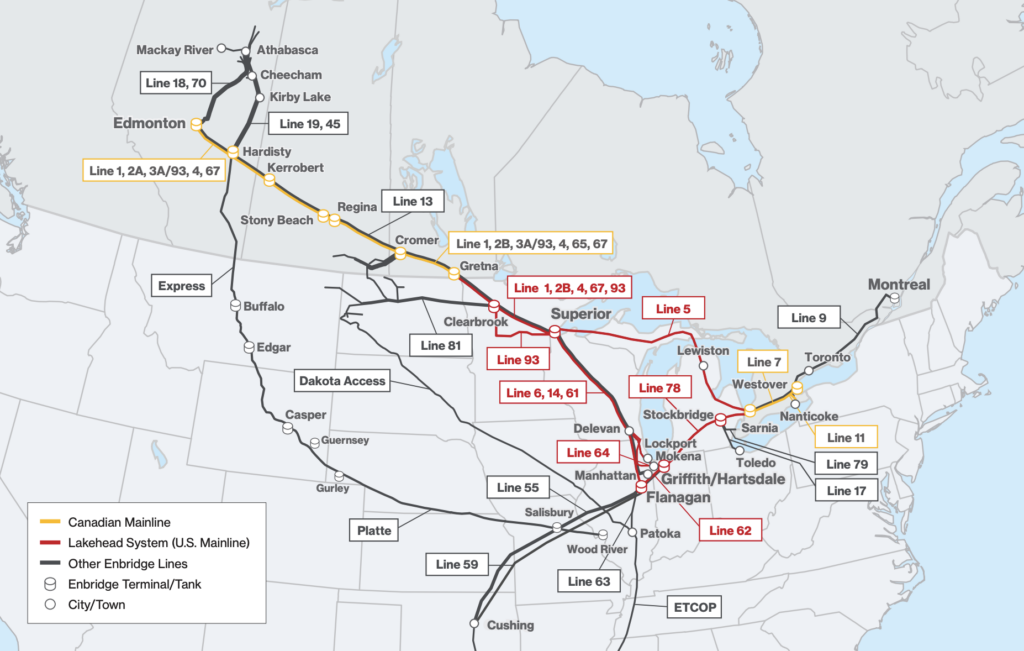
Line 5 transports between 400,000 and 450,000 barrels per day (bpd) of crude oil, in addition to about 80,000 bpd of NGLs east from Superior, Wisconsin, to Sarnia, Ontario. At least 88% of Line 5 crude oil is delivered to Canada.
PGL concluded:
“Based upon careful research as well as PLG’s more than 15 years of consulting experience in energy supply chains and logistics, our analysis demonstrates that energy markets will adapt – as they have always done and continue to do – in the event that Line 5 is shut down. With advance notice, the markets can be expected to do so without supply shortages or price spikes.”
The reality is that if Line 5 were to shut down tomorrow, the vast North American pipeline system would recalibrate “and would not materially affect the affordability or market competitiveness of product delivered to any given Line 5 destination area.”
Recall, the dire predictions of widespread energy shortages accompanying the disruption of energy supplies resulting from the Russian invasion of Ukraine in February 2022. The immediate response included recalibration of the European energy system and the near immediate phase out of EU dependence on Russian gas, oil and coal.
Canada is considering a new pipeline to avoid the Great Lakes — and the United States.
The Canadian government is actively exploring a new pipeline corridor wholly on Canadian soil that would connect Alberta production directly to Sarnia, bypassing the Great Lakes entirely. This alternative would accomplish Enbridge’s stated objective — delivering crude to Sarnia refineries — without running a high-risk line across Michigan and the Straits of Mackinac, or spending billions on a tunnel under the Great Lakes.
The fact that Canada is seriously studying this option undercuts the claim that Line 5 is irreplaceable. If a domestic Canadian route is technically and economically feasible—and Ottawa’s interest suggests it is—then doubling down on the construction of a contested, geotechnically challenged tunnel becomes even harder to justify.
Enbridge acknowledges that the “tunnel solution” is temporary.
Enbridge itself acknowledges that the “tunnel solution” is temporary. In a filing to the U.S. Federal Energy Regulatory Commission, the company sought to shorten (“truncate”) depreciation schedules for its U.S. energy infrastructure. The deprecation schedule is important because it sets a time horizon for when the tunnel becomes an essentially worthless asset. Enbridge’s stated reasons are telling: “current and anticipated competition to the Enbridge Mainline,” “actions by state and local governments,” and “the uncertainty arising from the recent acceleration” of decarbonization laws and policies in both the U.S. and Canada.
Electric vehicle adoption is reducing oil demand as well. The International Energy Agency forecasts that electric vehicles will displace more than 5 mb/d by 2030.
In plain terms, Enbridge has informed regulators that long-term demand for its pipelines is uncertain and increasingly constrained by policy and market changes. That admission directly contradicts any narrative that Line 5 — and especially a massive new tunnel project — is an essential, long-term energy asset. If Enbridge expects its mainline infrastructure to face declining utilization and competitive pressure, why should regulators or consumers underwrite an expensive new tunnel that is likely to be underused well before its engineered lifespan expires?
We will all pay for the tunnel.
Finally, consumers will ultimately pay for the avoidable $2 billion cost of the tunnel. Pipeline companies recover capital expenditures on infrastructure like the tunnel through tariffs — fees that are embedded in the price of gasoline, diesel, jet fuel, and home heating fuels and passed on and paid by the end-user: you. A multibillion-dollar tunnel that is not critical for regional energy security is, in effect, a privately directed but consumer-funded infrastructure project.
In a market that already enjoys ample supply, multiple alternative routes, and strong redundancy, forcing households, small businesses, and industrial users to finance an unnecessary tunnel is neither reasonable nor prudent. Those dollars could instead support grid modernization, energy efficiency, electrification, or genuinely forward-looking infrastructure that aligns with evolving decarbonization policies.
Taken together, the evidence points to a clear conclusion: Line 5 is not a lynchpin of North American energy security. The integrated, surplus-rich, and highly adaptable North American pipeline system already in place can reliably serve the Great Lakes region without the dangerous Line 5 shortcut and the tunnel. With viable Canadian alternatives emerging, Enbridge’s own acknowledgment that its assets face declining long-term demand, and a hefty price tag that would be borne by consumers, the proposed Line 5 tunnel is not just risky — it is unnecessary.

Flow senior advisor Stanley “Skip” Pruss was the former director of the Michigan Department of Energy, Labor, and Economic Growth; and the State’s Chief Energy Officer under former Gov. Jennifer Granholm. Earlier in his career, Skip served as Deputy Director of the Michigan Department of Environmental Quality.
