Canadian pipeline company Enbridge wants to bore a massive fossil fuels tunnel through Straits of Mackinac. The proposed four mile tunnel would remove 364,000 cubic yards (or
27,000 dump truck loads) of earth and rock from the bottomlands of the Great Lakes.
The U.S. Army Corps of Engineers finds that the tunnel project would result in both short- and long-term detrimental impacts1, including loss of wetlands and wildlife habitats; potential release of drilling fluids; up to six years of construction noise, lights, traffic, and vibrations; limits to recreational activities; destruction of archaeological resources; and impacts to property values and tourism.
The State of Michigan is the legal trustee of the Straits, and has the power and duty to protect them for the benefit of Michiganders and future generations. Let’s take a look at why the tunnel is a dead end:
1. The Line 6B disaster.
Enbridge was responsible for the devastating 2010 Line 6B oil spill in Marshall, Michigan — one of the worst inland oil spills in U.S. history. In its investigation of the 1.2 million gallon disaster, the NTSB cited “pervasive organizational failures” at Enbridge.2
2. Bad track record.
There have been 34 documented Line 5 oil spills in Michigan and Wisconsin, totaling over 1.3 million gallons. The pattern continued as recently as November 2024, when 70,000 gallons3 spilled in Jefferson, Wisconsin
3. Irresponsible.
In 2024, the federal government had to order Enbridge to repair cracks4 in Line 5, and assess cracks using more comprehensive methods that account for all pipeline stresses.5 Enbridge should have taken this measures without being told.
4. Unaccountable.
In 2020, an Enbridge internal investigation revealed that an Enbridge-contracted ship likely dragged a cable and damaged Line 5 in the Mackinac Straits. Enbridge later admitted it failed to notify the state as was required.6
According to Enbridge, Line 5 supplies half of the oil used in Ontario and Quebec,7 or approximately 396 thousand barrels per day.8 Line 5 carries 400-450 thousand barrels of crude oil per day9 from northwestern Canada, eastward. Upwards of 88% of Line 5 crude oil flows from Canada, to Canada, using the Great Lakes and Michigan as a risky short-cut to Sarnia, Ontario.
Line 5 also carries 80 thousands barrels of Natural Gas Liquids per day.
“We’ve seen multiple occasions where as a country we [Canada] can’t get behind building pipelines, so it’s important to keep the existing ones up and running.”10
Vern Yu, Enbridge Executive Vice-President and President, Liquids Pipelines (fmr.)
Unstudied, unstable.
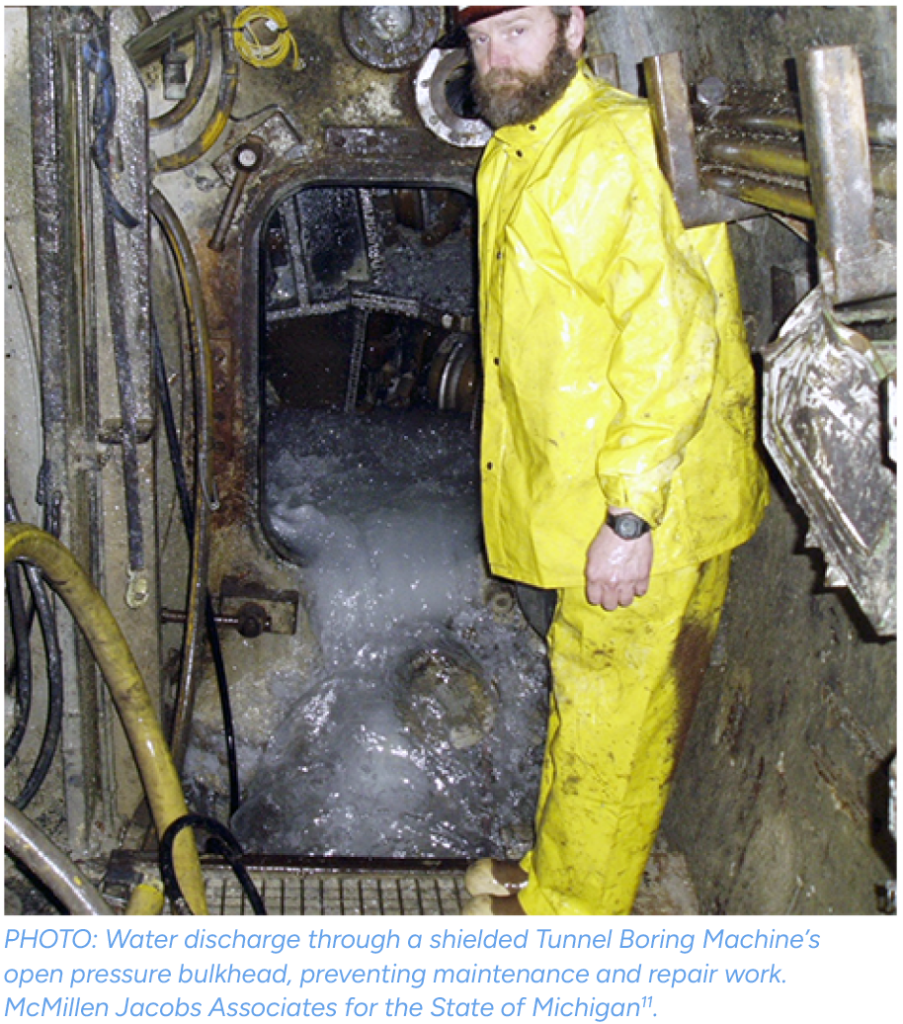
What we know about the rock quality under the Straits.
A technical review of the proposed tunnel by the Michigan Department of Transportation raised numerous red flags and factors that could result in tunnel collapse, environmental damage, or even an explosion.
Enbridge hasn’t done its homework.
1. Lack of due diligence.
Understanding the bedrock and geology of the tunnel’s path is critical for its safe construction and operation. But Enbridge only sampled the rock an average of once every 950 feet, far below the industry standard of once every 50 to 250 feet.13
2. Insufficient sampling.
Enbridge only took one rock sample over a span of about 11,000 feet14 — the deepest, most critical section of the proposed tunnel route. There is a span of 1.5 miles that has not been sampled at all (thousands of feet longer than the un-sampled sections of similar tunnel project).15
3. Wrong depth.
Enbridge didn’t take enough rock samples, and some of the samples it did take were not deep enough.16 The percentage of samples laying within the zone of the tunnel path was less than the typical amount of samples studied during comparable projects.17
4. Unprecedented.
A hazardous liquids pipeline tunnel of this length, depth, and in geologic and hydrostatic pressure conditions like those found in the Mackinac Straits has never before been attempted.18 We cannot allow the Great Lakes to be Enbridge’s guinea pig.
The unacceptable risk of collapse and explosion.
Instead of solid, uniform bedrock, this tunnel would bore through fractured geologic formations that are “poor” and “very poor” quality, and contain voids.19 This type of rock with large, open seams, has high hydraulic conductivity, which means water can easily flow through it. Studies have also found high hydrostatic pressure at tunnel depth.20
This all adds up to a sponge-like environment that is vulnerable to uncontrollable inflows of water — water that is connected to Lake Michigan.
Tunneling through a slurry of rock and soil, or mixed-face tunneling, is “the most dangerous type of tunneling”21 and there is a risk of collapse around the tunnel boring machine (TBM).
Experts also warn that vapors within the tunnel and dissolved methane in the groundwater could ignite and cause an explosion.22, 23
A tunnel to the past.
Investing in a new fossil fuels tunnel doesn’t add up.
The world is changing, and so are energy markets. Increasing fuel efficiency, electric vehicle sales, and decarbonization across industries make this new fossil fuels tunnel a bad bet.
With global oil demand predicted to peak this decade,24 we should not invest in a massive piece of fossil fuel infrastructure that will start to become obsolete almost as soon as it opens.

A bad investment for Enbridge and Michigan.
1. Skyrocketing costs.
A 2025 report by the non-partisan Institute for Energy Economics and Financial Analysis (IEEFA) found that the tunnel may cost up to three times more than initial estimates.25 Meanwhile, Enbridge also faces an expensive 41-mile reroute in Wisconsin.
2. Depressed market.
During this critical time for climate action, projects like the Line 5 tunnel are a bad bet — and Wall Street knows it. The fossil fuels sector underperformed the S&P 500 for 7 of the last 10 years, delivering the lowest performance of all S&P 500 sectors.26
3. Declining demand.
According to Goldman Sachs, global oil demand will peak in 2035 and then begin to decline27 — just six years after the tunnel is scheduled to open.28 U.S. gasoline consumption peaked in 2018 and has fallen more than 4% despite population growth.29
4. You’re on the hook.
Ownership of the tunnel would transfer to the Mackinac Straits Corridor Authority — or in other words, Michigan taxpayers. Enbridge may lease the tunnel rent- free30 for up to 99 years. It’s unclear who will be liable for its upkeep if the lease is terminated early.31
The tunnel isn’t the answer.
There’s no question: Line 5 as it exists today, resting exposed on the lake bed floor, buffeted by strong currents and vulnerable to anchor strikes,32 is an unacceptable threat to our Great Lakes.
That’s why Michigan Gov. Gretchen Whitmer revoked the Line 5 easement in 2020 and ordered that it be shut down. (Enbridge continues to operate Line 5 in defiance of the State of Michigan.)
Due to the poor rock quality and volatile gasses, the tunnel would not eliminate the threat of an oil spill.
The multi-year construction phase would be especially risky, as Enbridge plans to operate the existing Line 5 during the boring underneath.
The good news is, there are other ways33 to supply fossil fuels to eastern Canada and replace the much smaller amounts supplied by Line 5 to Michigan and the U.S. — alternatives that don’t endanger the Great Lakes.
Here’s the big picture: building the tunnel would feed climate change, lock Michigan into fossil fuels, and deincentivize the development of healthier regional energy networks and solutions. We can do better.
Michigan after Line 5.

We can get oil out of the Great Lakes and make a better future.
Facing competition from other pipeline companies and declining demand, Enbridge is working overtime to protect its profits and convince Michiganders that we’re dependent on Line 5, but that’s not true.
We have a range of viable alternatives to Line 5, including excess capacity in existing pipelines34 that go around, and not through, the Great Lakes
What happens when we decommission Line 5.
1. Stable prices.
Enbridge’s own expert found that gas prices in Michigan would only increase half a cent per gallon,36 well within normal fluctuations. And a report from supply chain analyst PLG Consulting says that a planned and orderly shut down of Line 5 will not result in price spikes.37
2. Depressed market.
PLG Consulting has also calculated that 87% of Line 5’s crude oil supply could be replaced within three months by fully utilizing Enbridge Line 78 through southern Michigan. Any shortfalls could be supplemented by other transport methods and regions.38
3. Energy independence for Canada.
Since early 2025, Canadian leaders have expressed new interest in investing in their energy security.39 This could include reviving the proposed Energy East pipeline, which would run entirely north of the U.S. border and Great Lakes, supplying Canada’s eastern provinces.40
4. Protected waters.
Michigan has the power to deny the tunnel permit, and protect the Great Lakes from years of construction upheaval, wetlands damage, and other risks. Michigan can assert its sovereignty, stop the exploitation of our resources, and protect the waters today and for generations to come.
References
1. U.S. Army Corps of Energineers, Enbridge Line 5 Tunnel Project Final Environmental Impact Statement.
2. National Transportation Safety Board, https://www.ntsb.gov/investigations/AccidentReports/Reports/PAR1201.pdf
3. Wisconsin Public Radio, https://www.wpr.org/environment/enbridge-oil-spill-jefferson-county-wisconsin-pipeline
4. Detroit News, https://www.detroitnews.com/story/news/local/michigan/2024/07/08/enbridge-line-6 b-proposed-eighth-modification-circumferential-cracks/74327136007/
5. U.S. Dept. of Justice, https://www.justice.gov/enrd/media/1359506/dl
6. MI Attorney General, https://www.michigan.gov/ag/news/press-releases/2020/06/25/judge-orders-line-5-to -cease-operations
7., 10. Canada House of Commons, https://www.ourcommons.ca/DocumentViewer/en/43-2/CAAM/meeting-4/evidence
8. Government of Canada, https://www150.statcan.gc.ca/t1/tbl1/en/cv.action?pid=2510003001 9., 33., 34., 35., 37., 38. PLG Consulting, https://plgconsulting.com/white-paper-likely-market-responses-to-a-line-5-shutdown/
11., 12. McMillen Jacobs & Associates for MDOT, https://www.michigan.gov/-/media/Project/Websites/egle/Documents/Multi-Division/L ine-5/MDOT_Question_on_Collapses_in_Terms_of_Loss_of_Face_Control_Jan_2021.pd f
13. Michigan Advance, https://michiganadvance.com/2020/09/28/geologists-condemn-line-5-tunnel-plan-pe rmitting-the-project-at-this-time-would-be-a-mistake/
14., 15. McMillen Jacobs & Associates for MDOT, https://www.michigan.gov/-/media/Project/Websites/egle/Documents/Multi-Division/L ine-5/MDOT_Question_on_Risk_mitigation_Jan_2021.pdf
16., 17., 19., 20. McMillen Jacobs & Associates for MDOT, https://www.michigan.gov/-/media/Project/Websites/egle/Documents/Multi-Division/L ine-5/MDOT_Question_on_Geotechnical_Investigation_Jan_2021.pdf
18. EarthJustice, https://earthjustice.org/press/2025/tribes-greens-take-line-5-tunnel-to-michigans-supremecourt
21. Michigan Advance, https://michiganadvance.com/2020/09/28/geologists-condemn-line-5-tunnel-plan-permittin g-the-project-at-this-time-would-be-a-mistake/
22. Richard Kuprewicz, comments to the Michigan Public Service Commission, https://narf.org/nill/documents/20211214-line5-mpsc-kuprewicz-testimony.pdf
23. Brian O’Mara, testimony to the Michigan Public Service Commission, https://turtletalk.blog/wp-content/uploads/2023/02/bay-mills-experts.pdf
24., 27. Goldman Sachs, https://www.goldmansachs.com/insights/articles/peak-oil-demand-is-still-a-decade-away 25. Institute for Energy Economics and Financial Analysis, https://ieefa.org/resources/enbridge-should-consider-closing-its-old-troubled-line-5-pipeline
26. Institute for Energy Economics and Financial Analysis, https://ieefa.org/sites/default/files/2025-01/REVIEWED-15818-Briefing%20Note_2024%20Re cap%20oil%20stocks%20%281%29.pdf
28. Bridge Michigan, https://www.bridgemi.com/michigan-environment-watch/trump-administration-fast-track-lin e-5-tunnel-calling-project-emergency 29. U.S. Energy Information Administration, https://www.eia.gov/tools/faqs/faq.php?id=23&t=10
30., 31. State of Michigan, https://www.michigan.gov/psab/-/media/Project/Websites/psab/archive/media/ProposedTun nelLease_12-13-18.pdf
32. Flow Water Advocates, https://flowwateradvocates.org/line5
36. Neil K. Earnest, Muse, Stancil & Co, federal court filing, https://environmentaldefence.ca/wp-content/uploads/2022/06/Report-expert-Enbridge-exp ert-Neil-Earnest-Muse-Stancil.pdf
39. Canadian Broadcasting Corporation, https://www.cbc.ca/news/politics/west-east-pipeline-jonathan-wilkinson-1.7452406
40. Financial Post, https://financialpost.com/commodities/energy/sentiment-pipelines-trump-canada
