Tag: Line 5

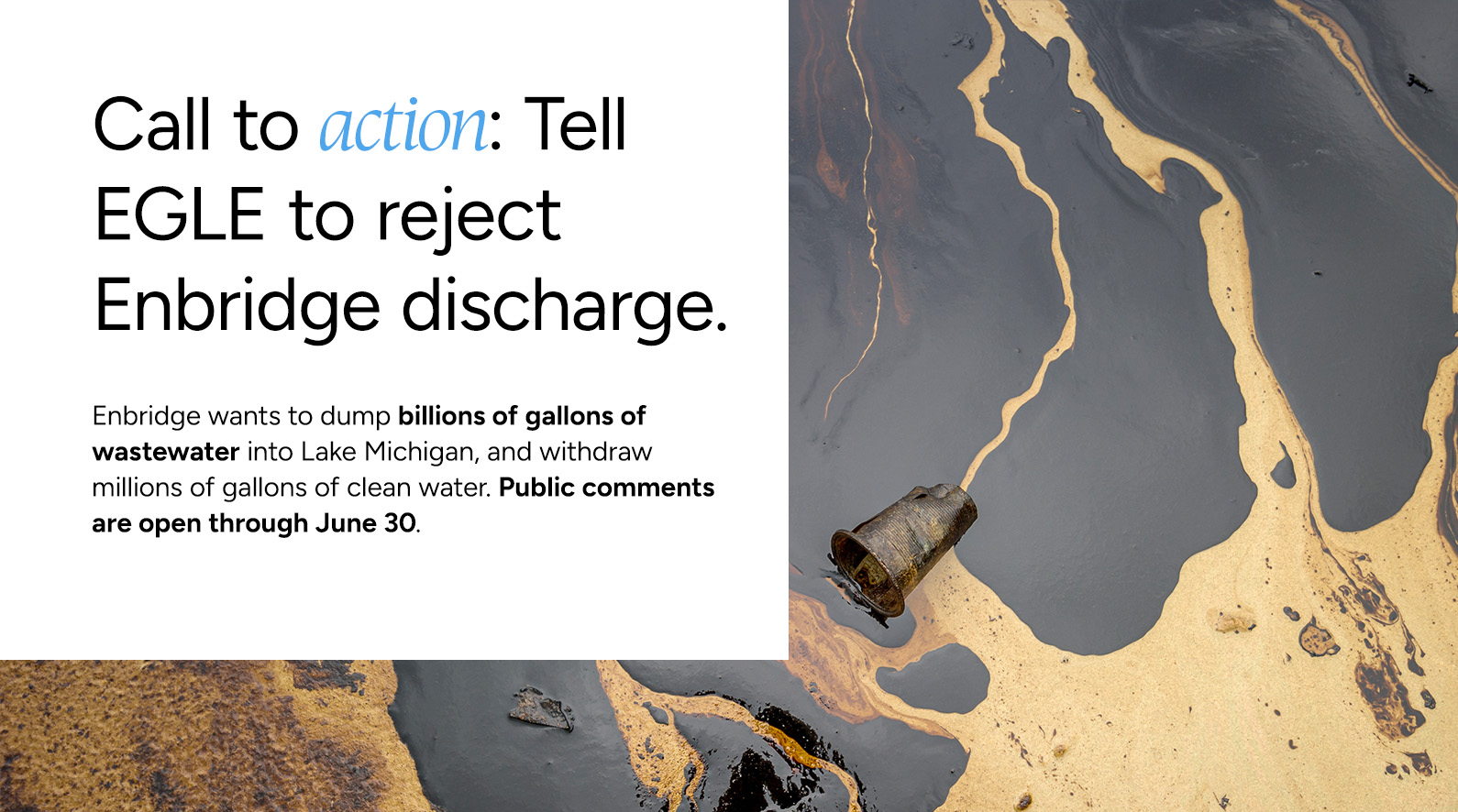
Last chance to speak up: Reject Enbridge’s discharge into Lake Michigan

What is happening:

Enbridge is requesting a permit from the Michigan Department of Environment, Great Lakes, and Energy (EGLE) for its proposed Line 5 pipeline tunnel under the Straits of Mackinac. If approved, the permit would allow Enbridge to:

  • Dump billions of gallons of wastewater into Lake Michigan — enough to fill 9 Olympic-sized swimming pools every day
  • Take up to 2 million gallons of water per day directly from Lake Michigan
  • Discharge chemical additives, chlorides, solids, as well as pollutants from the heavy machinery used to bore the tunnel (like metals, oil, and grease)

The discharges may also affect the temperature and pH of the water, altering its chemistry and stressing fish and other aquatic life.

What you can do:

EGLE is now taking public comments on Enbridge’s requested National Pollutant Discharge Elimination System (NPDES) permit, now and through June 30.

1) Tell EGLE and the State of Michigan to say NO to Enbridge’s plan to take millions of gallons of clean water from Lake Michigan, and discharge billions of gallons of dirty wastewater back into Lake Michigan. DEADLINE: June 30.

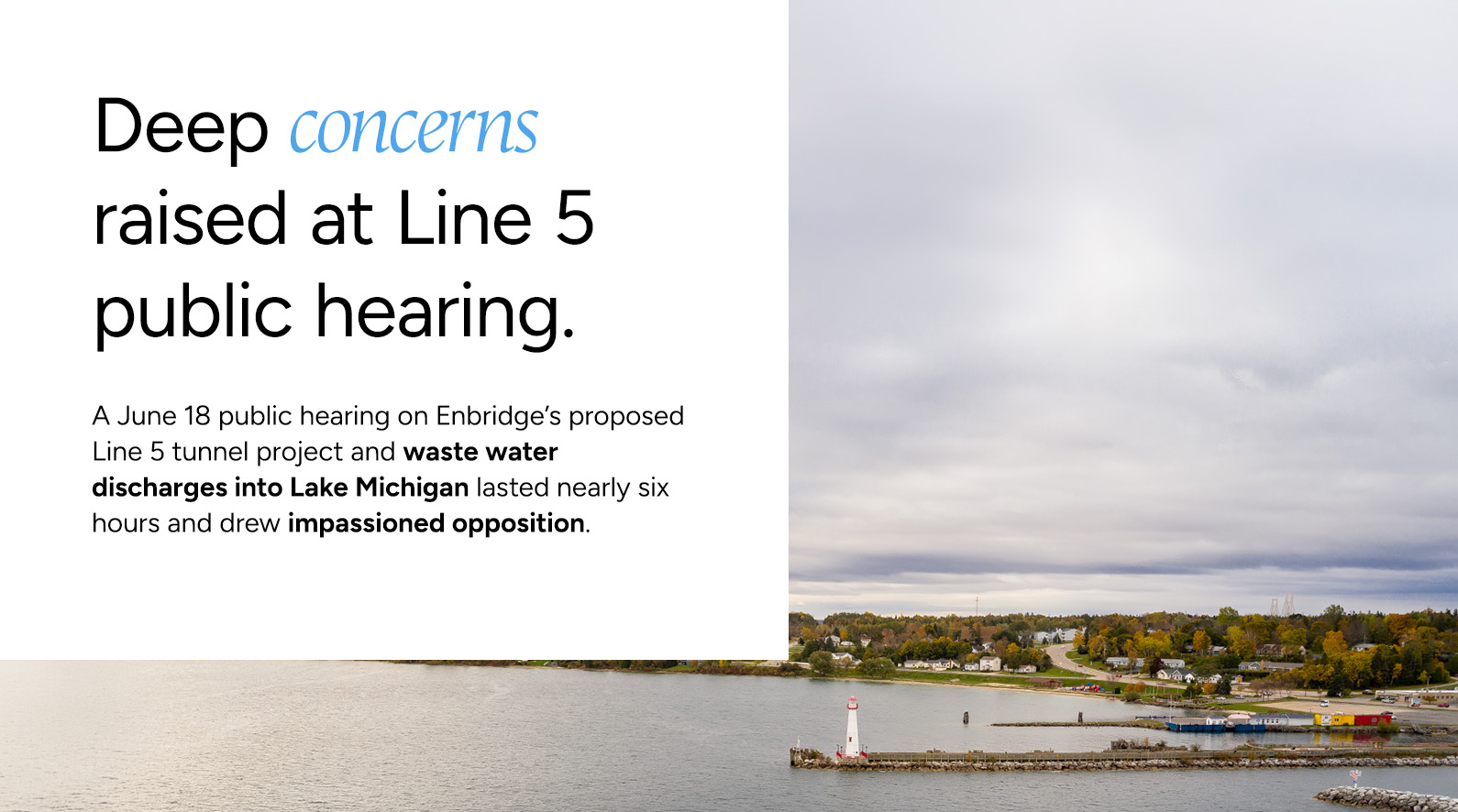
2) Attend the virtual public hearing on June 18 at 6:00pm. The public meeting will include a presentation and Q&A session, after which the public will have an opportunity to provide comments for the record. 

Enbridge must receive multiple state and federal permits for its troubled tunnel proposal. You may have already commented on a previous federal or state permit application for the tunnel (thank you!), but it’s important to comment on this new permit too.

This is likely our last chance to tell EGLE and Governor Whitmer to reject Enbridge’s dangerous and unnecessary tunnel project and deny Enbridge permission to pollute the Great Lakes.

Additional resources:

Michigan gets the risk, Canada gets the oil

What every Michigander needs to know about the Line 5 tunnel

REPORT: Enbridge's tunnel plan costly and ill-advised

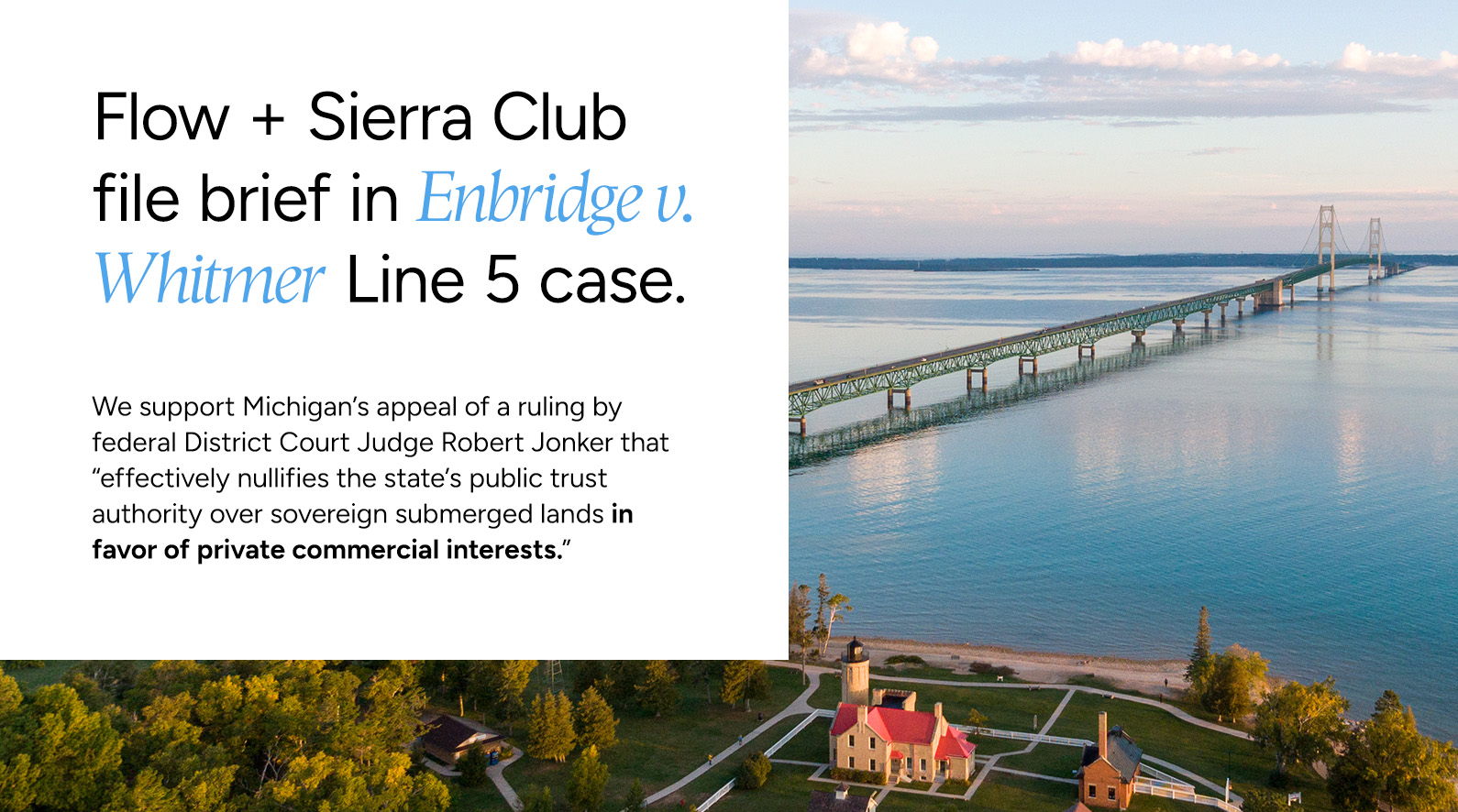
Flow and Sierra Club file joint amici brief in Enbridge v. Whitmer Line 5 case

Traverse City, Mich. — On May 11th, 2026, Flow Water Advocates (“Flow”) and Sierra Club filed an amici curiae, or friend of the court, brief in support of the State of Michigan’s appeal of a federal court’s failure to recognize and uphold an essential attribute of state sovereignty — the public trust doctrine. Flow and Sierra Club together represent thousands of Michiganders who stand up for the State’s right and duty to protect our publicly held lands in the Straits of Mackinac from the urgent threat to the waters and shorelines of the Great Lakes posed by Enbridge’s aging and vulnerable Line 5 pipeline.

Last December, federal District Court Judge Robert Jonker issued a ruling that, as Flow and Sierra Club explain in their brief, “effectively nullifies that state’s exercise of public trust authority over sovereign submerged lands in favor of private commercial interests — an extraordinary action never before sanctioned by the United States Supreme Court or any federal appellate court.” Flow and the Sierra Club argue further that the District Court committed legal error in holding that the State’s attempt to shut down Line 5 is preempted by the safety regulations in the federal Pipeline Safety Act of 1992 and interferes with the federal government’s conduct of relations with Canada and the administration of a 50-year-old treaty between the two countries.

Flow’s Senior Legal Advisor and Founder, Jim Olson said, “Public trust rights and interests foreclose any preemption because the State’s public trust responsibility is an essential element of statehood and can never be abrogated.”

“State sovereignty has to be protected here. The State of Michigan stood by its people and took action to protect Michiganders from the Line 5 pipeline. The safety of Michigan’s communities, lands, and waters is at risk every day this pipeline continues to operate,” said Anne Woiwode, leader, Sierra Club Michigan Chapter.

Flow and Sierra Club’s argument is grounded in the well-established, Supreme Court affirmation of the public trust doctrine (Ill. Cent. R. Co. v. Illinois, 146 U.S. 387, 453-55 (1892)) that supports revocation of a conveyance that was wrongfully granted in violation of the public trust. The State’s power to revoke isn’t just a power possessed by the state; it is an obligation when a conveyance (in this case, the easement) violates the public trust. As stated in Flow and Sierra Club’s brief: “Equating Michigan’s exercise of its public trust authority with enforcement of a “safety standard,” and thus preempted by 49 U.S.C. Section 60104(c), requires a semantical backflip that is contrary to the clear statement rule.”

Flow and Sierra Club also argue that the State’s easement revocation is not preempted by the foreign affairs doctrine; in fact, the 1977 Treaty governing transnational pipelines expressly provides the State with the authority to do what Michigan did in this case. The District Court’s interpretation of the treaty would “read a significant reservation of rights out of the treaty altogether.”

Five additional amici were filed in support of the state, including: The Great Lakes Business Network; a coalition of states led by Minnesota; a group of preemption, energy law, and environmental law scholars; a coalition of tribal nations led by Bay Mills Indian Community; and a group of foreign relations law professors.

###

Flow Water Advocates is an independent 501(c)(3) nonprofit organization based in Traverse City, Michigan. Our mission is to ensure the waters of the Great Lakes Basin are healthy, public, and protected for all. With a staff of legal and policy experts, strategic communicators, and community builders, Flow is a trusted resource for Great Lakes advocates. We help communities, businesses, agencies, and governments make informed policy decisions and protect public trust rights to water. Learn more at FlowWaterAdvocates.org.

Sierra Club is America’s largest and most influential grassroots environmental organization, with more than 3.5 million members and supporters. In addition to protecting every person’s right to get outdoors and access the healing power of nature, the Sierra Club works to promote clean energy, safeguard the health of our communities, protect wildlife, and preserve our remaining wild places through grassroots activism, public education, lobbying, and legal action. For more information, visit www.sierraclub.org.

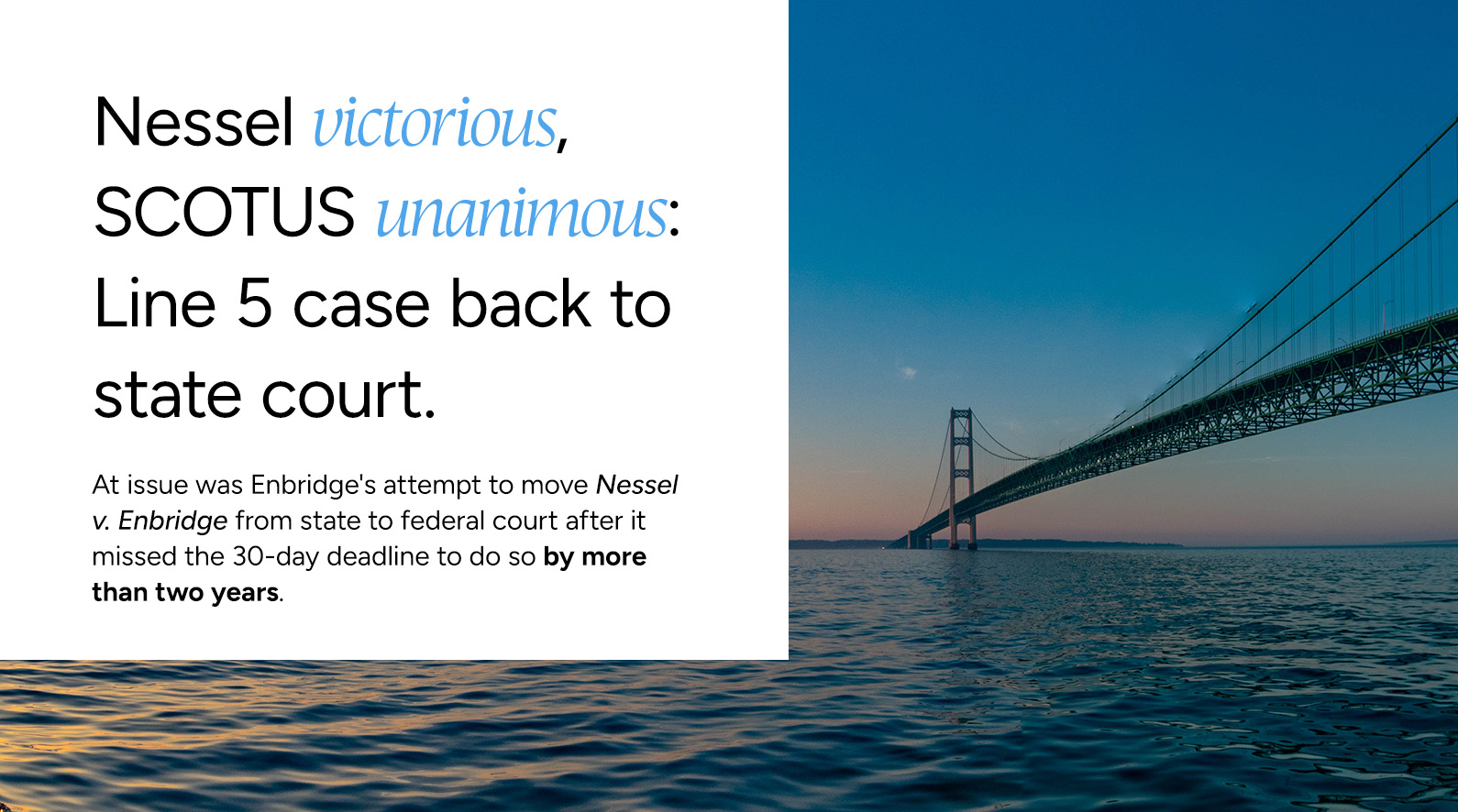
SCOTUS unanimous: Nessel v. Enbridge Line 5 case belongs in state court

Traverse City, Mich. — In a victory for the State of Michigan and its allies opposing the continued operation of the Enbridge Line 5 pipeline through the Straits of Mackinac, the Supreme Court of the United States has issued a unanimous decision that Nessel v. Enbridge will be heard in state rather than federal court. At issue was Enbridge’s attempt to move the lawsuit to federal court after it missed the 30-day deadline to do so by more than two years (in fact, Enbridge waited 887 days).

In June 2024, the federal Sixth Circuit Court of Appeals issued a decision to send Michigan Attorney General Dana Nessel’s 2019 lawsuit back to state court where it started. The Sixth Circuit held that Enbridge’s removal of the lawsuit to federal court was untimely and unjustified. Enbridge then appealed that decision to the US Supreme Court, which heard oral arguments in the case (Enbridge Energy, LP v. Nessel) on February 24.

In the opinion authored by Justice Sonia Sotomayor for the unanimous court, Sotomayor wrote that “Enbridge’s counterarguments are not persuasive.”

Flow Water Advocates has supported AG Nessel throughout the nearly-seven year procedural odyssey, including in its 2023 amicus brief urging the Sixth Circuit to remand the lawsuit back to state court.

“We are confident that once there is a trial on the merits in the proper state court venue, Attorney General Dana Nessel will successfully argue that the State of Michigan has the legal authority and duty to protect the Great Lakes from a potential catastrophic Line 5 pipeline oil spill,” said Liz Kirkwood, executive director of Flow Water Advocates. “Today’s unanimous decision from the US Supreme Court brings an end to Enbridge’s years-long delay campaign to move the case to a venue it perceives to be friendlier to the company’s ultimate goal of keeping oil profitably flowing through the heart of the Great Lakes — the large majority of which is bound for Canadian markets.”

###

Flow Water Advocates is an independent 501(c)(3) nonprofit organization based in Traverse City, Michigan. Our mission is to ensure the waters of the Great Lakes Basin are healthy, public, and protected for all. With a staff of legal and policy experts, strategic communicators, and community builders, Flow is a trusted resource for Great Lakes advocates. We help communities, businesses, agencies, and governments make informed policy decisions and protect public trust rights to water. Learn more at FlowWaterAdvocates.org.
Line 5 tunnel appeal: Join us in Lansing on March 11!

Flow Water Advocates and our allies are challenging the MPSC’s Line 5 tunnel permit in the Michigan Supreme Court, and you’re invited to a gathering and press conference in Lansing on March 11. 

Join in community at Lansing’s Central United Methodist Church at 9:00am to listen to oral arguments via livestream, make posters, and mingle with other Line 5 advocates. Space in the courtroom is very limited, so we’ve arranged this separate venue where everyone can listen and participate.

Following oral arguments, we’ll head to the Michigan Supreme Court steps for a press conference and show of solidarity. 

Coming from Traverse City? Oil & Water Don’t Mix has arranged for a bus to take folks down to Lansing at 5:45am; returning at 3:30pm.

Whether you plan to ride the bus or not, please register here for this event:

Congress must reinstate the Oil Spill Liability Trust Fund (OSLTF)

On December 31, 2025, the Oil Spill Liability Trust Fund Act (OSLTF) expired.1 The OSLTF was first authorized to tax oil producers in 1990, and provided funds for federal responses to oil spills and compensation for certain damages.2 Without the OSLTF, states and taxpayers may be left on the hook for oil spill costs and remediation.

Here in Michigan, the Enbridge Line 5 pipeline — which carries more than 540,000 barrels of petroleum products a day through the Straits of Mackinac where Lake Michigan and Lake Huron meet — has leaked more than 30 times in its 72-year-lifespan.3 According to a 2016 University of Michigan study, more than 700 miles of Great Lakes shoreline would be at risk if the pipeline fails.4 The results would be catastrophic for Michigan and our natural resources, and OSLTF funding would be essential for any hope of recovery (if even possible).

Prior to its expiry, funding from the OSLTF was pulled from two major buckets: the emergency fund, and the principal fund.5 The emergency fund was used by federal employees to respond to oil discharges and make initial natural resource damage assessments.6 While the principal fund was used to pay claims (generally damages not paid by the polluter) and fund appropriations for research and development.7 The OSLTF had been financed primarily by a per-barrel excise tax on domestic crude oil and imported petroleum, which recently sat at $0.09 per barrel.8

The OSLTF was last extended in 2021 by the Consolidated Appropriations Act, and in the 118th Congress, some members of congress introduced legislation (H.R.8554 and S.4406) that would have extended the per-barrel tax without expiration and increased the tax rate to 10 cents per barrel. This legislation failed, and similar legislation has not been proposed by the 119th Congress.9

Without this tax, there is no OSLTF funding to remediate damages to natural resources caused by oil spills, and some of the world’s wealthiest companies and worst polluters are afforded yet another break by the Trump Administration. While the precise motivation behind Congress’ decision not to reinstate the tax remains unclear, one thing is certain–if a high-volume oil spill occurs (like the potential of a Line 5 incident), remediation would be severely curtailed without the OSLTF.

Fortunately, there are some other funding buckets that the government can pull from for oil spill remediation, such as the Hazardous Substance Superfund. In 2026, oil producers can expect to pay $0.18 per barrel for the Hazardous Substance Superfund, but producers are now no longer paying the $0.09 per barrel OSLTF tax.10 The OSLTF tax could be reinstated at any time, if there is the political will to do so.11 In previous years, the tax has had gaps in its active status, for example, it expired in 2018 but was reinstated in 2020.12

This tax may someday be essential to save the Great Lakes from the worst potential Line 5 outcome. We encourage you to call your representatives today and urge them to reinstate the OSLTF.


References

1 Ramseur, Jonathan L., The Oil Spill Liability Trust Fund Tax: Background and Selected Issues, Congress.gov, https://www.congress.gov/crs-product/IF13049.
2 Id.
3 Matt Davenport, Line 5 and its risks: ‘The consequences of failure would be catastrophic.’, UMich News (May 28, 2025) https://news.umich.edu/line-5-and-its-risks-the-consequences-of-failure-would-be-catastrophic/.
4 Id.
5 Upper Mississippi River Basin Association, UMR Resource Manual- OSLTF, https://umrba.org/sites/default/files/documents/UMR-Resource-Manual-OSLTF.pdf.
6 Id.
7 Id.
8 Supra, nite 1.
9 Id.
10 Jack McLoone, Tax Funding Oil Spill Cleanups Has Expired, IRS Clarifies, Law360 (Jan. 7, 2026) https://www.law360.com/articles/2427647/tax-funding-oil-spill-cleanups-has-expired-irs-clarifies.
11 “Oil spill tax” imposed under section 4611 expired on December 31, 2025, KPMG (Jan. 2, 2026) https://kpmg.com/us/en/taxnewsflash/news/2026/01/oil-spill-tax-imposed-section-4611-expired.html.
12 Id.

Flow files reply brief in Line 5 tunnel permit case before the Michigan Supreme Court

Download Flow’s reply brief (PDF)

Traverse City, Mich. — On January 23, Flow Water Advocates (“Flow”) filed its reply to the arguments raised by Enbridge Limited Energy LLC, the Michigan Public Service Commission (MPSC), and other Appellees in Flow’s Michigan Supreme Court case challenging the MPSC’s issuance of a permit to the company for its proposed Line 5 pipeline tunnel through the Straits of Mackinac.

The Office of the Michigan Attorney General and the Great Lakes Business Network filed amicus briefs in support of Flow. The parties now have the opportunity to respond to adverse amicus briefs, due on February 13. The court will hear oral arguments in March.

In its brief, Flow argues that under the Michigan Environmental Protect Act (MEPA) and the common-law public trust doctrine, the MPSC has an obligation to withhold authorization for the tunnel project unless and until EGLE determines that the tunnel will not impair the public’s rights to the Great Lakes “waters and [the] lands beneath them” (Glass v Goeckel (2005); see also Collins v Gerhardt (1926)). Neither EGLE nor any state entity has made such a determination.

Support Flow’s work to defend the Great Lakes.

Notably, EGLE is currently reviewing a new, modified permit application from Enbridge. It is seeking additional information about the environmental impacts and alternatives to the tunnel because, according to EGLE, Enbridge has thus far failed to demonstrate that the project will not create untenable risks or violate Great Lakes Submerged Lands Act (GLSLA) standards.

In September, the Court granted Flow and other parties a landmark application for leave to appeal, paving the way for a review of the MPSC tunnel permit. The court specifically directed the parties to address whether the MPSC is required to comply with the common law public trust doctrine in its permitting decisions. Flow’s reply brief can be downloaded in full from its website, FlowWaterAdvocates.org/Line5.

Flow is represented in this case by its legal team and co-counsel, Kanji & Katzen, P.L.L.C. and Olson & Howard, P.C. The case will be heard alongside a related appeal from a coalition of the Little Traverse Bay Band of Odawa Indians, Bay Mills Indian Community, Grand Traverse Band of Ottawa and Chippewa Indians, and Nottawaseppi Huron Band of the Potawatomi, with the Environmental Law and Policy Center and the Michigan Climate Action Network.

###

Flow Water Advocates is an independent 501(c)(3) nonprofit organization based in Traverse City, Michigan. Our mission is to ensure the waters of the Great Lakes Basin are healthy, public, and protected for all. With a staff of legal and policy experts, strategic communicators, and community builders, Flow is a trusted resource for Great Lakes advocates. We help communities, businesses, agencies, and governments make informed policy decisions and protect public trust rights to water. Learn more at www.FlowWaterAdvocates.org.

Federal District Court improperly blocks Michigan’s termination of the 1953 Line 5 pipeline easement.

Traverse City, Mich. — On December 17, the District Court for the Western District of Michigan issued its opinion in Enbridge v. Whitmer. The federal case was brought by the Canadian oil company to stop Michigan state officials from enforcing Governor Whitmer’s 2020 Notice of Revocation and Termination of the 1953 Easement for the operation of the aging Line 5 Dual Pipelines through the Straits of Mackinac — the heart of the Great Lakes.

Support our work: We’re taking the Line 5 tunnel permit to the Michigan Supreme Court.

The Court’s sweeping opinion rests on its adoption of Enbridge’s arguments that federal law preempts the State’s ability to enforce the terms of the Easement and the requirements of the public trust doctrine to protect Michiganders’ rights in the waters and bottomlands of the Great Lakes.

To reach its decision, the court improperly conflates Michigan’s public trust doctrine with federal pipeline safety standards. The public trust doctrine, however, is a completely independent, long-standing common law doctrine that is an essential aspect of state sovereignty. Thus, the court’s reduction of the public trust to the equivalent of a safety standard is not only legally wrong, it is offensive to state sovereignty and a century of Michigan Supreme Court jurisprudence. The court similarly errs in adopting Enbridge’s position that the State, in holding the company accountable for its violations of State law, impermissibly interferes with foreign affairs.

“Flow is disappointed by the outcome, and the court’s distortion of Michigan’s public trust doctrine and the State’s inalienable sovereign duties as trustee of that trust,” says Flow Water Advocates Staff Attorney Kacey Cook, “but we remain steadfast in our support of the Department of Attorney General’s exceptional advocacy on behalf of the state officials and their efforts to protect Michigan’s water resources, for all of us.”

The parties now have the option to appeal the district court’s decision to the U.S. Court of Appeals for the Sixth Circuit.

###

Flow Water Advocates is an independent 501(c)(3) nonprofit organization based in Traverse City, Michigan. Our mission is to ensure the waters of the Great Lakes Basin are healthy, public, and protected for all. With a staff of legal and policy experts, strategic communicators, and community builders, Flow is a trusted resource for Great Lakes advocates. We help communities, businesses, agencies, and governments make informed policy decisions and protect public trust rights to water. Learn more at www.FlowWaterAdvocates.org.

Comments on Army Corps’ Line 5 Supplemental DEIS considering Horizontal Directional Drilling


DOWNLOAD: Flow Water Advocates, Sierra Club, and Surfrider Foundation comments on Line 5 Tunnel Project Supplemental Draft EIS on the HDD Installation Alternative


Traverse City, Mich. — On December 5, Flow Water Advocates (Flow), a Great Lakes water protection organization, in partnership with the Sierra Club and Surfrider Foundation (known collectively as the Water Coalition), submitted written comments on the U.S. Army Corps of Engineers’ Supplemental Draft Environmental Impact Statement (Supplemental DEIS) for Enbridge’s proposed Line 5 tunnel project, which is now considering an alternative to the tunnel proposal using Horizontal Directional Drilling (HDD) to create a borehole and install a replacement pipeline under the Straits of Mackinac (the HDD Installation Alternative).

Support Flow’s work to defend the Great Lakes.

Enbridge’s application for the proposed project’s federal Clean Water Act and Rivers and Harbors Act permits is currently under review by the U.S. Army Corps of Engineers (the Corps). The National Environmental Protection Act (NEPA) requires agency and public review, including the preparation of both a Draft and Final Environmental Impact Statement (and supplements, when warranted), which must assess the purpose and need for the proposed project, alternatives to the proposal, and an assessment of the environmental consequences of the project.

While the Corps originally discounted the HDD Installation Alternative as infeasible years ago, the Supplemental DEIS states that Enbridge submitted information that pursuing the alternative is now technically feasible due to advances in technology, and that the Corps subsequently determined that the HDD Installation Alternative should be subject to “detailed analysis” in the EIS.

The Water Coalition’s comments emphasize that the Corps’ unjustified fast-tracking of the review process for both the DEIS and the Supplemental DEIS unlawfully undermines public participation in the process, as well as the “hard look” required by the agency under NEPA. The comments also highlight the Supplemental DEIS’ striking failure to include the information necessary for the agency to properly review the HDD Installation Alternative and its potential impacts on the surrounding lands and waters. Among the deficits are a failure to detail impacted wetlands, confirm the stability of the bedrock, and survey for protected species and archeological resources.

In order to comprehensively compare the potential environmental impacts of the HDD Installation Alternative against Enbridge’s preferred tunnel project, the Corps and the public must have sufficient location-specific data and information about the risks posed by each technology, as well as the site-specific impacts of each method. The Corps attempts to justify these deficiencies in the Supplemental DEIS by deferring the required assessment to a potential future in which Enbridge chooses to pursue the HDD alternative. However, this reasoning hampers the evaluation of alternatives, and is unacceptable under federal law.

The comments conclude that the supplemental review does not remedy the fatal flaws of the May 2025 DEIS, outlined in the Water Coalition’s June 2025 comments, but rather compounds them.

The people of the Great Lakes Basin depend on the Corps, with its technical expertise and mandate to serve the public interest, to take great care in its consideration of the potential significant environmental impacts of the proposed tunnel and alternatives. The Corps violates that mandate in both the May 2025 DEIS and the new Supplemental DEIS, by failing to collect the information necessary to properly assess the risks, and by unlawfully failing to consider feasible alternatives to building a new pipeline through the Straits. Flow and its partners remain steadfast in their commitment to hold the Corps accountable to its legal obligations.

The Corps anticipates that it will publish a Final EIS in early 2026, followed by a Record of Decision in the Spring.

###

Flow Water Advocates is an independent 501(c)(3) nonprofit organization based in Traverse City, Michigan. Our mission is to ensure the waters of the Great Lakes Basin are healthy, public, and protected for all. With a staff of legal and policy experts, strategic communicators, and community builders, Flow is a trusted resource for Great Lakes advocates. We help communities, businesses, agencies, and governments make informed policy decisions and protect public trust rights to water. Learn more at www.FlowWaterAdvocates.org.

Michigan revoked the Line 5 easement 5 years ago. What happens next?

Updated December 19, 2025

Five years ago, on November 13, 2020, Michigan Governor Gretchen Whitmer and the Department of Natural Resources revoked and terminated the 1953 easement that had allowed Enbridge to locate and operate its dual Line 5 pipelines on the lakebed and in the waters of the Straits of Mackinac. As public trustee and fiducidary, the state revoked the easement for two key reasons:

  • The state has a duty under the public trust doctrine to protect the waters of the Great Lakes for the people of Michigan. This duty required the state to revoke the easement due to the “extraordinary and unacceptable risk” posed by the aging, vulnerable pipelines, which have been struck multiple times by anchors and cabling.
  • Enbridge “repeatedly and incurably” violated the express terms of this public trust easement, and had done so for decades. Enbridge persistently failed to satisfy numerous conditions related to the support, protective coatings, and curvature of the pipelines.

An analogy to landlord-tenant law is warranted since the state of Michigan is the sovereign owner and protector of the public trust waters and bottomlands in the Great Lakes. In the case of landlord-tenant relations, any landlord would be within their rights to evict a tenant who violated their lease, repeatedly left the stove on and the bathtub overflowing, and refused to leave when the lease was up. And a landlord would be correctly concerned about a tenant who had previously burned down another apartment due to negligence.

Half a decade later.

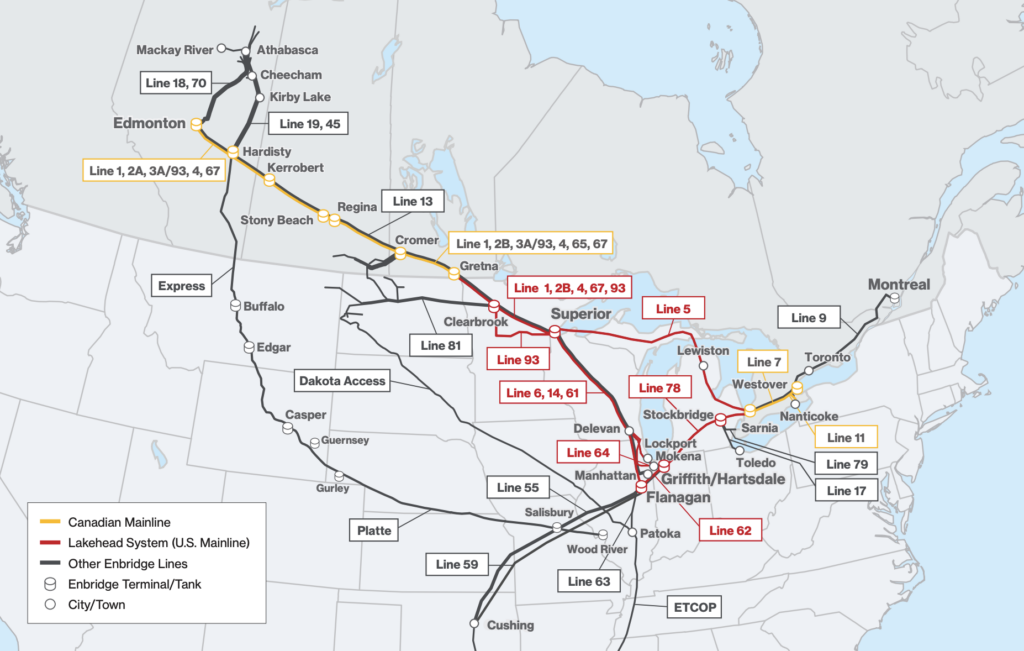
And yet, half a decade later, the Line 5 pipelines remain, haphazardly suspended across the lakebed floor, buffeted by strong currents and vulnerable to anchor strikes and other hazards in one of the busiest shipping lanes in the Great Lakes. Each day, Line 5 carries nearly 23 million gallons of fossil fuels from western Canada, through the Great Lakes — the majority of which supply Canadian refineries in Ontario and Quebec. The water security of the Great Lakes is at high risk every day.

On each of the 1,825 days and counting since the easement was revoked, Michigan has borne unacceptable risks so that a Canadian pipeline company can continue to profit, protect its market share, and deliver crude oil primarily from Canada to Canada. The Line 5 pipeline in the Straits of Mackinac could only be built in 1953 with a public trust easement from the state of Michigan; therefore, an easement authorizing Enbridge permission to occupy our public waters is necessary for its continued operation. That easement no longer exists.

The Line 5 pipeline and the proposed replacement tunnel are now being fought in multiple courts by multiple parties, including Flow Water Advocates.

Here’s where Line 5 currently stands in Michigan:

Nessel v. Enbridge

At issue:
In 2019, Michigan Attorney General Dana Nessel filed suit in Michigan’s 30th Circuit Court (Ingham County), seeking an order to decommission Line 5. She argues that its continued operation violates the public trust doctrine, is a public nuisance under common law, and violates the Michigan Environmental Protection Act.

Flow, along with the Great Lakes Business Network and the Sierra Club, briefed the court in 2019, 2021, and 2024 in support of Michigan’s sovereignty and public trust rights.

What has happened so far:
Enbridge has successfully delayed the case (and kept the oil and profits flowing) over matters of jurisdiction, and it initially succeeded in moving the case from state to federal court — long after the 30-day time limit to do so had passed.

  • In June 2024, the U.S. Sixth Circuit Court of Appeals ruled that the move to federal court was indeed untimely, and sent the case back to state court.

  • Enbridge then appealed to the U.S. Supreme Court, which in June 2025 agreed to hear the case on the procedural question of whether district courts have the authority to excuse the 30-day time limit — again prolonging the risks of Line 5’s continued operation. The SCOTUS will hear oral arguments in spring 2026.
What happens next:
In August 2025, Ingham County circuit court Judge James Jamo denied Enbridge’s request to stay (pause) the state case while awaiting a SCOTUS ruling. We are now awaiting a decision by Judge Jamo on whether Line 5 will be shut down.

Enbridge v. Whitmer

At issue:
On November 24, 2020, Enbridge filed its federal court lawsuit asserting that Governor Whitmer does not have the authority to protect its sovereign interests of public trust waters and submerged lands, and that state action against Line 5 may violate Enbridge’s alleged treaty right to pump oil through the Great Lakes uninterrupted.

What has happened so far:
Governor Whitmer moved to dismiss the action on the grounds that state officials have immunity from federal lawsuits under the U.S. Constitution’s Eleventh Amendment. Enbridge’s separate federal case against the state still remains before Judge Jonker in the U.S. District Court for the Western District of Michigan who held (we think wrongfully) that an exception applies.

  • In an October 2024 amicus brief, Flow and the Great Lakes Business Network argue that Enbridge’s lawsuit impairs state sovereign and public trust duties; and that long-standing legal principles that balance federal and state sovereign interests weigh in favor of states’ rights and jurisdiction over the public navigable waters and bottomlands of the Great Lakes.

On November 12, 2025, Judge Jonker heard oral arguments in the case. Michigan Assistant AG Keith Underkoffler argued that the state’s preexisting authority could not be undermined by the federal Pipeline Safety Act, which wasn’t enacted until 1968. Further, he argued that the state would not have granted the easement in 1953 if it had known that 15 years later, the state’s rights in relation to the easement would be preempted by the federal government.

On December 17, 2025, Judge Jonker issued a decision improperly preventing the State of Michigan from enforcing Gov. Whitmer’s revocation and termination of the easement.

What happens next:
The State of Michigan now has the option to appeal Judge Jonker’s decision to the U.S. Court of Appeals for the Sixth Circuit.

Michigan Supreme Court: Line 5 tunnel permit

At issue:
In late 2023, the Michigan Public Service Commission approved a permit for Enbridge’s proposed Line 5 pipeline tunnel under the Straits of Mackinac. In doing so, Flow argues that the MPSC failed in its duties under the public trust doctrine, Michigan Environmental Protection Act (MEPA), and Great Lakes Submerged Lands Act to protect the waters of the Great Lakes and their bottomlands for the people of Michigan; and that the MPSC failed to consider feasible and prudent alternatives to the tunnel.

What has happened so far:
Flow, along with other environmental groups, tribes, and an individual, appealed the MPSC’s permit decision in the Michigan Court of Appeals. In February 2025, the Court of Appeals affirmed the MPSC’s tunnel permit.

Flow and others then appealed that decision to the Michigan Supreme Court, which in September 2025 announced it would hear the appeals, paving the way for a review of the permit. The Supreme Court specifically directed the parties to address whether the MPSC is required to comply with the common law public trust doctrine and MEPA in its permitting decisions.

What happens next:
Flow and the other appellants submitted opening briefs to the court on November 14, 2025. Additional briefing will take place in December and January, with oral arguments expected to be scheduled in 2026.

Meanwhile, the proposed tunnel has yet to receive the required permits from the Michigan Department of Environment, Great Lakes, and Energy (EGLE) and the U.S. Army Corps of Engineers (USACE).

Read: Flow’s comments to EGLE; Flow’s comments to USACE.

The USACE is now also conducting a supplemental Environmental Impact Statement (EIS) that will evaluate horizontal directional drilling. Flow, in partnership with the Sierra Club and Surfrider Foundation, submitted public comments on December 5, 2025.

The next five years.

It is unlikely — though not impossible — that we will go another half-decade before the Line 5 threat is resolved. Flow is fighting every day for a resolution that respects Michigan’s sovereignty, the public trust doctrine, and the rights of all Michiganders present and future to enjoy, navigate, use, and be sustained by the irreplaceable waters of our Great Lakes. As part of our work, we also are committed to ensuring water security and energy security solutions for the Great Lakes region. It is our fervent hope that Line 5 is shut down lawfully by our civil courts, and not because of an oil spill disaster.

Flow Water Advocates files Line 5 brief with the Michigan Supreme Court.

November 17, 2025

[ DOWNLOAD: Flow Water Advocates Brief on Appeal (PDF) ]


Traverse City, Mich. — Flow Water Advocates (“Flow”) has filed a brief in its appeal of the Michigan Public Service Commission’s decision to approve a permit for Enbridge’s proposed Line 5 pipeline tunnel under the Straits of Mackinac. Flow’s appeal will be heard in the Michigan Supreme Court.

In September, the Court granted a landmark application for leave to appeal, paving the way for a review of the permit. Flow initiated the legal challenge, arguing that the MPSC failed to uphold its public trust obligations to protect Michigan’s waters and submerged lands. The Supreme Court’s order specifically directs the parties to address whether the MPSC is required to comply with the common law public trust doctrine in its permitting decisions.

Support Flow’s work to defend the Great Lakes.

In its brief filed on November 14, Flow addresses three central questions regarding the common-law public trust doctrine and the Michigan Environmental Protection Act (“MEPA”) and their application by the MPSC.

First, Flow argues that the plain meaning of the statutory text and the legislative history of MEPA binds all agencies to protect the air, water, and other natural resources and the public trust in these resources.

Second, Flow maintains that all agencies, including the MPSC, as arms of the state have an independent duty to comply with the State’s public trust obligations. As the sovereign title holder, the State may not violate the public trust by granting rights to use the Great Lakes bottomlands without regard to the trust’s restrictions. Thus, the effect of the common-law public trust doctrine is to safeguard the public’s interests in the waters and submerged lands of the Great Lakes. When the MPSC granted the tunnel permit without conducting a public trust analysis, it failed to fulfill its duty to assess potential impacts to the public’s paramount rights in the resources at stake.

Third, Flow argues that the MPSC cannot permit Enbridge’s tunnel project unless and until the Department of Environment, Great Lakes and Energy (“EGLE”) makes the requisite public-trust determinations under the common-law public trust doctrine and the Great Lakes Submerged Lands Act. In its brief, Flow articulates what a proper public trust analysis must look like to ensure that the proposed action — in this case, the siting and construction of an underground tunnel and pipeline through the bottomlands of the Straits — does not violate the State’s obligation to protect these public trust resources. EGLE cannot approve any proposed use of Great Lakes bottomlands, unless it has determined both that the adverse effects to the environment and the public trust will be minimal, and that there is no feasible and prudent alternative to the applicant’s proposed activity — such as the shutdown of Line 5. These mandatory determinations have not been made; therefore, the MPSC is required to deny Enbridge’s permit application under Michigan law.

Flow is represented in this case by its legal team and co-counsel, Kanji & Katzen, P.L.L.C. and Olson & Howard, P.C. The case will be heard alongside a related appeal from a coalition of the Little Traverse Bay Band of Odawa Indians, Bay Mills Indian Community, Grand Traverse Band of Ottawa and Chippewa Indians, and Nottawaseppi Huron Band of the Potawatomi, with the Environmental Law and Policy Center and the Michigan Climate Action Network.

###

Flow Water Advocates is an independent 501(c)(3) nonprofit organization based in Traverse City, Michigan. Our mission is to ensure the waters of the Great Lakes Basin are healthy, public, and protected for all. With a staff of legal and policy experts, strategic communicators, and community builders, Flow is a trusted resource for Great Lakes advocates. We help communities, businesses, agencies, and governments make informed policy decisions and protect public trust rights to water. Learn more at www.FlowWaterAdvocates.org.