Tag: CEIC

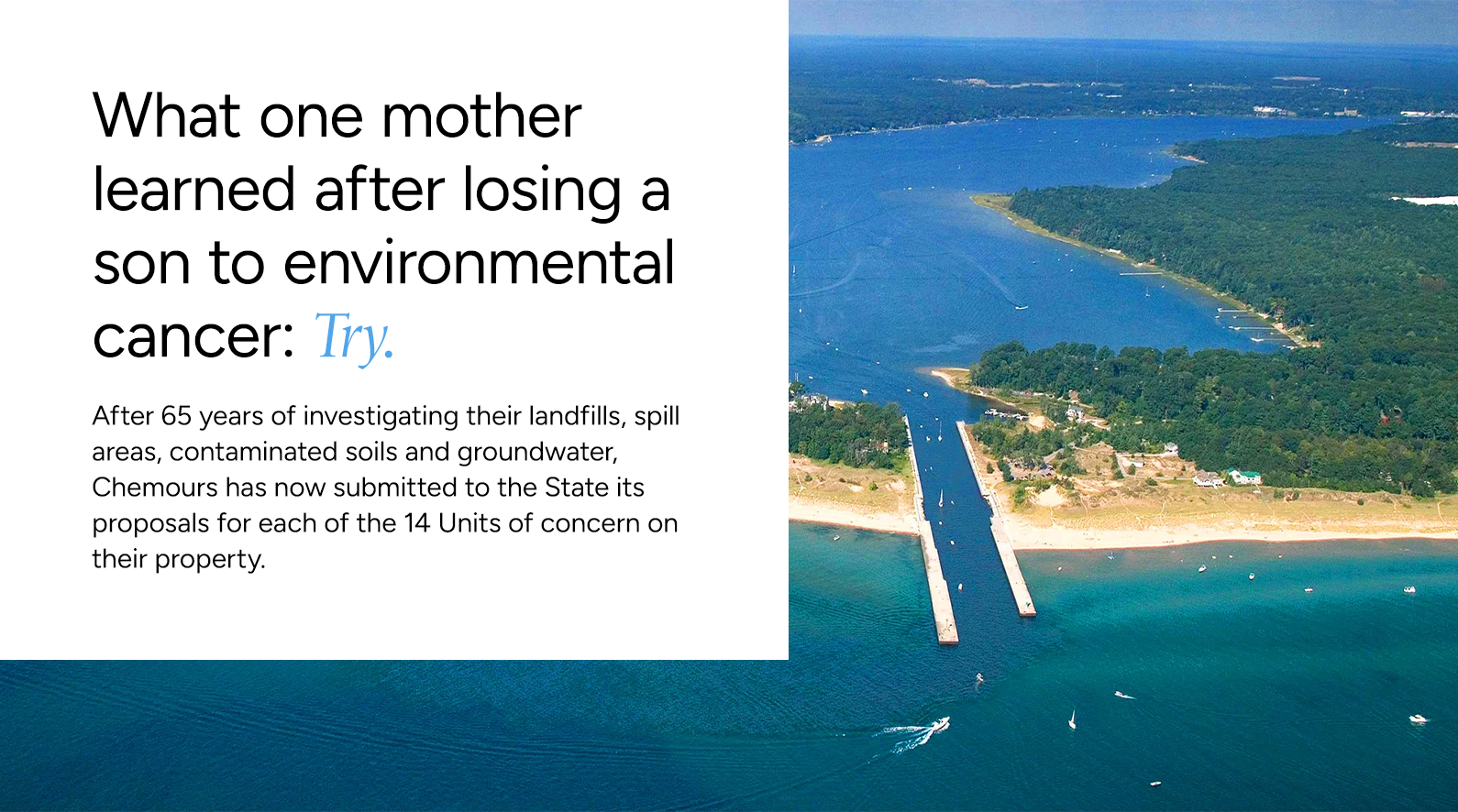
What one mother learned after losing her son to environmental cancer: Try.

SAVE THE DATES

CEIC members are holding a public information meeting on May 20, 5:30 to 7:30 and May 30, 1 to 3pm at White Lake Community Library. Presentations will be the same, so no need to go to both. 

On Thursday, June 11, 5:30 to 7:30pm EGLE will present at NBC Middle School. It is important to pack the room for this event. 

By Claire Schlaff, April 21, 2026

In the late 1970s I began seeing stories in local newspapers about protests by community
members trying to get authorities to do something about the foul air and water emanating from our chemical plants. I am ashamed now to say that I was too busy raising our two young sons and working as an occupational therapist to join the protests.

My focus changed in 2006 when our son, Doug, age 33 and father of 3 little boys, was diagnosed with Ewing Sarcoma, an environmental cancer. After Doug’s death in December 2008 at age 35, I began collecting newspaper articles about White Lake’s industrial history, joined the White Lake Public Advisory Council, and launched the White Lake Area Cancer Mapping Project.

I will never know for certain what caused Doug’s cancer, but I can tell you that as a parent who has lost a child, I have thought about every possible exposure he may have had during his brief lifetime.

Doug’s wonderful wife has raised their boys into fine young men, making their grandparents proud. We have had the privilege of enjoying all the milestones and the little things in their lives that their dad had to miss. The worst is that our grandsons have had to grow up without their dad.

Now, 20 years after Doug’s diagnosis, I find myself in a role that I couldn’t have imagined back in 2006 – a member of the Chemours Environmental Impact Committee (CEIC), a devoted group of volunteers working since 2018 to clean up, conserve, and restore the Chemours (former DuPont) property and its connected waterways.

Everything we have been working for is coming to a head this year. After 65 years of investigating their landfills, spill areas, contaminated soils and groundwater, Chemours has now submitted to the State its proposals for each of the 14 Units of concern on their property.

We want the landfills – the sources of the contamination – removed. CEIC members are preparing our response to Chemours’ proposals and are launching a public information campaign, featuring two presentations in May in preparation for and leading up to a public meeting on June 11 at the NBC Middle School at which CEIC will present our response with Chemours and the State present to hear our concerns and answer questions.

Chemours’ proposed plans fall far short of our community’s expectations. They propose to continue the groundwater treatment system they have been using for decades while leaving the unlined landfills and spill areas in place with minor surface amendments.

According to an enforceable document signed in 2024, if the State approves their proposals (which we think they will, based
on our conversations with them over the years), Chemours has 120 days to develop their detailed implementation plan. Only after that plan has been submitted does the community have a chance for public comment.

But CEIC has other plans.

We understand that there is a chance that, despite our work and devotion to the cause, we may fail. Fail to get those leaking landfills removed. Fail to get those forests and shorelines preserved. Fail to get Sadony Bayou restored.

We have learned that “Community Acceptance is a Factor” in cleanup decisions. Our best chance for success is a groundswell of support from our fellow community members and our growing team of partners. It is the hope of CEIC that the community will pack the meetings to fight for our natural resources now and for future generations.

We are now close to the finish line. It is important to the well-being of our community, now and in the future, that we succeed.

After 2 ½ years of suffering, as Doug neared the end of his long fight for his life, he had one, barely audible, final word:

Try.

We have no choice but to try.

Community power: CEIC works to restore Sadony Bayou and Mirror Lake

In April 2023, FLOW’s Dave Dempsey blogged about contamination at a quiet place called Sadony Bayou, north of White Lake along the Lake Michigan coastline, where lime piles and decades of industrial waste have decimated once-thriving habitat. The bayou doesn’t look like much from the road running by, but inside, it’s a struggling universe – an ancestral home and migration territory to dragonflies, long-horned caddisflies, damselflies, purple martins, blue herons, belted kingfishers, caspian terns, wood frogs, green frogs, Fowler’s toads, and a former spawning ground for pike. Once, bullfrogs sang.

(click to enlarge)

Once known as “Stump” (because a stump served as a post office) and Ferrysburg or Ferrisville, the community that formed at the old channel connecting the bayou to Lake Michigan was the first settlement in the White Lake area – a bustling logging town.

In the 1860s, Government Channel was constructed, connecting White Lake to Lake Michigan. By 1877 the Old Channel had been blocked off. Although still receiving water from Pierson Creek, Sadony Bayou had no way to cleanse and revive itself by moving water and sediments in and out, as bayous must to survive. Then, in the 1950s, Dupont Chemical arrived next to the bayou, depositing lime and other industrial waste on its property, which then migrated into soil and water. A 1965 berm breach in Dupont’s Pierson Creek Landfill, uphill from Pierson Creek, which feeds the bayou, caused extensive contamination with toxic waste. In 1967, a valve opened over Pierson Creek, diverting wastewater into the creek, killing everything.

(click to enlarge)

On top of the chemical burden, blowing and drifting dunes deposited enough sediment that algae began to choke the strangled bayou. Sadony Bayou was once very deep and flowed directly into Lake Michigan. Now it’s shallow, without flow. The sun beats down, warming the water. Nutrients from upstream agriculture and a golf course consume available oxygen, degrading habitat. Kayaks and canoes have disappeared, and anglers no longer line up to cast lines off the bridge by the Old Channel Inn for pike, perch, and largemouth bass.

When the Chemours Environmental Impact Committee (CEIC, pronounced “seek”) formed in 2018 to represent the concerns of local residents and ensure a thorough cleanup, they were focused on the many landfills and spill areas on the Chemours property. Over the past 6 ½ years, CEIC has communicated regularly with the Michigan Department of Environment, Great Lakes, and Energy’s Hazardous Waste Section, as it works with Chemours on its Facility Investigation and Corrective Measures Study. Last summer Chemours and EGLE signed an enforceable document, known as the Corrective Action Consent Order, which allows EGLE to approve actions and impose deadlines. Currently CEIC is awaiting release of the report that will provide insight into cleanup plans in the Corrective Measures Implementation plan.

Back in 2018, CEIC did not imagine that they would sidetrack into a related, yet unrelated mission – the restoration of Sadony Bayou. In 2023, Marty Holtgren, an aquatic biologist with experience in restoring waterways, joined CEIC’s efforts as project manager. CEIC, with the Muskegon Conservation District as fiscal sponsor, received an EGLE grant for an “Evaluation of Sadony Bayou to Support Restoration.” That work continued into 2024 with the help of experts brought in by Marty.

Meanwhile, Marty, CEIC, and fiscal sponsor Muskegon County Environmental Coordinating Council, received a grant from the White Lake Community Fund, called “Establishing a Vision for Sadony Bayou.” Marty and his team listened to residents in three visioning sessions while looking at historical data, maps, and photos of the bayou since the early 1800s.

These smaller grants prepared the way to begin restoration in earnest. Marty Holtgren and Caroline Gottschalk of the University of Wisconsin, with FLOW as fiscal sponsor, have submitted a pre-proposal for a National Fish and Wildlife Foundation-National Coastal Resilience Fund grant, to arrive at a community- and township-supported restoration design that is ready to advance to final design and permitting.

—–

(click to enlarge)

CEIC has also been busy these past several weeks with another water body, this one located on the Chemours property, just south of the giant lime pile and in the center of the plume of contaminated groundwater. In the words of one resident who visited Mirror Lake as a teen in the 1960s, “It was a wildlife paradise. A lot of ducks: Green- and blue-winged teal, black, and mallards. (A lot of them.) Mink, muskrats, red-tailed hawks, goshawk (like a big falcon), ruffed grouse. You would see them down there everywhere.”

CEIC has known for years that Chemours intended to dredge the lime from Mirror Lake, and when they suddenly received a Public Notice of Chemours’ application for a permit to “excavate the escaped lime from wetland area and at edge of Mirror Lake,” CEIC jumped into action, submitting comments and encouraging community members and supporters to respond as well, which would earn a chance for a public hearing. Comments ranged from where they intended to deposit the dredged lime, to the apparent lack of a restoration and monitoring plan, to concerns of how the dredging might influence the water level and the migration of the plume of contaminated water.

On May 5th, CEIC was pleased to receive a formal announcement of a virtual Public Hearing on May 27th at 6:00 pm. This notice is accompanied by a Restoration and a 10-year Monitoring plan developed by the Muskegon Conservation District. At this writing, CEIC is still consulting with experts regarding some details of the evaluation and plan and will be submitting further comments, as well as encouraging community members to consider submitting comments by the June 6 deadline.

These are encouraging developments, but local residents – and local bullfrogs – should expect nothing less than full transparency and a commitment to robust cleanup from the agency charged with “safeguard(ing) the state’s natural resources, including air, water, and land, from pollution, impairment, and destruction.” Michigan Constitution of 1963, Art. IV, Sec. 52.

Make It Right Michigan: Restore Sadony Bayou

The Chemours Environmental Impact Committee (CEIC, pronounced “seek”) of White River Township, in West Michigan, has been advocating for the long-overdue cleanup of the sources of groundwater and soil contamination on the DuPont property, now owned by Chemours. This contaminated property connects with both White Lake and Lake Michigan. 

FLOW supports the Committee’s position that all navigable water bodies in the state must be protected and/or restored to meet water quality standards. There is no room for “writing off” such waters as lifeless or not usable.

For more information, contact the Committee by emailing makeitrightchemours@gmail.com or on Facebook at Make It Right Chemours.


Make It Right, Michigan: Restore Sadony Bayou 

The vista from his 80-acre compound was filled with a creek-fed bayou whose waters meandered southerly for nearly a mile to White Lake, and eventually Lake Michigan.

Called the “Valley of the Pines,” the estate was home for Joseph Sadony, an inventor, hobby scientist, and author. From the time he moved there in 1906 and through the following five-plus decades, the wetland that evolved into the name of Sadony Bayou supported flora and fauna that thrived in and around the water.

Sadony wasn’t the only person who enjoyed this miniature Eden. Visitors joined residents to try for pike, largemouth bass, panfish and perch from boats and canoes, or to bobber-fish from the Old Channel Trail bridge. Turtles abounded as did garter snakes, along with the typical assortment of warm-blooded creatures that call Michigan home. The bayou was a mecca for bullfrogs whose nighttime croakings serenaded many nearby residents to sleep. 

In 1960, DuPont began manufacturing acetylene and neoprene and then Freon at its nearby manufacturing plant in White River Township. The process resulted in the use of a series of unlined landfills in the site’s sandy soil to dump byproducts, including some hazardous wastes. There were some spills at other locations. In 1961, a nearby resident’s well exhibited taste and odor problems. Groundwater studies confirmed contamination. 

Today, six decades later, if Sadony Bayou isn’t virtually dead, it is a shadow of its former self. No longer an historic spawning bed for pike. Rare are the sightings of eagles, hawks, herons, and swans. The lessened drone of insects reflects a wildlife habitat that has taken a hard punch to the stomach. People don’t interact with its natural environment as they once did. 

What happened? 

One of Dupont’s unlined landfills was located 250 feet uphill from Pierson Creek, whose origins from spring-fed tributaries are about five miles north of the bayou. In 1965, a berm along the western edge of the landfill failed, releasing liquid wastes into Pierson Creek. Recalled a witnessing resident: “What looked like a lava flow 40 feet wide and one foot deep flowed down the hill and into the creek.” 

Two years later, wastewater from DuPont’s disposal pipe was diverted into the creek for a short time, causing the death of thousands of fish. Attempts to restock the waters with prized game fish had the same results as the leak – dead fish. Some residents remark that after the fish kill, the bayou has never returned to what it used to be.” 

In the late 1960s and 70s, the state took surface water and sediment samplings. Several contaminants, including heavy metals found in the bayou near the Old Channel bridge, exceeded water quality criteria. For other chemicals, there was mention of data quality concerns. 

Why, since then and into 2023, has there been no follow-up to gather reliable data from the bayou? 

DuPont’s wastes aren’t the only problem. Accumulated sediments in the bayou can raise water temperature to levels too high for certain fish and their food sources. Fertilizer runoff from farms to the north can lead to weeds and depletion of oxygen in the water, harming fish and other wildlife. Lack of flow can result in less capacity to dilute and degrade wastes. 

This navigable waterway is connected to the Great Lakes system – the public has a right to use it. In its current condition, it is unsuitable for fish, bullfrogs, or humans in kayaks. Why has the gradual degradation of the bayou continued unchecked? 

In 2014, the White Lake Public Advisory Council, after 22 years overseeing the cleanup of White Lake, expressed concerns about White Lake being removed from the Great Lakes Area of Concern list despite the ongoing groundwater contamination at the Dupont site. Federal and state authorities assured citizens the state agency responsible for the cleanup of that site would “continue its oversight of activities at the facility to assure that the corrective-action process progresses forward.” 

In 2015 DuPont spun off the site to Chemours – the company now responsible for the cleanup. The Hazardous Waste Section of Michigan’s Department of Environment, Great Lakes, and Energy (EGLE), continues its oversight activities at the Chemours site. And still no cleanup. 

Our local Chemours Environmental Impact Committee (CEIC) was formed in 2018 to keep track.

This all-volunteer group has been trying since 2019 to get the Hazardous Waste Section to authorize and/or conduct testing of sediments and the fish in Sadony Bayou. The state’s Water Resources Division did try to test the fish in 2021. Problem was, it couldn’t find many fish to test. Only a pumpkinseed sunfish. 

EGLE has many divisions with expertise in maintaining the health of the waters of the state. An appropriate division of EGLE needs to take the lead on the restoration of this waterway, including thorough assessment to develop a protocol for testing of the sediments so that safe restoration may proceed. CEIC and the local citizenry need a qualified partner from one or more of EGLE’s water-quality divisions to oversee the return of Sadony Bayou to a vibrant, healthy ecosystem. 

Nearby residents recall 60 years ago – kids in canoes chasing turtles, the saga of the big one that got away, the baying of bullfrogs, people in kayaks taking in the essence of nature and its creatures along the creek, netting to see what a young pike looks like before it heads out into White Lake. 

Will we see that day again? 

To borrow an epic-creating piece of dialogue from Kevin Costner’s “Field of Dreams:” “If you restore it, they will come.” Even after 60 years.

 * * * * * 

For more information, contact CEIC at makeitrightchemours@gmail.com, or Marisa McGlue at (517) 881-2421 

Submitted by members of the Chemours Environmental Impact Committee: Laura Anderson, George Dufresne, Lisa Kiel, Marisa McGlue, Barb Reese, Dave Roodvoets, Jim Rose, Claire Schlaff, Tom Thinnes, Jan Vanderwerp, Sara Warber, and Steve Welter