Tag: Enbridge Line 5

Flow Water Advocates files Line 5 brief with the Michigan Supreme Court.

November 17, 2025

[ DOWNLOAD: Flow Water Advocates Brief on Appeal (PDF) ]


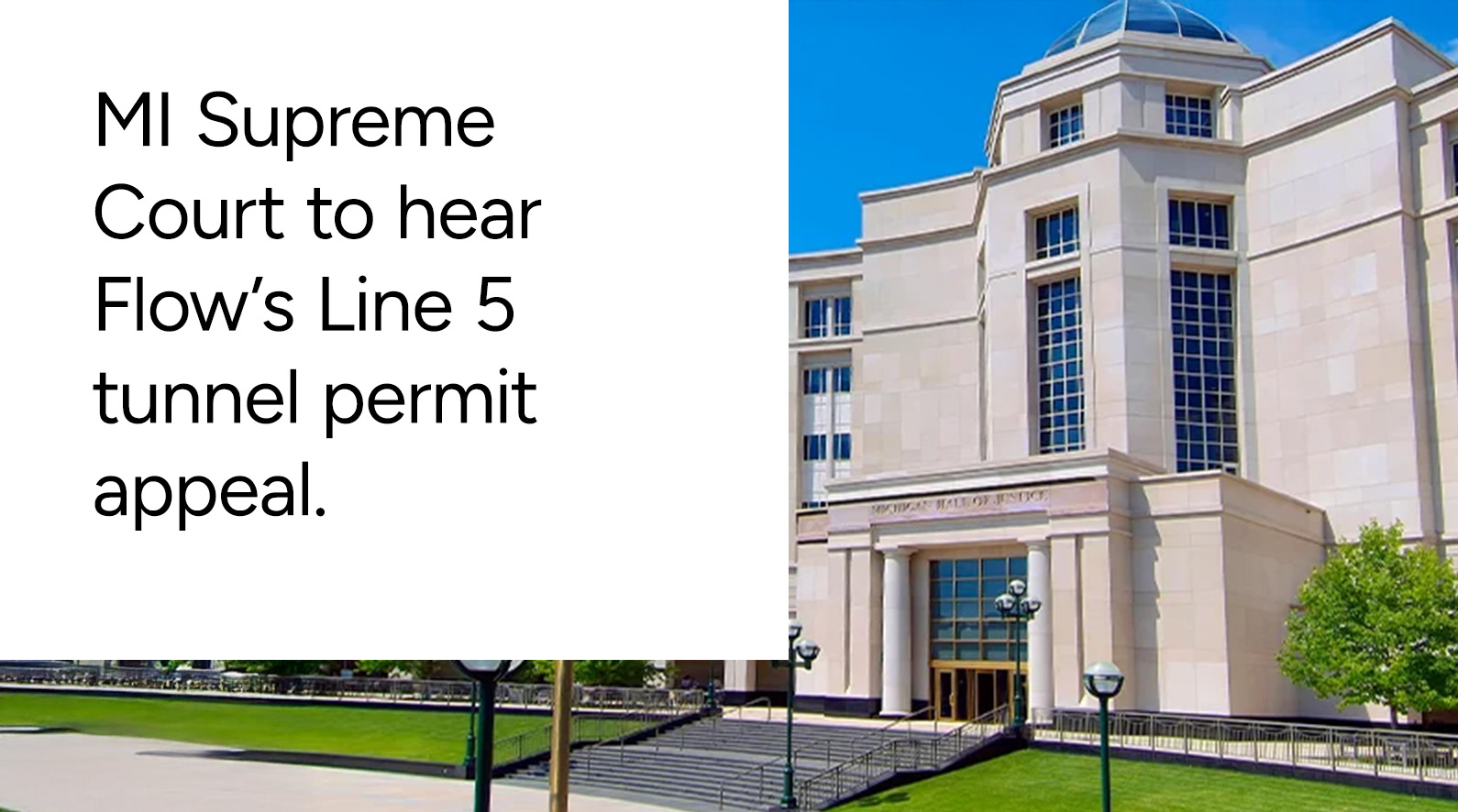
Traverse City, Mich. — Flow Water Advocates (“Flow”) has filed a brief in its appeal of the Michigan Public Service Commission’s decision to approve a permit for Enbridge’s proposed Line 5 pipeline tunnel under the Straits of Mackinac. Flow’s appeal will be heard in the Michigan Supreme Court.

In September, the Court granted a landmark application for leave to appeal, paving the way for a review of the permit. Flow initiated the legal challenge, arguing that the MPSC failed to uphold its public trust obligations to protect Michigan’s waters and submerged lands. The Supreme Court’s order specifically directs the parties to address whether the MPSC is required to comply with the common law public trust doctrine in its permitting decisions.

Support Flow’s work to defend the Great Lakes.

In its brief filed on November 14, Flow addresses three central questions regarding the common-law public trust doctrine and the Michigan Environmental Protection Act (“MEPA”) and their application by the MPSC.

First, Flow argues that the plain meaning of the statutory text and the legislative history of MEPA binds all agencies to protect the air, water, and other natural resources and the public trust in these resources.

Second, Flow maintains that all agencies, including the MPSC, as arms of the state have an independent duty to comply with the State’s public trust obligations. As the sovereign title holder, the State may not violate the public trust by granting rights to use the Great Lakes bottomlands without regard to the trust’s restrictions. Thus, the effect of the common-law public trust doctrine is to safeguard the public’s interests in the waters and submerged lands of the Great Lakes. When the MPSC granted the tunnel permit without conducting a public trust analysis, it failed to fulfill its duty to assess potential impacts to the public’s paramount rights in the resources at stake.

Third, Flow argues that the MPSC cannot permit Enbridge’s tunnel project unless and until the Department of Environment, Great Lakes and Energy (“EGLE”) makes the requisite public-trust determinations under the common-law public trust doctrine and the Great Lakes Submerged Lands Act. In its brief, Flow articulates what a proper public trust analysis must look like to ensure that the proposed action — in this case, the siting and construction of an underground tunnel and pipeline through the bottomlands of the Straits — does not violate the State’s obligation to protect these public trust resources. EGLE cannot approve any proposed use of Great Lakes bottomlands, unless it has determined both that the adverse effects to the environment and the public trust will be minimal, and that there is no feasible and prudent alternative to the applicant’s proposed activity — such as the shutdown of Line 5. These mandatory determinations have not been made; therefore, the MPSC is required to deny Enbridge’s permit application under Michigan law.

Flow is represented in this case by its legal team and co-counsel, Kanji & Katzen, P.L.L.C. and Olson & Howard, P.C. The case will be heard alongside a related appeal from a coalition of the Little Traverse Bay Band of Odawa Indians, Bay Mills Indian Community, Grand Traverse Band of Ottawa and Chippewa Indians, and Nottawaseppi Huron Band of the Potawatomi, with the Environmental Law and Policy Center and the Michigan Climate Action Network.

###

Flow Water Advocates is an independent 501(c)(3) nonprofit organization based in Traverse City, Michigan. Our mission is to ensure the waters of the Great Lakes Basin are healthy, public, and protected for all. With a staff of legal and policy experts, strategic communicators, and community builders, Flow is a trusted resource for Great Lakes advocates. We help communities, businesses, agencies, and governments make informed policy decisions and protect public trust rights to water. Learn more at www.FlowWaterAdvocates.org.

An abridged and ongoing list: Things Enbridge Takes Credit For

Published May 24, 2024; updated November 7, 2025

Do you enjoy celebrating the holidays with your friends and family? How about checking items off your bucket list, or watching the Super Bowl? Are cookies, chips, and pizza some of your guilty pleasures?

Believe it or not, you can thank your friendly neighborhood pipeline company for all of these things and more! (Unless your neighborhood is Marshall, MI.)

We don’t know if this is absolutely bonkers PR, or just some good old-fashioned Search Engine Optimization tactics. But either way, you almost have to admire the chutzpah!

An ongoing list of things Enbridge takes credit for:


Treating diabetes

Achieving your lifelong dreams

4th of July Celebrations

Chocolate chip cookies

Thanksgiving dinner and parade balloons

Not dying of a heart attack

4th of July Celebrations (again)

Fudge

Back to School shopping

Potato chips

Michigan fall tourism

Thanksgiving dinner and visiting your family

The Super Bowl and Super Bowl parties

Not dying from diabetes

Family fun

County fairs and festivals

Detroit-style pizza and football

Eyeglasses, kayaks, deodorant, etc.

Christmas presents

Christmas decorations


But there are some important things Enbridge doesn’t like to take credit for, like being penalized six times by the United States for failing to live up to its commitments on safety; violating the terms of its pipeline easement with Michigan; or operating a pipeline in the open waters of the Straits of Mackinac that is uniquely vulnerable to anchor strikes.

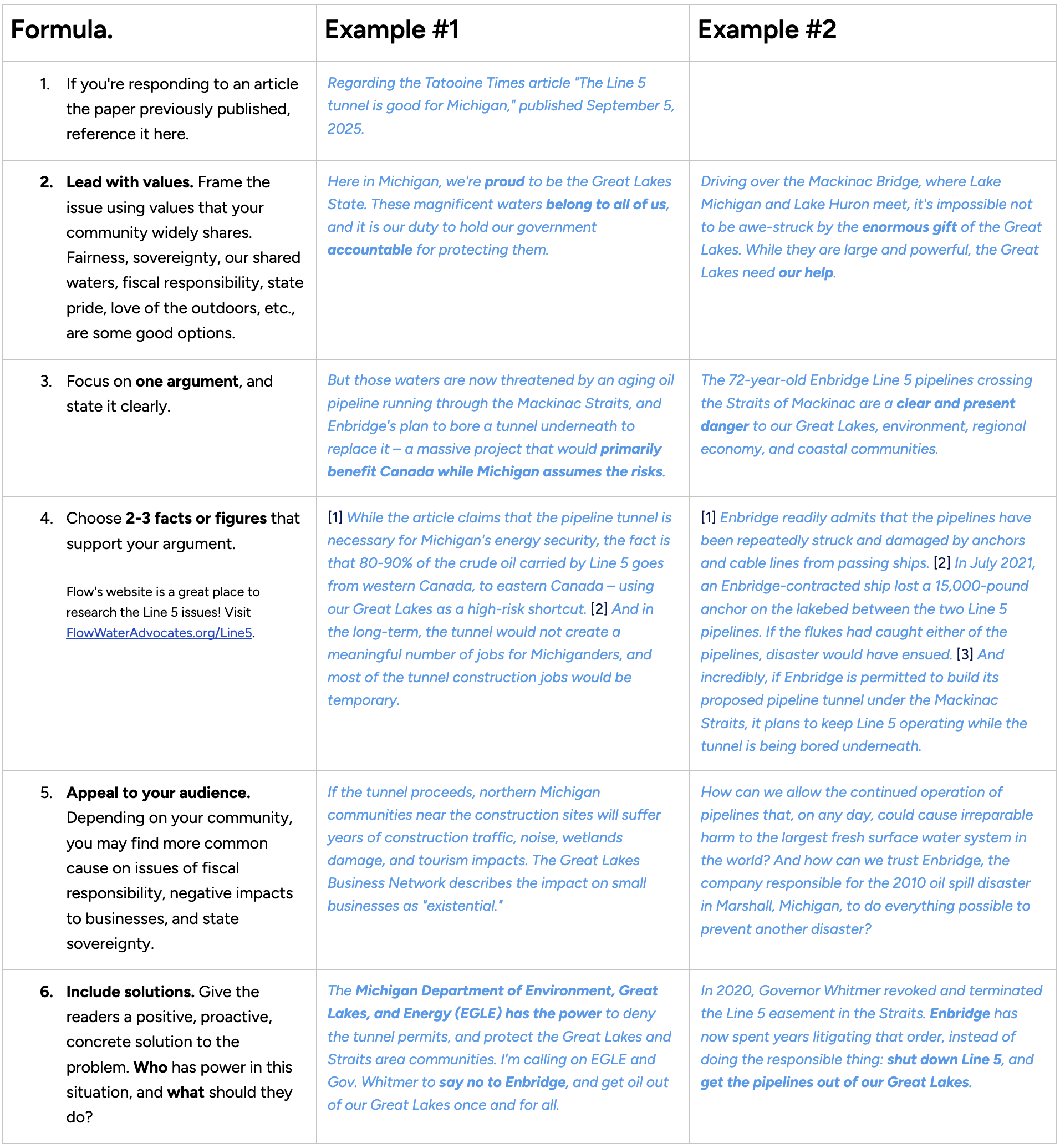
How to write a great Line 5 letter to the editor

Writing a Letter to the Editor of your local newspaper is a great way to keep the Line 5 pipeline issue front and center, and educate our communities and elected officials about the threat Line 5 poses, and why we need to shut down Line 5.

First, know your newspaper’s guidelines:

  • Before you write your letter, visit the newspaper’s website or call to find out the word count limit. (Most are 100-250 words.)

  • Follow your newspaper’s directions on how to submit your letter (e.g. via email, through their website, or by mail).

  • Some newspapers require your full name and current city of residence, so be sure to include that information if needed.
Ready? Time to write your letter!

  • Personalize your letter and write it in your own voice. We’ve provided a tried-and-true formula below, but we encourage you to make it your own!

  • If your local newspaper has recently run a story about Line 5, reference it in your letter.

  • The Line 5 issue can feel really frustrating, but remember, your mission is to persuade, not to vent. Focus on a couple of key points that will resonate across the aisle and in your community.

Guide and examples (click to enlarge).

Michigan Supreme Court grants review of Line 5 tunnel permit

FOR IMMEDIATE RELEASE: September 19, 2025

Lansing, Mich. – The Michigan Supreme Court has granted a landmark application for leave to appeal, paving the way for a review of the Michigan Public Service Commission’s (MPSC) decision to approve a permit for Enbridge’s proposed oil pipeline tunnel in the Straits of Mackinac. This order, issued on September 19, 2025, also invites the State Bar of Michigan Environmental Law Section and Real Property Law Section to file amicus briefs.

Support Flow’s work to defend the Great Lakes.

For Love of Water (FLOW), a Traverse City-based environmental nonprofit recently rebranded as Flow Water Advocates, initiated the legal challenge, arguing that the MPSC failed to uphold its public trust obligations to protect Michigan’s waters. The Supreme Court’s order specifically directs the parties to address whether the MPSC is required to comply with the common law public trust doctrine in its permitting decisions.

“This is an incredibly important step forward for the protection of the Great Lakes,” said Flow Water Advocates Legal Director Carrie La Seur. “The public trust doctrine is a fundamental principle of Michigan law that must be considered in decisions that affect our natural resources. We are eager to argue this case and ensure that our state’s waters are protected for generations to come.”

The case will be heard alongside a related appeal from the Little Traverse Bay Bands of Odawa Indians, a testament to the broad legal and public interest in this issue. The Supreme Court’s decision to grant review signifies the high stakes and critical legal questions surrounding the Enbridge Line 5 tunnel.

Flow is represented in this case by its legal team and co-counsel.

###

Flow Water Advocates is an independent 501(c)(3) nonprofit organization based in Traverse City, Michigan. Our mission is to ensure the waters of the Great Lakes Basin are healthy, public, and protected for all. With a staff of legal and policy experts, writers, and community builders, Flow is a trusted resource for Great Lakes advocates. We help communities, businesses, agencies, and governments make informed policy decisions and protect public trust rights to water. Learn more at www.FlowWaterAdvocates.org.

Flow, Sierra Club, and Surfrider Foundation to EGLE: Reject the Line 5 tunnel permit.

PRESS RELEASE: SEPTEMBER 9, 2025

Download the written comments to EGLE (PDF)

Traverse City, Mich. – On August 29, 2025, Flow Water Advocates, a Great Lakes water protection organization, together with the Sierra Club and Surfrider Foundation, submitted written comments on Enbridge’s application for a Water Resources Permit for its proposed Line 5 tunnel project through the Straits of Mackinac. The Michigan Department of Environment, Great Lakes, and Energy (EGLE) is reviewing the application for compliance under the Michigan Natural Resources and Environmental Protection Act (NREPA), Parts 303 and 325.

Flow’s comments demand that EGLE’s review consider the entire project, and detail the many adverse environmental impacts that will or are likely to result from the project’s approval, including:

  • a projected six years of construction traffic and noise, light, and air pollution; 
  • the destruction of precious wetland ecosystems; 
  • climate impacts from the tunnel’s construction and the products it will transport for the duration of a 99-year lease, and 
  • the potential impacts resulting from a project failure, including a catastrophic oil spill.

Flow’s comments also highlight the expert reports and Enbridge’s own expert testimony that have confirmed available alternatives for transporting the products currently flowing through Line 5.

Because the proposed tunnel will have significant–and potentially catastrophic–impacts on Michigan’s public trust waters and natural resources, and because these impacts can be avoided through available alternatives, EGLE must deny the permit under Michigan’s controlling environmental laws and regulations.

Michiganders are counting on the State to uphold its responsibility to protect the public trust rights of current and future generations who depend on the Great Lakes for their drinking water, subsistence, and way of life.

An additional public comment period for Enbridge’s application to EGLE for a wastewater discharge permit under NREPA, Part 31, is anticipated in the coming months.

###

Flow Water Advocates is a nonpartisan 501(c)(3) nonprofit organization based in Traverse City, Michigan. Our mission is to ensure the waters of the Great Lakes Basin are healthy, public, and protected for all. With a staff of legal and policy experts, writers, and community builders, Flow is a trusted resource for Great Lakes advocates. We help communities, businesses, agencies, and governments make informed policy decisions and protect public trust rights to water. Learn more at www.FlowWaterAdvocates.org.

The Line 5 tunnel isn’t what we were told.

Line 5 – the 72-year-old dual pipelines suspended across the bottomlands of the Straits of Mackinac – has been battered by anchor strikes and entangled by cables from passing ships.

It is universally accepted that the exposed pipelines represent a clear and present danger to the Great Lakes and the regional economy should Line 5 fail.

In the final two months of Governor Rick Snyder’s second term in 2018, the State of Michigan hurriedly signed four agreements with Enbridge, the Canadian pipeline company that owns and operates Line 5, authorizing the construction of a tunnel beneath the Straits of Mackinac intended to contain and protect Line 5.

The agreements, hastily prepared without public hearings or public review of any kind, require the State of Michigan to take ownership of the tunnel once construction is complete, and to oversee the operation and maintenance of the tunnel for the next 99 years.

There is one notable  problem with this unusual partnership between the State and Enbridge: The tunnel the State agreed to manage is not the tunnel that Enbridge intends to build. 

"Almost every aspect of the tunnel’s design, construction, and operation is radically different that what was originally intended," says Brian O’Mara, an expert with over 30 years of tunnel construction experience. "The tunnel project is so off track in so many ways, it is questionable that it can ever be successfully constructed, let alone operated safely."

Basic design assumptions for the proposed tunnel.

The State’s participation in the tunnel project was based on a detailed report, Alternatives Analysis for the Straits Pipeline, authored in 2017 by Dynamic Risk Assessment Systems, Inc., a company providing engineering consulting services to the pipeline industry. Dynamic Risk’s assessment was based upon a tunnel design that was distinctly different from the tunnel design that Enbridge proposes today.

Dynamic Risk recommended a tunnel alternative for Line 5 pipeline based upon the following assumptions:

  1. A thorough and comprehensive investigation of the lakebed would be conducted to understand the geological conditions that the proposed tunnel project would encounter.
  2. The pipeline within the proposed tunnel would be permanently embedded in concrete that would completely fill the 10-foot diameter of the tunnel.
  3. The tunnel would be bored through entirely sound and solid bedrock.
  4. There would be minimal groundwater inflow and pressure.
  5. There would be no methane or toxic gas (H2S) encountered.

None of these assumptions proved to be true or accurate.

How the tunnel has changed.

First, the Dynamic Risk evaluation assumed that “a comprehensive site-specific subsurface investigation and lab testing program would be required” by the State of Michigan, before construction to identify the characteristics of the rocks the tunnel excavation would encounter.

But the expert consultants, McMillen Jacobs Associates (MJA), retained by the Michigan Department of Transportation, identified numerous problems and red flags that were not adequately addressed in Enbridge’s investigation of the proposed tunnel path. For example, MJA found that Enbridge “did not adequately characterize the anticipated ground conditions on site” and that many of the rock sample borings intended to characterize the underlying geology did not reach the proposed depth of the tunnel, with only one boring sample taken from the most critical two-mile length of the tunnel’s proposed pathway.

Second, the tunnel design recommended and approved by the State’s consultant, Dynamic Risk, was a tunnel, 10 feet in diameter, with a “closed annulus,” meaning that the interior of the tunnel would be filled with an impermeable, inflammable cement surrounding the pipelines. The concrete would permanently seal the pipelines, preventing damage or leaks and affording an additional critical measure of safety. The present design is for an open, unsealed, 21-foot tunnel lacking the security and protection that a sealed tunnel would provide.

Third, the Dynamic Risk report on which the State relied assumed that the tunnel would be bored through solid bedrock. But Enbridge’s limited investigation found conditions that would be extremely challenging. It found that the tunnel route would encounter rock formations that are highly fractured and highly permeable, with most rock formations classified as “poor” or “very poor.” Moreover, the boring samples repeatedly encountered “voids”- open underground spaces that would need to be filled with concrete and grout before the tunnel boring machine could progress through the proposed route.

Fourth, the MJA consultants found that the extreme depth of the tunnel route will result in the boring effort encountering high “hydraulic conductivity and hydrostatic pressure” constituting “areas of significant risk impacting tunnel operations due to high groundwater inflows.” The MJA reports state that pressures may “overwhelm” the systems designed to treat water infiltration, estimated at 25,000 gallons per day. The US Army Corps of Engineers’ draft Environmental Impact Statement indicates that the pressures the tunneling machine would encounter may be the highest ever in a tunnel construction project.

Fifth, Enbridge reported that no methane of consequence was encountered in its limited geological investigation, but internal reports indicated that methane was detected in some of the samples and Enbridge failed to note that the proposed tunnel would be situated directly above the Collingwood-Utica Shale Oil and Gas play capable of yielding gas and oil in recoverable quantities. In 1971, a similar tunnel building effort in Lake Huron resulted in a methane explosion that killed 22 construction workers inside the tunnel.

A continued threat to the Great Lakes.

The tunnel project on the table today is substantially different from the tunnel project that was proposed when the agreements were signed by Governor Snyder. And the tunnel design recommended by Dynamic Risk and relied upon by the Michigan Public Service Commission (MPSC) and the Mackinac Straits Corridor Authority (MSCA) is not the design being advanced by Enbridge now. 

The proposed tunnel construction has the potential to impair both the Great Lakes bottomlands and the waters of Lakes Michigan and Huron.  A recent survey found that there have been 321 documented tunnel failures through 2020.  The proposed project is replete with “red flags” indicating the project will encounter extraordinary environmental challenges. It is clear that the proposed tunnel project is not as safe as Enbridge wants Michiganders to believe. The risks that the proposed project presents to the Great Lakes cannot be ignored. With the permitting process for the tunnel underway, we must all call on our federal and state agencies to protect the public interest in our shared freshwater resources.

Enbridge appeals Line 5 decision to U.S. Supreme Court: Our statement

July 1, 2025
Kacey Cook, Flow Staff Attorney

In June 2024, the federal Sixth Circuit Court of Appeals issued a decision to send Attorney General Dana Nessel’s 2019 suit Nessel v. Enbridge back to state court where it started. The Sixth Circuit held that Enbridge’s removal of AG Nessel’s lawsuit to federal court, more than two years after it was filed, was untimely and unjustified. Enbridge’s attempt to take the lawsuit to federal court came well after the deadline for removal, and the Sixth Circuit ruled that the delay could not be justified on any of the grounds cited by Enbridge or the lower court.

Enbridge appealed that decision to the US Supreme Court, which has now agreed to hear the case. The appeal serves to prolong the operation of the company’s pipeline through the heart of the Great Lakes–allowing Enbridge to continue to profit, while our shared freshwater resources remain at risk.

Under Michigan public trust law, the State has the paramount responsibility, and power, to protect the Great Lakes and their bottomlands from occupation by private projects that present unacceptable risks to these shared public resources.

It is difficult to imagine a project that presents greater risks than Enbridge’s Line 5 pipeline–pumping approximately 23-million gallons of oil through the Straits of Mackinac every day with the ever-present potential for a catastrophic oil spill.

In 2020, Governor Whitmer issued a Notice of Revocation and Termination of the project’s easement across the Straits, citing both violations of the public trust doctrine and Enbridge’s “longstanding, persistent, and incurable violations of the Easement’s conditions and standard of due care.”

Today’s news is the most recent development in Enbridge’s years-long campaign of defiance against the State’s enforcement of Michigan law. Flow Water Advocates will continue to monitor all developments in the federal courts, and we stand with the State of Michigan in its efforts to ensure that this important case enforcing Michigan’s public trust doctrine is properly heard in State court.

Flow is also closely following Michigan agencies’ careful review of Enbridge’s state permit applications for the proposed tunnel project and applaud the State’s continued insistence that Enbridge provide all of the information required for a proper review of the risks associated with the unprecedented megaproject.

Flow submits written comments on Line 5 tunnel project Draft Environmental Impact Statement

June 30, 2025

Traverse City, Mich. – Today, Flow Water Advocates, a Great Lakes water protection organization, with sign-on from the Sierra Club Environmental Law Program and Surfrider Foundation, submitted written comments on the U.S. Army Corps of Engineers’ Draft Environmental Impact Statement (DEIS) for Enbridge’s proposed Line 5 tunnel project.

The Canadian pipeline company Enbridge proposes building a tunnel under the Straits of Mackinac to house a replacement segment of the Line 5 pipeline, with the stated intention of continuing to transport fossil fuels under the Great Lakes bottomlands for another 99 years.

Enbridge’s application for federal Clean Water Act and Rivers and Harbors Act permits for the project is currently under review by the Army Corps. Project proposals that involve a major federal action that could significantly affect the quality of the human environment must be reviewed by the permitting agency and the public through a process outlined under the National Environmental Protection Act (NEPA). This review includes the preparation of both a Draft and Final Environmental Impact Statement, which must assess the purpose and need for the proposed project, alternatives to the proposal, and an assessment of the environmental consequences of the project.

Flow’s comments highlight a number of serious gaps in the scope and substance of the Corps’ review, including failure to consider alternatives that do not involve pumping oil through the Straits of Mackinac, and a failure to require a more in-depth study of the geology, despite several red flags raised in earlier investigations.

We’re fighting to protect the Great Lakes from an oil spill. Donate today to support this important legal work:


Underground tunnel projects present unique and significant engineering challenges. Risks associated with underwater tunnel construction – such as blowouts and sinkholes – are compounded by the fact that the proposed tunnel would be constructed through fractured rock formations that have been described by studies as “very poor,” with voids that must be filled, anticipated water infiltration in the tunnel, and high methane levels – a potential source of explosions. The tunnel would be constructed as the 72-year-old dual pipelines continue to move 540,000 barrels of oil per day across the lake bottom above. This oil pipeline will run through the heart of the Great Lakes system that supplies over 40 million people with drinking water and contains approximately 84% of North America’s surface freshwater. It is imperative that permitting agencies rigorously review the hydrogeology and engineering plan.

The project is unprecedented and ill-advised. It is hard to imagine a project that would present greater risks of adverse environmental impacts than the proposed tunnel, and the two other alternatives considered in the Corps’ review both involve continued operation of the pipelines. Yet, not only has the Corps failed to properly assess and consider the risks associated with the reviewed alternatives, the Agency has unlawfully excluded from its consideration alternatives that do not involve a pipeline through the Straits. As a result, any final decision short of a permit denial will be unlawful.

The Corps has stated that it anticipates finalizing the EIS for the project in the fall of this year When the Final EIS is published, the public will have the opportunity to provide further comment before the Agency issues its Record of Decision on the project. Flow will continue to participate in the permit review process and express its opposition to this dangerous project, which presents unacceptable and unnecessary risks to our shared public trust resources.

Enbridge Line 5 webinar: What every Michigander needs to know

Facing competition, declining fossil fuel demand, and challenges building new pipelines in Canada, Enbridge is working overtime to convince Michiganders that we’re dependent on Line 5, but that’s not true.

On July 22, join Flow Water Advocates and Oil & Water Don’t Mix for a special live webinar, as our panel of experts and advocates discuss recent developments in the Line 5 litigation, why the tunnel isn’t good for Michigan, and how you can get involved.

Did you know that…

  • Enbridge was responsible for the devastating 1.2 million gallon oil spill in Marshall, Michigan — one of the worst in U.S. history.
  • 80-90% of the crude oil carried by Line 5 goes from Canada, to Canada.
  • The State of Michigan is the legal trustee of the Straits, and has the power and duty to protect them for the benefit of Michiganders.
  • Enbridge still needs permits from the U.S. Army Corps of Engineers and the Michigan Dept. of Environment, Great Lakes, and Energy (EGLE) to build the tunnel.

Our expert panel includes:

  • Riyaz Kanji, founding member and Directing Attorney of Kanji & Katzen – representing the Bad River Band of Lake Superior Chippewa
  • Carrie La Seur, Legal Director, Flow Water Advocates 
  • Skip Pruss, Senior Legal Advisor, Flow Water Advocates
  • Beth Wallace, Climate and Energy Director, National Wildlife Federation and Co-Director of the Great Lakes Business Network

Hosted and moderated by Flow staff attorney Kacey Cook.

This online webinar is free, and supported in part by the Mackinac Island Community Foundation’s Natural Resources and Preservation Fund and the Straits Area Community Foundation. 

About the panelists

Riyaz Kanji, Founding Member and Directing Attorney, Kanji & Katzen​

Riyaz Kanji is a founding member of Kanji & Katzen, PLLC, a firm whose mission is to advance Tribal sovereignty. A graduate of Harvard College and the Yale Law School, Riyaz served as a law clerk to the late Honorable Betty Fletcher of the United States Court of Appeals for the Ninth Circuit and Justice David Souter of the United States Supreme Court. He is an advisor to and vocal cheerleader for the Tribal Supreme Court Project. Riyaz represents Tribes at all levels of the federal court system, and was part of the team that argued and won the decision in McGirt v. Oklahoma vindicating the continued existence of the Muscogee Creek Reservation.

As Flow’s Legal Director, Carrie develops and implements legal and policy strategies to maximize protection of public trust resources and uses. A graduate of Yale Law School, Carrie recently relocated to northern Michigan from Montana, where she practiced civil litigation, specializing in environmental and climate issues. From 2006-2012 served as Executive Director of Plains Justice, a legal nonprofit she co-founded, litigating against new fossil fuel infrastructure.

Skip Pruss is an energy expert with decades of experience in both the public and private sector. He is a former cabinet member and director of the Michigan Department of Energy, Labor, and Economic Growth, as well as the former chief energy officer for the State of Michigan, under former Gov. Jennifer Granholm, where he was responsible for designing and implementing Michigan’s clean energy economy diversification efforts.

Earlier in his career, Skip served as Deputy Director of the Michigan Department of Environmental Quality. Skip also is a co-founder of 5 Lakes Energy LLC, a clean energy technology consultancy.

Bio coming soon!

Enbridge Line 5 tunnel: What every Michigander needs to know

Canadian pipeline company Enbridge wants to bore a massive fossil fuels tunnel through Straits of Mackinac. The proposed four mile tunnel would remove 364,000 cubic yards (or

27,000 dump truck loads) of earth and rock from the bottomlands of the Great Lakes.

The U.S. Army Corps of Engineers finds that the tunnel project would result in both short- and long-term detrimental impacts1, including loss of wetlands and wildlife habitats; potential release of drilling fluids; up to six years of construction noise, lights, traffic, and vibrations; limits to recreational activities; destruction of archaeological resources; and impacts to property values and tourism.

The State of Michigan is the legal trustee of the Straits, and has the power and duty to protect them for the benefit of Michiganders and future generations. Let’s take a look at why the tunnel is a dead end:

We can not trust Enbridge with our Great Lakes.

1. The Line 6B disaster.
Enbridge was responsible for the devastating 2010 Line 6B oil spill in Marshall, Michigan — one of the worst inland oil spills in U.S. history. In its investigation of the 1.2 million gallon disaster, the NTSB cited “pervasive organizational failures” at Enbridge.2

2. Bad track record.
There have been 34 documented Line 5 oil spills in Michigan and Wisconsin, totaling over 1.3 million gallons. The pattern continued as recently as November 2024, when 70,000 gallons3 spilled in Jefferson, Wisconsin

3. Irresponsible.
In 2024, the federal government had to order Enbridge to repair cracks4 in Line 5, and assess cracks using more comprehensive methods that account for all pipeline stresses.5 Enbridge should have taken this measures without being told.

4. Unaccountable.
In 2020, an Enbridge internal investigation revealed that an Enbridge-contracted ship likely dragged a cable and damaged Line 5 in the Mackinac Straits. Enbridge later admitted it failed to notify the state as was required.6

The Line 5 tunnel would primarily serve Canada, not Michigan.

According to Enbridge, Line 5 supplies half of the oil used in Ontario and Quebec,7 or approximately 396 thousand barrels per day.8 Line 5 carries 400-450 thousand barrels of crude oil per day9 from northwestern Canada, eastward. Upwards of 88% of Line 5 crude oil flows from Canada, to Canada, using the Great Lakes and Michigan as a risky short-cut to Sarnia, Ontario.

Line 5 also carries 80 thousands barrels of Natural Gas Liquids per day.

“We’ve seen multiple occasions where as a country we [Canada] can’t get behind building pipelines, so it’s important to keep the existing ones up and running.”10

Vern Yu, Enbridge Executive Vice-President and President, Liquids Pipelines (fmr.)

Unstudied, unstable.

What we know about the rock quality under the Straits.

A technical review of the proposed tunnel by the Michigan Department of Transportation raised numerous red flags and factors that could result in tunnel collapse, environmental damage, or even an explosion.

The combination of poor geology, length, depth, potential for methane gas pockets, and extremely high hydrostatic pressure12 all add up to an unprecedented, untested design unlike any other tunnel in the world.

Enbridge hasn’t done its homework.

1. Lack of due diligence.
Understanding the bedrock and geology of the tunnel’s path is critical for its safe construction and operation. But Enbridge only sampled the rock an average of once every 950 feet, far below the industry standard of once every 50 to 250 feet.13

2. Insufficient sampling.
Enbridge only took one rock sample over a span of about 11,000 feet14 — the deepest, most critical section of the proposed tunnel route. There is a span of 1.5 miles that has not been sampled at all (thousands of feet longer than the un-sampled sections of similar tunnel project).15

3. Wrong depth.
Enbridge didn’t take enough rock samples, and some of the samples it did take were not deep enough.16 The percentage of samples laying within the zone of the tunnel path was less than the typical amount of samples studied during comparable projects.17

4. Unprecedented.
A hazardous liquids pipeline tunnel of this length, depth, and in geologic and hydrostatic pressure conditions like those found in the Mackinac Straits has never before been attempted.18 We cannot allow the Great Lakes to be Enbridge’s guinea pig.

The unacceptable risk of collapse and explosion.

Instead of solid, uniform bedrock, this tunnel would bore through fractured geologic formations that are “poor” and “very poor” quality, and contain voids.19 This type of rock with large, open seams, has high hydraulic conductivity, which means water can easily flow through it. Studies have also found high hydrostatic pressure at tunnel depth.20

This all adds up to a sponge-like environment that is vulnerable to uncontrollable inflows of water — water that is connected to Lake Michigan.

Tunneling through a slurry of rock and soil, or mixed-face tunneling, is “the most dangerous type of tunneling”21 and there is a risk of collapse around the tunnel boring machine (TBM).

Experts also warn that vapors within the tunnel and dissolved methane in the groundwater could ignite and cause an explosion.22, 23

A tunnel to the past.

Investing in a new fossil fuels tunnel doesn’t add up.

The world is changing, and so are energy markets. Increasing fuel efficiency, electric vehicle sales, and decarbonization across industries make this new fossil fuels tunnel a bad bet.

With global oil demand predicted to peak this decade,24 we should not invest in a massive piece of fossil fuel infrastructure that will start to become obsolete almost as soon as it opens.

A bad investment for Enbridge and Michigan.

1. Skyrocketing costs.
A 2025 report by the non-partisan Institute for Energy Economics and Financial Analysis (IEEFA) found that the tunnel may cost up to three times more than initial estimates.25 Meanwhile, Enbridge also faces an expensive 41-mile reroute in Wisconsin.

2. Depressed market.
During this critical time for climate action, projects like the Line 5 tunnel are a bad bet — and Wall Street knows it. The fossil fuels sector underperformed the S&P 500 for 7 of the last 10 years, delivering the lowest performance of all S&P 500 sectors.26

3. Declining demand.
According to Goldman Sachs, global oil demand will peak in 2035 and then begin to decline27 — just six years after the tunnel is scheduled to open.28 U.S. gasoline consumption peaked in 2018 and has fallen more than 4% despite population growth.29

4. You’re on the hook.
Ownership of the tunnel would transfer to the Mackinac Straits Corridor Authority — or in other words, Michigan taxpayers. Enbridge may lease the tunnel rent- free30 for up to 99 years. It’s unclear who will be liable for its upkeep if the lease is terminated early.31

The tunnel isn’t the answer.

There’s no question: Line 5 as it exists today, resting exposed on the lake bed floor, buffeted by strong currents and vulnerable to anchor strikes,32 is an unacceptable threat to our Great Lakes.

That’s why Michigan Gov. Gretchen Whitmer revoked the Line 5 easement in 2020 and ordered that it be shut down. (Enbridge continues to operate Line 5 in defiance of the State of Michigan.)

Due to the poor rock quality and volatile gasses, the tunnel would not eliminate the threat of an oil spill.

The multi-year construction phase would be especially risky, as Enbridge plans to operate the existing Line 5 during the boring underneath.

The good news is, there are other ways33 to supply fossil fuels to eastern Canada and replace the much smaller amounts supplied by Line 5 to Michigan and the U.S. — alternatives that don’t endanger the Great Lakes.

Here’s the big picture: building the tunnel would feed climate change, lock Michigan into fossil fuels, and deincentivize the development of healthier regional energy networks and solutions. We can do better.

Michigan after Line 5.

We can get oil out of the Great Lakes and make a better future.

Facing competition from other pipeline companies and declining demand, Enbridge is working overtime to protect its profits and convince Michiganders that we’re dependent on Line 5, but that’s not true.

We have a range of viable alternatives to Line 5, including excess capacity in existing pipelines34 that go around, and not through, the Great Lakes

What happens when we decommission Line 5.

1. Stable prices.
Enbridge’s own expert found that gas prices in Michigan would only increase half a cent per gallon,36 well within normal fluctuations. And a report from supply chain analyst PLG Consulting says that a planned and orderly shut down of Line 5 will not result in price spikes.37

2. Depressed market.
PLG Consulting has also calculated that 87% of Line 5’s crude oil supply could be replaced within three months by fully utilizing Enbridge Line 78 through southern Michigan. Any shortfalls could be supplemented by other transport methods and regions.38

3. Energy independence for Canada.
Since early 2025, Canadian leaders have expressed new interest in investing in their energy security.39 This could include reviving the proposed Energy East pipeline, which would run entirely north of the U.S. border and Great Lakes, supplying Canada’s eastern provinces.40

4. Protected waters.
Michigan has the power to deny the tunnel permit, and protect the Great Lakes from years of construction upheaval, wetlands damage, and other risks. Michigan can assert its sovereignty, stop the exploitation of our resources, and protect the waters today and for generations to come.

References

1. U.S. Army Corps of Energineers, Enbridge Line 5 Tunnel Project Final Environmental Impact Statement.
2. National Transportation Safety Board, https://www.ntsb.gov/investigations/AccidentReports/Reports/PAR1201.pdf
3. Wisconsin Public Radio, https://www.wpr.org/environment/enbridge-oil-spill-jefferson-county-wisconsin-pipeline
4. Detroit News, https://www.detroitnews.com/story/news/local/michigan/2024/07/08/enbridge-line-6 b-proposed-eighth-modification-circumferential-cracks/74327136007/
5. U.S. Dept. of Justice, https://www.justice.gov/enrd/media/1359506/dl
6. MI Attorney General, https://www.michigan.gov/ag/news/press-releases/2020/06/25/judge-orders-line-5-to -cease-operations
7., 10. Canada House of Commons, https://www.ourcommons.ca/DocumentViewer/en/43-2/CAAM/meeting-4/evidence
8. Government of Canada, https://www150.statcan.gc.ca/t1/tbl1/en/cv.action?pid=2510003001 9., 33., 34., 35., 37., 38. PLG Consulting, https://plgconsulting.com/white-paper-likely-market-responses-to-a-line-5-shutdown/
11., 12. McMillen Jacobs & Associates for MDOT, https://www.michigan.gov/-/media/Project/Websites/egle/Documents/Multi-Division/L ine-5/MDOT_Question_on_Collapses_in_Terms_of_Loss_of_Face_Control_Jan_2021.pd f
13. Michigan Advance, https://michiganadvance.com/2020/09/28/geologists-condemn-line-5-tunnel-plan-pe rmitting-the-project-at-this-time-would-be-a-mistake/
14., 15. McMillen Jacobs & Associates for MDOT, https://www.michigan.gov/-/media/Project/Websites/egle/Documents/Multi-Division/L ine-5/MDOT_Question_on_Risk_mitigation_Jan_2021.pdf
16., 17., 19., 20. McMillen Jacobs & Associates for MDOT, https://www.michigan.gov/-/media/Project/Websites/egle/Documents/Multi-Division/L ine-5/MDOT_Question_on_Geotechnical_Investigation_Jan_2021.pdf
18. EarthJustice, https://earthjustice.org/press/2025/tribes-greens-take-line-5-tunnel-to-michigans-supremecourt
21. Michigan Advance, https://michiganadvance.com/2020/09/28/geologists-condemn-line-5-tunnel-plan-permittin g-the-project-at-this-time-would-be-a-mistake/
22. Richard Kuprewicz, comments to the Michigan Public Service Commission, https://narf.org/nill/documents/20211214-line5-mpsc-kuprewicz-testimony.pdf
23. Brian O’Mara, testimony to the Michigan Public Service Commission, https://turtletalk.blog/wp-content/uploads/2023/02/bay-mills-experts.pdf
24., 27. Goldman Sachs, https://www.goldmansachs.com/insights/articles/peak-oil-demand-is-still-a-decade-away 25. Institute for Energy Economics and Financial Analysis, https://ieefa.org/resources/enbridge-should-consider-closing-its-old-troubled-line-5-pipeline
26. Institute for Energy Economics and Financial Analysis, https://ieefa.org/sites/default/files/2025-01/REVIEWED-15818-Briefing%20Note_2024%20Re cap%20oil%20stocks%20%281%29.pdf
28. Bridge Michigan, https://www.bridgemi.com/michigan-environment-watch/trump-administration-fast-track-lin e-5-tunnel-calling-project-emergency 29. U.S. Energy Information Administration, https://www.eia.gov/tools/faqs/faq.php?id=23&t=10
30., 31. State of Michigan, https://www.michigan.gov/psab/-/media/Project/Websites/psab/archive/media/ProposedTun nelLease_12-13-18.pdf
32. Flow Water Advocates, https://flowwateradvocates.org/line5
36. Neil K. Earnest, Muse, Stancil & Co, federal court filing, https://environmentaldefence.ca/wp-content/uploads/2022/06/Report-expert-Enbridge-exp ert-Neil-Earnest-Muse-Stancil.pdf
39. Canadian Broadcasting Corporation, https://www.cbc.ca/news/politics/west-east-pipeline-jonathan-wilkinson-1.7452406
40. Financial Post, https://financialpost.com/commodities/energy/sentiment-pipelines-trump-canada