Tag: nessel v. enbridge

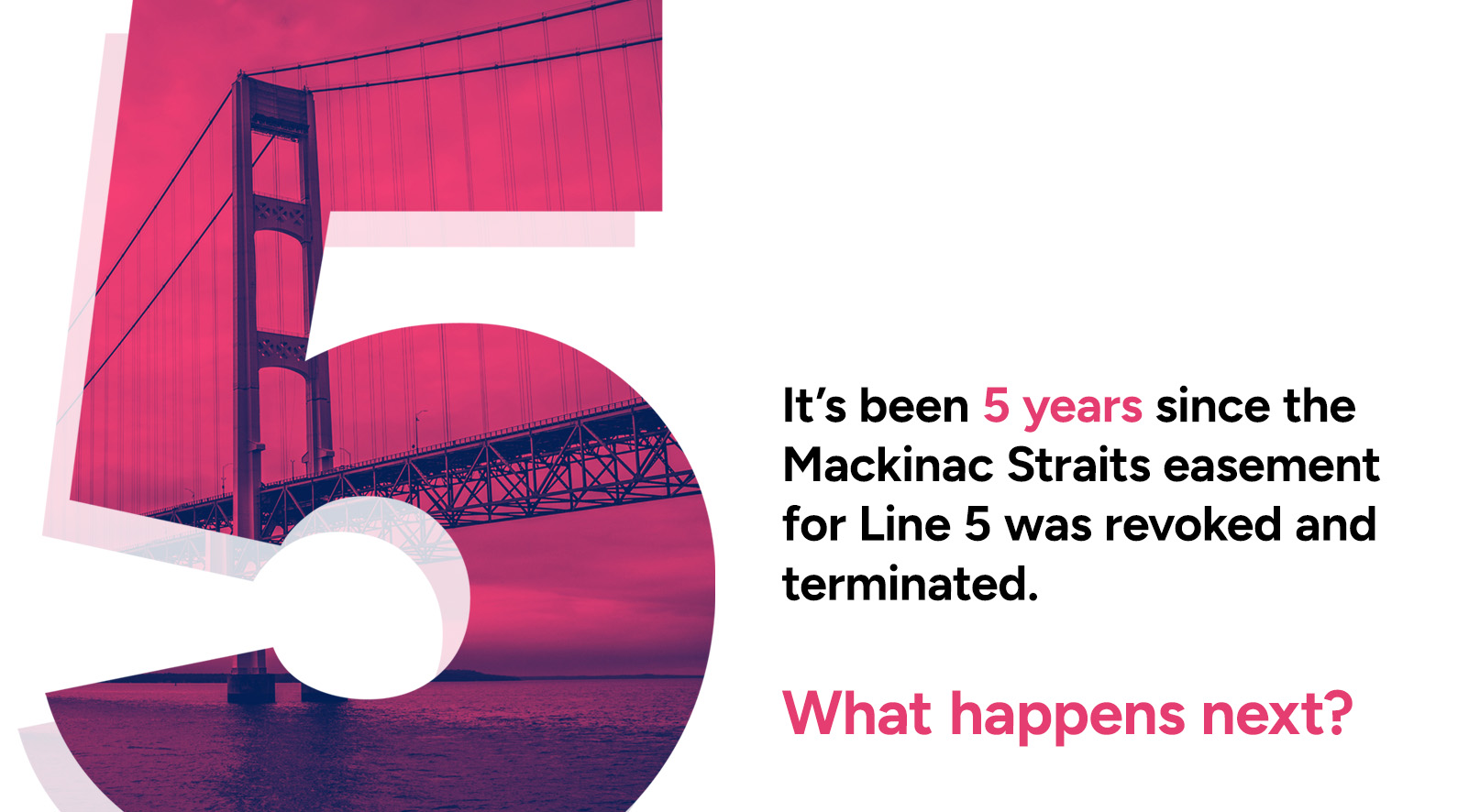
Michigan revoked the Line 5 easement 5 years ago. What happens next?

Updated December 19, 2025

Five years ago, on November 13, 2020, Michigan Governor Gretchen Whitmer and the Department of Natural Resources revoked and terminated the 1953 easement that had allowed Enbridge to locate and operate its dual Line 5 pipelines on the lakebed and in the waters of the Straits of Mackinac. As public trustee and fiducidary, the state revoked the easement for two key reasons:

  • The state has a duty under the public trust doctrine to protect the waters of the Great Lakes for the people of Michigan. This duty required the state to revoke the easement due to the “extraordinary and unacceptable risk” posed by the aging, vulnerable pipelines, which have been struck multiple times by anchors and cabling.
  • Enbridge “repeatedly and incurably” violated the express terms of this public trust easement, and had done so for decades. Enbridge persistently failed to satisfy numerous conditions related to the support, protective coatings, and curvature of the pipelines.

An analogy to landlord-tenant law is warranted since the state of Michigan is the sovereign owner and protector of the public trust waters and bottomlands in the Great Lakes. In the case of landlord-tenant relations, any landlord would be within their rights to evict a tenant who violated their lease, repeatedly left the stove on and the bathtub overflowing, and refused to leave when the lease was up. And a landlord would be correctly concerned about a tenant who had previously burned down another apartment due to negligence.

Half a decade later.

And yet, half a decade later, the Line 5 pipelines remain, haphazardly suspended across the lakebed floor, buffeted by strong currents and vulnerable to anchor strikes and other hazards in one of the busiest shipping lanes in the Great Lakes. Each day, Line 5 carries nearly 23 million gallons of fossil fuels from western Canada, through the Great Lakes — the majority of which supply Canadian refineries in Ontario and Quebec. The water security of the Great Lakes is at high risk every day.

On each of the 1,825 days and counting since the easement was revoked, Michigan has borne unacceptable risks so that a Canadian pipeline company can continue to profit, protect its market share, and deliver crude oil primarily from Canada to Canada. The Line 5 pipeline in the Straits of Mackinac could only be built in 1953 with a public trust easement from the state of Michigan; therefore, an easement authorizing Enbridge permission to occupy our public waters is necessary for its continued operation. That easement no longer exists.

The Line 5 pipeline and the proposed replacement tunnel are now being fought in multiple courts by multiple parties, including Flow Water Advocates.

Here’s where Line 5 currently stands in Michigan:

Nessel v. Enbridge

At issue:
In 2019, Michigan Attorney General Dana Nessel filed suit in Michigan’s 30th Circuit Court (Ingham County), seeking an order to decommission Line 5. She argues that its continued operation violates the public trust doctrine, is a public nuisance under common law, and violates the Michigan Environmental Protection Act.

Flow, along with the Great Lakes Business Network and the Sierra Club, briefed the court in 2019, 2021, and 2024 in support of Michigan’s sovereignty and public trust rights.

What has happened so far:
Enbridge has successfully delayed the case (and kept the oil and profits flowing) over matters of jurisdiction, and it initially succeeded in moving the case from state to federal court — long after the 30-day time limit to do so had passed.

  • In June 2024, the U.S. Sixth Circuit Court of Appeals ruled that the move to federal court was indeed untimely, and sent the case back to state court.

  • Enbridge then appealed to the U.S. Supreme Court, which in June 2025 agreed to hear the case on the procedural question of whether district courts have the authority to excuse the 30-day time limit — again prolonging the risks of Line 5’s continued operation. The SCOTUS will hear oral arguments in spring 2026.
What happens next:
In August 2025, Ingham County circuit court Judge James Jamo denied Enbridge’s request to stay (pause) the state case while awaiting a SCOTUS ruling. We are now awaiting a decision by Judge Jamo on whether Line 5 will be shut down.

Enbridge v. Whitmer

At issue:
On November 24, 2020, Enbridge filed its federal court lawsuit asserting that Governor Whitmer does not have the authority to protect its sovereign interests of public trust waters and submerged lands, and that state action against Line 5 may violate Enbridge’s alleged treaty right to pump oil through the Great Lakes uninterrupted.

What has happened so far:
Governor Whitmer moved to dismiss the action on the grounds that state officials have immunity from federal lawsuits under the U.S. Constitution’s Eleventh Amendment. Enbridge’s separate federal case against the state still remains before Judge Jonker in the U.S. District Court for the Western District of Michigan who held (we think wrongfully) that an exception applies.

  • In an October 2024 amicus brief, Flow and the Great Lakes Business Network argue that Enbridge’s lawsuit impairs state sovereign and public trust duties; and that long-standing legal principles that balance federal and state sovereign interests weigh in favor of states’ rights and jurisdiction over the public navigable waters and bottomlands of the Great Lakes.

On November 12, 2025, Judge Jonker heard oral arguments in the case. Michigan Assistant AG Keith Underkoffler argued that the state’s preexisting authority could not be undermined by the federal Pipeline Safety Act, which wasn’t enacted until 1968. Further, he argued that the state would not have granted the easement in 1953 if it had known that 15 years later, the state’s rights in relation to the easement would be preempted by the federal government.

On December 17, 2025, Judge Jonker issued a decision improperly preventing the State of Michigan from enforcing Gov. Whitmer’s revocation and termination of the easement.

What happens next:
The State of Michigan now has the option to appeal Judge Jonker’s decision to the U.S. Court of Appeals for the Sixth Circuit.

Michigan Supreme Court: Line 5 tunnel permit

At issue:
In late 2023, the Michigan Public Service Commission approved a permit for Enbridge’s proposed Line 5 pipeline tunnel under the Straits of Mackinac. In doing so, Flow argues that the MPSC failed in its duties under the public trust doctrine, Michigan Environmental Protection Act (MEPA), and Great Lakes Submerged Lands Act to protect the waters of the Great Lakes and their bottomlands for the people of Michigan; and that the MPSC failed to consider feasible and prudent alternatives to the tunnel.

What has happened so far:
Flow, along with other environmental groups, tribes, and an individual, appealed the MPSC’s permit decision in the Michigan Court of Appeals. In February 2025, the Court of Appeals affirmed the MPSC’s tunnel permit.

Flow and others then appealed that decision to the Michigan Supreme Court, which in September 2025 announced it would hear the appeals, paving the way for a review of the permit. The Supreme Court specifically directed the parties to address whether the MPSC is required to comply with the common law public trust doctrine and MEPA in its permitting decisions.

What happens next:
Flow and the other appellants submitted opening briefs to the court on November 14, 2025. Additional briefing will take place in December and January, with oral arguments expected to be scheduled in 2026.

Meanwhile, the proposed tunnel has yet to receive the required permits from the Michigan Department of Environment, Great Lakes, and Energy (EGLE) and the U.S. Army Corps of Engineers (USACE).

Read: Flow’s comments to EGLE; Flow’s comments to USACE.

The USACE is now also conducting a supplemental Environmental Impact Statement (EIS) that will evaluate horizontal directional drilling. Flow, in partnership with the Sierra Club and Surfrider Foundation, submitted public comments on December 5, 2025.

The next five years.

It is unlikely — though not impossible — that we will go another half-decade before the Line 5 threat is resolved. Flow is fighting every day for a resolution that respects Michigan’s sovereignty, the public trust doctrine, and the rights of all Michiganders present and future to enjoy, navigate, use, and be sustained by the irreplaceable waters of our Great Lakes. As part of our work, we also are committed to ensuring water security and energy security solutions for the Great Lakes region. It is our fervent hope that Line 5 is shut down lawfully by our civil courts, and not because of an oil spill disaster.

FLOW, GLBN, and Sierra Club file joint amici brief in Nessel v. Enbridge lawsuit

FLOW, Great Lakes Business Network, and Sierra Club File Joint Amici Brief in Nessel v. Enbridge Lawsuit, Dismantling Enbridge’s Allegations and Defending State Sovereignty


Contact:
Carrie La Seur, FLOW Legal Director
carrie@flowforwater.org
(231) 944-1568

Traverse City, Mich. – On December 2, 2024, For Love of Water (FLOW), Great Lakes Business Network (GLBN), and Sierra Club filed an amici curiae brief opposing Enbridge’s motion for summary disposition in the Line 5 lawsuit Nessel v. Enbridge. The three groups, representing tens of thousands of Michigan residents and hundreds of Michigan businesses, weighed in as “friends of the court”, arguing that Michigan has both the power and the duty to protect publicly held bottomlands in the Straits of Mackinac from the urgent threat of a pipeline breach.

The amici brief makes the case that the 1977 Transit Pipelines Treaty between the US and Canada explicitly reserves for the states the authority to regulate cross-border pipelines in the area of environmental protection. AG Nessel’s complaint targets the failing underwater section of Line 5, wholly within Michigan’s sovereign territory. Pointing out how Enbridge has misread the treaty, lawyers for FLOW, GLBN, and Sierra Club outlined how the U.S. Supreme Court has long held that the Constitution protects traditional states’ rights and responsibilities – including the responsibility to protect public trust resources like the Great Lakes.

The Line 5 controversy indeed exposes a threat to the prudent conduct of our nation’s foreign policy – and that threat is Enbridge. Hiding behind the cloak of the foreign affairs doctrine, Enbridge seeks a judicial stamp of approval for a new U.S. foreign policy – one that would privilege a foreign oil company’s uninterruptible flow of hydrocarbons over the sovereign rights and responsibilities of the states.

FLOW Legal Director Carrie La Seur said, “With this week’s filing, our coalition again stands with AG Nessel to defend Michigan’s priceless natural heritage from an urgent threat.”

Andy Buchsbaum, the Great Lakes Business Network’s attorney stated, “Enbridge continues to try to stop Michigan’s top law enforcement officer from preventing a massive oil spill in the Great Lakes that would devastate millions of people and thousands of businesses. That’s shocking, and we can’t let it happen. Great Lakes businesses are standing up for the Great Lakes in court, before Congress and wherever else we need to be.”

FLOW, GLBN, and Sierra Club separately briefed the court in 2019 and 2021, arguing for Michigan’s sovereignty and public trust rights, and detailing irreparable harm that would befall the region’s economic security and quality of life if the judicial relief sought by AG Nessel – the revocation of the Line 5 easement and the shut down of Line 5 – is not granted before Line 5 ruptures.

“We appreciate Attorney General Nessel continuing to fight for protecting our Great Lakes and the people of Michigan from a pending oil spill disaster,” said Elayne Coleman, Sierra Club – Michigan Chapter Director. “Enbridge has thrown millions of dollars into their efforts to undermine Michigan’s right to oversee our public trust. We’re not going to bend to a Canadian oil giant, and we’re glad Attorney General Nessel isn’t backing down, either.”

[ Download Amici Brief (PDF) ]

###

For Love of Water (FLOW) is a nonpartisan 501(c)(3) nonprofit organization based in Traverse City, Michigan. Our mission is to ensure the waters of the Great Lakes Basin are healthy, public, and protected for all. With a staff of legal and policy experts, writers, and community builders, FLOW is a trusted resource for Great Lakes advocates. We help communities, businesses, agencies, and legislators make informed policy decisions and protect public trust rights to water. Learn more at www.flowwateradvocates.org

The Great Lakes Business Network is a coalition of businesses dedicated to preserving the integrity and vitality of the Great Lakes, fostering sustainable business practices, and advocating for policies that protect the environment and the economy of the Great Lakes region. It is co-managed by National Wildlife Federation and Groundwork for Resilient Communities. Learn more at glbusinessnetwork.com

Sierra Club is America’s largest and most influential grassroots environmental organization, with more than 3.5 million members and supporters. In addition to protecting every person’s right to get outdoors and access the healing power of nature, the Sierra Club works to promote clean energy, safeguard the health of our communities, protect wildlife, and preserve our remaining wild places through grassroots activism, public education, lobbying, and legal action. For more information, visit www.sierraclub.org.

###

FLOW applauds decision sending Nessel v. Enbridge Line 5 case back to state court

FLOW (For Love of Water) applauds the federal Sixth Circuit Court of Appeals’ decision yesterday sending Michigan Attorney General Dana Nessel’s legal action against Enbridge’s Line 5 back to state court where it started. In 2019, AG Nessel sought a court order to shut down Enbridge’s failing Line 5 crude oil and natural gas pipeline. In 2020, Governor Whitmer revoked Enbridge’s easement. As a result, Line 5 now illegally occupies the Lake Michigan lakebed at the Straits of Mackinac, and presents a clear and present danger of a catastrophic spill into the Great Lakes.

Now the Sixth Circuit has held that Enbridge’s removal of AG Nessel’s lawsuit to federal court, more than two years after it was filed, was untimely and unjustified. Enbridge’s attempt to take the lawsuit to federal court came well after the deadline for removal, and the Sixth Circuit ruled that the delay could not be justified on any of the grounds cited by Enbridge or the lower court. Enbridge’s delay tactic of removal is typical of fossil fuel companies being held to account by state authorities, and it failed here.

FLOW has vigorously supported AG Nessel throughout this procedural odyssey, including submitting an amicus curiae (friend of the court) brief to the Sixth Circuit. FLOW is confident that at a trial on the merits, the AG will demonstrate the monstrous and unacceptable threat the 70-year-old Line 5 poses to the precious clean water resources of the Great Lakes, and achieve the shutdown remedy she and Governor Whitmer have so vigilantly pursued. FLOW and its many supporters and allies remain committed to this goal, and we are grateful for the leadership of AG Nessel and Gov. Whitmer in this fight.

###

FLOW is an independent, 501(c)(3) nonprofit that serves as a Great Lakes water law and policy center dedicated to ensuring the waters of the Great Lakes Basin are healthy, public, and protected for all. The enduring idea of the commons and legal principles of the public trust offer unifying adaptive solutions to address basin-wide threats. FLOW’s staff of legal and policy experts, journalists, and community-builders makes FLOW an authoritative resource for Great Lakes advocates. FLOW builds a knowledge base for communities, state agencies, and legislators to inform policy and advocacy for water issues.

Recent Line 5 News

Nessel v. Enbridge: Oral arguments in the U.S. Court of Appeals for the Sixth Circuit

Download as PDF

Listen to audio recording of the oral arguments

Traverse City, Mich.— Today, March 21, the U.S. Court of Appeals for the Sixth Circuit heard oral arguments in Michigan Attorney General Nessel v. Enbridge, the 2019 lawsuit seeking to shut down Line 5 in the open waters of the Straits of Mackinac. Michigan Attorney General Nessel maintains that this case belongs in state court based on the state of Michigan’s sovereign responsibility to protect the public trust in the waters of the Great Lakes.

Both before and after Nessel’s suit, the Straits pipelines have been repeatedly struck by anchors or cables dragged by passing vessels, and two anchors have been found lying on the lakebed near the pipelines. “The threat of rupturing the aging pipeline and causing a catastrophic oil spill in the Great Lakes is a clear and ever-present danger,” stated FLOW Executive Director Liz Kirkwood. “The largest fresh surface water system in the world is at great risk.”

The Attorney General filed her lawsuit in Michigan state court in 2019 to force shutdown of Line 5. Since then, Enbridge, following Big Oil’s playbook of delay, has thrown up numerous procedural roadblocks to try to derail the lawsuit, including removal of the case to federal court. The Attorney General challenged that removal on the grounds that Enbridge’s tactic came way too late, and the federal courts lacked jurisdiction over the state law-based claims in the complaint originally filed in state court.

In 2023, the federal district court sitting in Grand Rapids sided with Enbridge, and the Attorney General appealed. Today, Assistant Attorney General Dan Bock argued to the Sixth Circuit that by waiting more than two years to remove the case to federal court, Enbridge’s removal was untimely and must be rejected. Mr. Bock also argued that, timing issues aside, the federal court misapplied the law when it ruled that the case belongs in federal court rather than state court. The Attorney General argued that yanking the case out of state court simply because Enbridge prefers a federal forum violates the State’s right to have state claims resolved in state court.

Enbridge’s attorney Alice Loughran argued that the removal to federal court was timely, and should remain in federal court because federal issues dominate the case. Those issues include the effect of the 1977 U.S. – Canada transnational pipelines treaty, the federal Submerged Lands Act, and the extensive federal regulation of oil pipelines. Enbridge essentially argued that Michigan’s sovereign rights and responsibility to protect the clean waters of the Great Lakes from another Enbridge oil pipeline disaster are not enforceable in state court and must yield to the need for continuous crude oil delivery through Line 5. In short, the protection of commerce and Enbridge’s Line 5 profits (roughly $2 million per day) are federal issues that must take precedence.

The arguments were presented to a three-judge panel of the Sixth Circuit Court of Appeal: Judges Griffin, Thapar and Nalbandian. The questioning by the judges reflected deep skepticism of Enbridge’s argument that the district court was correct when it excused the company from compliance with the time requirements for removal of the case from state court to federal court. On the question of jurisdiction, the judges seemed divided on whether the federal Submerged Lands Act or the pipelines treaty with Canada provide a sufficient basis for the exercise of federal court jurisdiction. At the conclusion of the arguments the case was taken under advisement. While no timeline was given, we expect the court to issue its ruling this spring.

FLOW filed an amicus curiae (friend of the court) brief in support of the Attorney General. In its brief, FLOW argued that removal of the case to federal court upset the traditional balance of responsibilities between the federal and state judiciaries. In particular, an affirmance of removal would deprive the State of Michigan and the Attorney General of well-established rights under Michigan law and U.S. Supreme Court precedent to assert the public trust doctrine to prevent the use of state-owned Lake Michigan bottomlands for private, commercial gain. FLOW also argued that Enbridge’s reliance upon the so-called “foreign affairs doctrine” to shield it from state remedies for violation of the public trust, nuisance law, and enforcement of the Michigan Environmental Protection Act is a gross distortion of federal-state relations under our federal system of government guaranteed by the U.S. Constitution. Mr. Bock acknowledged FLOW’s arguments during his presentation to the court.

FLOW strongly supports Attorney Nessel’s effort to return this case to state court and proceed to a trial on the merits of her claim that Line 5 is unreasonably dangerous, and that the threat of an enormous environmental disaster must be terminated without further delay.