Tag: water infrastructure

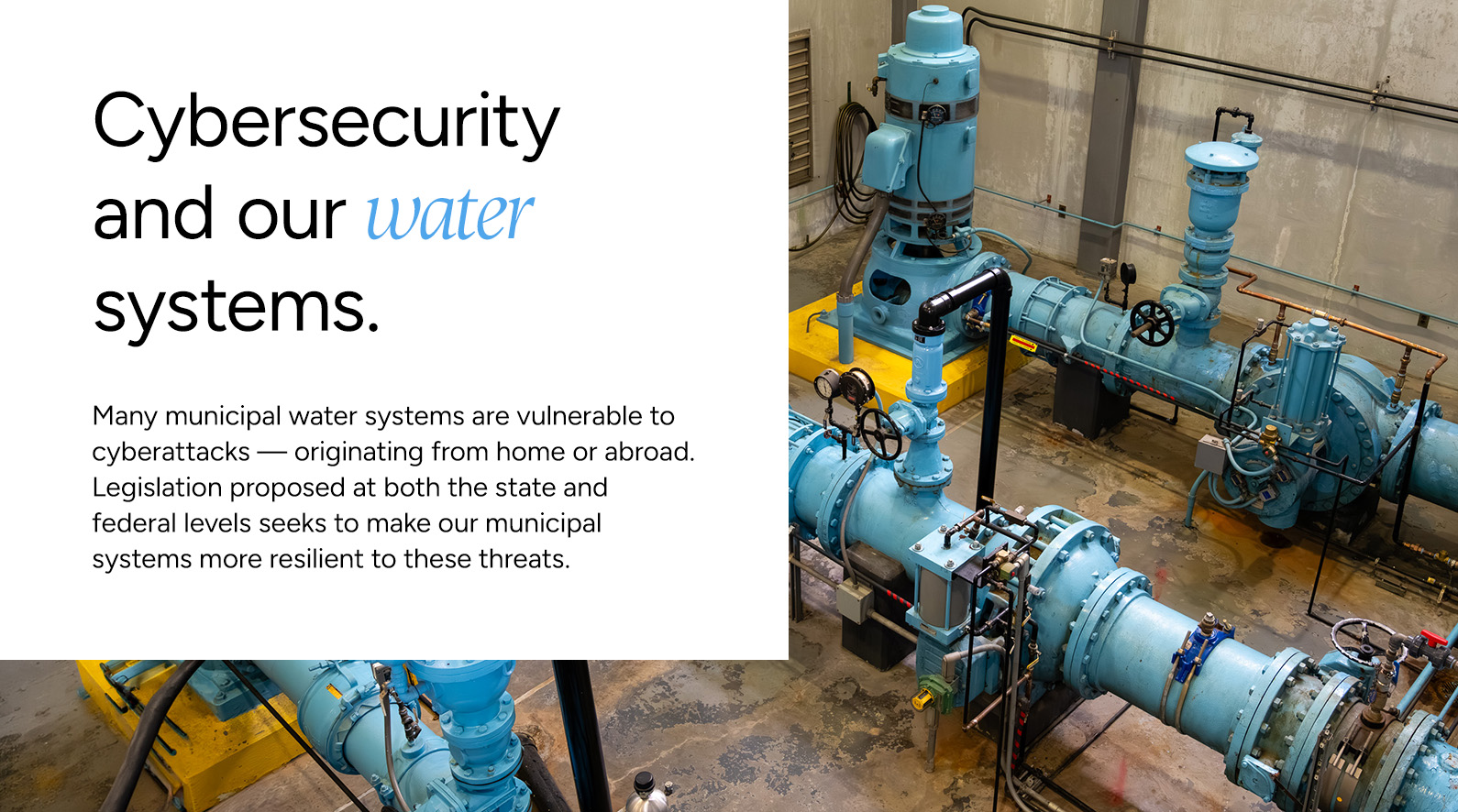
Cybersecurity and our water systems

An emerging threat to public drinking water supplies is drawing increased attention in Washington, DC and Lansing.

The threat of cyberattacks has implications for the safety and security of these water supplies. International tensions are also cause for concern. Members of Congress and the Michigan Legislature are proposing solutions.

What’s the threat?

Most water and wastewater systems in the U.S. rely on operational technology and IT systems to operate. This makes the systems vulnerable to cyberattacks.

The threat has recently increased. In April, the EPA, the FBI, the Cybersecurity and Infrastructure Security Agency (CISA), and the National Security Agency (NSA) issued a joint advisory warning to U.S. organizations, including those in the water sector, of an urgent and ongoing Iranian-affiliated cybersecurity threat.

According to the U.S. EPA, cyberattacks against community water systems have been “increasing in frequency and severity across the country. Based on actual incidents, we know that a cyberattack on a vulnerable water system may allow an adversary to manipulate operational technology, which could cause significant adverse consequences for both the utility and drinking water consumers. Possible impacts include disrupting the treatment, distribution, and storage of water for the community, damaging pumps and valves, and altering the levels of chemicals to hazardous amounts.”

In 2024, the U.S. Government Accountability Office described potential harms from cyberattacks on water systems as including “drinking water with unsafe levels of bacteria or chemicals.” Nations, cybercriminals, and others have targeted some of the nearly 170,000 U.S. water systems, which are increasingly automated.

EPA stated that its inspectors identified “alarming” cybersecurity vulnerabilities at drinking water systems across the country — for example, some water systems failed to change default passwords, used single logins for all staff, or failed to curtail access by former employees. In November 2024, EPA’s Office of Inspector General found that 9% of the public drinking water systems it scanned had critical or high-priority cybersecurity vulnerabilities. In August 2021, a ransomware attack on a California water and wastewater system was discovered after the ransomware variant had been in the system for about 1 month. ·A July 2021 ransomware attack on a water and wastewater system in Maine forced officials to run the system manually until the computer was restored using local control. A March 2021 ransomware attack focused on a Nevada water and wastewater facility’s SCADA system and backup systems. A September 2020 ransomware attack affected files within a system at a New Jersey water and wastewater facility. In a March 2019 attack at a Kansas facility, a former employee used unrevoked credentials to remotely access a facility computer and threatened drinking water safety.

GAO identified the following vulnerabilities:

  • Water systems may contain hundreds of diverse components, making it difficult to properly map and keep operational technologies updated with security patches.
  • Attackers may use IT networks to steal data or to move within the network to access operational systems.
  • IT and operational networks may not be properly separated, allowing attackers to access the operational systems and disrupt critical processes.

Despite the risks, many communities have not made vulnerability assessments because of the need to allocate limited budget resources to the basic services that are clearly required by law.

Legislative and Administrative Initiatives

Members of Congress have proposed cybersecurity legislation designed to protect the water sector. The chief proposed Congressional water systems security legislation, H.R. 2594, proposes the establishment of a Water Risk and Resilience Organization (“WRRO”) to develop risk and resilience requirements for the water sector. The requirements would “provide for the cyber resilient operation of a covered water system and the cyber resilient design of planned additions or modifications to a covered water system.”

EPA has established a Cybersecurity center on its website, to provide information and resources to water utilities. In conjunction with the Association of State Drinking Water Administrators, EPA has also developed a cybersecurity brief for states, as well as a list of funding sources for conducting assessments.

Michigan’s Approach

In Michigan, the Department of Environment, Great Lakes, and Energy (EGLE) coordinates with the Michigan Cyber Command Center on prevention and response to cybersecurity incidents. As at the federal level, some best practices for the prevention of these incidents are voluntary. For example, the state declares that cybersecurity assessments analyzing system vulnerabilities, threats, and security measures to enhance overall cybersecurity resilience are not mandated by the Safe Drinking Water Act, “but they are highly recommended.” In 2024, EGLE launched an initiative to establish “a comprehensive strategy that bolsters operators’ resilience against both online and offline threats to water systems.”
Proposals for Michigan

State Representative Reggie Miller has introduced legislation requiring public drinking water supplies to have security measures in place to thwart cyberattacks and a risk-based cybersecurity and resilience program. Flow Water Advocates has contacted Rep. Miller to express support for her legislation.
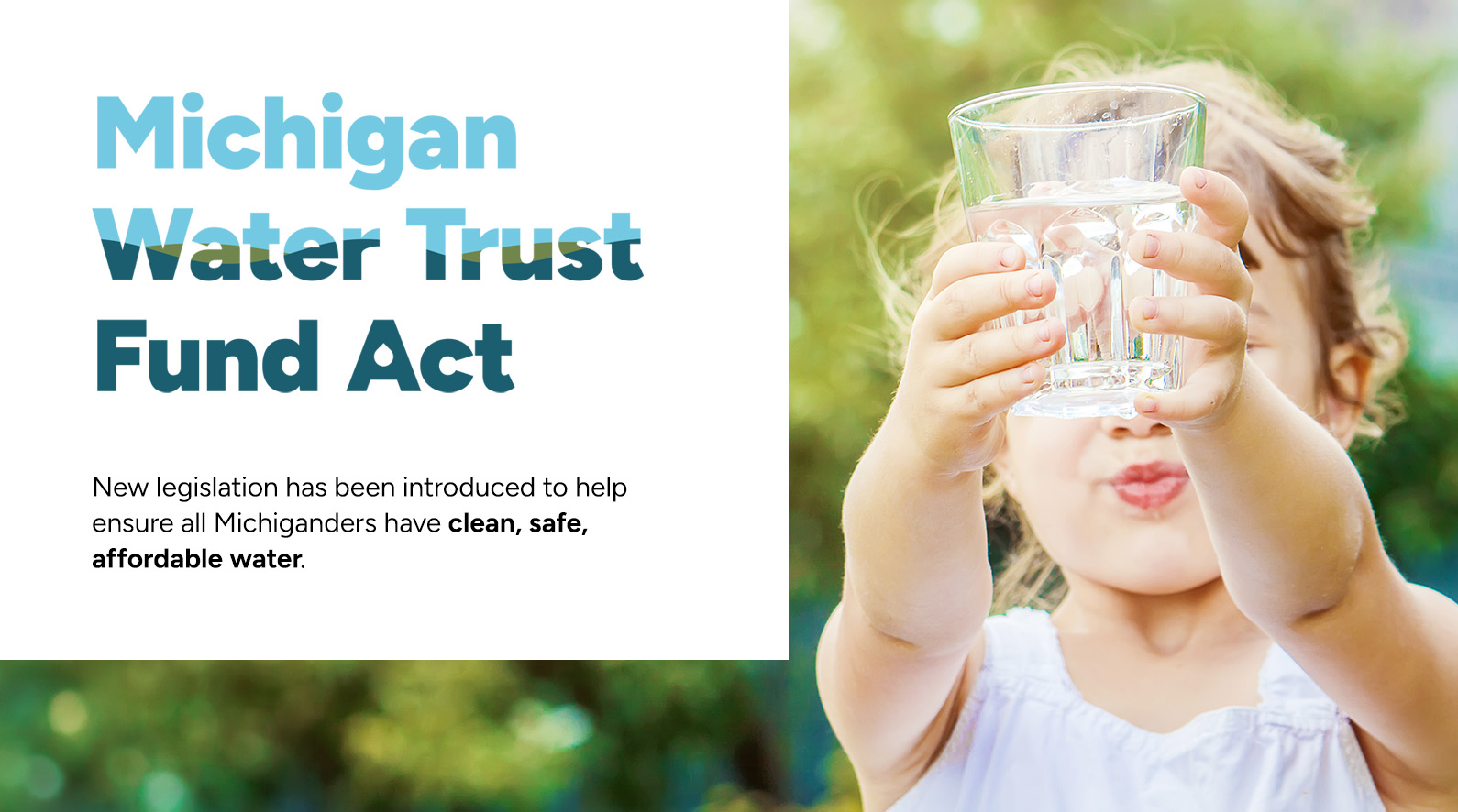
Michigan Water Trust Fund Act introduced in state senate

FOR IMMEDIATE RELEASE: May 7, 2026

Lansing, Mich. — Today in the Michigan Senate, Sen. Sam Singh (D-28) introduced legislation to address Michigan’s persistent, underfunded water infrastructure needs and support safe, affordable drinking water for all Michigan residents.

The Michigan Water Trust Fund Act (SB 950 & 951) would raise approximately $300 million annually by imposing a 25-cent per gallon royalty to be paid by bottled water companies that extract and sell Michigan’s public water resources.

“We live in the heart of the world’s largest freshwater system, and yet too many of our neighbors are without clean, safe, affordable water,” said Sen. Singh. “And widespread flooding last month exposed the perilous condition of many of our dams, bridges, and stormwater systems. Michigan’s water infrastructure needs are serious, urgent, and underfunded. This legislation creates a durable, equitable mechanism to support infrastructure improvements throughout the state, without raising taxes or water rates.”

The legislation also ensures that the waters of the Great Lakes and their tributary rivers and streams remain in the public domain, and defines the “waters of the state” broadly to include groundwater, in recognition that all waters are part of the interconnected hydrologic cycle.

The fund is modeled after Michigan’s successful Natural Resources Trust Fund. Established 50 years ago, the NRTF has directed more than $1 billion in revenues from oil and gas drilling on state land to acquire public parks and recreational land across every county in the state. Polling conducted by Lake Research Partners indicates that 71 percent of Michiganders would support companies paying a royalty on Michigan water bottled for commercial sale.

Urban and rural communities alike face many challenges related to Michigan’s aging water infrastructure, including lead pipes, contaminated well water, failing septic systems, stormwater runoff, and unaffordable water bills. Recent widespread flooding further exposed the perilous condition of many of our dams, bridges, and drainage systems.

Michigan’s annual water infrastructure needs total approximately $1 billion, and many municipalities struggle to maintain systems that have been degraded by decades of underinvestment. The Michigan Section of the American Society of Civil Engineers’ 2023 Report Card gives Michigan a lackluster “C-” for its drinking water infrastructure. Despite this critical need, the Trump administration’s proposed 2027 budget would reduce federal support to state clean water and drinking water state revolving funds (SRFs) by 90 percent.

Flow Water Advocates applauds Sen. Singh for leading this important effort to protect Michigan’s public trust waters and promote fairness by shifting the costs of water infrastructure from Michigan taxpayers to the private corporations that extract and sell Michigan’s public water for great profit.

The Michigan Water Trust Fund Act is based in part on legislation developed by Flow and its coalition partners, including Clean Water Action, Friends of the St. Clair River, Huron River Watershed Council, Michigan Lakes and Streams Association, Michigan Resource Stewards, and Oakland County Resource Commission.

“Michigan’s waters are held in trust by the state, which has a duty to protect them for use and enjoyment by the people of Michigan. This important legislation reaffirms public trust protections for our waters,” said Liz Kirkwood, Flow executive director. “When bottled water companies pay their fair share, we can help ensure that every Michigander has clean, affordable water.”

To learn more about the Michigan Water Trust Fund Act, visit FlowWaterAdvocates.org/MWTFA.

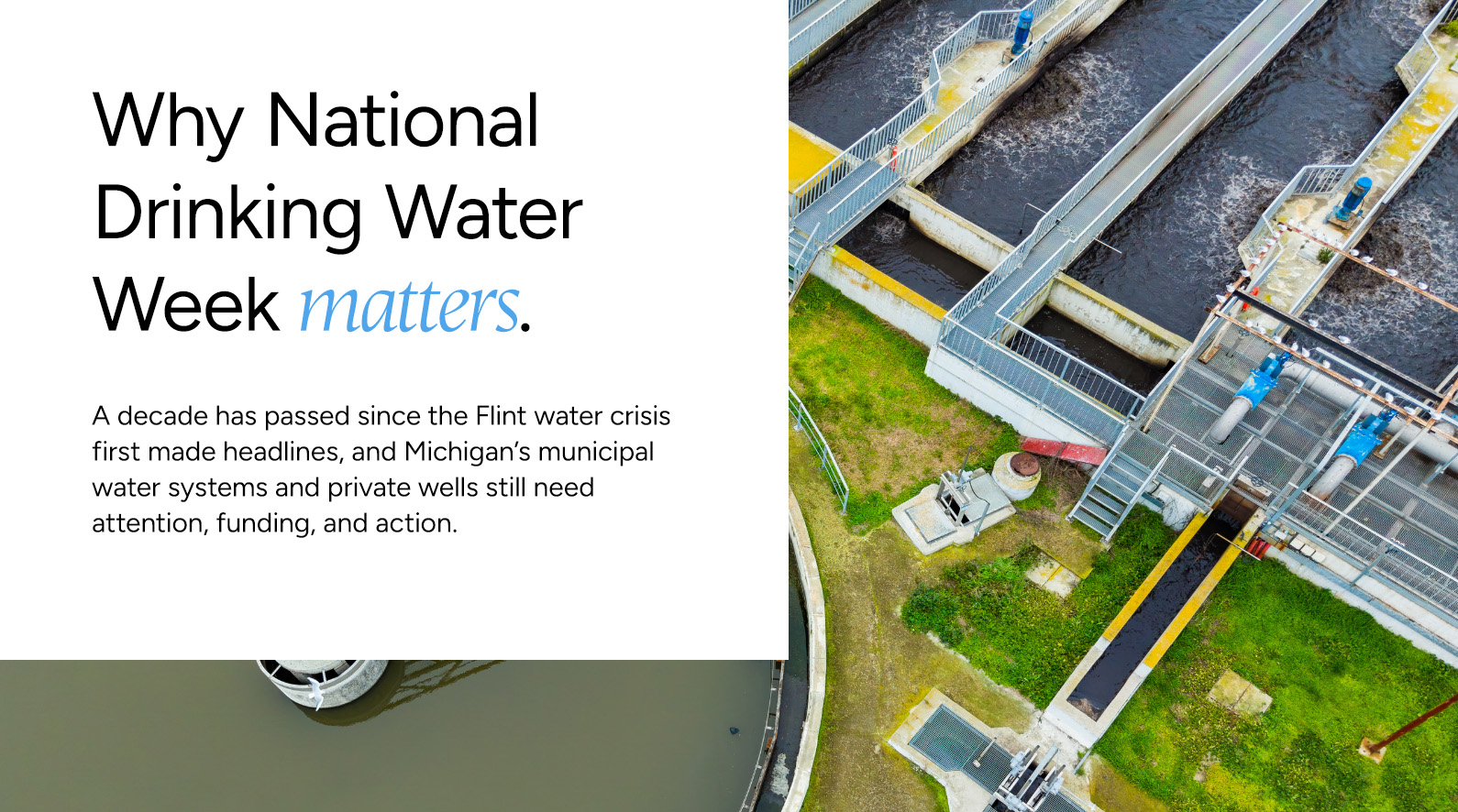
National Drinking Water Week 2026

If any state has a reason to be on guard for drinking water contamination, it’s Michigan. Ten years ago, headlines around the world cast attention to the lead contamination of Flint’s drinking water.

Flint residents were advised not to drink the municipal tap water unless it had been filtered through an approved filter certified to remove lead. The result of inadequate corrosion control of water delivery pipes, the crisis ultimately exposed over 100,000 people to potentially unsafe drinking water.

Although the crisis generated actions to clean up the Flint supply, it’s timely during this Drinking Water Week to recognize both public water systems and private wells are strained.

Governments continue to underinvest in both the construction and upgrade of public water supplies, which serve 5.5 million people in Michigan. A 2023 report card (PDF) created by the American Society of Civil Engineers observed, “Most of the infrastructure within the State of Michigan’s community water supply systems (CWS) is over 50 years old and a significant portion is approaching 100 years of service life. The state has a $860 million to $1.1 billion annual gap in water infrastructure needs compiled from decades of deferred maintenance and lack of knowledge on asset conditions.”

Also of concern is the lack of funding in the state program that monitors and protects drinking water supplies. A consultant to a state task force estimated a need of more than $40 million annually for the staff needed to carry out the program. That state spends less than $20 million.

The state has been fortunate to avoid widespread contamination of public drinking water, although much more progress needs to be made to remove 580,000 lead and galvanized service lines. As of 2024, only about 11% had been replaced.

In 2024, the state recorded 1,375 violations of Safe Drinking Water Act requirements by 332 systems. Many of the violations were related to monitoring requirements. Contaminants that affected a small percentage of violations included two PFAS compounds, naturally occurring arsenic, and total coliform.

The state’s 1.2 million private drinking water wells, which serve 2.6 million people, are also at risk. Unlike public water supplies, private wells are not routinely monitored. That responsibility belongs to homeowners – a point that the state made on Private Residential Well Awareness Day.

Threats to private well water are potentially serious. Nitrates, a form of pollution caused by excessive application of nitrogen fertilizers and animal waste on agricultural fields, have contaminated thousands of wells. Nitrates are associated with “blue baby syndrome” in infants and some forms of cancer in adults.

What does Drinking Water Week mean?

For private well owners, it should mean self-education and action to protect themselves and their loved ones.

And it should mean citizen vigilance and pressure on lawmakers to adequately fund a program that is relevant to every Michigander, every day.

The Safe Drinking Water Act turns 50

The law that protects the quality of America’s more than 170,000 public drinking water supplies is 50 years old as of Monday, December 16. While the Safe Drinking Water Act’s results have been mixed, its purpose and impact have become ever more relevant over the past five decades.

The potential impact of unsafe drinking water was demonstrated in Milwaukee when, in 1993, inadequate treatment led to a disease outbreak resulting from cryptosporidium, which affected 403,000 people and resulted in at least 69 deaths. The lead contamination of Flint’s water supply, beginning in 2014, exposed about 99,000 people to high levels of the neurotoxin. Flint officials failed to properly treat lead when the city switched to a new water supply, leading to concerns about high lead levels in children. The water switch also contributed to an outbreak of Legionnaires’ disease—a potentially life-threatening form of pneumonia—that killed at least 12 residents.

The backbone of the law is the setting of enforceable national standards for primary contaminants ranging from microorganisms to human-made chemicals like PCBs.

For each regulated contaminant, EPA sets a health goal based on risk (including risks to the most sensitive people, e.g., infants, children, pregnant women, the elderly, and the immuno-compromised). EPA then sets a legal limit for the contaminant in drinking water or a required treatment technique.

Earlier this year, EPA set standards for six PFAS compounds, the first time any of this family of chemicals has been thus regulated.

The Safe Drinking Water Act covers 1,400 community water supplies and 10,000 noncommunity water supplies in Michigan. (A noncommunity system provides water for drinking or potable purposes to 25 or more persons at least 60 days per year or has 15 or more service connections.)

Michigan community water supplies had 35 chemical standards violations in 2023: four for perfluorooctane sulfonic acid (PFOS) at one supply, four for perfluorooctanoic acid (PFOA) at two supplies, 23 for arsenic at seven supplies, and four for Di(2-ethylhexyl) phthalate at two supplies. There were 21 new or continuing chemical MCL violations reported in 2023 at noncommunity water systems. There were nine supplies that incurred arsenic MCL violations, seven had nitrate MCL violations, and five were issued PFAS MCL violations.

The standards do not cover private water wells serving fewer than 25 people. Michigan has over 1.1 million such wells.

Amendments to the law in 1986 and 1996 expanded the law’s scope to include prevention of drinking water contamination and education. Each customer of a public water supply is supposed to receive an annual report, called a consumer confidence report, on the quality of that supply and any exceedances of the drinking water standards in the previous year.

The law also provides low-interest loans to communities to upgrade their safe drinking water infrastructure. Michigan’s Drinking Water State Revolving Fund is the source of the state loans. The funding available, however, falls far short of Michigan’s drinking water infrastructure needs. A 2021 analysis of the state’s infrastructure needs found that Michigan has an annual unmet need of $860 million to $1.1 billion for drinking water treatment systems and upgrades.

“Many of Michigan’s water systems are older than the Safe Drinking Water Act itself,” Phil Roos, the director of Michigan’s Department of Environment, Great Lakes and Environment noted this fall. “Many systems are over 50 years old, with some approaching a century of service. Decades of underinvestment have left many communities struggling to maintain critical infrastructure.”

It’s time for a Water Trust Fund in Michigan

Rep. Rachel Hood (D-81) and Rep. Donavan McKinney (D-14)

This month, Michigan House Rep. Rachel Hood (D-81) and Rep. Donavan McKinney (D-14) introduced important bills (HB 6273, 6274), based on FLOW’s model legislation, that would impose a $0.25 per gallon royalty on bottled drinking water extracted from Michigan’s publicly-held water resources (including groundwater), and create a Water Trust Fund. The Fund would use the royalties to address a number of water infrastructure and accessibility needs, including:

  • Help for low-income families struggling to pay water bills
  • Grants to local governments for lead service line replacement, contamination remediation, and emergency water supplies
  • Local public health department funding for water testing and implementation of septic system regulations

By recouping twenty-five cents per gallon from water bottling companies, the trust fund could generate between $250-300 million annually, and help address Michigan’s $1 billion in annual water infrastructure needs. This mechanism for funding water infrastructure and accessibility is a bold, forward-thinking solution, and affirms public protection of Michigan’s waters. But it is also not without precedent.

Forty years ago, in November 1984, Michigan voters overwhelmingly approved constitutional protection for the state Natural Resources Trust Fund (NRTF.) This fund has become a model for other states.

Bankrolled by revenue from oil and gas drilling on state lands, the NRTF funds the purchase and development of recreational and environmentally significant lands for state and local governments. Because constitutional protection assures that these funds cannot be diverted by legislators to other purposes, Michigan voters can be confident that the NRTF will for decades continue to assure an increase in the amount of public land devoted to recreation and environmental protection.

(click to enlarge)

NRTF and its predecessor have enabled hundreds of projects worth more than $1.3 billion. There is an NRTF-supported project in every county of the state.

A tradition has developed that further strengthens the NRTF. When the five-member NRTF Board recommends projects to the Legislature for funding approval, lawmakers typically accept and approve the list without political gamesmanship.
Public lands will become increasingly important as the population grows and the climate changes. The need for clean, abundant public waters will also increase.

FLOW has been working with Rep. Hood, Rep. McKinney, and other lawmakers to address Michigan’s water infrastructure and accessibility needs with a 21st-century analog to the Natural Resources Trust Fund. FLOW authored this legislation to bring the colliding crises of water extraction, failing infrastructure, and water affordability under a comprehensive legal framework, and to recalibrate Michigan’s priorities on protecting its water and its people.

By establishing the Water Trust Fund, Michigan can lead the way and assure that our water remains public, safe, and affordable for all.

Drinking Water Week 2024

We are so used to turning on the tap and receiving safe drinking water that we often forget how vulnerable that water can be to contamination.

During Drinking Water Week, recognized May 5-11 by the State of Michigan and nationally, filling knowledge gaps is a critical priority. Knowing the source of your drinking water is crucial, and so is knowing about threats to its safety and legal and environmental defenses to prevent its contamination. Michigan also proclaims Thursday, May 9, as Private Residential Well Awareness Day to bring attention to the 2.6 million Michiganders who depend on private wells for their drinking water.

Michiganders have reason to grasp the threat to our drinking water. The lead contamination crises in Flint and Benton Harbor provide sobering lessons about one threat to drinking water. The federal government has now committed $15 billion nationwide for the replacement of lead pipes through which drinking water flows.

Another threat to public drinking water is the family of chemicals known as PFAS, the so-called “forever chemicals”, used in many consumer products. These compounds pose potentially major human health effects.

The good news is that both the State of Michigan and the U.S. Environmental Protection Agency have set health-based limits for some PFAS in public drinking water supplies.

The threat from other contaminants is greatest to those who rely on the more than 1.25 million private wells in Michigan, which go largely untested. Many people don’t realize that 45% of Michigan’s population gets drinking water from underground sources.

The Centers for Disease Control and Prevention recommends that private well users have their water tested annually for contaminants. The CDC also recommends keeping household hazardous materials such as paint, fertilizer, pesticides, and motor oil far away from wells.

For Michigan residents who receive drinking water from public water supplies, safety and contamination are regulated. Federal and state Safe Drinking Water laws require regular testing and treatment of public water. Customers of public water supplies are entitled to receive annual consumer confidence reports that detail levels of key contaminants and any violations of drinking water standards.

In 2022, according to the Department of Environment, Great Lakes and Energy (EGLE), there were 1,012 violations of Safe Drinking Act requirements at 328 community supplies. Most of these violations related to treatment or reporting requirements, not violations of health-based drinking water standards.

Many Michiganders drink bottled water—some as a short-term replacement for contaminated public or private water supplies, but far more do so for the perceived convenience and hydration. Many bottled water customers, however, do not realize that much bottled water comes from public supplies—they are drinking bottled tap water from systems paid for by taxpayers and marked up for significant profit by the private sector. Aquafina and Dasani labels in Michigan are drawn from the public supply for Southeast Michigan. And most of the remainder of bottled water packaged in Michigan—such as BlueTriton’s (formerly Nestle’s)—comes from groundwater that is tributary to Michigan’s streams and lakes. In effect, it and consequent private profits come from sources that belong to the people of Michigan under the public trust doctrine.

We should not take our drinking water for granted. Becoming aware of sources and threats is vital to our individual, family, and public health. Learn more about FLOW’s efforts to protect groundwater here on our website.

State Expands Clean Water Funding; More Funding Needed

On Earth Day, Governor Gretchen Whitmer and the Department of Environment, Great Lakes, and Energy (EGLE) announced a $290 million expansion of the MI Clean Water Plan with proceeds from the bipartisan, voter-approved 2002 Great Lakes Water Quality Protection Bond. The funds will expand state low-interest loans to local governments for drinking water and water management resources for their residents through an expansion of the state’s low-interest loan offerings.

Governor Whitmer said that during her tenure in office the state has invested over $4 billion to upgrade drinking water, stormwater, and wastewater facilities, supporting 57,000 jobs, but “we know we still have more work to do. “

This financing supports critical water infrastructure projects like lead service line removals, rehabilitation and upgrades to drinking water and wastewater plants, improvements to sewer systems, and much more. The $290 million will be split between the state’s Clean Water State Revolving Fund and Drinking Water State Revolving Fund and will be available through loans and low interest financing this year.

Even with the $290 million, the need from communities across the state for drinking water and sewage treatment far exceeds available resources.

  • In Fiscal Year (FY) 2024 EGLE provided historic financing and funding opportunities to communities but was still only able to fund $1.7 billion of the over $5 billion in community requests.
  • This funding shortfall will continue in FY 2025, where the department received over $3.5 billion in project requests from communities, but expects to have less than $720 million available after exhausting significant one-time federal resources.
  • Most of the state’s water systems are over 50 years old, and a significant portion are approaching 100 years of service life. Recent reports have highlighted that Michigan has an annual gap of between $860 million to $1.1 billion in water infrastructure needs due to decades of deferred maintenance.

Green Infrastructure: Smart solutions for stormwater runoff

Download the brief: Stormwater Utilities (pdf)

Over the past few decades, Michigan has faced an increase in unpredictable storm events. Unfortunately, our existing stormwater infrastructure is not built to handle the frequency and intensity of these storms, creating problems with water runoff and flooding. 

This, in turn, has led to problems such as water pollution, algal blooms, beach closures, threats to public health, and increased infrastructure costs to taxpayers. Polluted runoff also contaminates the environment and endangers aquatic life. Stormwater utilities can be a part of the solution, by enabling communities to fund modern, green stormwater infrastructure and protect the environment and public health.

In the brief above, dive in deeper as FLOW explores the issue and possible solutions to solve it. FLOW is working to develop a legislative solution to enable small and mid-sized communities in Michigan to legally establish stormwater utilities and secure a reliable source of funding for this crucial infrastructure. Stormwater utilities are an essential tool for managing and mitigating the negative impacts of stormwater runoff, including flood damage, erosion, and pollution.


Water: Essential for Life, Victim of Politics

By Jim Olson, FLOW founder and senior legal advisor

Recent reports show that four decades ago, Congress was advised that citizens in our cities and towns would face lead poisoning from lead pipes in municipal drinking water systems. Nothing was done. The failure of Congress to address this crisis then and now is a window into the collapse of our society’s shared view that government exists for the common good of all.

A recognized research scientist advised Congress in the 1980s that citizens in our cities and towns would be exposed to lead in drinking water. But as with tobacco, asbestos, agent orange, PFAs, and climate change – the list goes on – government leaders sat and sat and sat again on the lead poisoning threat. Imagine, Congress didn’t act for forty years to address something as fundamental to life and health as drinking water, and it did not act until the lead-poisoning of residents in Washington D.C., the City of Flint, and elsewhere boiled into national outrage.

Behind the lead poisoning and similar health issues is the failure of Congress to restore federal grant funding to communities across America. Beginning in the late 1980s, Congress halted federal grants, monies that had made municipal drinking water safe and affordable since the early 1970s. By the mid-1990s, federal aid turned into massive loans that shifted the financial burden to cities and towns and their resident ratepayers to pay for their drinking water.

The result: grossly unaffordable water bills and a plague of deteriorating drinking water systems, all dumped on the backs of the poor and middle class. This outcome is not surprising given that in 1977 federal funding provided 63% of funding for water infrastructure systems in the United States. But by 2014, this had fallen to 9% – with most of the funding coming in the form of loans to be repaid by local ratepayers.

Politicians too often wait to do anything until there is an emergency or crisis. Then they drag their feet until hauled into court or public pressure becomes too strong to ignore. By the time an emergency exists, the damage is devastating and irreparable, and the costs to fix the problem are magnitudes higher than the cost if the problem had been met head on in the first place. Rather than “win-win,” our leaders chose “lose-lose.”

In the 1980s, deregulation, neoliberalism, so-called free markets and tax cuts, heavily tilted toward the wealthy, became more important to presidential administrations and leaders on both sides of the political aisle than the safety of citizens. Now, this bury-the-problem disease is endemic.

Water is public, not owned by anyone. Water is held and managed by states as sovereign for their people. Why? The reality is that water is essential to life and health and serves everyone. Water must not become the victim or servant of political self-interests and ideology.

Governor Whitmer’s Budget Proposes Major New Funding for Water Priorities

Whitmer budget presentation

The budget proposal announced by Governor Whitmer on February 8 contains hundreds of millions of dollars in new and increased funding for vital water needs and is an encouraging sign as the new legislative session gets into full swing.

Whitmer’s budget for the fiscal year that begins next October 1 includes the following items:

  • $280.5 million for local wastewater and drinking water infrastructure;
  • $226 million to remove and replace 40,000 lead service lines over the next 10 years;
  • $122.5 million to ensure the quality of drinking water through water filter distribution, and faucet and plumbing replacement in residences with lead pipes;
  • $100 million to establish an environmental justice contamination cleanup and redevelopment fund for sites in underrepresented and underserved communities. The Governor says the initiative will also expand air pollution controls in historically disadvantaged and underrepresented communities. “This funding will begin the process of rectifying environmental injustice,” the budget says.
  • $25 million for the removal of dams, allowing natural flow of rivers and preventing catastrophic dam failures.
  • $23.8 million to conduct studies and collect data on Michigan’s groundwater resources.
  • $7 million for a new, interactive groundwater database.

FLOW is reacting positively to the Governor’s proposal.  “Whitmer’s budget reflects her Administration’s continued commitment to securing safe, affordable drinking water for all,” said Liz Kirkwood, FLOW’s Executive Director.  

Kirkwood said the Governor’s groundwater funding proposals are welcome. Groundwater protection is a FLOW priority. “We applaud the Administration’s commitment to investing in groundwater management and protection. For too long, Michigan has ignored the vital role of groundwater in protecting our drinking water and the ecological health of rivers, lakes, streams, and wetlands.

“Moving forward,” Kirkwood continued, “FLOW will work to ensure decision-makers scale up long-term investments in our water infrastructure with affordable rates, groundwater management and protection, and climate and community resiliency.” 

In a separate bill already signed by the Governor, the Michigan Legislature approved $25 million to establish a water affordability program that would prevent the shutoff of water services to residential customers struggling to pay their water service bills. While the fund lands well short of the need, its establishment is an encouraging sign that the Governor and Legislature understand water service is essential to all Michiganders.