Tag: water withdrawals

Bottled water companies get a (nearly) free ride in Michigan

By Liz Kirkwood, Flow Executive Director
This piece originally appeared in Bridge Michigan.

Michigan’s abundant water has turned into a cash cow for private bottled water companies.

They’re making large profits off publicly owned water, while paying next to nothing to the state for water extraction.

At the same time, low- and middle-income families often pay more for home water use than the companies that take and sell the public’s water at a huge markup.

Household customers of public water systems in Michigan pay average monthly bills of $33 to $174. This equates to annual bills of $396-$2,088, according to a 2023 study by Public Sector Consultants. For Michigan residents living on fixed incomes, rising water rates hit particularly hard.

Meanwhile, bottled water companies seeking approval to extract groundwater, like Primo Brands (formerly Nestle and Blue Triton), pay a one-time $2,000 application fee and an annual administrative fee of just $200 for withdrawals that could amount to hundreds of millions of gallons per year.

Families pay hundreds or even thousands of dollars each year for the water they need, while bottlers pay pennies and make tens of millions in profits. The average Michigan household will use 45,625 gallons in a year, at an average total cost of $864. That’s just under $0.02 per gallon. A new water bottler on the scale of Primo Brand’s Evart facility (which withdrew 138 gallons per minute in 2022) would use 72,532,800 gallons in a year, at an annual cost of only $200 — or $0.000003 per gallon.

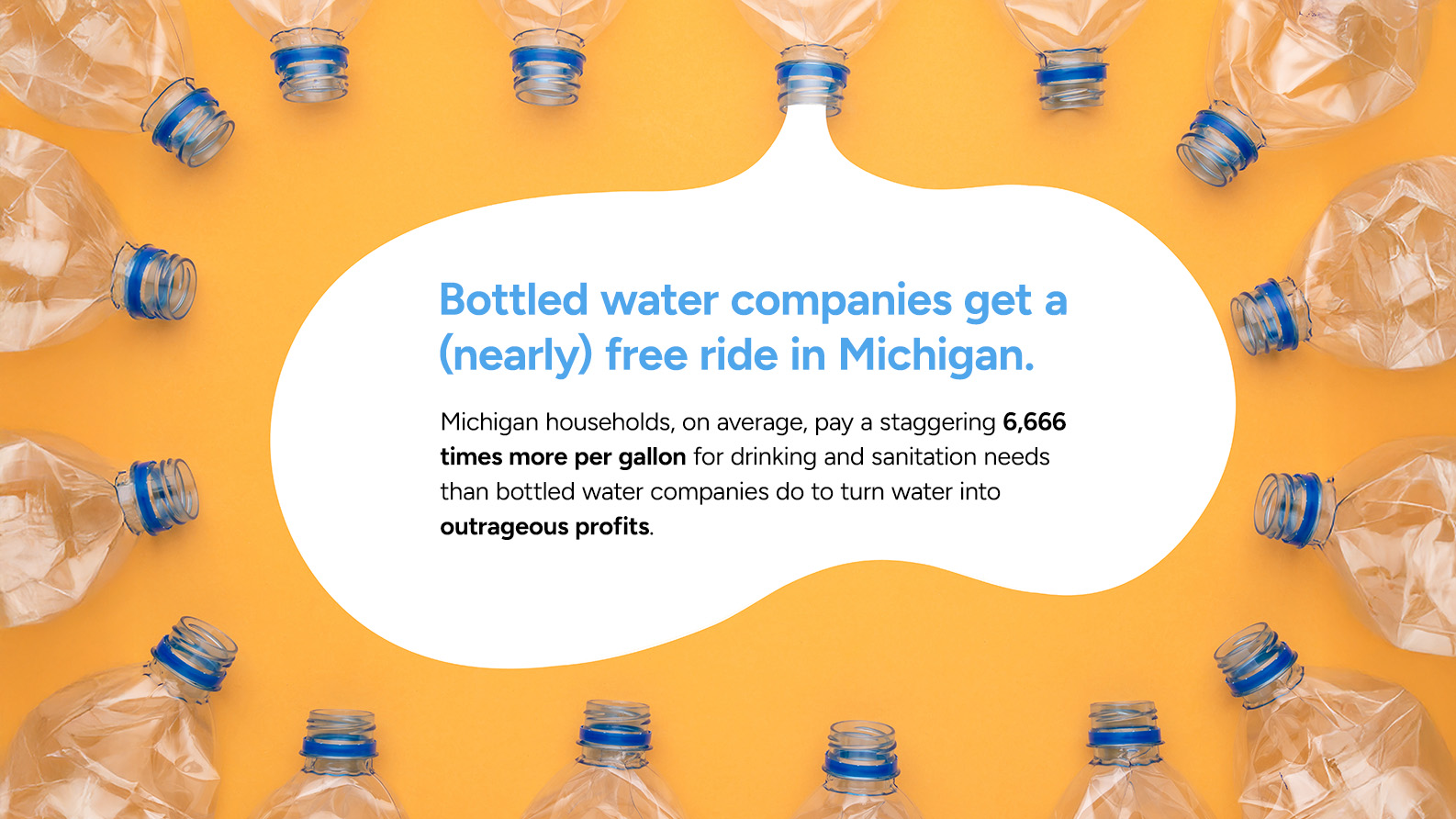
The bottom line? Michigan households, on average, pay a staggering 6,666 times more per gallon for drinking and sanitation needs than bottled water companies do to turn water into outrageous profits.

As of 2023, there are approximately 100 companies with approval for bottling by the Michigan Department of Environment, Great Lakes, and Energy (EGLE). EGLE’s 2023 water usage data documents bottled water withdrawals from Michigan lakes, rivers, and groundwater totaling nearly 473 million gallons. And that figure doesn’t include bottled water brands that draw from municipal water systems, like Aquafina and Dasani, which bottle and sell Detroit city water.

Michigan’s meager fees for large-scale bottled water companies do not reflect the significance of the water they’re taking — water that belongs to Michiganders. Meanwhile, too many Michigan families are paying 20%, 25%, or even more of their household income for basic, essential water needs.

Michigan also needs to get a better handle on who is extracting and bottling water, and how much. Databases are inconsistent, and the regulatory framework is a hybrid between EGLE and the Michigan Department of Agriculture and Rural Development (MDARD).

Under Michigan food law, bottled water facilities are listed as food processing facilities, meaning each facility requires a food establishment permit from MDARD. In order to sell bottled water in Michigan, companies also need a bottled water registration from MDARD for each brand name and water dispensing machine. There are currently 42 licensed bottling companies on MDARD’s bottling registration list.

In short, Michigan’s regulatory framework is fragmented: EGLE oversees water safety and withdrawals, while MDARD regulates bottling as food processing. This patchwork makes it difficult to track who is bottling water and how much they’re taking, leaving major gaps in oversight.

It’s time for Michigan to protect our shared, public waters from corporate exploitation, ease the cost burden to households, and stand as a bulwark against the growing threat of privatization and commodification of our state’s publicly-held water resources.
Michigan’s water withdrawal program lacks tools needed to protect our water—Here’s why it matters

Michigan sits at the heart of the Great Lakes—the largest freshwater system on Earth. Despite this abundance, our water resources are not immune to overuse and mismanagement. A 2024 audit released by the Office of the Auditor General highlighted several important areas where the state’s water withdrawal program can be improved to better protect our water resources.

Download the audit report (PDF)

Weak enforcement mechanisms in the law, flaws in the methodology for predicting impacts, and poor data security are all major concerns. Without stronger systems in place, it’s possible for some users to withdraw volumes of water that threaten stream health, aquifers, and the principles of the Great Lakes Compact. In this piece, we unpack the audit’s findings, why they matter, and the changes we need to ensure Michigan protects its most vital resource—our water.

About Michigan’s water withdrawal law.

The Michigan Legislature passed, and former Governor Granholm signed into law, a bill regulating large-scale water withdrawals in 2008. The legislation was needed to fulfill Michigan’s responsibilities to manage water quantity under the Great Lakes Compact. The law requires the Michigan Department of Environment, Great Lakes, and Energy (EGLE) to register large quantity water withdrawals between 100,000 and 2 million gallons per day, collect annual water use data, make determinations about potential impacts on water resources, and process permits for withdrawals greater than 2 million gallons per day.

What the audit found.

The Office of Auditor General’s 2024 performance review of the Michigan Department of Environment, Great Lakes, and Energy (EGLE) pointed to several challenges in implementing the state’s water withdrawal program, including:

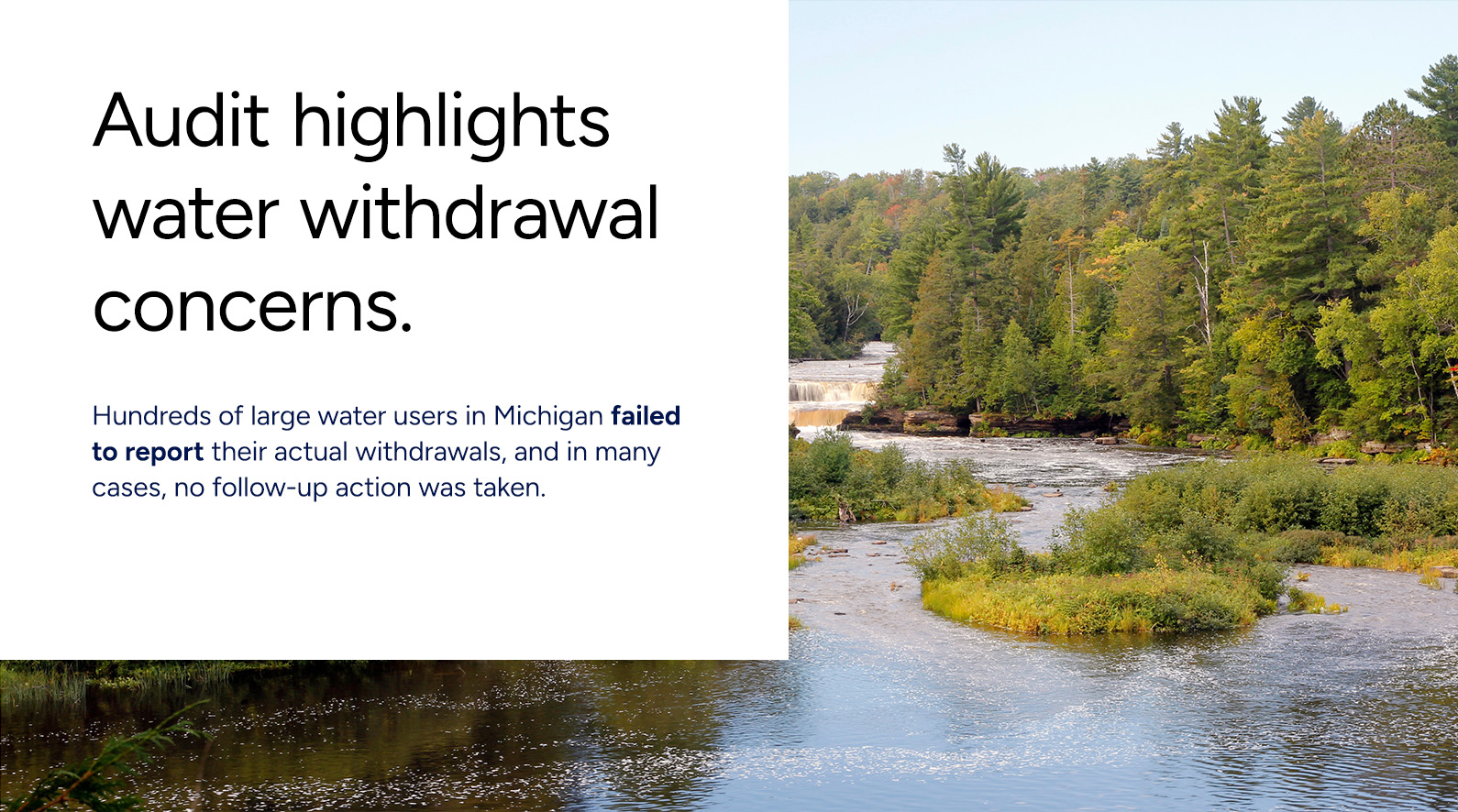
  • Enforcement limitations: Hundreds of large water users failed to report their actual withdrawals, and in many cases, no follow-up action was taken.
  • Flawed oversight: EGLE’s review process for new large-scale withdrawals was plagued by delays and inaccuracies, leaving some withdrawals underestimated or unregulated.
  • Data security risks: Weak access controls in EGLE’s databases could lead to unauthorized changes to withdrawal records.

These findings suggest that Michigan’s ability to track and regulate large-scale water withdrawals needs reinforcement. Without timely and accurate data, the state may not be able to prevent overuse or ensure compliance with legal standards—posing risks to long-term water sustainability.

A particular concern is that the tools used by EGLE to evaluate the impact of proposed water withdrawals do not always result in the same calculations. The Auditor General found that in one case, the difference might have resulted in an adverse resource impact. The difference in the permits the Auditor General reviews was minus 2.4 to plus 4.7 million gallons per year. The Michigan Water Use Advisory Council has called for state funding investments in groundwater and surface water data collection to help address this need.

Why does it matter?

Although Michigan is rich in water resources, scarcity is already a worsening problem in some local areas of the state. In recent years, these areas have faced lower stream flows, stressed aquifers, and polluted water supplies – particularly in agricultural areas where heavy irrigation and fertilizer use put additional pressure on water resources.

The audit raises important questions about how well Michigan is upholding its commitments under the Great Lakes–St. Lawrence River Basin Water Resources Compact (commonly known as the Great Lakes Compact). This regional agreement, supported by Michigan and seven other states, is designed to prevent overuse and privatization and ensure the long-term sustainability of Great Lakes water. Under the Compact:

  • Any new or increased large-scale withdrawals in Michigan must be properly reviewed to ensure they do not harm water resources.
  • Withdrawals that could affect Great Lakes levels or cause environmental harm must be subject to strict review and regulation.
  • The state is responsible for monitoring and enforcing compliance.

Michigan has a responsibility to ensure that large-scale withdrawals are properly reviewed, monitored, and publicly reported. The audit underscores areas where more robust enforcement and improved oversight could help fulfill that commitment and close potential gaps in implementation.

What needs to change.

To protect Michigan’s water future, we believe the audit should be a catalyst for improvement. Key actions include:

  • Strengthening enforcement: Water users who fail to report their withdrawals must face real consequences. The legislature must give EGLE the tools to enforce the law, including stronger penalties and authority to move swiftly after violations.
  • Ensuring compliance with the Great Lakes Compact: Michigan must ensure that every large-scale withdrawal follows the Compact’s rules. That includes proper environmental reviews, accurate monitoring, and transparent public reporting. Improvements in water withdrawal assessment tools are critical, and so is the data collection needed to make the tools work.
  • Increasing transparency: The public has a right to know how much water is being taken from Michigan’s lakes, rivers, and aquifers—and whether that use is sustainable. EGLE should make water withdrawal data publicly accessible to increase accountability.

Why this matters to you.

Water is Michigan’s greatest natural resource. From the Great Lakes to groundwater aquifers, it sustains our communities, ecosystems, and economy. When large-scale withdrawals are not properly monitored or enforced, we will all pay the price—in the form of depleted rivers, contaminated wells, and strained public water supplies.

At Flow Water Advocates, we see this audit as an opportunity for constructive action. By addressing the issues raised and strengthening our water withdrawal program, Michigan can honor its Compact commitments and ensure long-term water security.

You can help by:

  • Staying informed about water policy issues in Michigan.
  • Supporting stronger water withdrawal protections.
  • Calling on EGLE and state lawmakers to enforce the Great Lakes Compact and strengthen oversight of water withdrawals.

Our water is a public trust. Let’s keep it that way.