FOR IMMEDIATE RELEASE: September 29, 2026
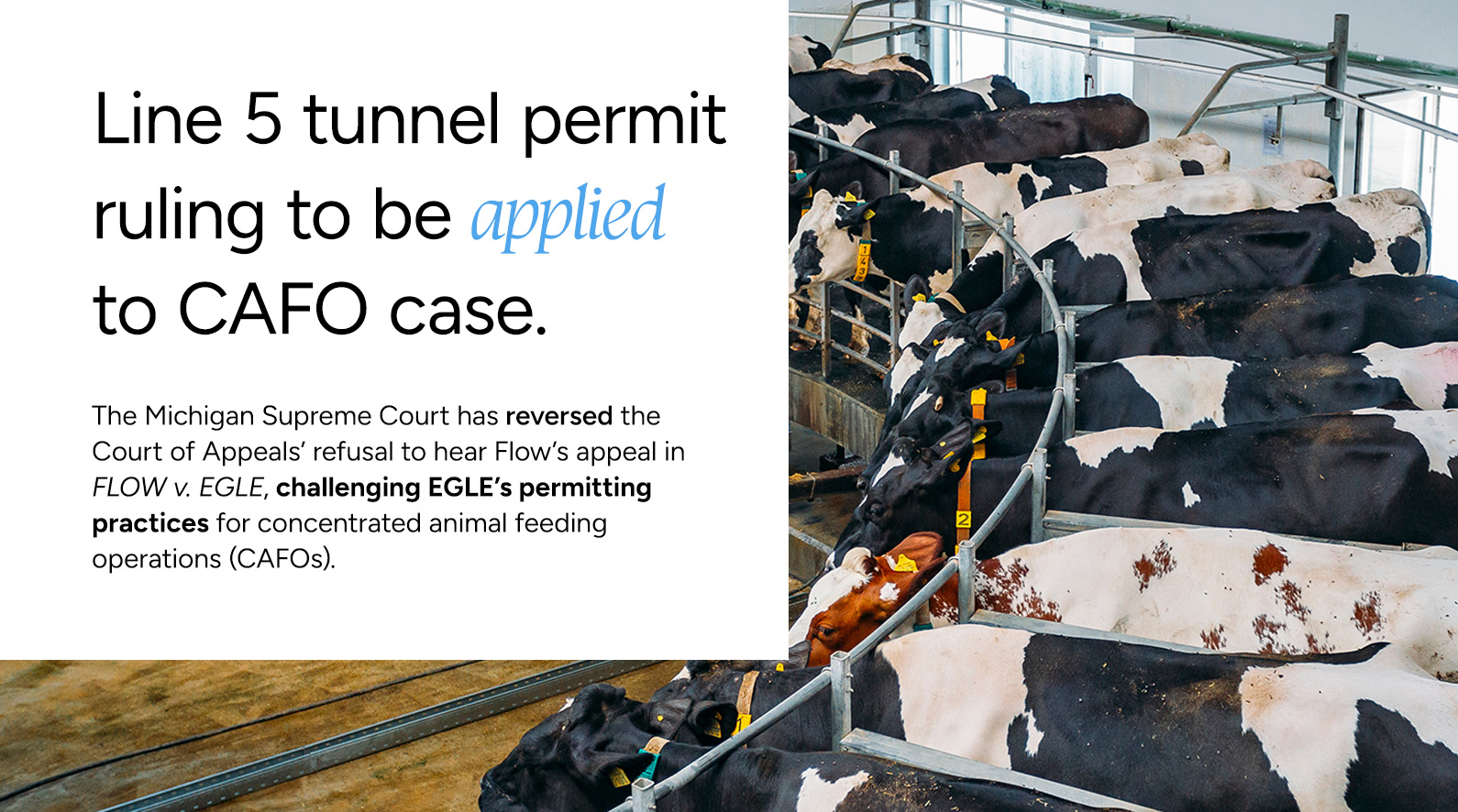
TRAVERSE CITY, Mich. — On September 25, 2026, the Michigan Supreme Court reversed the Court of Appeals’ refusal to hear Flow Water Advocates’ appeal challenging the Michigan Department of Environment, Great Lakes, and Energy (EGLE) and its permitting practices for industrial agriculture pollution. Flow appealed to the High Court following a lower court decision in FLOW v. EGLE that failed to properly apply the Michigan Environmental Protection Act (MEPA) in permitting proceedings for wastewater discharges from concentrated animal feeding operations (CAFOs). CAFOs generate an immense volume of animal waste, which is primarily spread on fields as fertilizer. Excess manure on these fields can then leach into groundwater and run off into waterways, fueling algal blooms and creating toxic “dead zones.”
The High Court directed the Court of Appeals to apply its July 31, 2026 Line 5 tunnel permit ruling in FLOW v. MPSC and the related Tribal coalition case. In that ruling, the High Court found that MEPA requires the Michigan Public Service Commission (MPSC) to determine the proper scope and likely impacts and alternatives to the proposed Enbridge Line 5 tunnel under Lake Michigan in the Straits of Mackinac. With its new order in FLOW v. EGLE, the High Court is signaling to the lower courts that in their de novo review of permit decisions, Michigan agencies must separately apply the state’s flagship environmental law, MEPA, and public trust common law to all permitting decisions that implicate Great Lakes waters and bottomlands.
“Flow and our partners were deeply gratified by the High Court’s decision in the Line 5 tunnel permit case,” said Liz Kirkwood, executive director of Flow. “And while that decision certainly marked an important milestone in the fight to get oil out of the Great Lakes, just as important are the ripple effects we are now seeing — this powerful precedent can now be applied to other critical threats to our waters, like CAFO pollution.”
Passed in 1970, MEPA paired with public trust common law to prevent and minimize environmental harm to Michigan’s natural resources. In permitting decisions, MEPA requires state agencies to determine whether proposed conduct is harmful, and if so, prohibits the conduct in favor of feasible and prudent alternatives.
In FLOW v. EGLE, both parties agreed to the undisputed facts that EGLE’s CAFO permitting and certificate of coverage (COC) approval program allows ongoing pollution of Michigan’s waters and natural resources. But Flow and EGLE disagreed on whether EGLE is required to conduct a separate and independent MEPA analysis for CAFO permitting decisions. Flow’s position is that EGLE must apply a separate MEPA analysis when issuing a Part 31 wastewater discharge permit or CAFO certification. Furthermore, if no feasible and prudent alternatives exist, the EGLE permit process must determine alternative locations, methods, or measures for animal waste disposal to mitigate the likely harm. In its September 25th order, the Michigan Supreme Court reversed and remanded these significant public interest questions for a decision in the first instance by the Court of Appeals.
“Public rights to our public waters are empty promises without permitting systems that prevent pollution and harm to our water ecosystems,” said Kirkwood. “You can’t fish, swim, or drink contaminated waters and that’s why we have environmental laws like MEPA and the public trust to keep our public rights protected from one generation to the next.”
Flow is represented in the lawsuit by environmental attorneys Jim Olson and Rebecca Millican of the Olson & Howard P.C. law firm in Traverse City, and the late Jeffrey Haynes of Birmingham, Michigan.
###
Flow Water Advocates is an independent 501(c)(3) nonprofit organization based in Traverse City, Michigan. Our mission is to ensure the waters of the Great Lakes Basin are healthy, public, and protected for all. With a staff of legal and policy experts, strategic communicators, and community builders, Flow is a trusted resource for Great Lakes advocates. We help communities, businesses, agencies, and governments make informed policy decisions and protect public trust rights to water. Learn more at www.FlowWaterAdvocates.org.
