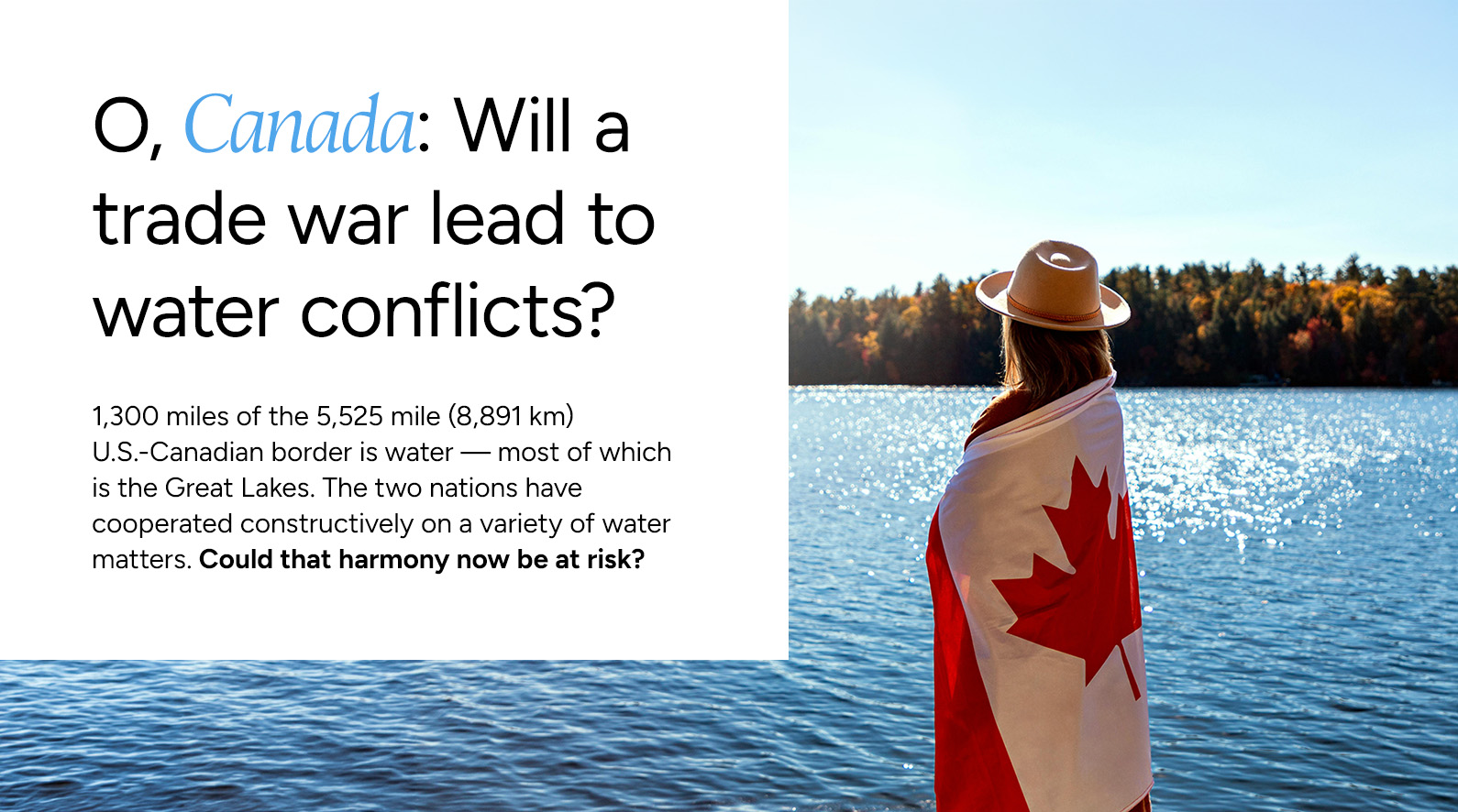

The recent breakdown in trade talks between the U.S. and Canada has the potential to alter the nations’ relationship permanently — and set off water conflicts.
The U.S. and Canada share the longest non-militarized border in the world, 5,525 miles (8,891 km). Some 1,300 miles of that is a water boundary, with the overwhelming share in the Great Lakes. The two nations have cooperated constructively on a variety of water matters. It’s been a world-class model of binational harmony.
That is at risk now.
It goes deeper than one of the two nations trying to name a shared lake after itself.
The U.S. -Canada water relationship has been governed by the Boundary Waters Treaty of 1909. That treaty pledges the U.S. and Canada to recognize and respect each other’s rights and its own responsibilities along the aquatic border. It also pledges them to consult each other to prevent and resolve disputes over boundary waters projects that affect interests on the other side, including dams and diversions.
The treaty allows either party to withdraw from the agreement with one year’s notice, but an impatient U.S. Administration might not wait that long. Withdrawing from or ignoring the treaty means the U.S. could construct water projects along the border that jeopardize Canadian interests without bothering to consult that nation. It could even divert boundary waters on the U.S. side.
Another risk is that the Trump Administration might view the U.S. waters of the Great Lakes as its property, regardless of the fact that water washes back and forth across the border. There is danger in monetizing water and treating it as an asset, leased or sold just like minerals on public land.
A potentially greater threat would put the 2008 Great Lakes Compact on the line. The Compact, ratified by all eight Great Lakes states, was designed to keep water within those states, instead of shipping it elsewhere. But the Compact also contains a loophole allowing diversion of Great Lakes water “in a non-commercial project on a short-term basis for firefighting, humanitarian, or emergency response purposes.”

As Flow Water Advocates has pointed out, this exemption language is vague. Most importantly, “short-term, “humanitarian” and “emergency response” are undefined. Is it humanitarian to quench the thirst of the western states? Could water scarcity or drought outside the Great Lakes watershed be declared an emergency? If there is an apparent national emergency, would Washington exercise federal pre-emption as it did on the so-called energy emergency on Inauguration Day 2025?
A president who is angry at Canada for standing up to him on trade, and thinks a “giant faucet” exists in Canada that can be used to help solve California’s water problems may have even wilder ideas about what the Great Lakes can do.
The water quality of the Great Lakes is not at immediate risk because of the trade war. So far, the U.S. Great Lakes Restoration Initiative has continued at close to previous levels with bipartisan support in Congress. That could change, but there’s no reason to think it will in the near term. In fact, the executive order attempting to rename Lake Ontario boasts that the U.S. “is the greatest protector of the Great Lakes, including the body of water currently known as Lake Ontario. Without the security and investment provided by the United States, this freshwater system would not be open for shipping, recreation, and responsible use to the same extent as it is today.”
Still, the Great Lakes states should be prepared to shoulder more of the fiscal burden to protect the lakes.
A final comment: Canadians are not the pushovers that some think. The U.S. mistakes Canadian civility for weakness. Having worked with Canadians on environmental issues for 40 years, I can assure anyone with doubts that our northern neighbors are as steely as any people.
As Bret Stephens said in the New York Times in August 2026, referring to American invasions of Canada in 1775 and 1812, “My guess is that this third attempt of ours to conquer our hearty Northern friends will end in much the same way.”
But in the meantime, water could be a casualty.
