Tag: wetlands

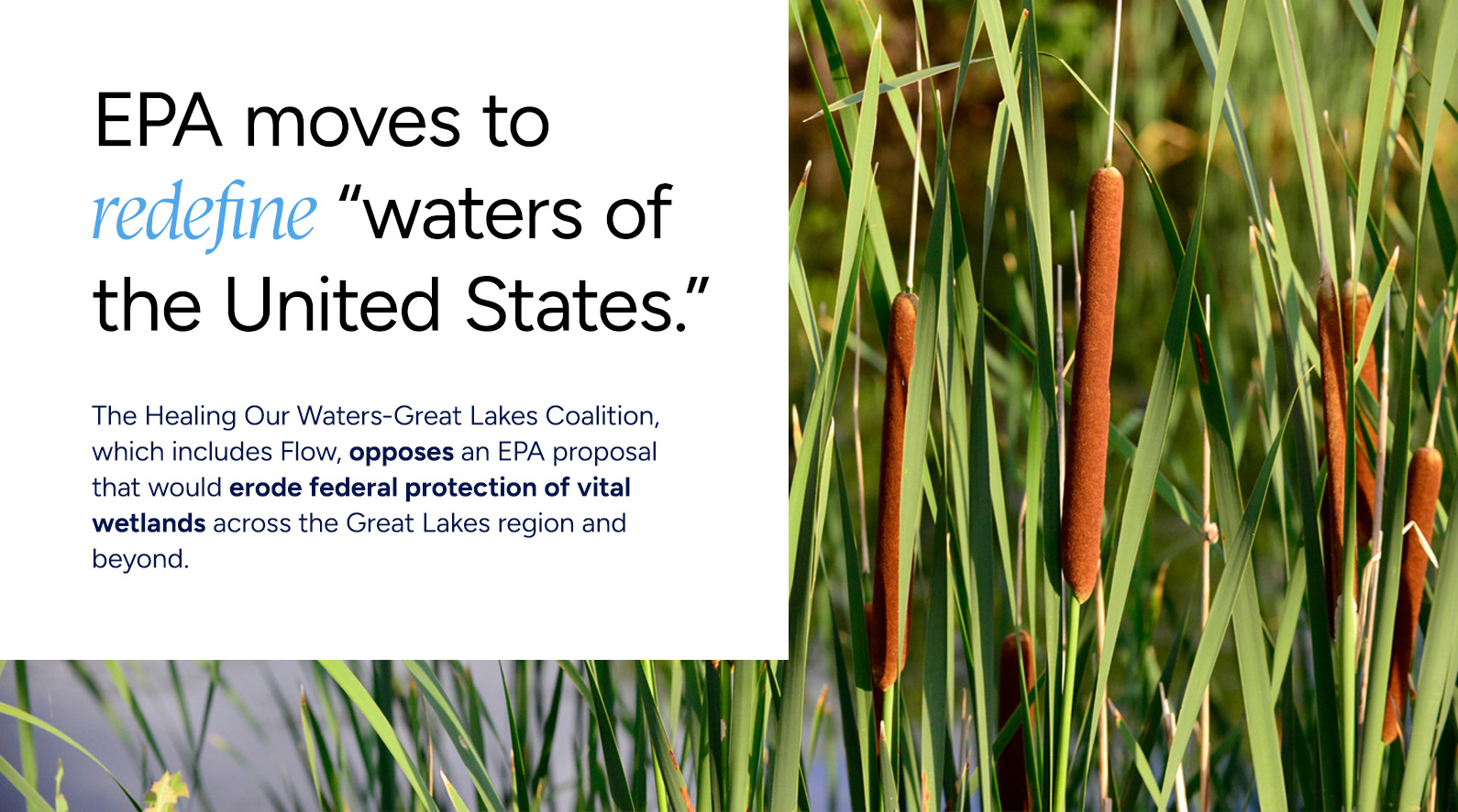
EPA moves to redefine “Waters of the United States”

On January 5, 2026, the Healing Our Waters-Great Lakes Coalition (HOW), a group of organizations (including Flow Water Advocates) that are committed to protecting water resources and communities across the Great Lakes and the Midwest region, submitted comments to the United States Environmental Protection Agency (EPA) and the U.S. Army Corps of Engineers (Corps) to oppose the agencies’ proposed 2025 definition of jurisdictional water regulated under the Clean Water Act, otherwise referred to as “waters of the United States” (WOTUS).

Announced on November 17, 2025, the EPA and the Corps are allegedly “implementing” the U.S. Supreme Court’s decision in Sackett v. Environmental Protection Agency by bringing regulations into conformity with the decision. However, as the comment letter explains, this rulemaking is unnecessary and contrary to the interests of the American public, and far exceeds the changes that Sackett may require.

EPA’s proposed rulemaking includes a new definition for “continuous surface connection” which will require wetlands to meet a new two-part test:

“1) they must abut a jurisdictional water, and 2) they must have surface water at least during the wet season.”

The new definition also excludes groundwater from the definition of WOTUS, and creates a definition for “relatively permanent” waters, which would result in the removal of federal protections for millions of miles of streams. The EPA summarizes the proposed revisions here.

The agencies’ proposal is particularly concerning for the Great Lakes region. According to the Great Lakes Commission, the lakes “sustain a $6 trillion economy, contain more than 90% of North America’s supply of surface freshwater, and provide drinking water for more than 40 million people in the United States and Canada.”

Fortunately, Michigan’s Wetland Protection Act of 1979 is a shield against eroding federal protections. Indiana is not so lucky.  Wetlands perform a number of important ecological and economic functions, including water storage (which slows erosion, reduces flooding, and recharges groundwater), water filtration, and biological productivity (as wetlands are home to some of the most productive ecosystems in the world).

This new proposed definition of WOTUS is the most restrictive rule in 50 plus years of the Clean Water Act’s history, and undermines the clear intent of Congress to protect the nation’s waters from pollution. Our water resources — and especially our wetlands — are in danger as the EPA adopts a regulatory framework that treats waterways as sewers for the disposal of toxins, sewage, and industrial waste rather than as resources that should be protected.

The time to protect our waters is now. Already, the US has lost more than half of the wetlands it once had. And with the critical role that wetlands play in filtering pollutants, storing floodwater, recharging groundwater, and providing habitat, the scientific reality cannot be ignored. Our wetlands are essential, and the EPA and the Corps need to step up to protect them.

Read the Healing Our Waters-Great Lakes Coalition comments here.
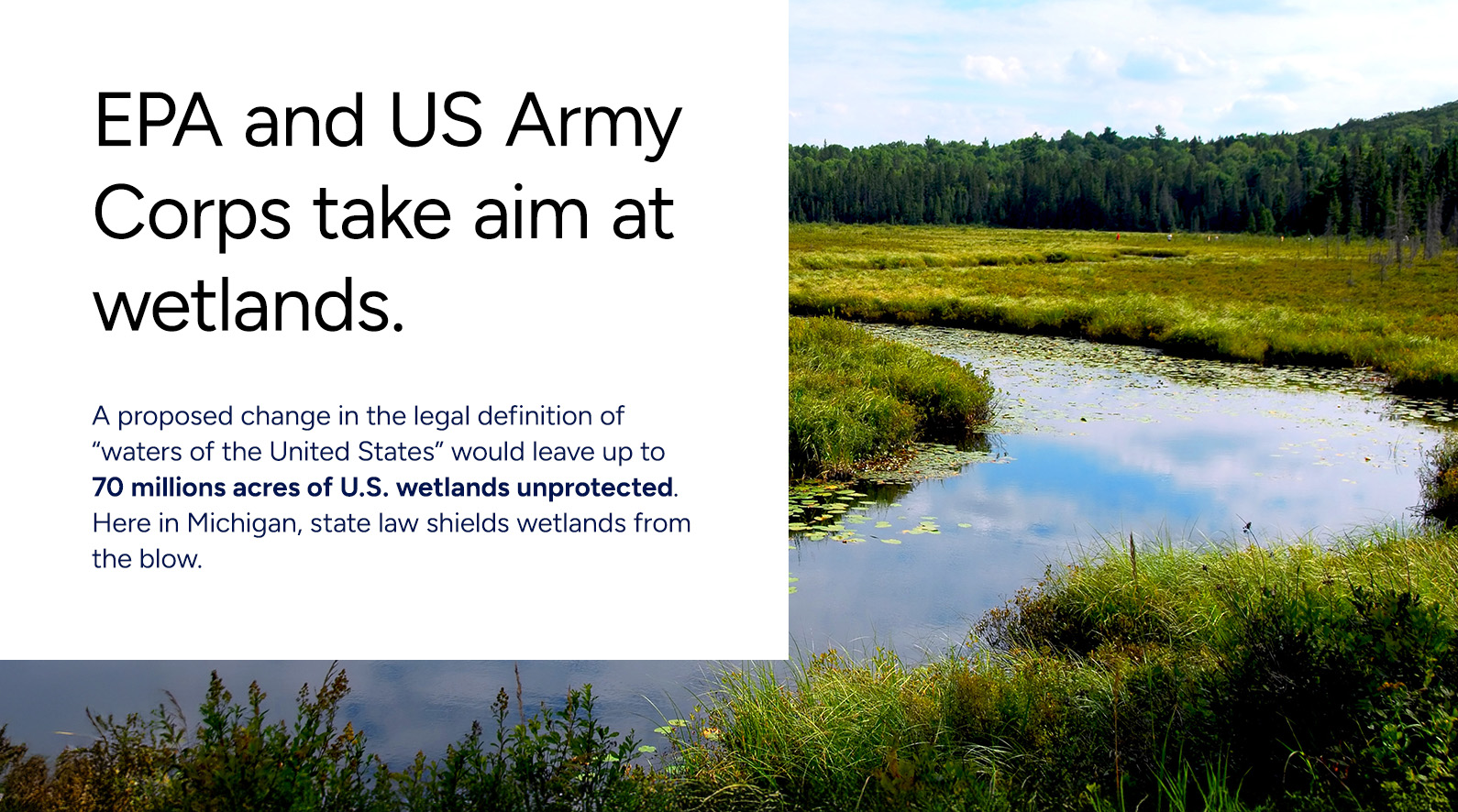
Trump administration takes aim at wetlands protections; Michigan state law shields the blow.

Wetland protection advocates across America recoiled earlier this month when the Trump Administration proposed opening up millions of acres of wetlands to be filled or drained and developed.

Michigan will fare somewhat better because of a 1980 state law that shields many wetlands that the U.S. EPA and the Army Corps of Engineers are proposing to leave unguarded by the federal government. The tougher-than-federal state law is a stout defense for Michigan’s approximately 6.47 million remaining wetland acres. (When Michigan became a state in 1837, it contained approximately 10.7 million acres of wetlands.)

At issue is the question of which wetlands were meant to be covered by the Clean Water Act of 1972. Because wetlands are vital to the health of streams, rivers, and lakes, the Act imposed restrictions on filling and destroying wetlands associated with navigable water bodies.

Wetlands are important for many reasons: they filter pollution, store floodwaters, provide fish and wildlife habitat, protect biological diversity and provide aesthetic benefits. You can learn more about the types and values of wetlands here.

The definition of “waters of the United States” has zig-zagged during the last several presidential administrations. The Obama and Biden administrations opted for a definition that included isolated wetlands, wetlands connected underground to lakes and streams, and areas that are not wet at the surface 12 months of the year, but are vital to stream health.

Ignoring the best science, the first Trump and now the second Trump Administration have tried to limit Clean Water Act protections for wetlands and open them up to development. Big Agriculture, manufacturing, and real estate interests support a limited scope of federal protection. The U.S. Supreme Court also undermined wetland protection in 2023 with a ruling in the Sackett case, reversing lower court decisions and narrowing the definition of “waters of the United States.”

According to a GIS analysis by the Natural Resources Defense Council, 38 to 70 million acres of U.S. wetlands are at risk of pollution or destruction if the new rule is adopted.

What implications does the proposed rule have for the Great Lakes? For seven of the eight Great Lakes states, it means a significant loss of protected wetlands and ultimately, degraded water quality. Some Great Lakes states have already lost enormous shares of their wetlands, including Illinois (90%) and Indiana (85%), and have little to spare.

But Michigan law sets a broader definition of wetlands than the U.S. Clean Water Act. Michigan law recognizes the scientific reality that many wetlands critical to the health of rivers and streams are hydrologically connected below the land surface.

That means the state can continue to require permits and other approvals before the alteration of most wetlands.

“This proposed rule is what we have come to expect from the Trump Administration’s ruinous environmental policies,” said Liz Kirkwood, executive director of Flow Water Advocates. “This rule ignores science, threatens our communities, and caters to polluters and private developers. We’re fortunate Michigan has stronger protections.”

Despite exemptions for certain activities and sometimes inconsistent enforcement, Michigan’s wetland law works. The rate of wetland loss in Michigan has slowed dramatically since the state law took effect in 1980. According to a tally by the former Department of Environmental Quality in 2014 (the most recent wetland census) and other sources, wetland losses slowed from an average of 28,000 acres per year over the first 150 years of Michigan’s statehood to approximately 1,200 acres per year between 1998 and 2005.

Citizens can comment at this link on the proposed EPA/Army Corps rule until January 5, 2026.

Court upholds permit denial for private boat basin and channel on Long Lake

Citizen action and public engagement safeguards Michigan waters

Most everyone familiar with the beauty and majesty of Long Lake regard it as an exceptional example of the stunning natural features that are so abundant in Northwest Lower Michigan. The largest lake in Grand Traverse County and the headwaters of the Platte River, Long Lake harbors five exquisite islands that enhance every lakeshore view and vista.

Recently, the Department of Environment, Great Lakes, and Energy (EGLE) received an application for the construction of a boat storage basin that would significantly impair Long Lake’s ecology, shoreline, and wetlands. The proposed project would entail dredging 292 cubic yards of bottomland materials to create a private entrance channel 88 feet long and 33 feet wide.

The dredged channel would provide connecting access to the inland boat basin, requiring the excavation of more than 3,200 additional cubic yards of material landward of the ordinary high water mark. In addition, the proposed project would include a 40-foot-long by 5-foot-wide boardwalk, supported by helical piers, to be constructed across 200 feet of wetlands.

EGLE denied the permit based on those impacts, as well the determination that the dredging would disturb fish habitat and interfere with littoral currents. The permit applicant, the Carrie C. Barnes Trust, appealed, much to the consternation of neighboring lakefront property owners. EGLE’s administrative law judge (ALJ) affirmed the permit denial in every particular.

When the Barnes Trust appealed the ALJ’s decision to EGLE’s Environmental Permit Review Commission (EPRC), FLOW was asked to weigh in. After reviewing the extensive record, FLOW provided detailed comments on the facts and applicable law. The EPRC unanimously upheld the ALJ’s decision.

But the Carrie C. Barnes Trust wasn’t done. The trust filed yet another appeal to the 13th Circuit Court in Grand Traverse County.

The good news is that on Tuesday, April 9, Judge Charles M. Hamlyn affirmed EGLE’s permit denial.

As a result, a project that would have done significant, permanent harm to Long Lake has been averted. And the citizens who would have been most impacted successfully joined together in concerted action to maintain the health, character, and ecology of Long Lake. FLOW commends their efforts and is proud to have supported them.

Indiana Wetland Protection Rollback Threatens Great Lakes

A new Indiana law that weakens the state’s wetland protection framework will have repercussions beyond Indiana’s borders.

Indiana’s move follows a U.S, Supreme Court ruling last year that gutted federal wetland protection under the Clean Water Act and gave states leeway to weaken their wetland protections. The ruling removed federal protection for about 50% of the nation’s wetlands. Indiana had already weakened its wetland law in 2021.

Wetlands have multiple benefits. They filter pollutants, provide habitat for fish and wildlife, and reduce flooding by storing and slowly releasing excessive flows.

Because flowing waters cross state boundaries, weakening wetland protection in Indiana will have an impact on the Great Lakes and Mississippi River watersheds.

Indiana’s new move will compound ecological damage sustained by over a century of development. The state has lost an estimated 85% of its original wetland acreage.

The Indiana law that just took effect lowers protections for the most sensitive wetlands in the state, in less developed settings that often contain rare, threatened or endangered species. 

Michigan has a stronger wetland law and program than the federal minimums. The 2023 Supreme Court ruling is having little impact on state protection of Michigan’s wetlands. Similarly, Wisconsin’s expansive wetland protection authority is limiting the impact of the Supreme Court decision.

From Wastelands to Wetlands: Once Condemned, Now Celebrated

World Wetlands Day is February 2, 2023.

World Wetlands Day, celebrated annually on February 2, is not only an opportune time to appreciate these special ecosystems, but also to understand why we destroyed so many until recently.

Michiganders especially need to know this history, and what residents of the Great Lakes State can do to write new chapters in the understanding and protection of wetlands. Over 6 million acres of Michigan wetlands remain—a vast number, but that’s 4 million acres less than existed when European settlement began in the mid-17th century.

Over 6 million acres of Michigan wetlands remain—a vast number, but that’s 4 million acres less than existed when European settlement began in the mid-17th century.

Today we know wetlands to be a valuable element of Michigan’s landscape, places that filter out pollutants, store floodwaters, provide habitat for diverse species of plants and animals, and provide recreation. We now recognize, in fact, that wetlands are among the most productive ecosystems in the world, comparable to rain forests and coral reefs. It wasn’t always so.

To generations of Americans, wetlands were “associated with disease, dangerous animals, muck that can swallow you whole, poisonous gases, death, and decay. Words used to perpetuate that perception of wetlands as undesirable places include: dismal, miasma, putrid.”

Like other states in the 19th century, Michigan public policies actively encouraged the destruction of wetlands.

Policy of Destruction

Like other states in the 19th century, Michigan public policies actively encouraged the destruction of wetlands. These policy tools included drainage districts, ruled by powerful drain commissioners whose mission was to convert wetlands to “productive” uses like agriculture. Drain commissioners remain an important part of Michigan wetland law and policy, but some of these elected officeholders now devote considerable effort to protecting and even creating wetlands. For example, the Ingham County Drain Commissioner created Lansing’s Tollgate Wetland, which beautifies a neighborhood while reducing stormwater pollution.

Michigan did not have an effective law for wetland conservation until 1980, when the Wetland Protection Act took effect.

Michigan did not have an effective law for wetland conservation until 1980, when the Wetland Protection Act took effect. Its passage was complicated by development interests that wanted the freedom to destroy wetlands for human use and by organizations that claimed the law would trample on private property rights. But the law was carefully crafted to allow trade-offs where some wetlands could be converted to developed uses in exchange for the creation or protection of other wetlands, usually in the same watershed.

Before the 1980 law, Michigan had lost 4.2 million acres of its original wetlands endowment of 10.7 million acres, approximately 39%.

Before the 1980 law, Michigan had lost 4.2 million acres of its original wetlands endowment of 10.7 million acres, approximately 39%. Since the passage of the state’s wetlands protection law, the rate of wetland loss has declined dramatically, according to a 2014 state report. The total decline of wetland between 1978 and 2005 is estimated at 41,000 acres, with the rate of decline slowing between the periods 1978 to 1998 (loss of approximately 1,642 acres per year) and 1998 to 2005 (loss of approximately 1,157 acres per year).

A global treaty commemorates wetlands of significance on a worldwide level. Michigan’s Humbug Marsh is one of those wetlands, important for fish, wildlife and other values.

One step toward protecting wetlands is to know where they are.

Dive into FLOW’s immersive story map—Groundwater: Michigan’s 6th Great Lake

Where Are the Wetlands?

One step toward protecting wetlands is to know where they are. Michigan’s Department of Environment, Great Lakes, and Energy offers a wetland map viewer. FLOW’s immersive Groundwater Story Map also features a section on “unique ecosystems,” explaining in text and visuals that groundwater flows can create distinct surface environments where rare ecosystems thrive. Many of these are a type of wetland, or peatland, called a fen. Protection of peatland is a priority focus for the 2023 World Wetlands Day because of the terrestrial wetland ecosystems importance in combating climate change and promoting biodiversity.

What we once neglected and despised—wetlands—can become an appreciated, even cherished piece of the living world around us.

We celebrate wetlands today because we see the beauty in them, and because science has taught us much about their importance to a healthy, functioning environment. World Wetlands Day is a day of hope. What we once neglected and despised can become an appreciated, even cherished piece of the living world around us.

Celebrate “Earth’s Kidneys” on World Wetlands Day

A global aquatic resource under threat from drainage, filling, and development is the focus of World Wetlands Day, which is observed annually on Wednesday, February 2. Michigan has a special stake in preventing wetland destruction and promoting wetland restoration.

Michigan was a national leader when the state legislature approved the Wetland Protection Act in 1979. This visionary statute requires a state permit before most wetlands can be altered. It has dramatically slowed, but not stopped Michigan wetland loss.

Dubbed “Earth’s kidneys” because of their valuable role in filtering pollutants, wetlands make other important contributions to ecology and society. They reduce flooding by storing high water and provide critical habitat for fish and waterfowl. The United Nations Ecological, Scientific, and Cultural Organization (UNESCO) Ramsar Convention on Wetlands has estimated that wetlands provide trillions of dollars in annual health and ecological benefits worldwide. The U.S. Environmental Protection Agency notes that Great Lakes coastal wetlands are a key ingredient in recreational activities that feed a sector worth more than $50 billion annually in economic activity in the Great Lakes region.

Wetlands are among the most productive ecosystems in the world, comparable to rain forests and coral reefs. Yet a 2014 science journal article estimated that the world has lost as much as 87% of its wetlands since the year 1700. They are often sacrificed for everything from housing and business development to road construction and drained for agriculture.

Wetlands photo courtesy, Michigan Department of Natural Resources

The theme of the worldwide observance on Feb. 2 is a call to take action on behalf of wetlands. Michigan has been a leader in wetlands protection, yet continues to face challenges in their conservation.

Michigan was a national leader when the state legislature approved the Wetlands Protection Act in 1979. This visionary statute requires a state permit before most wetlands can be altered. It has dramatically slowed, but not stopped, Michigan wetland loss.

Before the 1979 law, Michigan had lost 4.2 million acres of its original wetlands endowment of 10.7 million acres, approximately 39%. The counties that had lost the greatest percentage of wetlands were Monroe (93%), Wayne (90%), and Saginaw (87%).

Wetlands are among the most productive ecosystems in the world, comparable to rain forests and coral reefs. Yet a 2014 science journal article estimated that the world has lost as much as 87% of its wetlands since the year 1700. They are often sacrificed for everything from housing and business development to road construction and drained for agriculture.

Since the passage of the state’s wetlands protection law, the rate of wetland loss has declined dramatically, according to a 2014 state report. The total decline of wetland between 1978 and 2005 is estimated at 41,000 acres, with the rate of decline slowing between the periods 1978 to 1998 (loss of approximately 1,642 acres per year) and 1998 to 2005 (loss of approximately 1,157 acres per year).

Slowing wetlands destruction is not enough. Wetland restoration will be critical to Michigan’s future water quality, fish and wildlife habitat, recreation, and quality of life.

How can you get involved in protecting nature’s kidneys?

  • Organize your friends and neighbors, and connect with local watershed groups, to seek passage of local wetlands ordinances. Unlike the state, local governments can regulate destruction or development of most isolated wetlands smaller than 5 acres. Only about 40 of Michigan’s approximately 1,850 local units of government have enacted such ordinances. 
  • Educate the community, including owners of properties containing wetlands, about wetlands values.
  • Remain vigilant about legislative threats to Michigan’s wetlands protection law. Special interests and allied lawmakers frequently favor development and destruction of wetlands instead of conservation for current and future generations.