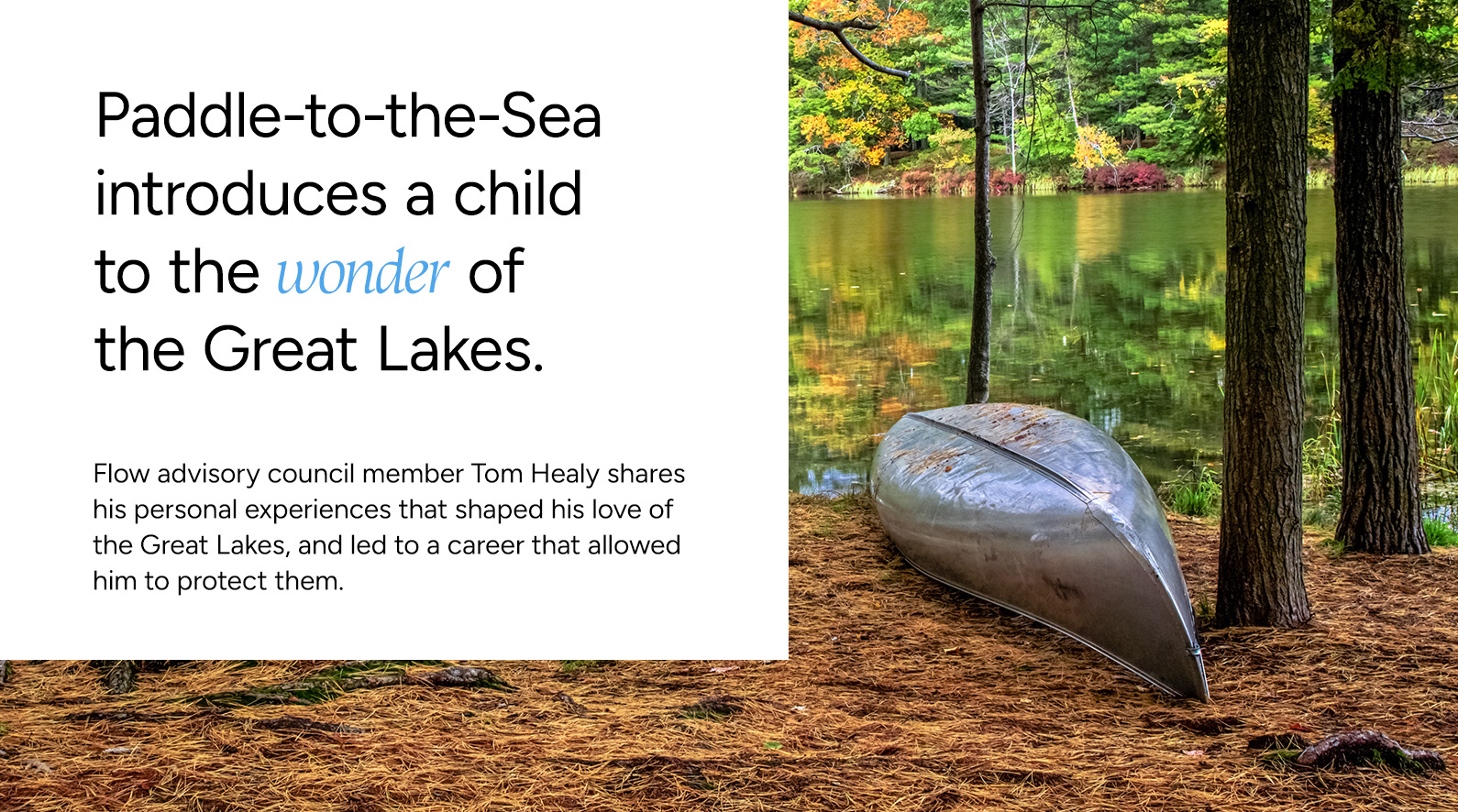
By Tom Healy,
Flow Advisory Council member
My heart jumped when I saw the slim volume on the bookstore shelf. I was as much surprised by my reaction as by the sight of the cherished book from my childhood: Paddle-to-the-Sea. What a joy to rediscover a friend after so many decades. It’s a story that helped spark a lifelong love affair with the majesty of the Great Lakes.
I wonder sometimes about how I became interested in the history, features and dynamism of the Great Lakes, and how that evolved into a sustained passion for the ecological health of the lakes and the economic health of the region. I am vaguely aware that this interest started in childhood—with family trips to beaches along Chicago’s North Shore and trips to points of interest around the lakes. But I also know there was something else that had affected me, but nearly lost to demands of adulthood and the forces of modern life.
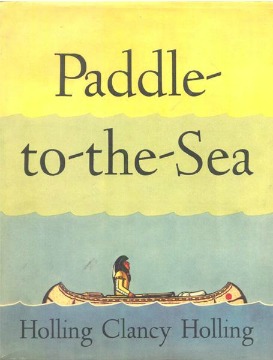
Holding Paddle-to-the-Sea in my hands brought it all rushing back. I don’t know if the book was first read to me before I could read, but I remember practically memorizing the 27 one-page chapters. I was captivated by the richly colorful full-page illustrations opposite each chapter and the vivid language describing each segment of Paddle’s journey through the Great Lakes: the last second rescue at the sawmill in Nipigon Country, bobbing among giant freighters at the Duluth iron ore loading docks, witnessing the wintry shipwreck and rescue in the violent, icy waters of Whitefish Bay, tumbling in the torrent at Niagara Falls. The story pressed two realities upon me. I could sense the immensity of the Great Lakes and their unique relationship one to another, and to us. And I felt the possibilities of great adventure, even for someone as small as Paddle-to-the-Sea, or me.
I can now recall that as a child I took tissue paper and meticulously traced the shorelines of each lake displayed in the family atlas, then transposed the penciled outlines onto a sheet of plywood, then painted the waters blue and the lands green, all quite crudely of course. I remember giving grade-school book reports on how glaciers formed the lakes, French-Canadian fur trappers, and the opening of the St. Lawrence Seaway and its benefits for cities and farmers of the heartland.
I remember squirreling away a special issue of National Geographic devoted to the Great Lakes and studying every picture, map and graphic. I could stare endlessly at the nautical map of the lakes that hung on our basement wall, showing lakebed depths, shipping routes and locations of navigational beacons.
Boy Scouts in the early sixties included summer camp in northern Wisconsin where I learned campcraft, canoeing, orienteering, wilderness first aid, and water safety—skills that inexorably led to wilderness canoe trips in Quetico Provincial Park, canoe and kayak racing in the 1970s, and, now leisurely paddling “Up North” along the untrammeled shores of northern Lake Michigan not far from Sleeping Bear Dunes. My love of wilderness and wild-water touring, much of it in the Great Lakes region, is part of my soul. Paddle-to-Sea seemed to be at my side.
Few moments are as secure in my memory as these: Sitting quietly beside a dark, pristine lake, deep in the Canadian wilderness, accompanied by only a bright moon and shimmering water reflection; intently scouting twisty, frothy rapids and plotting the zigzag course and muscle-straining draws and braces that would bring me safely through; hearing tribal elders describe their peoples’ creation story centered in the Great Lakes—a story that sustains their memory, their way of life embedded in the ecology and bounty of the lakes, and their willingness to fight against all odds to preserve and pass along the heritage bequeathed to them.
These very personal experiences nourish a deep appreciation for our natural, unconstructed world, not just as resources to be managed or playthings for things for the privileged, but as something sacred, worthy of deep respect and commitment, and soulfully central to all of us. We have lost so much, we have so much to save and restore.
The Great Lakes are hydrologically powerful and wondrous — and utterly defenseless.
They cannot defend themselves against invasive species delivered by ocean-traversing ships, or inadequately treated industrial and municipal waste streams, or toxic algal blooms caused by massive overapplication of agricultural nutrients, or leaking petroleum pipelines crisscrossing the watersheds of the region.
Will the lakes survive this unrelenting onslaught? What would Paddle-to-Sea encounter if he to journeyed through the lakes today? What would Paddle say to us?
Perhaps he would say, with a tear in his eye, “If you love and admire the lakes, you have a duty to defend them.”
About the author.
Tom Healy brings over four decades of environmental law and policy experience to the Flow Water Advocates advisory council. Before his retirement in 2018, Tom served as the Deputy General Counsel for the American Medical Association and for many years has provided pro bono legal services to organizations fighting to protect the Great Lakes, the region and its inhabitants. During his 19 years at the AMA, Tom helped devise partnerships and collaborations across the health care arena to improve pre-diabetes and hypertension awareness, attack health care disparities, and help physicians better serve their patients.

Prior to his work with the AMA, he held associate and partner positions at law firms based in Chicago, where he concentrated on environmental law, antitrust litigation, commercial disputes and other civil litigation. Tom and wife Gia enjoy all manner of paddle sports on the rivers and lakes of Michigan and Wisconsin; and exploring nature with their young grandchildren.
