America’s wetlands haven’t changed, but federal law regarding wetlands has never stopped changing in recent decades.
Federal environmental and agricultural agencies and federal courts have taken a zig-zag course, alternately strengthening and weakening Clean Water Act (CWA) protections. In recent years, courts and the two Trump Administrations have taken direct aim at the very definition of wetlands under the 1972 CWA, opening vast areas of previously protected wetlands to development.
So far, most Michigan’s wetlands remain protected thanks to a 1979 state law that has a broader definition than the one pronounced by federal courts. But Michigan legislators have introduced a bill (H.B. 5536) that would roll back the state’s wetlands definition to the weaker federal definition. Flow Water Advocates has resolved to stop this legislation.
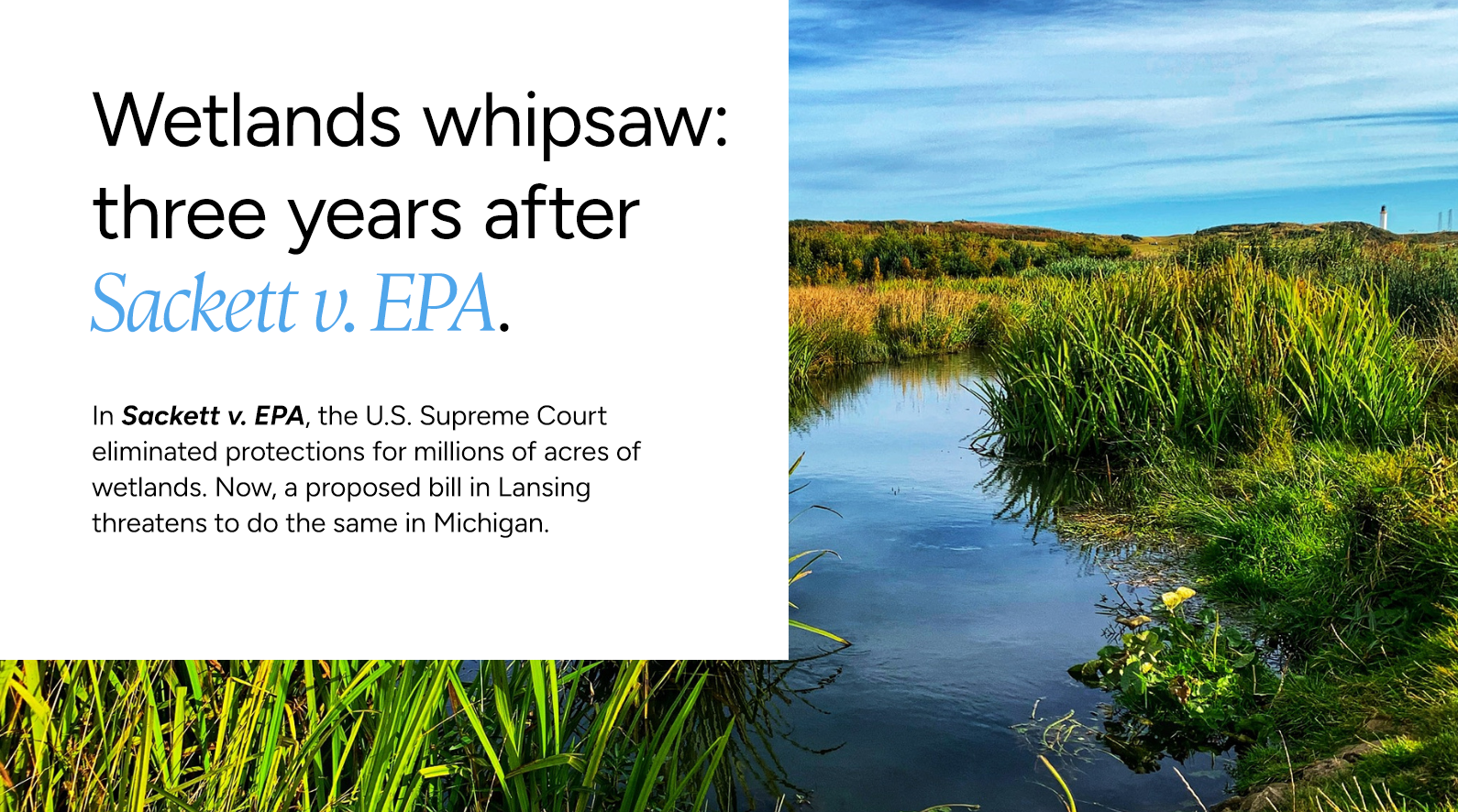
This week marks the third anniversary of one of the biggest recent blows against U.S. wetlands. In Sackett v. EPA, decided on May 25, 2023, the U.S. Supreme Court eliminated CWA protections for millions of acres of wetlands.
Ignoring science, the Court ruled that the CWA covered only wetlands with a continuous surface connection to rivers, streams and other waters of the United States. But a multitude of wetlands connect through subsurface links to navigable waters. These wetlands are essential to drinking water and aquatic health, and should be protected.
Authored by Justice Samuel Alito, the SCOTUS majority opinion rejected the previous approach which had allowed the EPA and Army Corps of Engineers to regulate wetlands that were adjacent to – and ecologically or hydrologically connected to – larger navigable waters.
“America’s wetlands provide numerous benefits, including absorbing and storing flood waters, filtering water pollution, and providing valuable fish and wildlife habitat. The Sackett ruling undermines those benefits,” said Liz Kirkwood, executive director of Flow Water Advocates.
In November 2025, the Trump Administration followed the Sackett decision with a proposed rule creating a two-part test that must be met if the wetland is covered under the CWA: The wetland “must contain surface water throughout the wet season, and [it] must be touching a river, stream or other waterbody that also flows throughout the wet season.” The Environmental Defense Council estimated the new definition would expose up to 91% of America’s non-tidal wetlands to alteration.
Maintaining Michigan’s protective definition of wetlands is vital for the state’s water quality and habitat. The 1979 state law has slowed what had been runaway wetland loss to a crawl. Prior to 1978, Michigan lost 4.27 million acres of its original 10.74 million acre of wetlands — an average annual loss of more than 30,000 acres. But between 1998 and 2005, Michigan lost only 1,157 acres annually.
