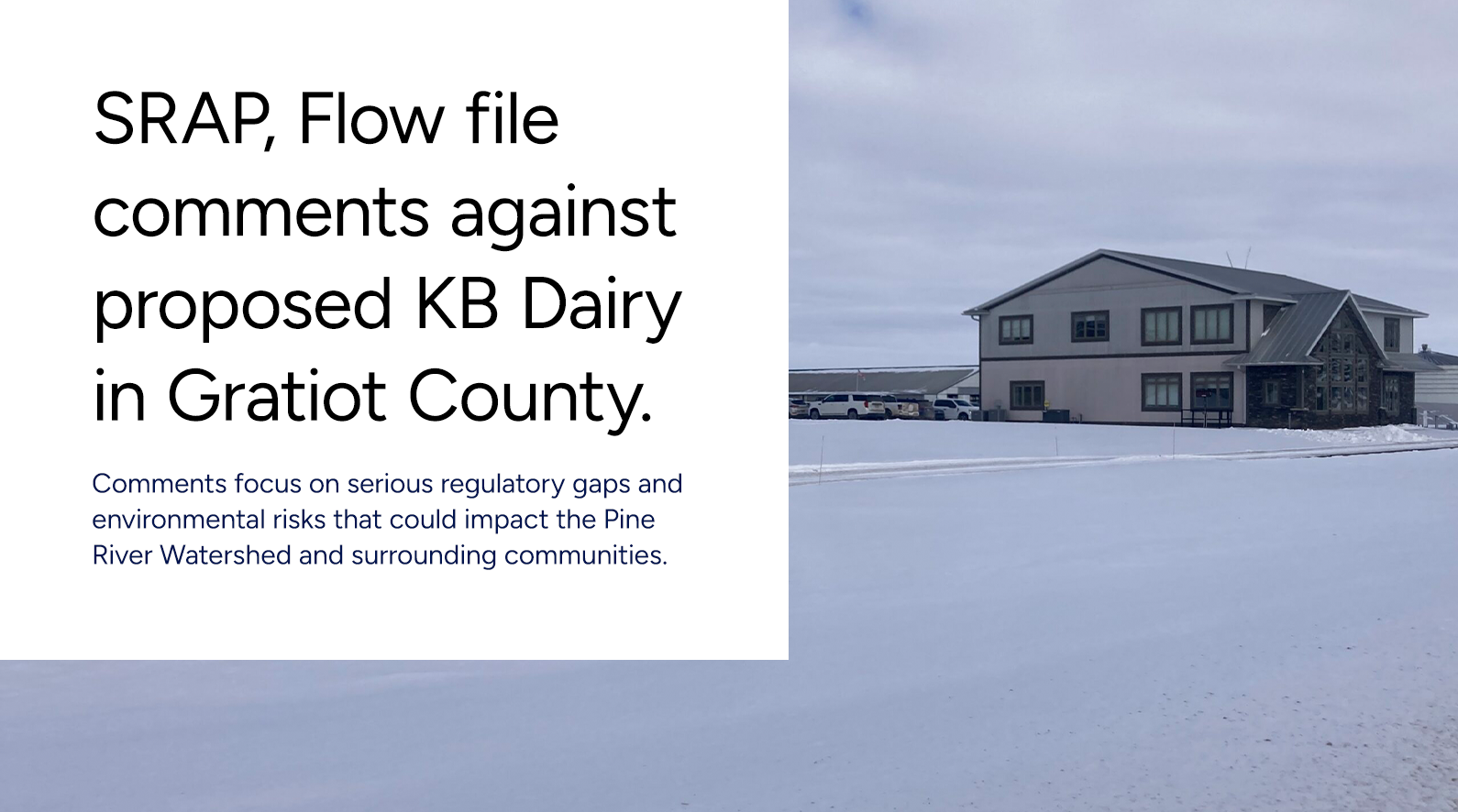
In a joint effort to protect water quality and community health in mid-Michigan, the Socially Responsible Agriculture Project (SRAP) and Flow Water Advocates (Flow) have submitted detailed comments urging the Michigan Department of Environment, Great Lakes, and Energy (EGLE) to deny a proposed permit for KB Dairy, a large concentrated animal feeding operation (CAFO) planned near Ithaca. Their joint comments focus on serious regulatory gaps and environmental risks that could impact the Pine River Watershed and surrounding communities.
A strategic partnership for water protection.
SRAP, “Socially Responsible Agriculture Project” is a national nonprofit supporting communities impacted by industrial livestock operations, partnered with Flow, a Michigan-based water protection organization, to bring both legal expertise and local watershed knowledge to the issue. Together, they argue that KB Dairy cannot be evaluated in isolation. Instead, it must be considered alongside the adjacent De Saegher Dairy and related entities because of shared infrastructure, waste systems, and ownership ties.
Big issues raised in the comments.
Failure to require a groundwater permit
The groups argue that the combined number of animals at the KB and De Saegher facilities far exceeds Michigan’s regulatory threshold requiring a state groundwater discharge permit. With nearly 12,000 cattle projected at the site, and documented shallow groundwater conditions, they contend that relying solely on a CAFO general permit ignores clear risks to drinking water and aquifers that feed into the Pine River system.Commingled waste and common infrastructure
The comments detail how waste from multiple dairies is piped into a shared anaerobic digester and then redistributed back into storage lagoons and land application fields. This commingling of manure and digestate—along with shared roads, storage pits, and irrigation systems—indicates the facilities function as one operation. Treating them as separate entities, SRAP and Flow argue, allows operators to skirt stricter environmental oversight.Common ownership and regulatory evasion
The organizations present evidence suggesting overlapping corporate control, shared financing, land transfers, and joint mortgages among the dairy entities. Under state and federal rules, adjacent operations under common ownership using shared waste systems must be permitted together. Failing to recognize this relationship, they argue, undermines enforcement and weakens public protections.
Impacts on public health & the environment.
The Pine River Watershed includes vulnerable soils, shallow groundwater, and hydrological connections that make it particularly susceptible to nutrient pollution. Excess nitrogen, phosphorus, pathogens, and emerging contaminants from manure and digestate can contaminate private wells, harm aquatic ecosystems, and contribute to algal blooms downstream.
By calling for a comprehensive groundwater review and a unified permitting approach, SRAP and Flow are urging regulators to prioritize science-based oversight. Their message is clear: without stronger scrutiny, the expansion of industrial dairy operations could jeopardize clean drinking water, degrade the Pine River, and place long-term public health and environmental integrity at risk.
