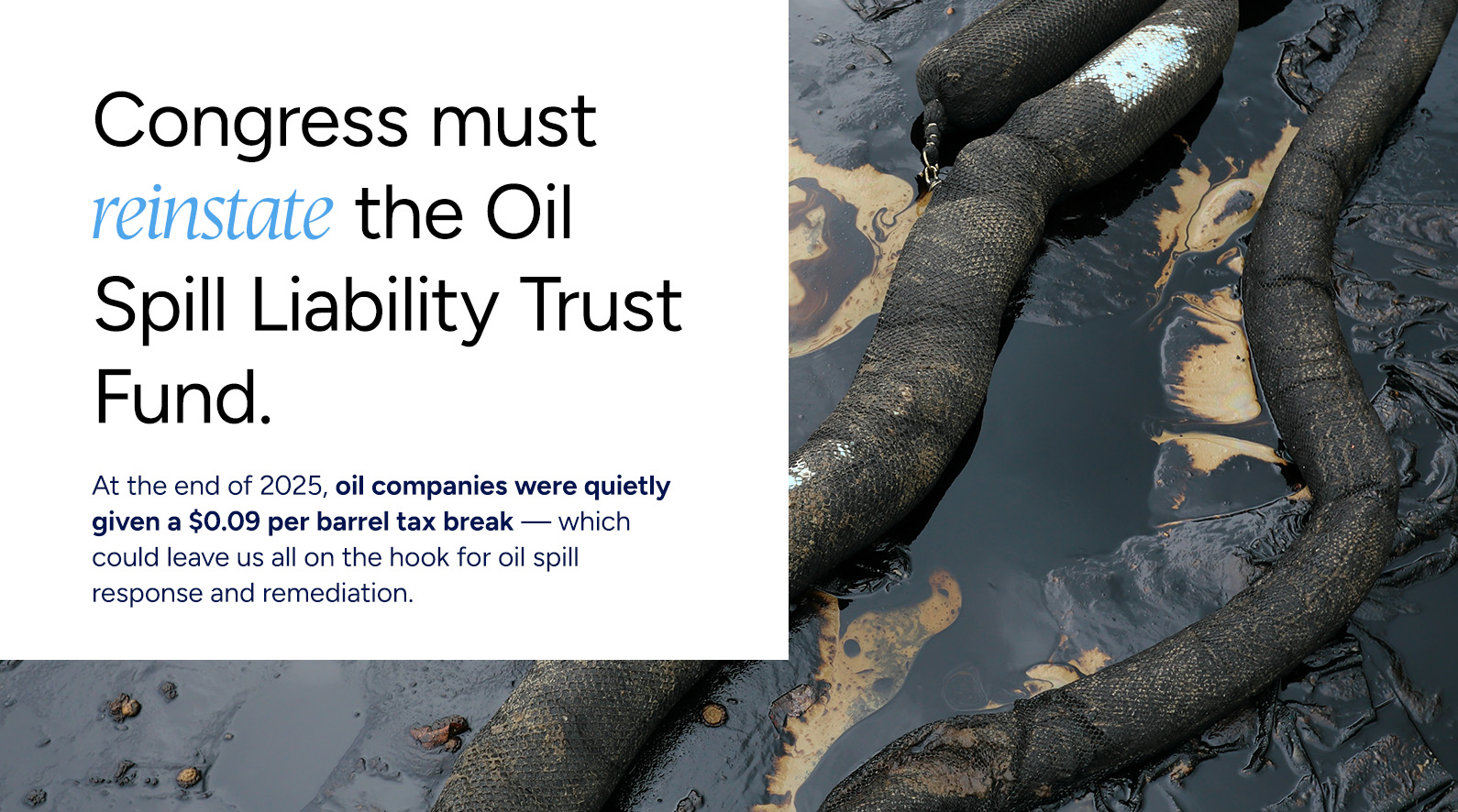
On December 31, 2025, the Oil Spill Liability Trust Fund Act (OSLTF) expired.1 The OSLTF was first authorized to tax oil producers in 1990, and provided funds for federal responses to oil spills and compensation for certain damages.2 Without the OSLTF, states and taxpayers may be left on the hook for oil spill costs and remediation.
Here in Michigan, the Enbridge Line 5 pipeline — which carries more than 540,000 barrels of petroleum products a day through the Straits of Mackinac where Lake Michigan and Lake Huron meet — has leaked more than 30 times in its 72-year-lifespan.3 According to a 2016 University of Michigan study, more than 700 miles of Great Lakes shoreline would be at risk if the pipeline fails.4 The results would be catastrophic for Michigan and our natural resources, and OSLTF funding would be essential for any hope of recovery (if even possible).
Prior to its expiry, funding from the OSLTF was pulled from two major buckets: the emergency fund, and the principal fund.5 The emergency fund was used by federal employees to respond to oil discharges and make initial natural resource damage assessments.6 While the principal fund was used to pay claims (generally damages not paid by the polluter) and fund appropriations for research and development.7 The OSLTF had been financed primarily by a per-barrel excise tax on domestic crude oil and imported petroleum, which recently sat at $0.09 per barrel.8
The OSLTF was last extended in 2021 by the Consolidated Appropriations Act, and in the 118th Congress, some members of congress introduced legislation (H.R.8554 and S.4406) that would have extended the per-barrel tax without expiration and increased the tax rate to 10 cents per barrel. This legislation failed, and similar legislation has not been proposed by the 119th Congress.9
Without this tax, there is no OSLTF funding to remediate damages to natural resources caused by oil spills, and some of the world’s wealthiest companies and worst polluters are afforded yet another break by the Trump Administration. While the precise motivation behind Congress’ decision not to reinstate the tax remains unclear, one thing is certain–if a high-volume oil spill occurs (like the potential of a Line 5 incident), remediation would be severely curtailed without the OSLTF.
Fortunately, there are some other funding buckets that the government can pull from for oil spill remediation, such as the Hazardous Substance Superfund. In 2026, oil producers can expect to pay $0.18 per barrel for the Hazardous Substance Superfund, but producers are now no longer paying the $0.09 per barrel OSLTF tax.10 The OSLTF tax could be reinstated at any time, if there is the political will to do so.11 In previous years, the tax has had gaps in its active status, for example, it expired in 2018 but was reinstated in 2020.12
This tax may someday be essential to save the Great Lakes from the worst potential Line 5 outcome. We encourage you to call your representatives today and urge them to reinstate the OSLTF.
References
1 Ramseur, Jonathan L., The Oil Spill Liability Trust Fund Tax: Background and Selected Issues, Congress.gov, https://www.congress.gov/crs-product/IF13049.
2 Id.
3 Matt Davenport, Line 5 and its risks: ‘The consequences of failure would be catastrophic.’, UMich News (May 28, 2025) https://news.umich.edu/line-5-and-its-risks-the-consequences-of-failure-would-be-catastrophic/.
4 Id.
5 Upper Mississippi River Basin Association, UMR Resource Manual- OSLTF, https://umrba.org/sites/default/files/documents/UMR-Resource-Manual-OSLTF.pdf.
6 Id.
7 Id.
8 Supra, nite 1.
9 Id.
10 Jack McLoone, Tax Funding Oil Spill Cleanups Has Expired, IRS Clarifies, Law360 (Jan. 7, 2026) https://www.law360.com/articles/2427647/tax-funding-oil-spill-cleanups-has-expired-irs-clarifies.
11 “Oil spill tax” imposed under section 4611 expired on December 31, 2025, KPMG (Jan. 2, 2026) https://kpmg.com/us/en/taxnewsflash/news/2026/01/oil-spill-tax-imposed-section-4611-expired.html.
12 Id.
