SAVE THE DATES
CEIC members are holding a public information meeting on May 20, 5:30 to 7:30 and May 30, 1 to 3pm at White Lake Community Library. Presentations will be the same, so no need to go to both.
On Thursday, June 11, 5:30 to 7:30pm EGLE will present at NBC Middle School. It is important to pack the room for this event.
By Claire Schlaff, April 21, 2026
In the late 1970s I began seeing stories in local newspapers about protests by community
members trying to get authorities to do something about the foul air and water emanating from our chemical plants. I am ashamed now to say that I was too busy raising our two young sons and working as an occupational therapist to join the protests.
My focus changed in 2006 when our son, Doug, age 33 and father of 3 little boys, was diagnosed with Ewing Sarcoma, an environmental cancer. After Doug’s death in December 2008 at age 35, I began collecting newspaper articles about White Lake’s industrial history, joined the White Lake Public Advisory Council, and launched the White Lake Area Cancer Mapping Project.
I will never know for certain what caused Doug’s cancer, but I can tell you that as a parent who has lost a child, I have thought about every possible exposure he may have had during his brief lifetime.
Doug’s wonderful wife has raised their boys into fine young men, making their grandparents proud. We have had the privilege of enjoying all the milestones and the little things in their lives that their dad had to miss. The worst is that our grandsons have had to grow up without their dad.
Now, 20 years after Doug’s diagnosis, I find myself in a role that I couldn’t have imagined back in 2006 – a member of the Chemours Environmental Impact Committee (CEIC), a devoted group of volunteers working since 2018 to clean up, conserve, and restore the Chemours (former DuPont) property and its connected waterways.
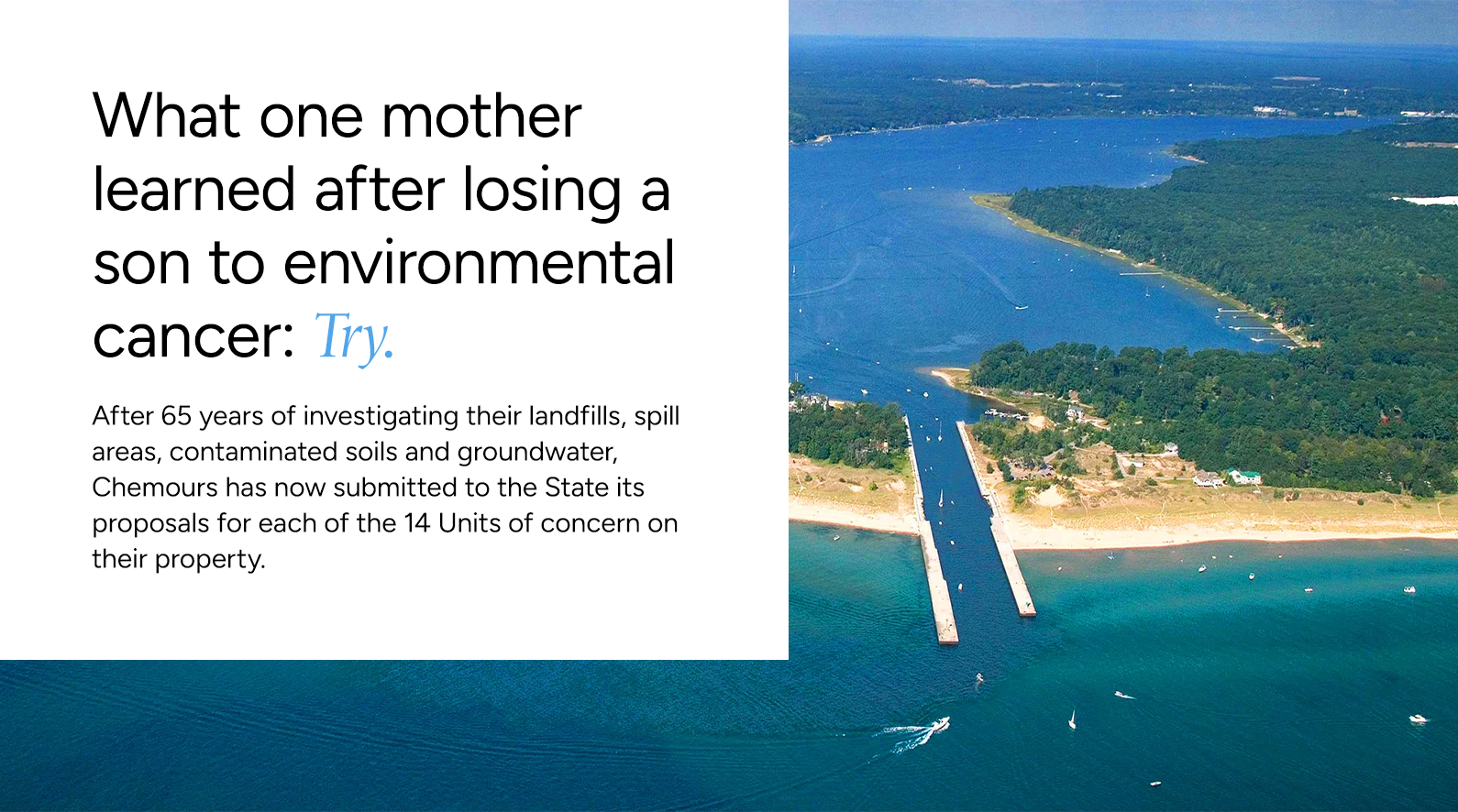
Everything we have been working for is coming to a head this year. After 65 years of investigating their landfills, spill areas, contaminated soils and groundwater, Chemours has now submitted to the State its proposals for each of the 14 Units of concern on their property.
We want the landfills – the sources of the contamination – removed. CEIC members are preparing our response to Chemours’ proposals and are launching a public information campaign, featuring two presentations in May in preparation for and leading up to a public meeting on June 11 at the NBC Middle School at which CEIC will present our response with Chemours and the State present to hear our concerns and answer questions.
Chemours’ proposed plans fall far short of our community’s expectations. They propose to continue the groundwater treatment system they have been using for decades while leaving the unlined landfills and spill areas in place with minor surface amendments.
According to an enforceable document signed in 2024, if the State approves their proposals (which we think they will, based
on our conversations with them over the years), Chemours has 120 days to develop their detailed implementation plan. Only after that plan has been submitted does the community have a chance for public comment.
But CEIC has other plans.
We understand that there is a chance that, despite our work and devotion to the cause, we may fail. Fail to get those leaking landfills removed. Fail to get those forests and shorelines preserved. Fail to get Sadony Bayou restored.
We have learned that “Community Acceptance is a Factor” in cleanup decisions. Our best chance for success is a groundswell of support from our fellow community members and our growing team of partners. It is the hope of CEIC that the community will pack the meetings to fight for our natural resources now and for future generations.
We are now close to the finish line. It is important to the well-being of our community, now and in the future, that we succeed.
After 2 ½ years of suffering, as Doug neared the end of his long fight for his life, he had one, barely audible, final word:
Try.
We have no choice but to try.
