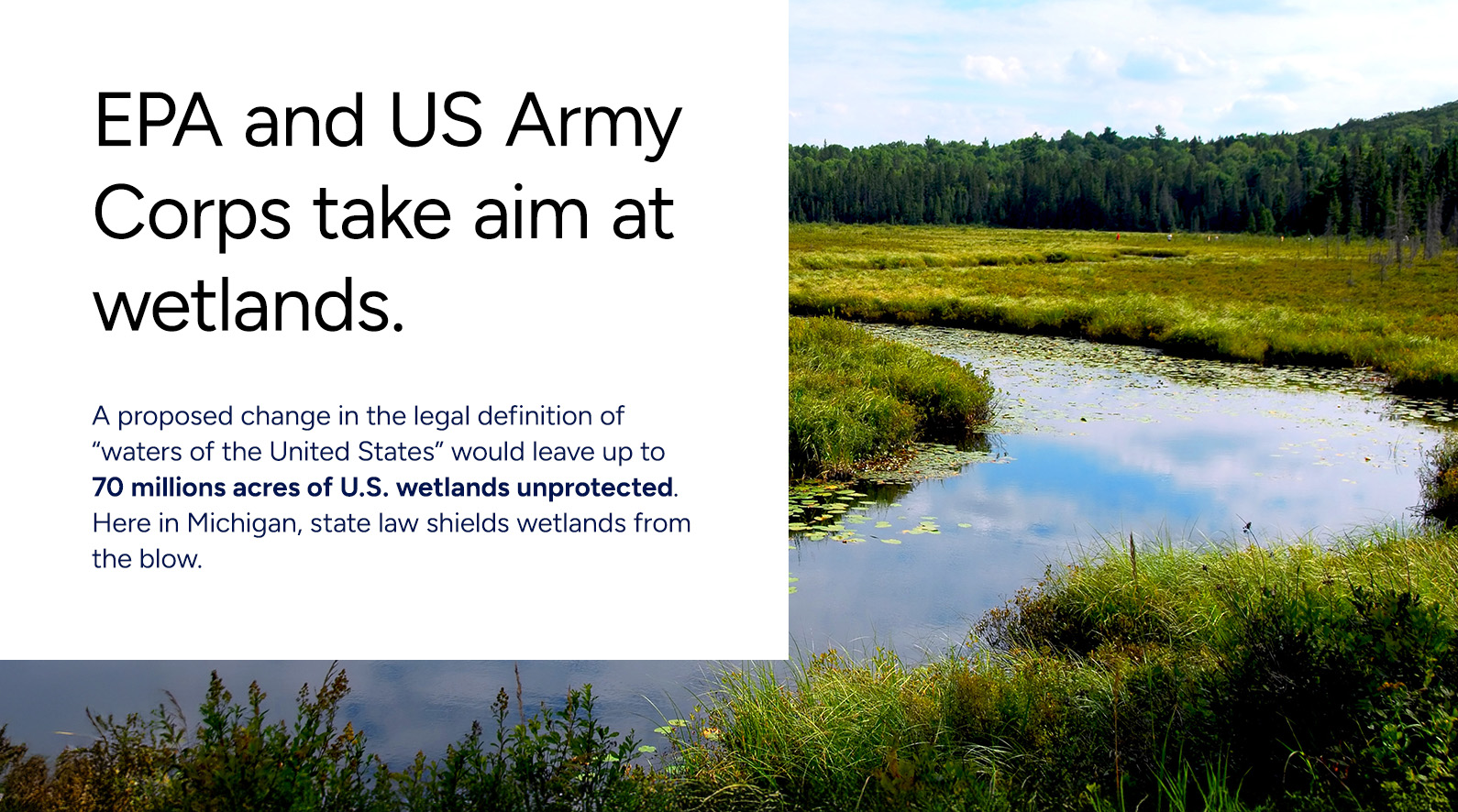
Wetland protection advocates across America recoiled earlier this month when the Trump Administration proposed opening up millions of acres of wetlands to be filled or drained and developed.
Michigan will fare somewhat better because of a 1980 state law that shields many wetlands that the U.S. EPA and the Army Corps of Engineers are proposing to leave unguarded by the federal government. The tougher-than-federal state law is a stout defense for Michigan’s approximately 6.47 million remaining wetland acres. (When Michigan became a state in 1837, it contained approximately 10.7 million acres of wetlands.)
At issue is the question of which wetlands were meant to be covered by the Clean Water Act of 1972. Because wetlands are vital to the health of streams, rivers, and lakes, the Act imposed restrictions on filling and destroying wetlands associated with navigable water bodies.
Wetlands are important for many reasons: they filter pollution, store floodwaters, provide fish and wildlife habitat, protect biological diversity and provide aesthetic benefits. You can learn more about the types and values of wetlands here.
The definition of “waters of the United States” has zig-zagged during the last several presidential administrations. The Obama and Biden administrations opted for a definition that included isolated wetlands, wetlands connected underground to lakes and streams, and areas that are not wet at the surface 12 months of the year, but are vital to stream health.
Ignoring the best science, the first Trump and now the second Trump Administration have tried to limit Clean Water Act protections for wetlands and open them up to development. Big Agriculture, manufacturing, and real estate interests support a limited scope of federal protection. The U.S. Supreme Court also undermined wetland protection in 2023 with a ruling in the Sackett case, reversing lower court decisions and narrowing the definition of “waters of the United States.”
According to a GIS analysis by the Natural Resources Defense Council, 38 to 70 million acres of U.S. wetlands are at risk of pollution or destruction if the new rule is adopted.
What implications does the proposed rule have for the Great Lakes? For seven of the eight Great Lakes states, it means a significant loss of protected wetlands and ultimately, degraded water quality. Some Great Lakes states have already lost enormous shares of their wetlands, including Illinois (90%) and Indiana (85%), and have little to spare.
But Michigan law sets a broader definition of wetlands than the U.S. Clean Water Act. Michigan law recognizes the scientific reality that many wetlands critical to the health of rivers and streams are hydrologically connected below the land surface.
That means the state can continue to require permits and other approvals before the alteration of most wetlands.
“This proposed rule is what we have come to expect from the Trump Administration’s ruinous environmental policies,” said Liz Kirkwood, executive director of Flow Water Advocates. “This rule ignores science, threatens our communities, and caters to polluters and private developers. We’re fortunate Michigan has stronger protections.”
Despite exemptions for certain activities and sometimes inconsistent enforcement, Michigan’s wetland law works. The rate of wetland loss in Michigan has slowed dramatically since the state law took effect in 1980. According to a tally by the former Department of Environmental Quality in 2014 (the most recent wetland census) and other sources, wetland losses slowed from an average of 28,000 acres per year over the first 150 years of Michigan’s statehood to approximately 1,200 acres per year between 1998 and 2005.
Citizens can comment at this link on the proposed EPA/Army Corps rule until January 5, 2026.
