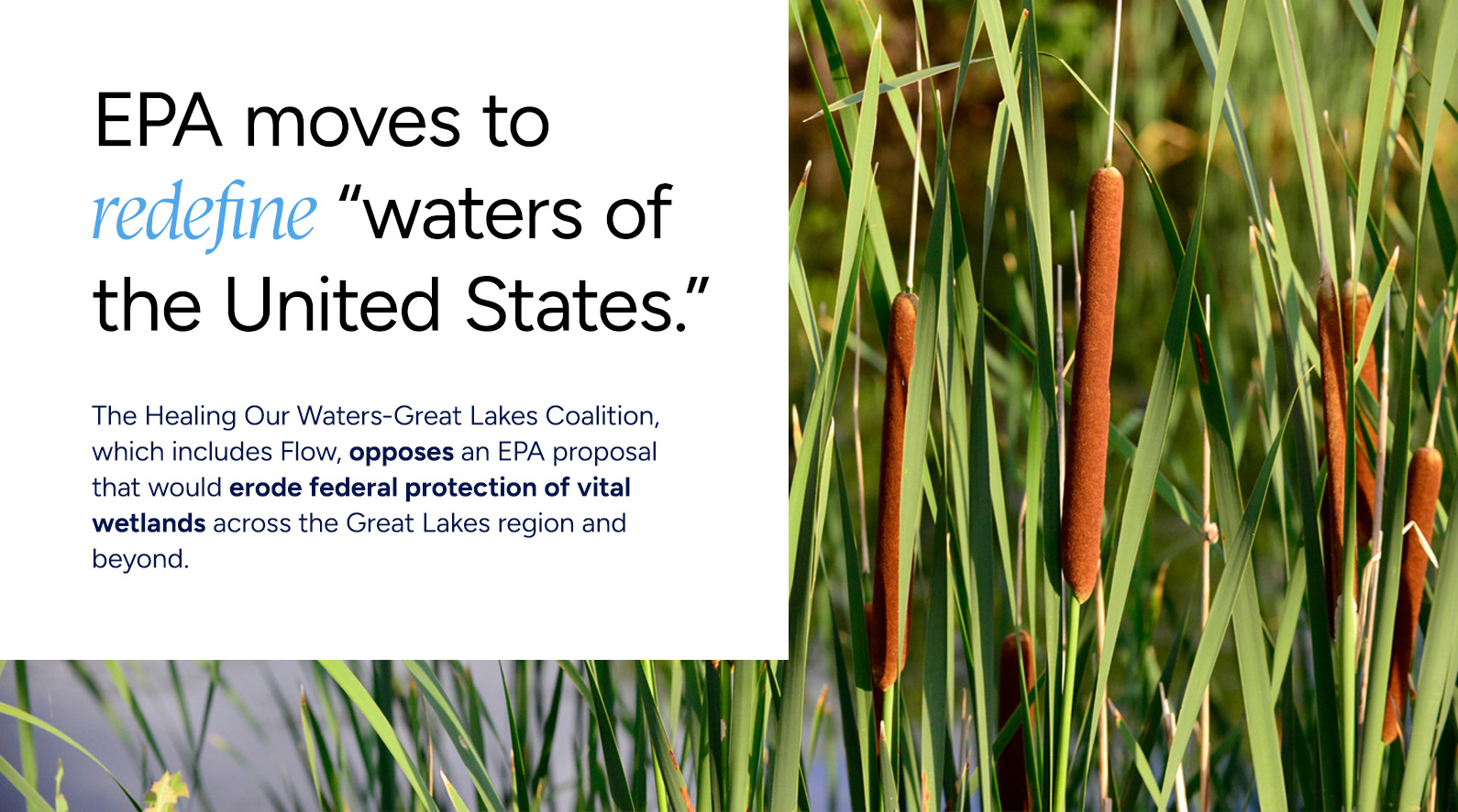
On January 5, 2026, the Healing Our Waters-Great Lakes Coalition (HOW), a group of organizations (including Flow Water Advocates) that are committed to protecting water resources and communities across the Great Lakes and the Midwest region, submitted comments to the United States Environmental Protection Agency (EPA) and the U.S. Army Corps of Engineers (Corps) to oppose the agencies’ proposed 2025 definition of jurisdictional water regulated under the Clean Water Act, otherwise referred to as “waters of the United States” (WOTUS).
Announced on November 17, 2025, the EPA and the Corps are allegedly “implementing” the U.S. Supreme Court’s decision in Sackett v. Environmental Protection Agency by bringing regulations into conformity with the decision. However, as the comment letter explains, this rulemaking is unnecessary and contrary to the interests of the American public, and far exceeds the changes that Sackett may require.
EPA’s proposed rulemaking includes a new definition for “continuous surface connection” which will require wetlands to meet a new two-part test:
“1) they must abut a jurisdictional water, and 2) they must have surface water at least during the wet season.”
The new definition also excludes groundwater from the definition of WOTUS, and creates a definition for “relatively permanent” waters, which would result in the removal of federal protections for millions of miles of streams. The EPA summarizes the proposed revisions here.
The agencies’ proposal is particularly concerning for the Great Lakes region. According to the Great Lakes Commission, the lakes “sustain a $6 trillion economy, contain more than 90% of North America’s supply of surface freshwater, and provide drinking water for more than 40 million people in the United States and Canada.”
Fortunately, Michigan’s Wetland Protection Act of 1979 is a shield against eroding federal protections. Indiana is not so lucky. Wetlands perform a number of important ecological and economic functions, including water storage (which slows erosion, reduces flooding, and recharges groundwater), water filtration, and biological productivity (as wetlands are home to some of the most productive ecosystems in the world).
This new proposed definition of WOTUS is the most restrictive rule in 50 plus years of the Clean Water Act’s history, and undermines the clear intent of Congress to protect the nation’s waters from pollution. Our water resources — and especially our wetlands — are in danger as the EPA adopts a regulatory framework that treats waterways as sewers for the disposal of toxins, sewage, and industrial waste rather than as resources that should be protected.
The time to protect our waters is now. Already, the US has lost more than half of the wetlands it once had. And with the critical role that wetlands play in filtering pollutants, storing floodwater, recharging groundwater, and providing habitat, the scientific reality cannot be ignored. Our wetlands are essential, and the EPA and the Corps need to step up to protect them.
Read the Healing Our Waters-Great Lakes Coalition comments here.
