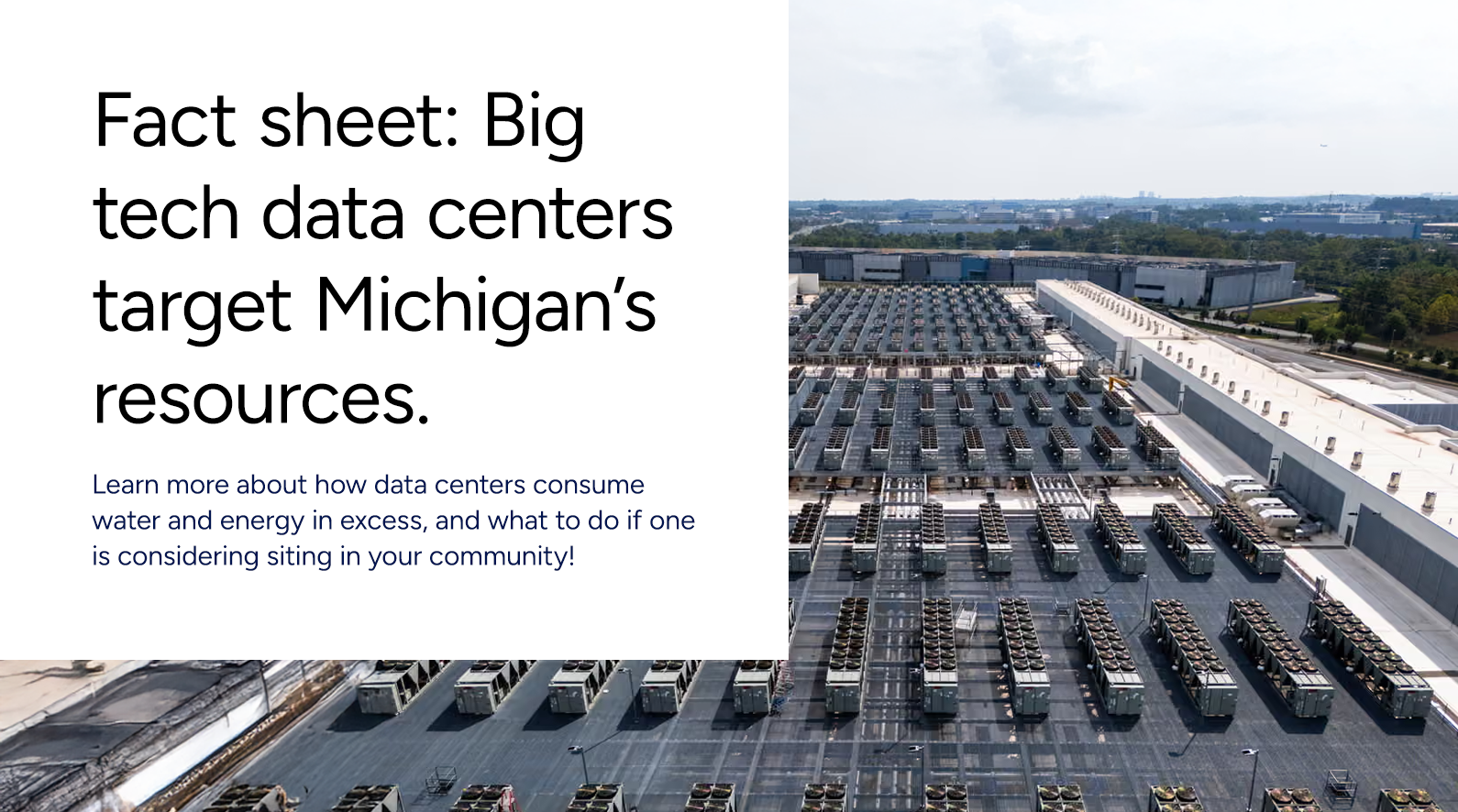
At issue: The rapid rise of data centers in our communities
Data centers are multiplying across America in response to increases in computing intensity, including the growing use of artificial intelligence. Significant growth in cloud computing, big data analytics, and cryptomining also contributes to demand for data centers. Viewed as the next job-creating industry by many state governments, including Michigan, data centers also present major environmental and social challenges, particularly for rural communities. Hyperscale data centers withdraw and consume enormous amounts of water from lakes, streams, and aquifers to cool their high-powered servers and equipment. To date, there has been insufficient discussion in Michigan about how public policy can manage and ameliorate the environmental impacts of this rapidly growing industry.
The Michigan data center market
Michigan has an estimated 56 data centers in 11 markets, with the greatest concentration in the Grand Rapids and Detroit markets. More are on the horizon. In July 2025, DTE Energy said it was in “advanced discussions with multiple hyperscalers” for over 3 gigawatts of new electricity load, and Consumers Energy said it had entered into an agreement to supply power for a data center. At least 10 hyperscale data centers are currently proposed in the Lower Peninsula. In December 2025, Michigan’s energy regulators gave the green light to the state’s first hyperscale data center, despite controversy and criticism about the lack of transparency, rising energy rates, climate impacts from fossil fuel used to power the facility, local land use and farmland loss, and high water use and pollution associated with cooling data servers.
Download our fact sheet: Big tech data centers target Michigan's resources.
This fact sheet breaks down the threat data centers bring to communities across Michigan and highlights specific threats like water consumption and energy usage. Download to learn more about what to do if a data center is considering siting in your community!
